Kyle Harrison
← Bookshelf 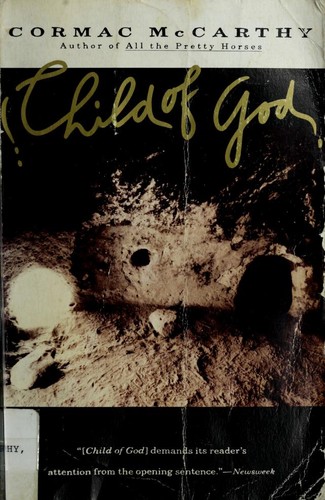
Child of God
Key Takeaways
Under Consideration — to be added.
Connections
Books: By the same author, Cormac McCarthy — Blood Meridian, The Road, No Country for Old Men, and All the Pretty Horses.
Highlights
Roam capture metadata — Author: Cormac McCarthy · Reading Status: Books Read · Source: https://medium.com/@kwharrison13/2018-in-books-7d3590e7f5e8 · Recommended By: Camden Harrison · Tags: #Books
- ==Highlighted Quotes==
- ==START REVIEWING HERE>>>==
- Round 3 with Mr. McCarthy, and I gotta say — this was the least fun I’ve ever had in my life. The book is short, and chronicles a terrible thing. The key takeaway I had came from the title, and a brief interaction that I quoted below. “Child of God.” The nature of human-kind is something a lot of people have thought on. The same humanity that leads someone to save someones life, or take them in, is the same humanity that leads to murder, rape, robbery, and pain. What are we to make of that?
- A lot of people use it to “annihilate” the idea of God. Stephen Fry, a vocal atheist, was asked what he would say if God turned out to be real, and he met Him/Her/It face to face.
- “Bone cancer in children? What’s that about? How dare you? How dare you create a world where there is such misery that is not our fault? It’s not right. It’s utterly evil.”
- {{youtube: https://youtu.be/2-d4otHE-YI}}
- You could add some of the things that happen in this book to Fry’s list. And as I thought about the idea of a Child of God, but one that does something we would call evil, what does that say about God? In my mind, the answer has everything to do with perspective. If this life is all their is, then yes, any amount of avoidable suffering is despicable and wrong. But if today is the only day we live, then getting surgery, vaccinations, putting our kids in timeout, or even making them exercise, or eat healthy, all of those things are completely out of the question and wrong, because they take this little time we have and fill it with unfortunate things.
- But today is not the only day. This life is not all there is. And so what suffering we see here is not an ultimate thing, and to treat it as if it was, is the same as saying we should never vaccinate our kids because it hurts them. It does. But in the long run, the result is more important than the pain.
- “It’s like a lot of things, said the smith. Do the least part of it wrong and ye’d just as well to do it all wrong.”
- “You think people was meaner then than they are now? the deputy said.
- The old man was looking out at the flooded town. No, he said. I don’t. I think people are the same from the day God first made one.”
- “Parallel Prophets: Paul and Joseph Smith” by Richard Lloyd Anderson
- “Joseph Smith and the Lighter Side” by Leonard J. Arrington
- “What Came From Kirtland” by M. Russell Ballard
- “Joseph Smith: The Chosen of God and the Friend of Man” by Ivan J. Barrett
- “The Profile of a Prophet” by Hugh B. Brown
- “Joseph Smith: The Mormon Prophet” by James A. Cullimore
- “Joseph Smith’s Christlike Attributes” by Jack H. Goaslind
- “Joseph Smith The Prophet” by David B. Haight
- “Praise to the Man” by Gordon B. Hinckley
- “A Choice Seer” by Neal A. Maxwell
- “Joseph Smith: A Revealer of Christ” by Bruce R. McConkie
- “Joseph Smith and the Problem of Evil” by David L. Paulsen
- “But For Joseph” by Katherine D. Pullins
- “Stand by My Servant Joseph” by Cecil O. Samuelson
- “Joseph Smith: Lover of the Cause of Christ” by Heidi S. Swinton
- “Where is the clear voice of authority on right and wrong? Divided and drifting churches supply religious philosophers but not prophets. Yet Latter-Day Saints testify that Joseph Smith and his successors were called to rescue a world adrift in its own conceits and problems. Such a claim can be tested by the Bible, the record of prior prophets.”
- “What are the most important things in the world today? Do not look for them in the media, for the three best historians of the first century barely mention Christianity as a disreputable superstition, and no one mentions Paul.”
- “It was in such an environment that Joseph Smith grew up. But before he went through the stage of rebellion, before the development of a guilt complex, the Lord granted to him, at the age of fourteen, that glorious First Vision. The Lord got to him, in other words, before the religions of the day were able to deaden his youthful exuberance and openness, his capacity for enjoying the mental, cultural, and physical aspects of life. He thus avoided the artificially severe, ascetic, fun-abhorring mantle that contemporary religion seemed to insist upon. He was pious, but not inhibited; earnest, but not fanatical; a warm, affectionate, and enjoyable personality — a prophet who was both serious and playful — a wonderful exemplar of the precept “Man is that he might have joy.”
- “Elder Russell Nelson recently expanded on this important principle. He said, ‘The Lord can only teach an inquiring mind.’ What an important lesson. The Lord doesn’t generally come to us — he waits for us to come to Him and ask. Then he gives us the answer. How many times have you said, ‘I have not received direction lately’ or ‘I feel a void in my life.’ Do we inquire of the Lord? Do we ask, seek, and knock as the Savior directed? As you have problems and questions in your lives, do you follow this principle? I testify to you that as your minds are opened and as you truly inquire of the Lord, he will answer you. As we humble ourselves, he will lead us by the hand and give us answers to our prayers.”
- “Joseph Smith said something like this: ‘When I have heard a story about me, I sit down and think about it and pray about it, and I ask myself the question, ‘Did I say something or was there something about my manner to give some basis for that story to start?’ And often if I think about it long enough, I realize I have done something to give that basis. And there wells up in me a forgiveness of the person who has told that story, and a resolve that I will never do that again.”
- “Ages ago in the Great Council, Jesus was the prepared but meek volunteer. As the Father described the plan of salvation and the need for a Savior, it was Jesus who stepped forward and said humbly but courageously, ‘Here am I, send me.’ Never has anyone offered to do so much for so many with so few words.”
- “Elder Neal A. Maxwell, in his last visit to BYU in the spring of 2004, shed some significant light on this matter. In his comments he included our excellent faculty and generous donors, as well as you special students, in his expressions of gratitude for what has been and is being accomplished here. Listen carefully to his words: “In a way, LDS scholars at BYU and elsewhere are a little bit like the builders of the temple in Nauvoo, who worked with a trowel in one hand and a musket in the other. Today scholars building the temple of learning must also pause on occasion to defend the Kingdom. I personally think this is one of the reasons the Lord established and maintains this University. The dual role of builder and defender is unique and ongoing. I am grateful we have scholars today who can handle, as it were, both trowels and muskets.”
Referenced in
- No Country For Old Men book
- The Road book