Paper Dragon Anxiety
| Subtitle | How To Think About China |
|---|---|
| Published | November 21, 2026 |
| Length | About 3,100 words |
| Newsletter | Investing 101 |
| Portfolio ideas | Technological Innovation Historical Futurism |
| Tags | chinahistorical-futurismtechnological-innovationforeign-policydefense |
| Read on | Substack |
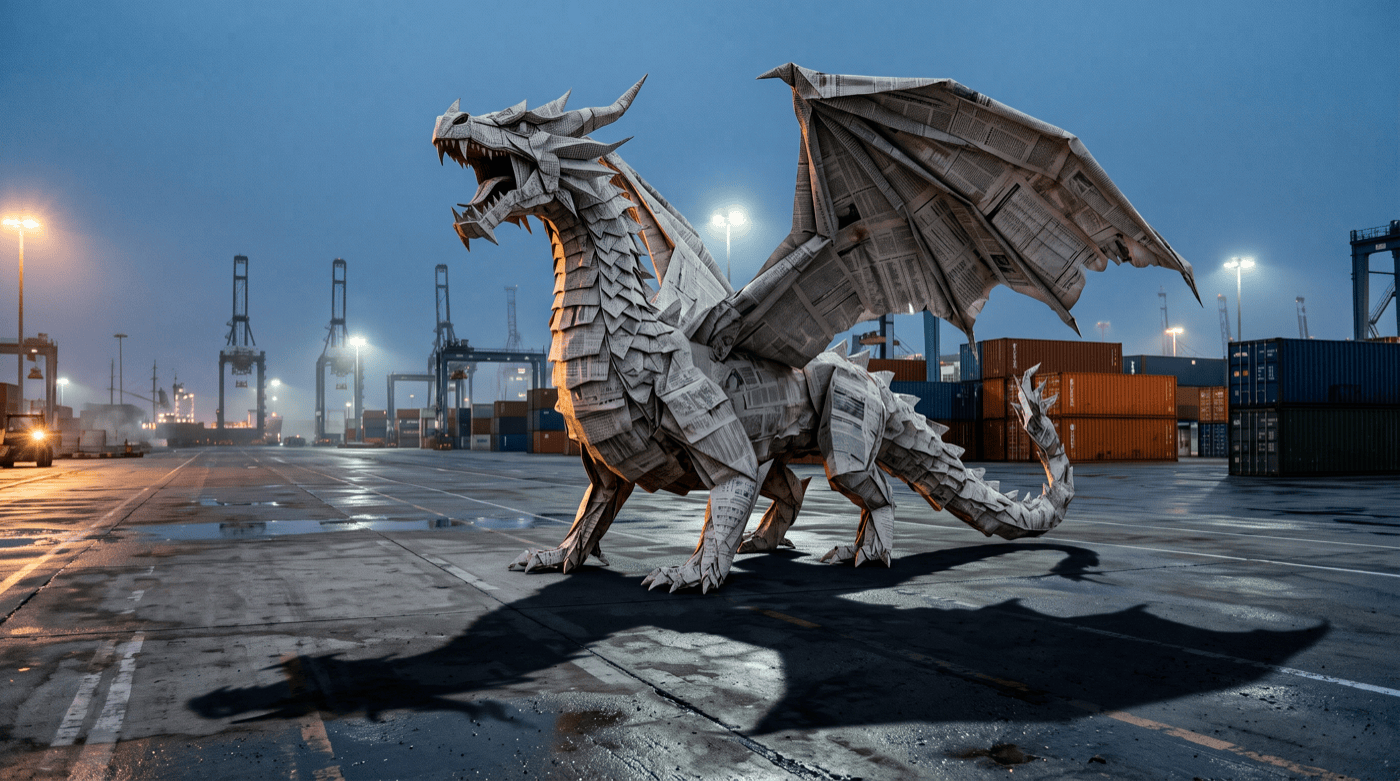
I spent over a year writing about Anduril and came out a lot more nervous about China than I went in. Plenty of smart people, Noah Smith included, are relaxing; I think they’re mostly reading a different scoreboard. If we’re going to be wrong about China, I’d rather be wrong in the direction that leaves us with shipyards.
Over the course of 2024 and 2025, I spent quite a bit of time writing The Anduril Thesis, and by the end of it I was a lot more nervous about where America sits on the geopolitical stage than when I started. Add to that the fact that, every year at Contrary Research, we put together a Tech Trends Report that reviews dozens of technology trends. Somewhere along the way it started to feel less like a trends report and more like a China report card, and they were crushing every subject.
With that perspective, I’m often surprised when other people don’t share the same anxiety about great power struggles and the growing loom of China. I tend to end up in one of two debates about it.
The first is about morals. Is China or the US the greater perpetrator of evil around the world? I might come back to that one next week. But for those of you willing to take my word for it, China represents a moral worldview I’d be pretty nervous to see reign supreme. We’re talking about mass surveillance of an entire region, a detention campaign against Uyghurs that the UN’s human rights office said may constitute crimes against humanity, ~1M Tibetan children moved into state boarding schools designed to assimilate them, and a 20-year prison sentence for a newspaper publisher in Hong Kong.
The second debate I run into with folks who agree China may not be all sunshine and daisies is the one I want to dig into this week. Should we actually be worried about China?
My sense has always been that the people closest to the geopolitical stakes are consistently nervous. In the book, I quoted retired Major General Cameron Holt, who said on a panel in January 2024 that he saw inadequate concern about China. “There’s a lot of good speeches about it, [but] frankly, I still don’t believe we’re on a wartime footing.” Then, a week or two ago, I read a piece from Noah Smith, who has called himself a China hawk for years, explaining why he’s becoming a China bear for the first time. He says he no longer feels “the same sense of desperate urgency.” It pushed me to reflect on why someone that thoughtful might come to a less anxious conclusion. And, more importantly to me, why my own mind is still unchanged.
Noah isn’t the only one, by any means. Over the summer a friend of mine who’s a student at Dartmouth told me he isn’t as worried about China as he used to be, after taking a government course with Professor Stephen Brooks, whose scholarship is basically one long argument that American power is more durable than the declinists think. What I respect about that course is that it doesn’t only teach one side. Students read Brooks’s own Foreign Affairs essay, “The Myth of Multipolarity,” alongside Kurt Campbell and Rush Doshi’s “Underestimating China,” which argues pretty much the opposite. Campbell was Deputy Secretary of State, and Doshi wrote the book on Chinese grand strategy. Anyone who has read my perspective on nuance and rhetoric will appreciate how excited I’d be to see a tenured professor putting the most credentialed rebuttal to his own worldview on display for his students, forcing them to wrestle with both ends of the spectrum.
Reflecting on all of that, I wanted to walk through why smart people disagree on something so important, why history should make us a little humble about forecasts in either direction, and why I’m still a nervous nelly anyways.
Paper Tigers
The phrase “paper tiger” comes from Mao Zedong. I wrote about this earlier this year in my Anduril book; starting in the 1940s Mao used it to dismiss American power as something that looked threatening but couldn’t withstand a real challenge. Eighty years later a whole school of analysts has picked up Mao’s phrase and pointed it back at China.
The case isn’t crazy. Michael Beckley, who runs the Asia Program at FPRI, wrote a book in 2018 called Unrivaled arguing that “China’s economic, financial, technological, and military strength is hugely exaggerated by crude and inaccurate statistics.” Chinese statistics are clearly problematic. Beijing reported 5% growth in both 2024 and 2025, while Rhodium Group estimates the real number for 2025 was closer to 2.5-3%. When youth unemployment hit 21.3% in 2023, the government simply stopped publishing the stat for a couple months until they’d come up with a new method for reporting it. Even Li Keqiang, before he became Premier, told the US ambassador that China’s GDP numbers were “man-made.” Savage.
And then there’s the demographics. China had 7.9M births in 2025, the fewest since 1949, and the population has now shrunk four years in a row. The UN’s middle projection has China falling from ~1.4B people to ~1.3B by 2050 and ~633M by 2100. I’ve heard plenty of people in defense frame the century as a race; we’re racing to reindustrialize before China makes a globally strategic move while China races to figure out automation before their population collapses. Who gets there first?
China’s automation answer to the population collapse potential is worth taking seriously. Palantir’s CTO Shyam Sankar put it this way:
“The CCP knows that digitization and automation are the only ways to sustain China’s breakneck pace of production as its working-age population craters in the decades ahead. China knows that software-defined production is the future. They want to get there first and do it better.“
China installed 54% of all the industrial robots put to work worldwide in 2024. Their 15th Five-Year Plan, approved this March, is built around what they call “new quality productive forces,” which is a fancy way of saying advanced manufacturing and technological self-reliance. That kind of talk certainly doesn’t feel like a “Paper Dragon” that is ignoring its own looming population crisis.
Granted, even the bears don’t lean on demographics anymore, either. Noah’s reasons for turning bearish are AI, the limits of a manufacturing-at-all-costs strategy, and Xi turning the country inward. On population, he said he doesn’t expect it to be a big factor “until at least 2040 or so.”
Two Scoreboards
When I read stuff like Brooks’s and Campbell’s essays side by side, I kept coming back to this idea of a scoreboard.
Brooks and his co-author Ben Vagle wrote a 2025 book called Command of Commerce, and their argument was about actual ownership of end profits. See, GDP and trade volumes make China look huge, but those numbers don’t tell you who profits most from the global production network. According to the book, American firms generate ~38% of global profits while Chinese firms generate ~16%, so in a broad economic cutoff China would lose 5-11x more than we would.
Campbell and Doshi, the counterargument, is about capacity. As they put it, “China possesses scale, and the United States does not—at least not by itself.” China makes ~31% of the world’s manufacturing value added, compared to us at ~15%, and in 2024 it built more than 53% of the world’s commercial ships. We built 0.1%.
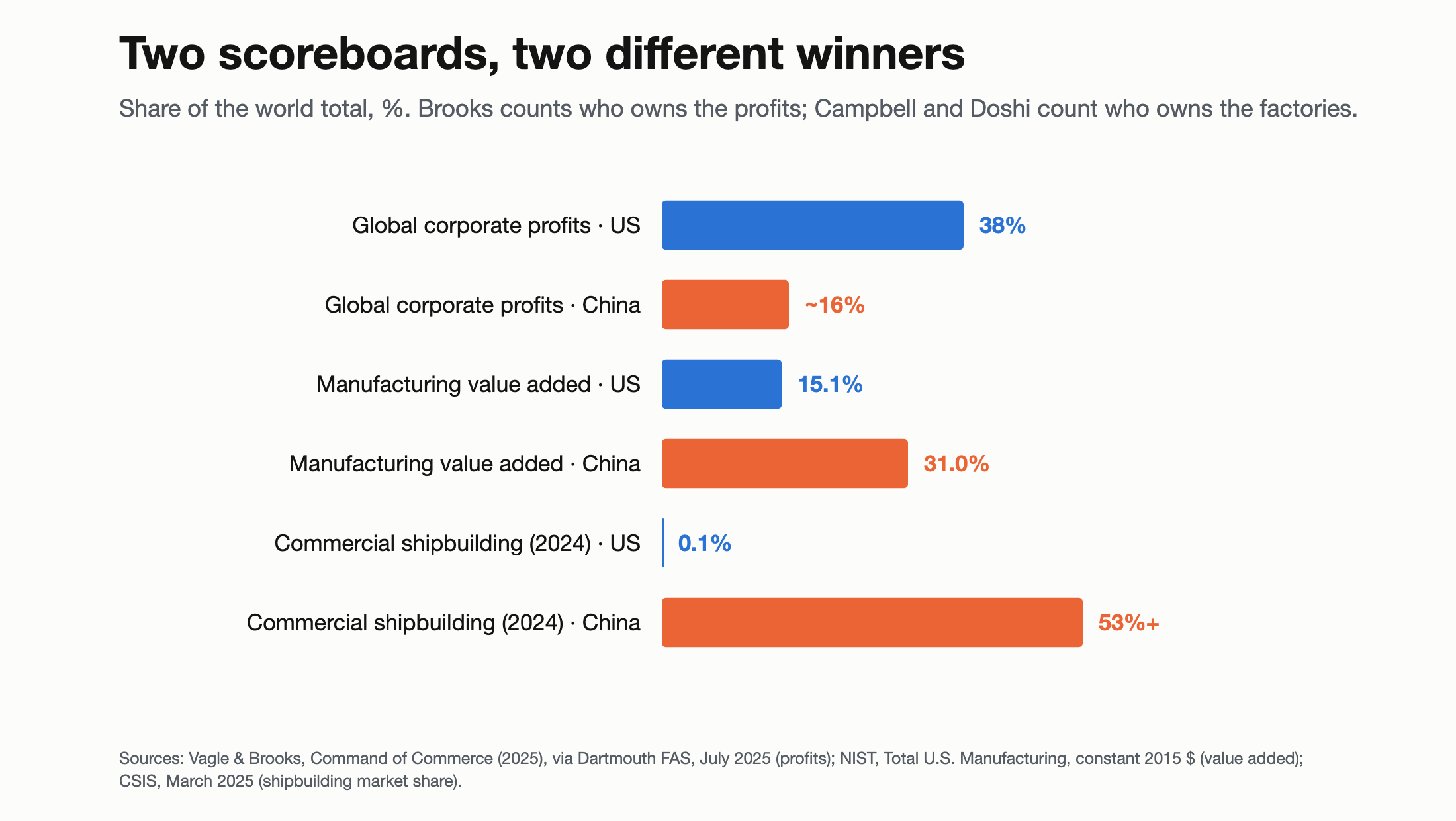
This is where my commitment to nuance starts to get me into trouble. Because the answer of how big of a threat China is sort of depends on what you’re putting the most weight on in the discussion. In a trade war, the side that owns the profits has a lot of leverage. But in a shooting war, profits are a lot less important than the factories that build military capacity. I’d bet a lot of those American profits come from factories sitting in other countries, some of them in China, so I wouldn’t want to bet on that kind of exposure.
Even when you extend economic power to include allies, it just isn’t at scale yet. The US and its allies have roughly 3x China’s GDP, but as Doshi articulated it, “That advantage is entirely theoretical.” Sure feels like a problem to me.
We’ve Been Here Before
Now, the bears do have history on their side, because we have a long track record of overestimating rivals.
Back in the 1980s it was Japan. Ezra Vogel’s Japan as Number One came out in 1979, and by the end of the decade Japan’s rise had Sony’s Akio Morita delivered an absolute atrocious burn when he was lecturing Americans that “The United States has been busy creating lawyers,”** while Japan had **“been busier creating engineers.” Swap Japan for China and that’s basically the tagline of Dan Wang’s Breakneck, 40 years later. A Japanese politician wrote a bestseller arguing Japan could coerce America because American military strength required Japanese chips. But then the Nikkei peaked on December 29th, 1989, and didn’t close above that level again for ~34 years.
We did the same thing with the Soviets. US estimates put the Soviet economy at roughly 60% the size of ours, while Soviet economists themselves said it was more like 14-28%. In 1990, Senator Daniel Patrick Moynihan wrote a piece titled “The Soviet Economy: Boy, Were We Wrong!” Before that, there was the missile gap, which John F. Kennedy campaigned on in 1960. Once we got satellites into the mix, we realized that there was indeed a missile gap, but it was in our favor.
So we should relax, right? I just can’t bring myself to that conclusion. I keep thinking about Sputnik. In October 1957 the Soviets put a beach ball with antennas into orbit, and the US lost its mind. Within a year we’d created ARPA, NASA, and the National Defense Education Act, all basically in response, the positioning for all of it, we said, was that “the security of the Nation requires the fullest development of the mental resources and technical skills of its young men and women.” We overestimated the Soviets, but the overestimation helped build the institutions that put Americans on the Moon, and threw in the agency that eventually gave us the internet as bonus points.
I’ve written before about how the US spent decades acting like history had ended. In 2017, Chris Brose and John McCain set up a briefing for all 100 US senators on the erosion of America’s technological edge over China, and only about a dozen showed up. When I read The Kill Chain, I wrote a note in the margin that still sums it up for me; the sine waves of fear and existential threat create urgency, while hubris and unearned confidence lead to falling behind. After the decades of hubris we’ve had, I think overestimating China is a risk worth running.
The Calm Before The Storm
Going back to Noah Smith’s arguments. He says that becoming a China bear makes him more of a China dove. He still wants friend-shoring, export controls and military alliances, but “they feel more like an insurance policy now.” So which is it, insurance policy or urgent necessity?
Hal Brands and Michael Beckley (the same Beckley who wrote Unrivaled) make an argument I find a lot more persuasive. The danger isn’t a rising power overtaking the leader. They call it a “peaking power trap”:
“Over the past 150 years, peaking powers—great powers that had been growing dramatically faster than the world average and then suffered a severe, prolonged slowdown—usually don’t fade away quietly. Rather, they become brash and aggressive. History warns the world should expect a peaking China to act more boldly, even erratically, over the coming decade—to lunge for long-sought strategic prizes before its fortunes fade.“
That rhymes with something I wrote about Russia earlier this year. One of the biggest reasons Russia poses a threat is that it has very little to lose. China has a real economy, which gives it a lot to lose, and that’s a stabilizing force. If China’s economy really does break, I’m not convinced it gets less dangerous. There’s a very real chance it gets more dangerous, because a country with less to lose behaves more like Russia.
Chris Miller, who wrote Chip War, has the line I keep coming back that’s relevant here:
“Some people console themselves by saying, ‘It’s high magnitude but low risk, so the expected cost is low.’ I’m not so sure about that. If you talk about the risk this year, maybe it’s low. But if you think about it over the next decade and factor in the risk compounding every year, suddenly, I don’t think those assumptions hold.“
Winning Like That
More than any other stat or framework, the thing that has made most anxious is in the wargames. Chris Brose wrote in The Kill Chain that in US wargames against China, “the United States has a nearly perfect record: we have lost almost every single time.” RAND’s David Ochmanek described their wargame results more colorfully in 2019: “In our games, when we fight Russia and China, [the US] gets its ass handed to it.” An Air Force general said the trend in their games wasn’t just that we were losing, but that we were losing faster. And then, last December, the New York Times described a classified Pentagon assessment called the Overmatch brief, which reportedly concludes the US would most likely be defeated if it intervened over Taiwan.
One of the most famous public wargames sort of looked like the exception. In 2023, CSIS wargamed a Chinese invasion of Taiwan 24 times, and in most of them the US, Taiwan and Japan held the island. Not to be dramatic, but at what cost? The US loses ~2 aircraft carriers, 10-20 large surface ships, hundreds of aircraft and thousands of service members in about three weeks. **CSIS’s own conclusion was that “the high losses damaged the U.S. global position for many years,” and that the US **“might win a pyrrhic victory, suffering more in the long run than the ‘defeated’ Chinese.”
Is that winning? Certainly doesn’t feel like it. China loses its invasion fleet, but it keeps its shipyards, and its shipbuilding capacity is roughly 232x ours. We could defend Taiwan and still come out of it unable to project real force anywhere for a decade, while China rebuilds its navy faster dramatically faster than we can. I’ve said before that half our fleet could be gone within a couple months of a real conflict, and it would take us something like 25 years to rebuild just to get back to where we were. Looking at it that way, even a win ends up becoming a loss.
Every Scenario
So, back to my core question. Is China a paper tiger or a rising peer?
A hollowed-out American industrial base is a problem if China is rising, a problem if China has peaked, and arguably a bigger problem if China is peaking and desperate. Some of the numbers I’d want anyone to know.
- China makes ~90% of the world’s rare-earth magnets, the ones that go into motors for missiles, drones and satellites.
- DJI alone sells an estimated 70-80% of the world’s commercial drones.
- In 2023 the Department of the Air Force’s use of Chinese suppliers went up 69%.
- ~90% of American machine shops, the companies making the parts for our weapons, have fewer than 20 employees.
What’s more, these aren’t hypothetical dependencies. China already uses those chokepoints. In April 2025, China put seven rare earths under export licensing, and its magnet exports fell ~75% after that. Those controls still restrict sales to defense contractors. In 2022, the Pentagon paused F-35 deliveries after discovering a magnet in the jet was made with a Chinese alloy, and then signed a waiver to keep them flowing anyway.
Palmer Luckey articulated the absurdity of all this pretty well:
“You have executives at major defense companies who are saying it’s impossible to decouple from China. At the same time, you have these same companies getting billions of dollars in contracts for weapon systems that are only useful in a world where we are fighting China toe to toe, which sure implies a decoupling to me.“
Why Not Us?
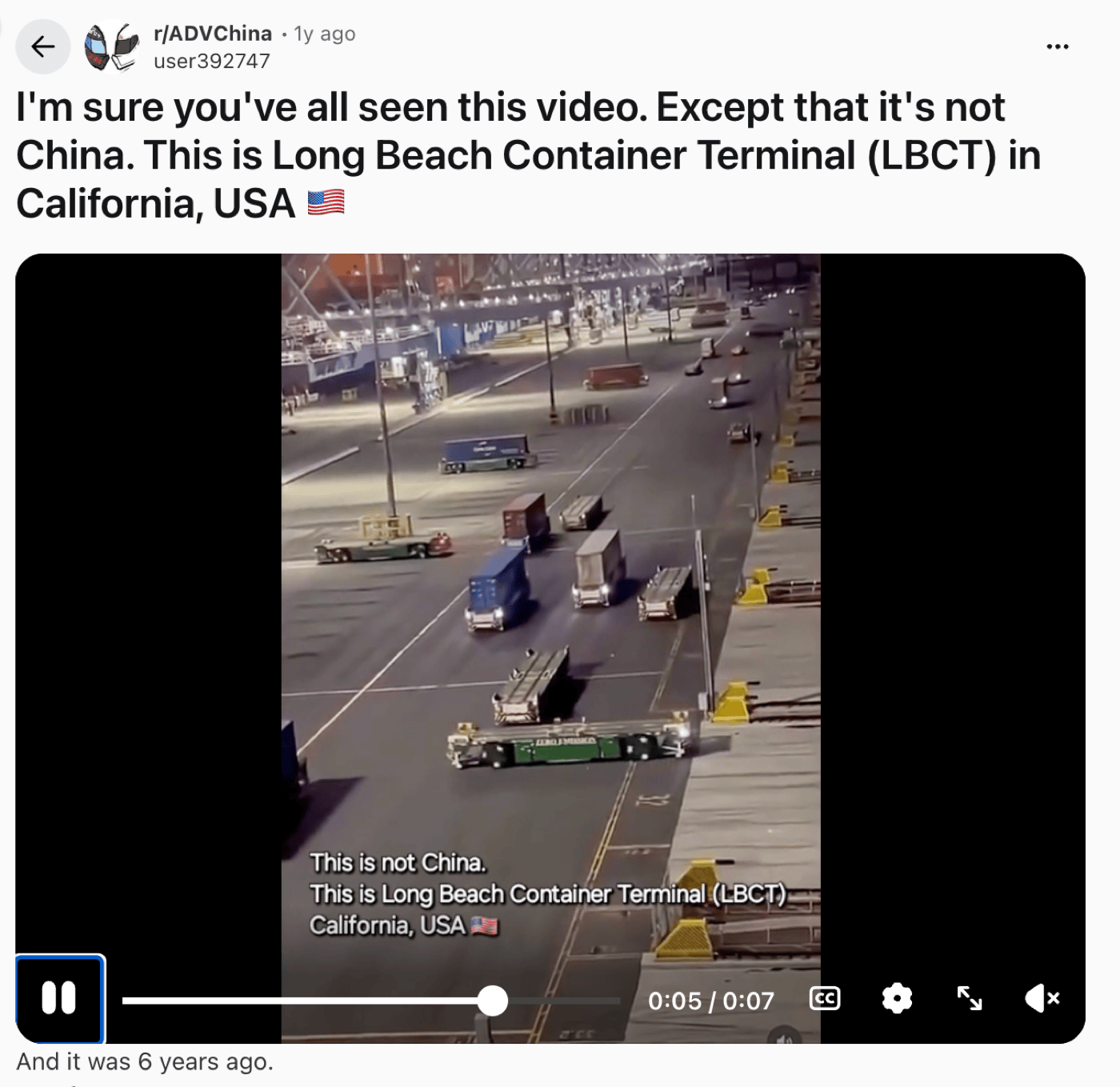
Every few weeks a video goes viral of a fully automated port, cranes moving in silent choreography without any humans around, captioned with something about how China is lapping us. Last October one of the big ones was actually Long Beach, California. We’re out here manufacturing China-superiority propaganda out of footage of our own infrastructure.
It goes the other way too. When DeepSeek launched, I wrote that I was still relatively convinced it was a Chinese psyop, and Palmer said the famous $5M training cost was “bogus.” Meanwhile Aaron Slodov, who runs a manufacturing company in the US, said he was sick of the China ragebait; he’s “really tired of ragebait on how advanced china’s industrial base is.” But he’s also the guy who reminds people that most American OEMs have basically zero supply chain visibility, while third tier suppliers are basically all Chinese.
I’ve written before that when being right is your identity, you will always be wrong, and that you have to go looking for the ways you’re wrong, on purpose. That’s what I respect so much about how Brooks teaches his class. He has a published position, but he still puts the best counterargument front and center.
Nervous, But Hopeful
So where do I land? I’m still nervous. I see the case Brooks makes, Noah makes a perfectly good argument too, and I’m genuinely hopeful they’re right. People like Brooks have done a lot of careful work, and the measurement problems with Chinese data are real. I’d love to look back in 2040 and laugh at how worried we all were.
But I’m not convinced that just being hopeful will prove to be an adequate perspective. I think China might be weaker than it looks and yet be even more dangerous because its teetering. I think the wargames we “win” look a lot like losing. And I think the industrial capacity we’ve let wither matters in every version of the future worth imagining. If I’m going to be wrong about China, I’d much rather be wrong in the direction that push us to build up shipyards, magnet plants, and a broader industrial base that can actually build stuff.