What Software Hasn't Eaten Yet
| Subtitle | Why I'm leading Marble's seed round to build the self-driving restaurant |
|---|---|
| Published | November 20, 2026 |
| Length | About 2,500 words |
| Newsletter | Investing 101 |
| Tags | marblerestaurantsaivertical-aisoftwaredeal-announcement |
| Read on | Substack |
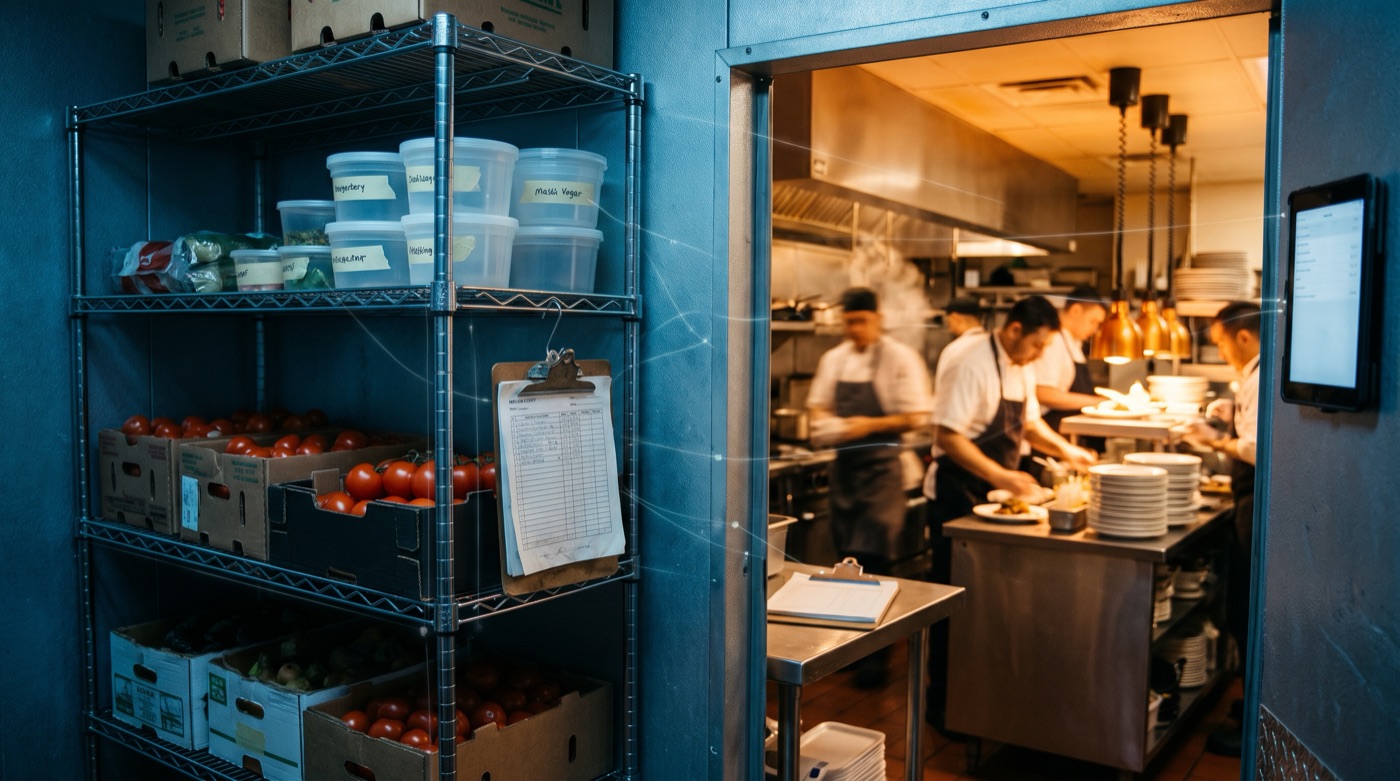
Fifteen years ago we were told software would eat the world, but it mostly ate the easy parts. AI’s biggest opportunity sits in the places software never reached, like a restaurant’s back of house where 42% of restaurants can’t turn a profit. That’s why I’m leading Marble’s seed round to build the self-driving restaurant.
In August 2011, Marc Andreessen wrote one of the most quoted sentences in the history of Silicon Valley thoughboi-isms. In a Wall Street Journal op-ed, he declared, “software is eating the world.” His argument was that, after six decades of computing, everything required to transform industries through software was finally working. Cloud, SaaS, mobile. It was time for the world’s biggest businesses to start taking advantage of it, “from movies to agriculture to national defense.”
It’s a quintessential entry in any Tech Nerd’s starter kit. And, in a lot of places, that’s exactly what happened. Amazon ate retail, Netflix ate video, Google and Facebook ate advertising (and rational decision-making, some would say). Andreessen even called his shot in terms of what he thought was next on the menu: “health care and education, in my view, are next up for fundamental software-based transformation.” He argued software was “also eating much of the value chain of industries that are widely viewed as primarily existing in the physical world.”
Fifteen years later, how did that go? Ask a doctor how they feel about their EHR. Meanwhile, in education, we’re too busy battling the existential crisis of students turning over their brains to AI rather than having been maximized by technology. Beyond those specific shots, let’s look at the rest of the world that was supposed to be ripe for the eating. Plumbing, homebuilding, or (where my focus is most recently) the general manager of a restaurant doing a 6 AM inventory count with a clipboard in a walk-in cooler. Software didn’t eat the world… it ate the parts of the world that were easy to chew.
This week, I’m excited to share that I’m leading the seed round for a company called Marble that’s making AI finally capable of tackling one of those harder-to-chew corners of the physical world: the restaurant back office. I wrote the formal Contrary perspective on “why we invested” here, and Aakar shared the company’s story here. But I wanted to use this space to explore the bigger idea that got me so excited about Marble in the first place, because I think it says something about where AI is actually going to matter.
The Low-Hanging Fruit
Anytime I think about the parts of the world that software did actually eat, I see a clear pattern. The industries that got transformed were the ones where the work was already information. Coding, advertising, payments — they’re all information. Retail writ large has been a bit messier, but at its core, a product catalog and a checkout flow are a database and a form. The workflows were addressable; codifiable, structured, repeatable, and already relatively digitizable.
Then look at what it didn’t eat. Construction, manufacturing, logistics, healthcare delivery, hospitality. Restaurants alone are a ~$1.5 trillion industry employing ~15.7 million people in the US. Don’t get me wrong, software has put its fingerprints all over bits and pieces of these bad boys. There’s a scheduling app or a POS system or an ERP in most of them. But touching an industry is different from transforming it. For a huge swath of the economy, software has only ever been tangential; a tool sitting next to the work rather than doing it.
That isn’t a knock on the last 20 years of software. Picking the low-hanging fruit first is the rational thing to do. You go where the work is legible, not just cause it’s easier to build, but because the customers are more ready to go, given they’re already sitting at a computer. But it also means the hardest, messiest, most human parts of the economy are left largely untouched.
AI Is Speed Running The Same Menu
There’s a new catchy tagline in town: if software ate the world, then AI is eating software. And when you look at where AI has hit first, that’s pretty logical. Coding was the most immediate use case because code is a programmatic, codifiable language. It’s structured, testable, and there’s a massive public corpus of it. Some stuff is just so programmatic that it’s very easy for AI to directly commoditize it.
Legal is next in line, along with accounting, customer support, and every other repetitive, document-heavy workflow. Real progress and real companies are being built there. But my sense is we’re mostly just watching AI speed-running the same low-hanging fruit exercise that software took ~20 years to work through.
The starting point for AI is just to eat the stuff software was already chewing on. But the real unlock comes as AI unlocks huge swaths of the economy that software could never quite reach; the messy, complicated, human-centric workflows where the information doesn’t live in a database and the work doesn’t happen at a desk.
The Pill Problem
I keep coming back to an analogy for this. Think about drugs (calm down). You can have an incredibly effective drug and a really gnarly disease, but you still need to get the drug into the person. Some drugs work as a pill while others only work as a shot. The delivery mechanism is a huge part of where the magic happens.
If a drug only works as a shot and you try to give it as a pill, it’s vaporware. Not because the drug doesn’t work, but because the overall delivery mechanism isn’t interchangeable. The patient swallows it, nothing happens, and everyone concludes the medicine was overhyped. (I’m looking at you Apollo).
AI is the same way. You can have a very capable system and a very messy, gnarly human workflow, and the whole question becomes the implementation layer. How do you actually get one into the other? The capability is the drug, but the delivery mechanism is what decides whether it ever reaches the disease.
That’s why I think the two loudest camps in the AI debate are both wrong. One camp is convinced all software will be irrevocably replaced by AI. The other thinks AI is an absolute fraud full of overstated claims. But AI is very capable at very specific things, and problems are still problems, just like they’ve always been; human and messy, full of incentives and operations and workflows and bad data. Software may still be the most effective delivery mechanism for getting one into the other. But AI is not going to adopt itself.
At Contrary Research, we tried to put some structure around this last year in The Vertical AI Playbook, and the conclusion holds up even better today. The handful of companies that really pop off are the ones that identified a well-crystallized problem area and built the right delivery mechanism for it. The rest are handing out pills for a disease that needs a shot.
The Restaurant Rat’s Nest
Restaurants might be one of the best examples I know of as a hard-to-reach part of the economy. Shockingly, 42% of operators said their restaurants were not profitable in 2025. Not just like “we had a tough year,” but genuinely, consistently, not profitable. That’s a wild number for an industry that every one of us interacts with probably every single week.
The squeeze is coming from both sides of the kitchen. Food costs ended 2025 up ~38% from 2019, and labor costs were up ~35% over the same stretch. The median full-service restaurant earned 2.8% of sales before taxes in 2024. And when you look at where the money goes, you realize just how little room there is for error:
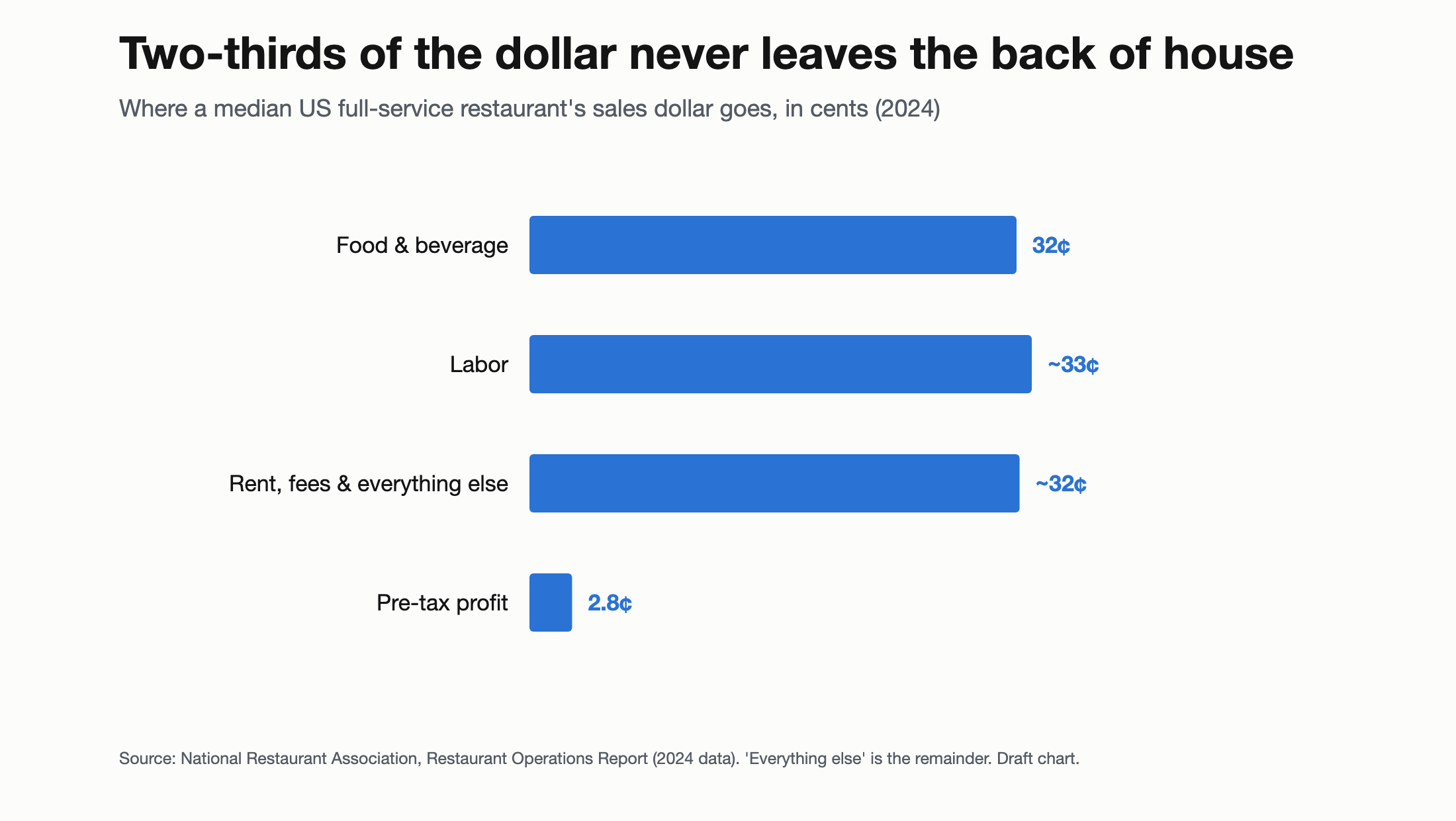
Food and labor eat roughly two-thirds of every dollar; that’s all the mish-mash of non-passion stuff going on in the back of house: how much food gets bought, how much of it gets thrown away, and how many hours get scheduled against how many customers actually walk in. When profit is 2.8 cents on the dollar, a single point of food waste or one overstaffed shift could be the difference between life and death for a restaurant.
Now, software has absolutely reshaped restaurants. Toast and Square rebuilt the point of sale; Toast alone runs on ~180K locations. DoorDash rebuilt how food gets from the kitchen to your couch. Reservations, marketing, and loyalty tools are all over the place. Over the course of my career, I’ve been an investor in Toast and Square, and I’ve looked at dozens of restaurant-focused point solutions. But notice where nearly all of that innovation landed: the front of the house. Getting customers in the door, taking their money, getting their order right. Technology got remarkably good at bringing customers to restaurants, but basically 0% better at helping restaurants make money from them.
The back of house is a different beast. It runs on weekly clipboard counts, orders placed from a manager’s gut, schedules built in spreadsheets, and a hodgepodge of point solutions for inventory, ordering, recipes, labor, and invoices that don’t talk to each other. In practice, the general manager is the integration layer, carrying data from one tool to the next by hand.
It’s a textbook Rat’s Nest Problem. Most of this stuff is death by a thousand cuts. There are so many different tools, expectations, plugins, and variables that every new solution just becomes one more thread in the tangle. Restaurant tech has historically died one of two deaths: either you’re drowning in a deluge of competitive point solutions, or you’re dying on the vine because you can’t ever get big enough to replace the systems the largest chains already run on.
If 42% of restaurants can’t turn a profit after 15 years of software eating the world, then technology hasn’t lived up to its promise in that particular regard. But I’m too much of an optimist to believe it’s a capability limitation. It simply lacks the right delivery mechanism.
The Self-Driving Restaurant
Which brings me to Marble. Aakar Khanna spent over a decade helping run his family’s multi-unit QSR franchise, doing the inventory, labor, finance, and bookkeeping himself. He went on to cover the restaurant sector as an investment banker at Goldman Sachs, then worked at AtoB. His co-founder, Arjun Chaliha, led AI and machine learning work for Bloomberg’s electronic trading team. They’re coming at the problem from two sides of the same coin: intense operations and in-production machine learning.

Aakar put it well in their announcement: the work that draws people to hospitality “is often orthogonal to the work that determines whether they can sustain a business in it.” People open restaurants because they love food and taking care of guests. They don’t open restaurants because they love reconciling a Sysco invoice against a delivery receipt at 11 PM.
What makes Marble a different kind of delivery mechanism is that it starts with the part software has always skipped: ground truth. A restaurant generates critical information every minute, basically none of which ever reaches a database; what’s left in the walk-in, what came off the truck, what got prepped, wasted, or substituted during service. Marble lets staff count a walk-in with a phone camera or by voice, pulls in sales from the POS, and forecasts demand at the item level. Then its agent, Remy (wink, wink), does the work: drafting orders, building prep sheets, reconciling invoices, and preparing schedules for a manager to approve.
Just the right shot instead of the ineffective pill. Rather than handing a manager another dashboard that tells them what to do, Marble does the work and just asks the manager to sign off.
And, guess what? It’s working. That’s what struck me when I first heard what Aakar has accomplished. Restaurants don’t rip out software unless there’s proven value; switching costs are brutal, and one botched migration that wipes out your historical schedules can sink a vendor relationship forever. But within weeks of starting, Marble was already ripping out dozens of tools like MarginEdge, Restaurant365, xtraCHEF, 7shifts, and Sling at customers. Today, some of the largest restaurant groups in the country are running their back-of-house on it. Onboarding takes ~3 days, because when you think about it, moving recipes, stockroom lists, and invoices from one system to another is really just a data parsing problem, and in this day and age, that’s plenty doable. Early customers have seen ~40% less food waste, 20+ labor hours saved per week, and up to a 20% lift in profit within their first 60 days. It’s still early but, as they say, this is the worst it will ever be and it’s already pretty frickin’ good.
When I talked to Aakar about how to tell this story, I kept pushing past the obvious framing. An AI-native ERP for restaurants, a nice N+1 on the systems that already exist, undersells it. What they’re actually working towards is the full-fledged disappearance of the back office. People don’t think about it at all. The goal is a fully self-driving restaurant; all you have to do is be a good restaurant, with a good brand and a compelling offering, and everything in the back of house takes care of itself.
That’s the bigger AI thesis in miniature. Restaurants are one of those hard-to-reach spots in the economy that software circled for 15 years without ever really making a dent in. If AI is going to be more than a faster version of the last cycle, it’s going to take the shape of purpose-built delivery mechanisms that can reach into messy, physical, human workflows and actually do the work.
A Matter Of Taste
To be clear, many restaurants are still going to fail. They should. Eating is, quite literally, a matter of taste, and not everyone can capture the zeitgeist well enough to get the people going. A self-driving back-of-house won’t save a bad concept; for those destined to fail, let the free market do its morbid work.
But what we don’t want is restaurants dying that should be successful. The ones where the food is great, the ambiance is vibing, and the people behind it bring real quality, care, and skill, but they go under anyway because they couldn’t keep up with the inventory counts, the vendor invoices, or the labor math. The boring stuff! That’s less the market working and more a back-of-house business strangling front-of-house artistry.
This week, Marble raised $5.5M, led by Contrary, with participation from Y Combinator, Robinhood Ventures, Restive Ventures, and a fantastic group of angels including the co-founders of Sweetgreen, Momos, and AtoB. If you run a restaurant group and any of this sounds familiar, go talk to them.
The promise of AI is that bad businesses will continue to die, but lots more good businesses will get built; starting with restaurants.