The Unfalsifiable Economy
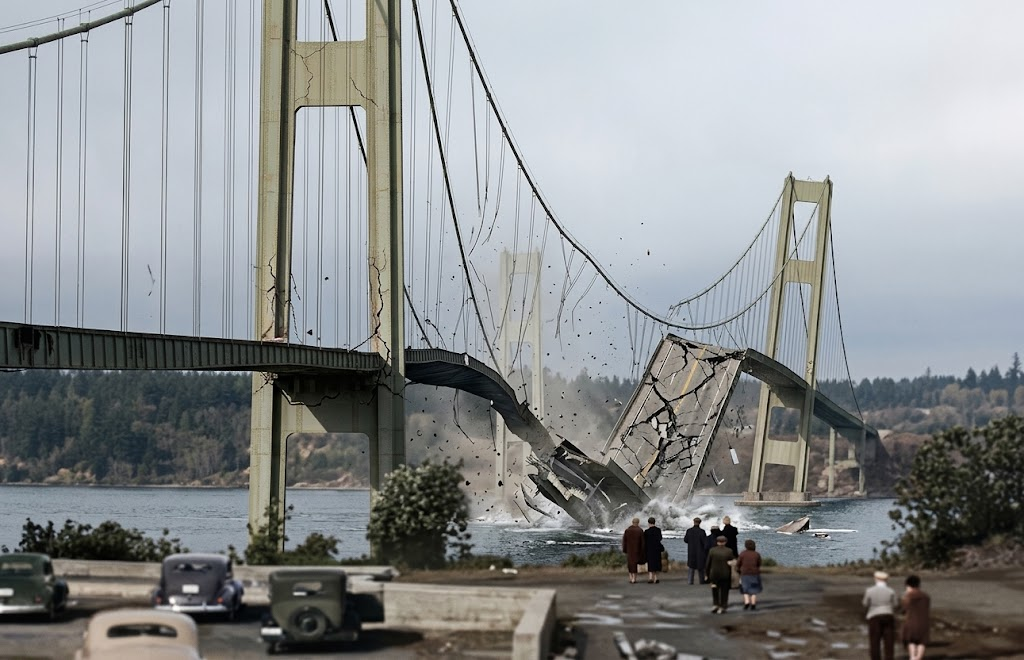
In 1940, the state of Washington built the Tacoma Narrows Bridge, a twin suspension bridge that was affectionately referred to as “Galloping Gertie.” Why, you might ask? Was it the herd of prancing ponies nearby? Nope. It was because, while they were building it, the bridge uh… moved… when it was windy. Sounds fine, right? They thought so too.
Cut the tape, open the bridge, pop the champagne. Welp. Four months later, in the midst of some hefty winds, the bridge collapsed. Luckily, (or unluckily if you’re not a sociopath who hates dogs), the only casualty was a Cocker Spaniel. If you watch the video of the crash, it’s heartbreaking; its owner crawls off the collapsing bridge, leaving his doggo to die.
Given the fact that deep fakes didn’t exist in the 1940s, you can’t argue with the video of that bridge collapsing (if you’re a moon landing denier, stop reading this cause you’re dumb). The video doesn’t result in a market assessment of the pros and cons of the outcome. No glass-half-full list of strengths and weaknesses. The bridge was wrong, and reality said so in no uncertain terms.
To opine on the event was an aerodynamics fella (his profession, I assume, rather than a description of his own aerodynamics). The fella, named Theodore von Kármán, later explained what went wrong. And as a result suspension bridges got better forever. Despite the terrible accident led to the untimely death of a Cocker Spaniel, the act of calling out the failure was a good thing.
This story came to mind because I’ve got an itch in my brain. My sense is that constructive criticism used to have a lot more teeth, but it’s been getting soft for the last 50 years or so. And my hunch as to the reason why is because the economy has shifted in terms of what it’s made of.
We used to, primarily, make things out of atoms. Bridges, engines, ships, reactors, rockets. Atoms don’t have feelings. Last time I checked, steel either holds or it doesn’t, and it doesn’t have a nuanced stance about it. Either the rocket flys or it comes apart. Then, ever so slowly, we stopped making things and started managing things. Reports, decks, quarterly OKRs (or weekly, if you’re a sicko). “Brand lift” was said, frequently, with a straight face. “Engagement” became a dominant principle. And here’s the rub. When your output is a judgement call; a vibe, as the kids say, there’s no von Kármán to tell you that you built a stupid bridge.
This framework has earned a phrase in my mind: the “Unfalsifiable Economy.”
Real criticism needs three things: (1) legible outputs, so you can tell whether something worked, (2) shared standards, so you agree on what “worked” even means, and (3) consequences for being wrong, so a bad idea actually costs somebody something. The atoms economy just so happened to have all three for free. But the Unfalsifiable Economy went ahead and got rid of them all.
When The Bridge Talked Back
The characteristic of criticism should emphasize accountability over politeness.
I think, often, of the American Founding. This is like the third or fourth time I’ve written about it in the last month. One case study that is, I think, instructive, is the pamphlet culture of 1790s. Anybody who has seen the musical, Hamilton, got a flavor of it. Anons on twitter, but with quills and parchment. Hamilton and Jefferson, in particular, had some raucous throwdowns because they were personal and ideological. It wasn’t passive aggressive peer-reviewed criticism. It was the stuff duels were made of.
And yet. When Hamilton articulated his “Report on the Public Credit” in 1790, Madison and Jefferson had to respond to the merits because either federal finances were going to balance, or they weren’t. In a young, budding republic, they had to contend with the reality publicly. When “Brutus”, the 1790 version of BigBalls69, attacked Article III it wasn’t a savage takedown, it was an articulate prediction about what an unaccountable federal judiciary would eventually do. Several of them came true. And Hamilton would have had to eat crow (or… crap? No. Eat crow) if the national bank had failed because he’d staked a falsifiable claim.
It wasn’t like the founders just weren’t nicer than us or weren’t more objective. The arguments they made were attached to things that you could come back and grade.
The Industrial Revolution doubled down, enforcing discipline in the least sentimental way possible. Edison versus Tesla got settled by which system actually electrified cities. Carnegie’s Bessemer process either produced cheaper steel or it didn’t. Patent fights required working prototypes, the Tacoma Narrows, like the foolish man who built his house upon the sands, came tumbling down down, and the outcomes had specific explanations of specific failures that reshaped specific disciplines.
The mid-century industrial state was the high-water mark. Chris Miller puts the through-line this way in Chip War: “World War II was decided by steel and aluminum, and followed shortly thereafter by the Cold War, which was defined by atomic weapons.”
Steel, aluminum, atoms, all gradeable by something other than a committee. I’ve written before that we went from producing 3K aircraft in 1939 to, a few years later, 96K a year, with one being completed in just over four days. The Eiffel Tower took 2 years. The Space Needle took 1. Name the last time we did something like that.
The institutions that built that stuff absorbed some pretty savage criticism; everything from Mother Nature killing a Cocker Spaniel to nuclear meltdowns. I’ve written before that in life, we may often look around at the reality we face and choose to disagree. But too rarely do we appreciate that, whether we like it or not, reality may sometimes disagree right back.
For about 150 years, reality disagreed right back on a schedule. Then we found a way to make it chill out and just feel the vibes.
The Assassins Won
Story time. Peter Robison’s book, Flying Blind, is the best I’ve read on how an atoms company gets captured by a vibes company. First? Let’s talk about what Boeing used to be.
There was a saying inside the company that every airplane development program has twenty thousand surprises. Focusing on the surprises made the point over and over that bad news was welcome. Alan Mulally ran the 777 on two core principles: (1) “no secrets” and (2) “the data will set you free.” One engineer remembers him putting it less gently: the only thing that would make him rip your head off was withholding information. When something went wrong, Ed Wells motto for decades as one of Boeing’s leaders was, “we will fix it.” One test pilot named Bob Wygle talked a program manager into a $22M redesign (roughly $200M today) with the argument, “I know it’s a big chunk to swallow, but the airplane’s going to be around a while and I really think we ought to do it.”
Every single one of those stories revolves around a company deliberately building a machine for finding out it was wrong. Falsifiability was the org design.
Then Boeing bought McDonnell Douglas, sort of. As one Boeing legend put it, “McDonnell Douglas has bought Boeing with Boeing’s money.” The executives from McDonnel Douglas who came over got described inside the company as “hunter killer assassins,” and the Boeing folks were “Boy Scouts.” Which, as an Eagle Scout, I am both offended and empathetic. The verdict is one of the bleakest sections in the book:
“It’s become sadly apparent that at Boeing, as at so many other places, the assassins won. Some of the very people who ran McDonnell Douglas into the ground resurrected the same penny-pinching policies that sank their old company. Borrowing a page from another flawed idol, Jack Welch’s General Electric…”
Ah, Jack Welch. The corporate specter of death. Anywhere there is large scale failure and truly awe-inspiring financial tom-foolery, somewhere lurking in the P&L shadows is the ghost of Jack Welch, shaking his chains.
In David Gelles’ The Man Who Broke Capitalism, Welch takes GE’s investor relations team and turns it into, in his own words, “the chief marketing officer for GE stock.” Nice. Not the marketing officer for turbines, or jet engines, or the things GE actually welded together out of metal. The chief marketing officer for the stock. “They were selling a narrative.” Soon GE employees “got up every morning and felt they were measured by the price of GE stock.” GE met or beat Wall Street’s expectations every quarter from 1995 to 2004, partly by pulling shenanigans like selling half a parking lot at the close of a quarter and buying it back later. Atoms down, vibes up.
It wasn’t just “dang, stuff got harder to build.” We swapped a legible output (did the engine run?) for an illegible one (did the story land) that could only be criticized in illegible ways. Less about score, more about spin.
And what did it cost at Boeing? Rather than investing in reshaping the world of atoms to their whims, company leadership instead poured more than $30B of cash into stock buybacks, and paid the CEO who drove them into the ground $100M (plus an additional $60M golden parachute). No hard feelings, though, right? Wrong. Not only hard feelings, but hard… ground. Two airplanes went down, and 346 people died. **The atoms were still there the entire time, patiently waiting, as the pesky, unavoidable arbiters that they are. **
The Whole Ball Game
When the shift happens from atoms to vibes, a law kicks in. I wrote about it in Rat’s Nest Problems: “Economists have a name for this, it’s Goodhart’s law: when a measure becomes a target, it stops being a good measure.” Carlos Perez put the general version better than I could:
“Schools don’t optimize learning, they optimize test scores. Companies don’t optimize long-term value, they optimize quarterly earnings… Each institution keeps its stated mission. But under the hood? Completely transformed.“
In the atoms economy, Goodhart’s Law was an occasional failure mode because the measure reflected the falsifiable failure. Whether the measure was good or not, it was, at the very least, determinable. But in the Unfalsifiable Economy, it’s like the operating system literally runs on false measures.
A civil engineer can’t retcon a collapse into a “strategy lapse.” But a strategy consultant very much can. And then, if the client succeeds, the consultant is a genius. If they don’t, it was an execution failure, or the macro, or the next consultant’s problem. Charlie Munger said it meaner: “In my long life, I have never seen a management consultant’s report that didn’t end with the same advice: ‘This problem needs more management consulting services.’” Savage lol.
The marketing “brand lift,” the HR “engagement score,” the strategy “alignment.” They’re constructed, graded, and interpreted by the same people whose work they measure. The referee, the scoreboard, the player… it’s all the same guy!
But it’s not just crapping on consultants. It’s impacting science. Science! Science IS the falsification machine. Science is THE falsification machine. (Not a typo; I’m trying to go for double emphasis). It’s the one institution we built specifically to find out when we were wrong. In Boom, Hobart and Huber describe what happened to it:
“Despite increased funding and the efforts of a growing population of researchers to churn out more papers than ever before, science is suffering from diminishing returns. Hyper-specialization and bureaucratization are slowing down scientific progress such that instead of scientific breakthroughs, we get more grant proposals and press releases.“
Grant proposals and press releases. Both of which are, you’ll notice, judgment outputs. Maybe they land, maybe they don’t. Who’s to say? Cause the arbiter is a committee. The Vibesters got us again…
“Reducing science to a popularity contest is a good way to ensure that breakthroughs never happen. When they do happen, it is often in defiance of risk-averse, citation-counting bureaucrats.” Their example is CRISPR. Leading journals rejected CRISPR papers as recently as ~10 years before the work won the 2020 Nobel Prize. As they put it, a major scientific breakthrough essentially occurred while no one was looking. Gosh, dang it!
The reproducibility crisis is the same story told in data. Physics, neurobiology, cognitive psychology, quantitative finance. Findings that couldn’t be replicated. Unreproducible is just another shade of unfalsifiable.
Glass Houses
Venture capital may be the single most unfalsifiable business ever invented.
I said as much in Being Honest About Intellectual Honesty: “when people are placed in situations where there isn’t as much objective reality (i.e. either something works or it doesn’t) it can be quite easy to slip into intellectual dishonesty. Investing in startups is a place without as much objective reality.“
Think about the structure. Your decision today gets graded in ~10 years. By then you’ve probably changed firms, raised new funds, changed titles, or all of the above. The winners get a self-congratulatory blog post while the losses get quietly marked down with a footnote about fund vintage quartiles.
I’ve also written before that venture funds, contrary to the marketing framework they like to reinforce, are not long-term thinkers. They’re a collection of short-term careerists focused on maximizing the amount of success they’re associated with, and minimizing the amount of failure they’re exposed to.
What does that produce? Most VCs became spineless, submissive, love-hungry puppies that will do anything for anyone’s validation. That kind of stuff cashes out in three ways: (1) they’re skeptical of anyone who likes them, (2) they’re rarely honest about when they might be wrong, and (3) they’re usually incapable of giving useful feedback. I’ve written about like… all of those.
Granted, our weird little industry does have at least one designated falsifiability ritual. One such example? Bessemer’s anti-portfolio, a public list of deals they missed. I love it as a bit. But as I’ve pointed out, it’s less an exercise in humility, and more a marketing exercise of “look how close we’ve been to greatness.” Even our confession is content… they got us again.
Granted, granted… venture isn’t the worst offender. As I noted in The Outcome Distortion Complex, professional investors, even in a bull market, care more about value creation than bureaucrats who are not measured by or compensated for their success. Fair point, Kyle. But come on, “better than a bureaucracy” is a low bar. And that’s not who we should want to be.
The Tribe Replaced The Bridge
Alright, so criticism can no longer be effectively targeted because the economic engine has become unfalsifiable. So what happens? Criticism doesn’t die; it’s like matter, neither created or destroyed. It’s simply reorganized. When outputs stop being legible, criticism migrates to the only things left standing: tone, affiliation, aesthetics, vibes, vibes, vibes. Did the deck look polished? Does the presenter seem confident? Are they one of us?
In The Coward’s Conviction I wrote that “the debate of ideas has been largely displaced by the debate of identities… We are, in most instances, arguing more about the identity of the person leading the argument, rather than the merits of the idea.” In The Black Swan, Nassim Taleb writes that “when Arabs and Israelis watch news reports they see different stories in the same succession of events. Likewise, Democrats and Republicans look at different parts of the same data and never converge to the same opinions.”
Every tribe has their vibe. The form of criticism is preserved, but the function, which used to be updating a belief against evidence, has been ever so gently hollowed out. Like a bridge painted on a wall. Looks like what we’re going for but effectively useless. It’s less about being right, and more about being wrong with the right tone. However,** the volume of your inaccuracy does not change the veracity of your beliefs.** We’ve lost our inoculation to it, and now we reason, chuckling to ourselves, “how wrong could I be if so many people think I’m right?”
In The Techno-Solutionist Commitment I made the point that people get addicted to criticism. They love fault-finding. It can feel like a unifying force of any in-group, to identify your villains and rage against the machine. Fault-finding used to be the cost of building a real thing, but now it’s the whole ball game. The dunk, the takedown, the Slack subtweet (is that what they call it on Slack? I spend too much time online), the “development feedback” performance review. None of them specify active, correctable criticism, because they’re signaling membership more than searching for truth.
Which brings me to the sneakiest phrase in modern life. Tom Nichols nails it in The Death of Expertise: we’re now supposed to “agree to disagree,” a phrase used indiscriminately as little more than **a conversational fire extinguisher. **Are you demonstrable right? Well, shut up. You’re being a dogmatic bigot.
Become Falsifiable
So what actually separates real criticism from the tribal cosplay? Real criticism tells you what would change its mind. That’s not my idea, it’s Karl Popper’s, and Taleb summarizes it this way in The Black Swan:
“Popper introduced the mechanism of conjectures and refutations, which works as follows: you formulate a (bold) conjecture and you start looking for the observation that would prove you wrong. This is the alternative to our search for confirmatory instances. If you think the task is easy, you will be disappointed; few humans have a natural ability to do this.“
Naval Ravikant puts it like this: “Least understood, but the most important principle for anyone claiming ‘science’ on their side: falsifiability. If it doesn’t make falsifiable predictions, it’s not science.” And then he takes the swing I wish more people would take: “I think macroeconomics, because it doesn’t make falsifiable predictions, has become corrupted. You never have a counterexample when studying the economy.”
The version I keep coming back to is this one: **if you can’t prove something wrong, you can’t really prove it right either. **In Intellectual Seat Belts, I wrote this exact same idea in a section I called “Become Falsifiable” back then, too. When being right is your identity, you will always be wrong. When being wrong is your identity, you will endlessly pursue truth. You have to go looking for the ways you’re wrong, on purpose.
Philip Tetlock, whose prediction research Nichols leans on heavily, has the least glamorous and most correct answer available: experts should maintain a public record of how often they were right or wrong. Not better intentions or smoother vibes, but more emphasis on the running scoreboard. Justin Kan proposed the civic version of this idea that I think about constantly:
“Someone should create an institute that publishes postmortems on laws passed. I.e. 5 years in, here is what the legislators promised would happen, and here is what happened. And then ruthlessly call out lawmakers that passed laws with negative unintended consequences.“
Bridge inspectors for harder to falsify jobs. Incredible.
Joe Lonsdale wrote an essay that names the same split at the scale of a whole country. He calls the productive part of America the Frontier, and defines it as “a falsifiable environment,” which is to say “an environment of true accountability.” Its opposite is the Core, Washington, the credentialed committee, where “bad ideas, bad bureaucracies, and bad systems don’t just survive… they prosper there. It’s an anti-Frontier.“ One of the more memorable lines is about money: “cheap money means that the cost to virtue signal is low; real money means the cost is real.”
Dag-nabbit, he said what I’ve taken 4K words to say, just smoother and better. Criticism gets rigorous exactly where being wrong is expensive, and gets tribal exactly where being wrong is free.
And underneath all of it, the master key, the reason the soft economy corrodes the discipline: the Upton Sinclair classic, “it is difficult to get a man to understand something, when his salary depends on his not understanding it.” In an economy of atoms, your salary eventually depended on the thing working. In an economy of vibes, your salary depends on the story holding. Different masters. And I’ll tell you what, nobody who lived their life governed by vibes ever had to crawl off a collapsing bridge, leaving their Cocker Spaniel to die under the weight of their “strategy doc.”
Granted, The Past Was A Mess
My Mom responded to my last newsletter and said I added too many “granted” caveats in my writing. Granted, I don’t feel like she’s a consistent reade… no I see it now. Crap. Well, here’s the mother lode of “granteds,” mother.
Granted, the Gilded Age was wall-to-wall fraud, stock manipulation, patent trolling (yes, even in the 1800s when we weren’t even typing patents), and empires built on patent “medicine” and land speculation. Granted, Apollo and the Manhattan Project had brutal internal politics and real cover-ups, and the reason they made hard calls wasn’t always superior character, it was existential stakes, a forcing function peacetime doesn’t have. Granted, Boeing’s golden age had a body count too, and “bad news was welcome” is a thing a company says about itself in a book written decades later; I’m sure plenty of bad news was met as very much unwelcome, even before Boeing sucked.
And granted, most of all: I’m comparing the best-remembered criticism of the past to the median Slack thread of today. The median 1920 factory-floor conversation was, I assure you, NOT a sophisticated Socratic dialogue.
People are people, it’s not just that we got softer, though we did. Measurement monarchies shape behavior, and when outputs become illegible, feedback unavoidably degrades, no matter what.
I’ve written before (however paradoxically) that bubbles produce thousands of failed companies, and each one represents a controlled experiment. That’s an Accelerated Failure Archive. Markets, for all their nonsense, are still one of the great falsification machines humans have ever built. A company either finds customers or it doesn’t. But if the foundation of the world was built not on virtue, but consequence, then it sort of feels like we pulled the floor out.
Reality Is About To Talk Back Again
Let’s try and end with some optimism. For 50 years, we got away with parading around an economy that mostly can’t be embarrassed by reality. It’s been an oddly survivable place to live, because the bill for being wrong kept not coming due. I wrote in An American Redemption that “the post-WWII boom was so total, so magnificent, that a generation or two stopped noticing it was a boom at all… We inherited the shade of trees we hadn’t planted, and mistook it for the default climate.“ We built a criticism culture to match the weather. Loud, tribal, unfalsifiable, and totally fine, as long as nothing was actually at stake.
There’s a story about Bertrand Russell’s chicken (you heard me). Fed every single day, at the same time, by the same hands. Every feeding is more evidence for the chicken’s theory of the world. Right up until the day its head gets chopped off. What looked to that chicken like a fundamental law of nature was just an as-of-yet uninterrupted trend.
We have been very well fed. But the stakes are coming back to roost. Chicken humor.
AI is starting to put the illegible stuff back to work. If a model can do the deck, the memo, and the analysis, then “did it actually work?” suddenly becomes the only real question. The fiscal reckoning of intelligence doesn’t care about your “strategic alignment”; you cannot subsidize failure and expect wealth, forever.
That’s why soft-criticism culture is so dangerous. We spent 50 years training ourselves out of the ability to notice we’re wrong before the world notices for us. A tribe can’t do that cause a tribe’s job is to never update, but simply to assimilate. We optimized for the wrong thing at the worst possible moment.
Here’s my conclusion: become falsifiable, on purpose, before reality does it for you. State what would change your mind, out loud, and mean it. Keep a scoreboard somebody else can read. Criticize the things you love from a place of love, so the criticism can be constructive instead of tribal. Prize the person who says “here’s how I’d know I was wrong” over the person who’s simply loudest. Build things that can fall down, so that when they stand, it means something.
There’s a line I saved a few years back and it is so, SO very good:
“The four words ‘I could be wrong’ should be etched above every schoolroom, political assembly hall, and scientific laboratory. The real error is to be too certain to see our mistakes. Certainty can become a prison for our minds.”
Reality used to talk back, and it’s starting to do it again, whether our institutions are ready to listen or not. Get ready to get reality-checked or get rocked.