The New Rules of YouTube (2027)
The New Rules of YouTube (2027)
Show: The Colin and Samir Show · Guest: Paddy Galloway · Hosts: Colin and Samir Published: August 19, 2026 · Runtime: 1:05:25 Watch: The New Rules of YouTube (2027) · Found via: Colin and Samir on X
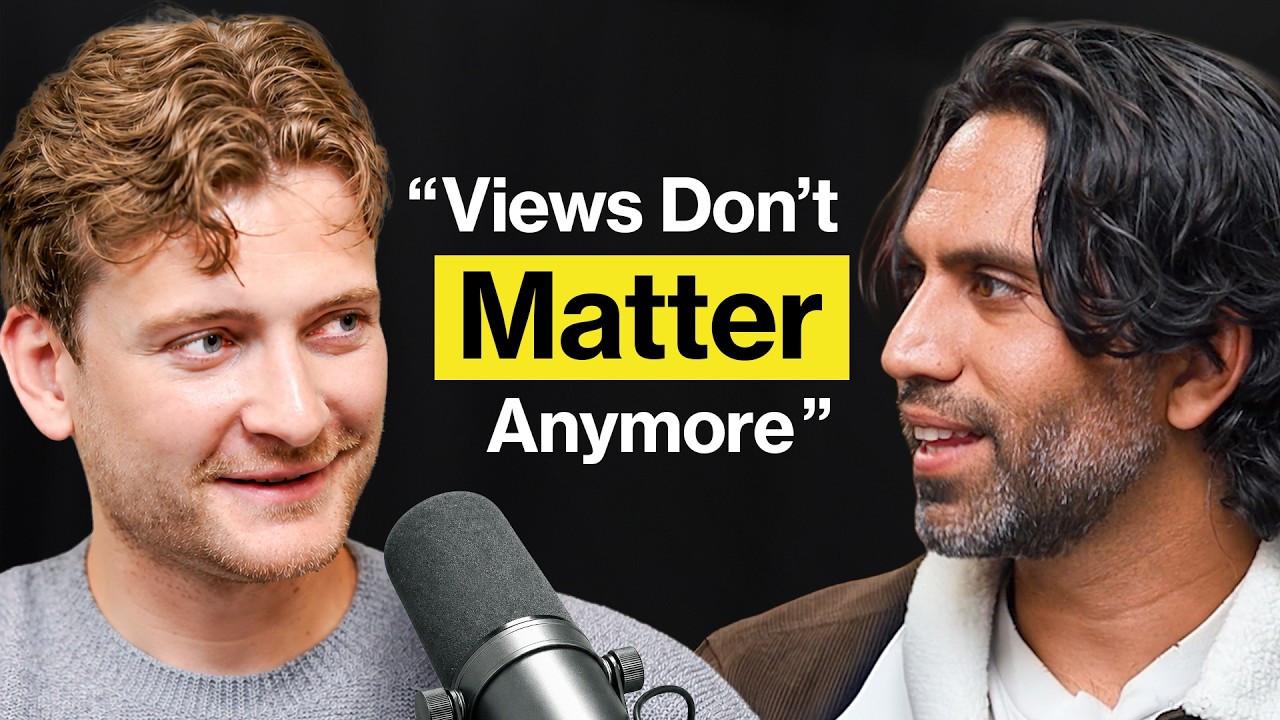
Galloway’s second annual appearance on the show. He is a YouTube strategist whose client roster (Red Bull, Jesser, the Philadelphia Eagles) has generated over 10 billion views, and he brought first-party data from his clients and his accelerator cohorts rather than platform talking points. Digest below; short quotes are attributed, the rest is summary.
The one-line argument
YouTube moved to the television, and the television changed everything downstream of it — video length, editing pace, what a “good” view count means, and whether a creator is building a format or a show. Galloway’s through-line is permission: as attention gets more abundant and more contested, what a creator is actually accumulating is the audience’s permission to take up 30 minutes of their evening. See Building a Following.
The device shift, with numbers
- Across Galloway’s largest clients, TV overtook every other device type around 2023. It went from roughly 23–24% of viewership in 2021 to over 50% today. Most creators the hosts talk to report 40–50%.
- Average long-form video length is up 51% since 2020 (measured across ~100 billion views of data). Creators averaged 12–16 minute videos in 2020; 20+ minutes is now routine.
- Average view duration is up 77% over four years across his biggest clients and accelerator students — from 4:35 to 8:00.
- The feared Shorts effect never showed up in the data: three years after Shorts launched, AVD went up, not down. The attention-span panic was wrong, at least on this metric.
Colin’s read on the causal loop: the YouTube app was always free, it landed on TVs, people already had a relationship with the brand — and then longer content performed better, carried more ads, funded higher production, which produced more TV-worthy video. A self-reinforcing cycle.
Permission, and the Red Bull Everest video
The case study is Red Bull’s “I skied down Mount Everest, world first, no oxygen” — 30M+ views, one of the most-watched videos of the quarter. What Galloway found notable was not the concept but the form: 31 minutes, few cuts, no narration, a slow unstructured edit.
“Five years ago, this would have been a 10-minute video.”
He frames the change as permission he himself would not have granted three or four years ago. The decision wasn’t “let’s hit 30 minutes,” it was that the feat “deserved to breathe.” Samir had stared at the thumbnail for weeks without clicking and only watched once a friend told him it wasn’t cut like a normal YouTube video — which is its own signal about the retention-editing era’s exhaustion.
Galloway’s working heuristic: given a choice between a great 12-minute video and a great 24-minute video, make the 24.
The switching-cost mechanism. Colin: on a couch with a remote, the friction of leaving a video is high, so he opens the app looking for a recognizable, show-shaped experience and will bank three episodes to watch in a row. Samir reports the opposite behavior — using TV to browse, finding new creators making 6–8 minute videos, and reserving 20–30 minute sessions for Netflix. Worth noting the two of them genuinely disagree here; the data supports the settling-in pattern, not a single viewer archetype.
Creators are now packaging for the TV: the birdwatching doc Listers and Extreme Beachcombing use thumbnails styled like film-festival submissions, with awards and credits — visual notice that this is not a phone video.
Less shelf space, but longer sessions
The new homepage gives long-form less real estate — roughly two long-form videos, an ad, then a Shorts block. Galloway’s distinction is between the homepage (“what do you want today?”) and the watch session, where long-form suggestions still surround you. He hasn’t yet seen a material viewership decline across his clients. His reframe: with less shelf space, the click still matters enormously, but what matters more is whether the click converts into duration.
Views vs. returning viewers
Galloway — who calls himself the view maximizer — makes a partial recantation:
“We all got so obsessed with just maximizing views that we kind of forgot how important a returning viewer is.”
His analogy: a striker who scores in six straight games and then goes scoreless isn’t benched. The algorithm behaves similarly, but creators have become terrified of experimenting, convinced a single off-format video will relegate them. His prescription is roughly one video in four or five made for the creator and their audience rather than for maximum reach.
The hosts’ own example is a vulnerable personal video: ~120,000 views, roughly 80% subscribers, no strategy and no business case behind it — “we had no choice but to make this video.” Galloway’s point is that satisfaction is the unmeasured metric: YouTube doesn’t expose it, so nobody tracks or optimizes for it, but that video almost certainly scored high on it.
Samir’s framing of the era, which the rest of the episode keeps returning to:
“20 million videos are uploaded to YouTube every single day. Every video that I think about is probably being made right now… So the only thing you should think about is: what’s my thing to say?”
What counts as a lot of views now
- Galloway’s benchmark for a small creator: 50–100k views on a long-form video puts you in the top 0.01% of creators who have ever existed. Colin’s gloss — that’s a stadium full of people.
- The signal has degraded. 20M-view videos used to be rare and now aren’t; dubbing in particular distorts comparison, since the same video with and without it can differ 4x on views that may not matter for what you’re actually optimizing for.
- Viewership and cultural relevance are different things. Plenty of 20–30M-view videos from the past year that none of the three had seen or heard discussed. Casey Neistat’s numbers in his heyday weren’t astronomical, but his relevance was. Sean Evans is more culturally relevant than his view counts suggest.
- Samir floats killing public view counts entirely: the creator keeps all the private data (AVD, CTR, returning vs. new), and originality gets rewarded because rivals can’t see what to copy. Galloway resists — public counts are how he reads trends — and Colin dissents from the other direction, saying a very low count does stop him clicking.
The milking argument. A creator from his accelerator (a 3–5k-subscriber channel at the time) hit with “atheist goes to Christian church for the first time” and then remade it across churches and religions for six months. Galloway’s advice was to keep digging, and his reasoning is competitive rather than aesthetic: if you don’t milk something, someone else will — and they can only do that because view counts are public.
Formats become shows
The clearest strategic shift in the episode. A format is a repeatable video; a show is a format with branding, a name, an intro, and recall.
- Abstract the format one level up. The Golden Cobra Family dog channel (11k subs on entering the accelerator, now near or past a million) hit with “golden retriever meets his new puppy sister.” The creator assumed it was a one-off — you can’t ethically adopt a dog a week. Galloway’s fix was to abstract: the format isn’t new puppy, it’s dog meets vulnerable other dog, which turned into rescue-dog transformation stories and now carries the whole channel.
- “It’s Top Gear, not Breaking Bad.” Episodic format, not deep serialized narrative.
- Evolve, don’t relaunch. Galloway advises a slow drift into show-ness — branding, consistent format, a name — rather than a ribbon-cutting.
- Examples cited: Michelle Khare’s Challenge Accepted, Sam Elkholm’s Access Granted, an accelerator creator building a longevity show called Human, Drew Ski’s Could Have Been Love, Quinlan Blackwell’s Feeding Starving Celebrities, Speed’s Speed Ghost Pro.
- Syndication is the payoff. MrBeast’s catalog on Prime Video is sorted into distinct shows (insane competitions, sports competitions) alongside Beast Games; Jesser’s YouTube videos were repackaged as Balling Out with Jesser on Hulu.
Samir’s compression of why this works: production has been democratized, so when abundance hits and everyone shares one screen, marketing matters — and a show is marketing. It changes how a thing is talked about, perceived, and remembered.
The counterweight, which Galloway supplies himself: individual videos still work (Red Bull has no “Red Bull show”), and a shows-only homepage would gatekeep. New creators grow by throwing out many individual ideas — the pilots — and a Netflix-style interface removes that testing ground. Colin’s addition: the pleasure of YouTube is being there for the rise, watching a creator before they were one.
The aspirational end state both hosts point at is comfort-watch permission — Good Mythical Morning with 3,000 episodes, or The Office, still one of the most-watched shows years after it ended, the default when you face a paralysis of choice.
Formats working right now
- “Every X.” I went to every Christian denomination church. I bought every robot vacuum. I read every self-help book. Galloway’s read on why: it promises something comprehensive and whole, it opens a large curiosity gap, and it represents effort the viewer will never expend themselves. Taking it literally misses the point — nobody believes you read every self-help book, and the video is interesting anyway. Related variant: “every level of X.”
- The entire-playbook video. Ramit Sethi’s “I’ve made millions of people rich, here’s my entire playbook.” Same wholeness instinct, applied to expertise. Typically a slow starter and steady grower rather than a spike.
- Quest / destination videos. Traveling to the location of the Windows desktop wallpaper — part spectacle, part nostalgia, and structurally satisfying because the video ends when he arrives.
- Building videos, for the same reason: the ending is defined by the thing being finished.
- Testing unique products.
Thumbnail and intro psychology
The worked example is “building a tiny office pod under my stairs” from Man Made, a one-year-old channel: 17 million views on a 51-minute video.
- Negative space is load-bearing. Galloway’s claim is that leaving open space above the pod is what makes it read as a thing inserted into a staircase rather than just a cool room — and that without it the video does 3M instead of 17M. A very small design decision.
- The person walking up the stairs, apparently unaware, adds the observed-secret feeling.
- The 16-second intro on a 51-minute video. It confirms the click (this is exactly the video the thumbnail promised), adds an unexpected turn (the reveal will be to a pro woodworker), and establishes personality — “I’ve got a feeling I’m going to mess this up,” cut to “I messed up big time.” Galloway’s summary: you can let a video breathe and still capitalize on the first 15 seconds. Both lessons survive.
“Giving someone a glimpse of your personality in the first 15 seconds is so important.”
- Age up kids’ formats rather than sneering at them. The secret-room genre is a kids/early-teen staple; this video is the adult translation. Galloway is pointed about creators who consider themselves above studying that content.
AI
- YouTube reports 92% of creators use AI somewhere in their workflow — mostly research, title workshopping, motion graphics and b-roll, not generative video.
- AI-enhanced thumbnails are already normalized. A 19–20M-view video (a private tour of an Indian billionaire’s wildlife rescue center) used a heavily AI-enhanced thumbnail built from things that actually appear in the video. Colin’s analogy: Photoshop and magazines. It’s a design tool.
- The harder problem is Adam Mosseri’s point that it will soon be easier to identify something as human than as AI — because authenticity itself can now be manufactured. Colin admits he doesn’t have an answer, and rules out the obvious one: lo-fi and DIY are already replicable.
- The human moats Galloway will defend: access (first camera into the Vantara sanctuary — “AI doesn’t have that, because it doesn’t know what’s there”), real people (an actual Philadelphia Eagles player is not a model of him), and brand plus permission. Samir’s version: “what are our unfair advantages over AI” — and he says plainly it’s a little worrying.
- What AI is eating: generic how-to content. “Five productivity tips” loses to one person’s specific transformation, because the second thing is a perspective and the first is a lookup.
- Slop: roughly 20% of videos served to a new YouTube user qualify.
Abundance, ranking, and curation
Galloway’s structural argument for calm: the pie is growing (more viewership than 2019), and YouTube’s long-form algorithm is a ranking system, far more mature than Shorts’ (recommendations date to ~2010–11; Shorts to 2022–23). Feeding a ranker more inputs doesn’t change that it outputs the 20–50 videos a given viewer should see. Going from 20M to 60M uploads a day wouldn’t move his clients. His actual worry is quality: if AI content stops being novelty-grade and becomes genuinely good long-form, the calculus changes. “It feels like we’re on an iceberg that’s shifting around.”
Samir predicts editorial Curation becomes necessary on top of algorithmic ranking as uploads climb toward 80–100M a day, and says he loves the word — tastemakers have always carried high cultural value.
Galloway takes the other side, and it’s the best exchange in the episode:
“The YouTube algorithm doesn’t care who your dad is.”
His example is the UK radio DJ who championed demo tapes and effectively birthed a generation of British bands — and who also, necessarily, missed a great many. Algorithms are better at not missing things. His concession is that at 100M videos a day even an algorithm may struggle. Colin’s position: his own career exists because of the lack of curation, but the cycle turns at that volume. All three land on the same place — algorithmic and editorial curation are not mutually exclusive (Spotify runs both), just as shows and individual videos aren’t.
Connections
- Building a Following — the concept page this digest seeds: permission and returning viewers as the real asset, rather than views.
- Paddy Galloway — the guest; a strategist arguing partly against his own optimization habit.
- Colin and Samir — the hosts; their own low-reach, high-satisfaction video is the episode’s clearest evidence for its thesis.
- Audience Building — the tactical counterpart. Most audience-building material is follower-count mechanics; this source argues the count is the degraded signal.
- Attention Economy — the abundance framing: 20M uploads a day, and every strategically obvious video already being made by someone or something.
- Curation and Tastemakers — the closing argument about whether editorial judgment returns to a platform built on its absence.
- Creator Economy · Content Creators — syndication to Prime Video and Hulu as the business consequence of formats becoming shows.
- Distribution — the homepage as shelf space, and the show as the packaging that survives it.
- Netflix — the reference frame for TV-shaped YouTube, including the question of whether public view counts survive.
- Artificial Intelligence — manufactured authenticity, human moats, slop, and the ranking-vs-volume argument.
- Brand Building · Personal Branding — “the only moat right now is brand, and permission.”
- Storytelling — the 16-second intro, and why a defined ending makes quest and build formats work.
- YouTube · MrBeast — the platform and the creator whose plastic-knife-table era Galloway uses to date the change.