The AI Hater's Manifesto
The AI Hater’s Manifesto
Author: Ed Zitron (Where’s Your Ed At) URL: https://www.wheresyoured.at/the-ai-haters-manifesto/ One-line: Three years into covering AI, Zitron sets out his whole position. LLMs are an interesting technology that is moderately useful as a tool, but their cost is inexcusable, and the industry around them runs on bad faith, subsidized tokens and promises about the future that cannot be paid for.
Key claims
- LLMs are interesting, and their cost is inexcusable. Zitron’s own uses (debugging his son’s Minecraft add-on, dumping crash logs) “kind of worked,” for “a trillion-plus dollars in capex and tens of billions of dollars of training compute.” His line is between outsourcing work, which is fine (a 30-line Python script, BQL queries, searching a document), and outsourcing thought, which covers research, writing and vibe-coded software.
- The comparison to human error goes only one way. If boosters compare LLMs to human workers, Zitron asks them to point to a time “we have invested a trillion fucking dollars in making human workers better.” That means mentorship, labor standards, healthcare and Universal Basic Income, not the scolding over Quiet Quitting.
- Users won’t pay the real cost. Subsidized subscriptions let users burn $20 to $40 in tokens per dollar of spend. When Microsoft moved GitHub Copilot to token billing, users who had been burning $1,000 to $5,000 a month for $20 saw costs rise “in some cases a hundred fold.” OpenAI and Anthropic moved companies with 150+ people onto token billing, and enterprises started cutting budgets. Anthropic’s more expensive “Fable” model levelled off at about 11% of usage (FT). GPT-5.6 Sol costs the same as 5.5 per token but “burns more than twice the amount of tokens.”
- There is no measurable ROI. In a 69-page OpenAI economists’ report covered by Fortune, a table on page 35 finds “no statistically significant correlation” between revenue per employee and AI usage. AT&T’s 80–90% savings from open models apply only “in certain applications,” out of more than a thousand. Klarna’s “$40 million profit improvement” claim gets the same reading.
- Only the infrastructure sellers make money, and they just raised prices. NVIDIA raised system prices 17% for next-year delivery after high-bandwidth memory costs doubled. CoreWeave had to offer 9.5% on bonds for an Anthropic data center, and Nebius raised $5 billion. Zitron calls NVIDIA “the GE Capital of AI” for its $6B Poolside “license,” its talks to invest in Perplexity at $30B, its $3B into Lancium, and a $4.9bn compute deal with Sharon AI, a company with $1.9m in quarterly revenue. BCA Research estimates the industry needs $10 trillion a year in revenue to justify the capex.
- The hyperscalers’ growth depends on two companies. OpenAI and Anthropic represent $440B+ of Microsoft, Google and Amazon revenue over the next 3.5 years, more than 34% of their cloud revenue. Total commitments, including $300B to Oracle, exceed $1.1 trillion. OpenAI’s compute spend and revenue share was 7% of Microsoft’s FY2026 revenue. Microsoft has spent $260B+ in capex for $34.33B in annual AI revenue, under $11B of it from customers other than OpenAI. Zitron’s argument is that no bailout fixes this: the labs have to keep growing their spend, not just survive.
- Progress depends on training money that disappears when the bubble pops. OpenAI spent $7.81B on training in 2024, $19.18B in 2025 and $8.6B in Q1 2026 alone. Without frontier training there is nothing to distill from (Distillation (AI)), so Zitron sees no post-bubble future for LLMs. He describes it as “a $30 billion TAM industry dressed up as a trillion dollar one.”
- AI data centers are not like dot-com fiber. Meta’s pre-AI data center in “Pineville Oregon” is 30MW, UBS’s Hayes data center is 5MW, and JPMorgan’s Orangetown site is 45.7MW. The smallest AI data center announcement Zitron has seen is 100MW, and most fall between 300MW and 1.2GW. “AI GPUs do not have other mass-market use cases. There is no post-Dot Com story.”
- The industry needs everyone to talk in the future tense. Anthropic’s “$65 billion annualized run rate” sits against $16.5B in actual revenue in H1 2026. ChatGPT has a billion weekly users, about 95% of whom don’t pay. OpenAI’s non-GAAP operating margin went from −122% to −183% in Q2 2026. Zitron’s conclusion: “you can’t really justify anything about this industry based on what it does today.”
Notable quotes
“Here’s how I feel about LLMs. In a vacuum, they’re an interesting technology that can do some interesting stuff, in the right scenarios, but never in a way that involves you fully surrendering your actual work product to it.”
“It just came to me — the problem that I have with most people using LLMs is the delineation between outsourcing work and outsourcing thought.”
“However, the most common application of a personal Jarvis seems to be … tinkering with one’s personal Jarvis.” — Robin Sloan, on “Jarvising”
“All of the AI projects we have observed as a team are failing. Every single one – we have seen 0% success in a year and a half, not only amongst projects we have been asked to participate in, but even within projects that we have observed in passing while doing totally unrelated work.” — Nik Suresh, AI Is Eviscerating Global Decisionmaking
“Most people don’t need to operate at the frontier,” said Miles Clements, a partner at Accel, which has invested close to $1bn in Anthropic. — via the Financial Times
“Revenue per employee is not meaningfully associated with output tokens per employee or messages per active user once other controls are included.” — OpenAI economists’ report, via Fortune
“Nothing about LLMs is worth a trillion dollars, or even $100 billion. This is, as I’ve said before, a $30 billion TAM industry dressed up as a trillion dollar one.”
“Ultimately, it was sold with the greatest lie of all: ‘this time it’s different!’ To be clear, they’re right. It’s so much weirder, and in the end will be so much worse.”
Charts and figures
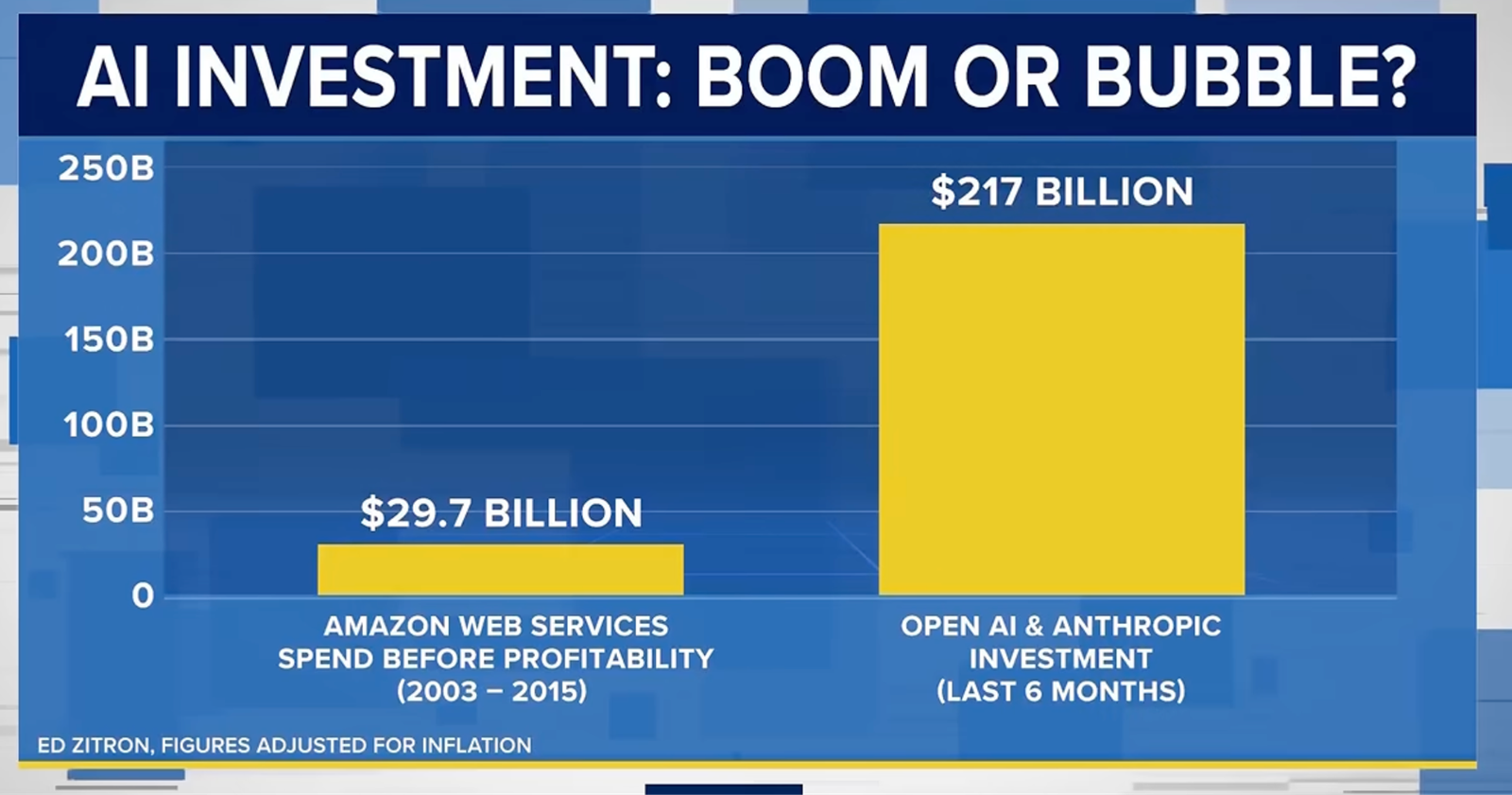
The “diagram from my hit on MSNOW.” The bar on the left is all of Amazon’s capex (store, logistics, Alexa and AWS) from AWS’s creation to its first profitable year. The bar on the right is what Anthropic and OpenAI have raised in 2026 so far.
How it connects
- Ed Zitron is the author. This is his statement of position after “the best part of three years” covering AI, written for an audience he puts at nearly 115,000 subscribers.
- Artificial Intelligence: Zitron separates the technology, which he finds interesting, from the industry built around it. He also calls the term itself a “bad faith attempt to conflate transformer models with things like robotics or autonomous cars.”
- Large Language Models: the outsourcing-work-versus-thought line, the “Jarvising” critique, and the claim that LLMs are “mathematically certain to make mistakes.”
- OpenAI: its training spend ($7.81B → $19.18B → $8.6B in Q1 2026), its widening negative operating margin, and an internal economists’ report that finds no link between AI usage and revenue per employee.
- Anthropic: the $2 trillion valuation target and $100B raise, the “$65 billion annualized run rate” set against $16.5B in H1 revenue, and weak demand for its pricier Fable model.
- NVIDIA and Jensen Huang: the 15–17% price increase, the “GE Capital of AI” deals, and the “$500 billion” financing figure that Bloomberg reported Huang announced before the deals came together.
- Microsoft: the $260B capex against $34.33B in AI revenue, and the GitHub Copilot shift to token billing that Zitron calls a “rug pull.”
- Amazon and AWS: Amazon’s $29.7B in 2003–2015 capex is the comparison Zitron uses against AI spending, and Amazon’s $25B commitment to Anthropic is part of the $115B Google and Amazon put in during 2026.
- Google: its $40B Anthropic commitment, and its place among the three hyperscalers whose cloud growth depends on the labs.
- CoreWeave and Nebius: neoclouds raising expensive debt (9.5% bonds, a $5B raise) to cover the rest of NVIDIA’s demand.
- Perplexity: “decaying AI search company” with $750M in annualized revenue after three years and more than $1B raised, now an NVIDIA investment target at $30B.
- AT&T and Klarna: Zitron’s examples of AI ROI claims with “more asterisks than the Steroid Hall of Fame.”
- Accel: partner Miles Clements’s FT quote that “most people don’t need to operate at the frontier.”
- Sam Altman: told David Senra that the industry has “been too ambitious on timelines.”
- Distillation (AI): “distillation requires a model to distill from.” When frontier training stops, cheap models stop too.
- Quiet Quitting and Universal Basic Income: Zitron’s counterexamples of investment society refuses to make in human workers.
- AI Is Already in Dangerous Hands expands this piece’s section “‘Dangerous AI’ Is Already In The ‘Wrong Hands’” three weeks later. What Happens If OpenAI Dies (a week earlier) and Let AI Burn are the financial arguments this manifesto summarizes.
- Where’re All The AI Chips (Ed Zitron) and Dead Money (Ed Zitron): later Zitron pieces on warehoused GPUs and the revenue AI capex needs to break even. They develop the infrastructure argument here.
- Treasury Has an Internal Report Warning About the Dangers of an AI Bubble and Texas Teachers’ CIO Warns AI Capex Boom Echoes Past Busts: institutional voices on the same dot-com comparison Zitron rejects. The Texas CIO compares AI capex to earlier US infrastructure booms.
- AI Keeps Stubbornly Refusing to Take Our Jobs: Noah Smith’s data on AI and employment, a counterpoint to Zitron’s claim that LLMs left “a near-permanent scar in the workforce.”
- AI Bubble: the overall thesis Zitron has built over three years. This piece is his summary of it.