Rails World 2026 Opening Keynote (DHH)
Rails World 2026 Opening Keynote (DHH)
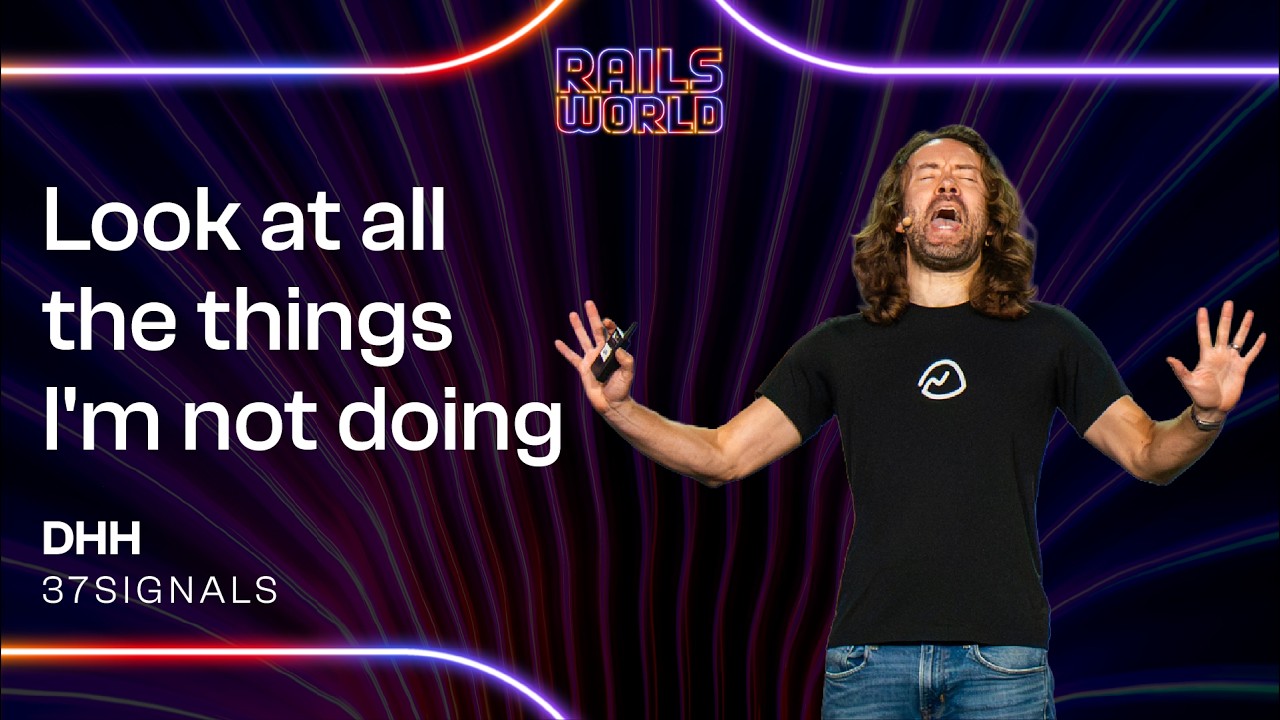
David Heinemeier Hansson’s opening keynote at Rails World 2026 in Austin, 63 minutes, published to the Ruby on Rails channel on 23 September 2026. It is the most committed public statement yet from a framework author that handwritten code is finished: 37signals has gone “pencils down,” Hey is being rebuilt as six native applications on a Rust backend, and DHH says he personally retired from professional programming around March. The full transcript Kyle supplied is archived verbatim with the wiki’s attachments.
The short version
Every technology that democratizes a craft kills the economic value of the craftsmanship and leaves the craft itself intact but relocated. Portrait painting was that craft; the Kodak Brownie was that technology; and — DHH argues — coding agents are the Brownie of software, with November 24th, 2025 as the date. The correct response is not defense of the old skill but full acceleration into the new one, and the only serious question left in software development is how do you get the most out of this intelligence explosion.
The analogy he builds the talk on
- An 18th-century portrait meant sitting for a master painter for months. Joshua Reynolds painted the Lady Waldegrave in 1781; an earlier Waldegrave commission was rejected by the client “because a piece of ankle was showing” and had to be redone. Only the upper bourgeoisie and royals could commission one.
- His own great-great-grandfather, the Danish painter Laurits Tuxen, spent three years on a portrait of the Danish royal family (1886), still hanging in Copenhagen. DHH’s great-grandmother, Yvonne Tuxen, is the woman in the pink dress at the center of a later canvas.
- Eastman Kodak’s Brownie (1900), at about a dollar, made photography general. Painters concluded that “depicting reality as perfectly as possible was no longer really an economically viable skill” and pivoted — Pablo Picasso into Cubism, the Danish Skagen painters into impressionism. Tuxen himself sat for a photographic portrait around 1921, shortly before his death.
- Then nothing happened for eighty years. The Leica I (1925) was close enough to the camera DHH’s 1980s childhood photos were taken on; he has maybe thirty of them. The camera phone was the second inflection: roughly 2 trillion photos taken per year in 2026.
The point of the detour is the shape, not the sentiment: technology moves in fits and stops, the democratizing step is the one that resets a profession, and the artists who pivoted got an explosion of creativity out of it.
The timeline he gives for agents
| Date | Event, in his framing |
|---|---|
| 24 Nov 2025 | Opus 4.5 — “the Kodak Brownie of our era.” The date he says history books will mark as the start of the age of agents. |
| Early 2026 | Open-weight frontier intelligence arrives; he ran Kimi K2.5 in fast mode at ~200 tokens/sec. |
| Feb–May 2026 | Trough of disillusionment. New models “kind of sucked”; Opus 4.6 read as a step backwards, a benchmark-flat OpenAI release knocked the market, and people concluded the exponential had stalled. |
| June 2026 | Fable 5 and Mythos. The disillusionment ends. This is the release where he shifts from assigning tasks to assigning problems and outcomes — “see those be solved… through no direction of my own on the implementation.” |
| Sept 2026 | GPT-6 Astra, which “saved us all from the dread that Anthropic was going to have a monopoly,” then DeepSeek-4-1 Flash a week later, ending the idea that frontier intelligence belongs to large American labs. |
He is explicit that the disillusionment lasted three months where photography’s lasted a century.
The 10x argument, restated
The 10x programmer came from a 1968 ACM Magazine study measuring a 5x–30x spread between the worst and best programmer, averaging 10x — and the profession then argued about it for forty-five years. DHH treats that debate as settled and skips to the new one:
- 100x between the worst programmer without these tools and the best programmer with them — “not a very controversial statement.”
- 1,000x — offered as only slightly more controversial. “That sounds about right.”
What 37signals is actually doing
Pencils down. A couple of weeks before the talk, 37signals decided it is done writing code by hand as a normal course of business. Handwriting code there is now “an exceptional state… like seeing a bug in Sentry” — a signal that the agent failed and the factory needs fixing. A show of hands in the room found about five people still writing material amounts of code by hand weekly.
The spring failure they misread. Finishing Basecamp 5, they had designers vibe-code the final features. Individually the PRs looked reasonable; twenty or thirty together “left the architecture looking a little like a Swiss cheese.” They concluded the technology wasn’t ready and went back to programmer review. He now calls that the wrong conclusion — “we could just have given it freaking 5 minutes, and we would have gotten Fable.”
Hey stops being a web app. A new version of Hey (“Hey Next,” name undecided) was kicked off about a week before the keynote as six native applications, demoed running behind him. His claim is that Hey was never a web app by preference — web apps, React Native and Hotwire Native all existed because a small team could not maintain six native clients, at a known cost in fidelity. That constraint is gone. A first Windows prompt came back not shippable; the redirected version landed twenty minutes later. Shopify’s rewritten native Shop app, replacing React Native with about six people in not very long, is his outside proof.
Rust on the backend, as a black box. He hates the language — “the ugliest programming language that has been invented in probably the last 40 years,” “like pouring acid in my eyes” — and loves the outcome, because he never has to read it. Porting the no-longer-web Hey backend to what it always was, a mail server, gives him: 99% less CPU, 95% less memory, and ten hosts kept only for redundancy — with a back-of-envelope claim that Hey’s peak traffic could be served by a single Raspberry Pi. He knows no Rust and calls that a feature: he evaluates the box from the outside, “as any business owner in history who’s ever commissioned a group of programmers.”
Async, not chat. The right way to work with agents, he says, is the way you work with a coworker — hand off the task, leave, review when something is ready — not sitting watching tokens. 37signals is building that direction layer inside Basecamp.
The numbers he puts on his own work
- Past 20 months: half as much code as the previous 21 years.
- Over 21 years, more than half his work was Ruby; this year about 3%.
- Long-run average ~30,000 lines of production Ruby per year; August 2026 alone: 150,000 lines, roughly 60x.
- He discounts his own figure twice — lines of code is “a weird, fuzzy, malleable size,” and Rust verbosity he would never tolerate in Ruby inflates it.
”English is a better programming language than Ruby”
The line he seems most surprised by himself. More expressive than Ruby, vaguer, less deterministic, and an absolute joy. The confession under it: he could have become a project manager twenty years ago if he only wanted outcomes — outcomes are how he got into programming before he fell in love with the craft. He says he retired as a professional programmer around March 2026. The framing he asks the room to adopt is joy rather than regret: a quarter century of chiseling by hand, filled with flow states, and now over. By the end of the year, he predicts, handwriting code will be uneconomic for virtually all programmers at virtually all companies.
Where that leaves Rails
Hey’s answer is native-plus-Rust, but he does not generalize it. The web’s advantage is that it never asks anyone to install anything, and a million businesses run on ephemeral users who will never install a thing — Basecamp’s own strangers-collaborating-briefly case included. Rails’ specific fit for the agent era, as he frames it:
- Convention over configuration leads directly to token efficiency.
- The one-person framework thesis “squares perfectly with what the age of agents is demanding.”
- Evil Martians is running agent evals for the Rails Foundation; agents saturated the first version at ~95% completion, so a harder benchmark has been instituted — implementing feature cards against reference applications.
His practical warning: people who know too much about how computers work are over-prescriptive. A beginner’s mindset prompts at a higher level and gets more.
The two things he wants rethought
1. Abstractions. He loves them, and thinks they no longer pay the same way. Abstractions exist partly to avoid repeating yourself — “now the price of repetition has gone to near zero,” as has the price of keeping things in sync. With hundreds or thousands of processes trying to mutate an application, an abstraction is a choke point. He has no blueprint, only the observation that the trade-offs inverted, and an invitation: this is object-orientation’s arrival moment, and the answers aren’t written yet.
2. CLIs, not chatbots. The most concrete ask in the talk. He does not want a concierge shoved into your app — “Save your tokens, bro” — he wants to bring his own butler and drive your application through a command line. “If your app doesn’t have a CLI, I want to see it by next Friday.” The payoff he shows is Hey’s CLI beating Elasticsearch: he found a five-year-old email when he knew neither the sender, the company, nor the year — only that it was about sneakers and a podcast. Concept search instead of keyword search, and he admits he doesn’t fully know how it did it.
Omarchy, and the “fix everything” loop
He says roughly $20 million has been raised for Omarchy, his Linux distribution, and it is the part of the talk where the thesis becomes personal: the ability to fix everything now applies to the whole computer.
- Install time: 3:33 demoed at Rails World 2025 → 35 seconds on an AMD Halo laptop → 9 seconds in the lab. Asked why 3 minutes wasn’t enough, he borrows Mitchell Hashimoto’s line: “The pursuit of excellence does not need justification.”
- A theme-matched calculator, one-shot from a screenshot: seven minutes from prompt to working app in C++/Qt (neither of which he knows), pushed public fifteen minutes later, then burned into a new ISO. “That’s the loop.”
- An iA Writer replacement, a video trimmer, and Hype — the Markdown-based presentation software he started on the Thursday before and used to give this keynote.
- Hype’s binary is half a megabyte, against Spotify’s 1.2GB. His reading: twenty years of computing progress was spent on programmer productivity, correctly, because a programmer hour was expensive. That constraint is gone, so every optimization is back within reach and a model can run one overnight.
The objections, and how he handles them
- Security is the one he concedes. “The agents maybe know their expiration date, and maybe they’re not so pleased.” A recent Rails CVE involving a C image library is his example; he points at HotCell (Mike’s talk) as the quarantine effort. The posture is agency, not powerlessness: invent the defense.
- Economic prediction is worthless. No economist can call the stock market six months out, let alone a paradigm shift. His case study is ATMs and bank tellers — the automation panic that didn’t happen, because cheaper branches meant more branches and more tellers (upselling you a subprime mortgage). He attributes the pattern to William Stanley Jevons.
- Oppenheimer as the cautionary tale about caution. Truman’s reported line after their Oval Office meeting — “I don’t want to see that son of a bitch in my office ever again” — is offered approvingly: the smartest people closest to the lab extrapolated a doom that didn’t arrive, the Cold War stayed cold, and the side-effect was nuclear power, which the world then squandered for forty years on bad reasoning it eventually corrected.
- Therefore: P-bloom over P-doom, as game theory. If you’re gloomy and it turns out well, you wasted the time; if the apocalypse comes, you should have been cheerier. “There’s only one play here, and it’s total optimism.” Closing images: “Agent Luther is going to disintermediate the cleric class,” competition from everyone becoming a programmer is nothing a Rails programmer should fear, kids have no layers to unlearn, and “the black pill is for fucking losers.”
What to keep in mind
This is a founder-author speaking to his own community about decisions he has already made, and the load-bearing claims are first-party and unaudited: the Hey backend’s 99%/95% reduction is a back-of-envelope figure from an effort a week old, the six native apps are a demo of an “effort we have barely just kicked off,” and the productivity numbers are his own line counts, which he discounts twice himself. The most interesting evidence is the part he reports against himself — the spring Basecamp 5 experiment where twenty or thirty independently reasonable agent PRs produced Swiss-cheese architecture. He attributes that to model quality and moves on; the alternative reading, that many parallel agents punching through a codebase is a coordination problem rather than a capability problem, is the one his own abstraction argument circles without landing on.
Two of his historical citations don’t survive checking, and both are load-bearing for the optimism. The bank-teller story is the standard Bessen/ATM example, but the dates and magnitudes are wrong in the telling: ATMs diffused through American banking from the 1970s onward, not the 1950s, and US teller employment has been counted in the hundreds of thousands, not thirty thousand rising to forty thousand. And Jevons’ paradox (1865) is about coal — efficiency gains increasing total consumption — not about ATMs or bank tellers; Jevons died in 1882. The underlying pattern he’s reaching for is real; the citation isn’t evidence for it.
Connections
- David Heinemeier Hansson · Basecamp · Shopify · Mitchell Hashimoto · Anthropic
- Creative Destruction · Technological Unemployment · Abstraction · Software Development
- AI Agents · Photography · Pablo Picasso · J. Robert Oppenheimer
- His ATM/bank-teller argument is the same argument as AI Keeps Stubbornly Refusing to Take Our Jobs; The AI Hater’s Manifesto is the corpus’s sharpest reply to the euphoria; AI Is Oil, Not God shares his commoditization read of open weights.
Source
Full transcript archived verbatim at wiki/attachments/rails-world-2026-opening-keynote-dhh/transcript.md (auto-generated captions supplied by Kyle, 2026-09-24; some proper nouns are garbled in the source captions).