Dr. Tokens or: How I Learned to Stop Worrying and Love the AI Bubble
I. Preface: A Note From The Author
Author’s Note1: Propriety dictates that I provide a brief disclaimer2 as to my complete lack of responsibility for the contents of this essay, as it was generated at a cost of $0.003 and is, therefore, worth roughly that.
II. Introduction: The Glorious History of Productive Delusion
The purpose of this essay is to chronicle the mass anxiety that is gripping every stably-sane individual in the face of, what appears to be, yet another NFT-esque3, Labubu-shaped, Tulip-reminiscent wave of consensus sense-losing.
Rather than assuage your fears with logic or dull your constipation with infographics, this Essay, instead, offers a core thesis, stated earnestly: humanity has never built anything of note without, first, losing its collective mind.
Take a brief tour though history’s most productive manias. Something many caffeine-soaked hedge fund analysts have done a half dozen times over the last three years, in search of an answer to the soul’s deepest question: “why am I losing so much money?”
In that tour, you will dabble in railroads, electrical grids, and the ideological orgy that was “The Dot-Com.” Each, in their time, dismissed as irrational excess, yet each leaving behind a foundation of infrastructure upon which each the subsequent future was built.
The Author cannot claim credit for this genius-level insight, despite possessing a genius-level intellect. No, this particular observation of Productive Delusion has both an ideological Matriarch and a, more recent, articulate set of Nephews.
First? Madame Carlota Perez’s 2002 treatise; Technological Revolutions and Financial Capital. If you’ve heard of it, you should be applauded. If you say you’ve read it, you should be eyed with doubt. But, what is more likely, is that you have read any number of blog posts from Monsieurs Azeem Azhar, Howard Marks of Oaktree, Derek Thompson, Ben Thompson4, Jerry Neumann, or perhaps the fellows and fellas5 of the Man Group or the Harvard Ash Center. The debate is well-worn, the framework well-framed, but alas. All are typically types and shadows of Madame Perez to varying degrees of sophistication.
Second, we have the more youthful interpretation and, in the opinion of the Author, a more approachable pronunciation of the same phenomenon, from Monsieurs Tobias Huber and Byrne Hobart in their canonical 2024 work: Boom: Bubbles and the End of Stagnation. There can be no better guide6 through humanity’s grand epics in Productive Delusion than this work.
Today we face a comparable entry in that Grand Diary of human accomplishment; artificial intelligence. The latest installment of that noble tradition of Civilizational Self-Deception. The question is not, “is this a bubble?” It is, instead, how productive can said bubble be?
III. The Physics of a Bubble (A Scientific Framework)
Written in our heritage is the plain fact that Productive Delusion is an inescapable part of the human experience. Rather than run from it, we must embrace it. As the Cave Folk of Old who, upon embracing fire, first learned the intricacies of third-degree burns, but eventually yielded the more productive lessons of Fire’s Fruits.
To do the same regarding the inflation of Technological and Ideological Bubbles, we must seek to understand the scientific framework. The physics of the bubble; or, as the French often say, Bublé Physicál7. Several critical components include:
- Surface Tension: The physical enormity of the bubble must be large enough to survive contact with reality’s weight of gravity for a minimum of ~18 months.
- Heat Transfer: Capital must flow at high enough speed as to prevent anyone from asking what “inference margins” mean.
- The Mpemba Effect8: “Hot” money cools faster, but paradoxically builds more infrastructure on the way down.
- Elastic Modulus: The bubble’s membrane must stretch sufficiently to accommodate an expanding valuation without rupturing, while remaining thin enough to enable successive TAM expansion.
- Vapor Pressure: Internal concentration of Day One mentality must exceed any external pressure of due diligence, lest the bubble undergoes spontaneous condensation into a SPAC.
The more we embrace the emerging AI Singularity, not as a mystical doom, but as a tangible physical force, the sooner we will come to understand it. As Madame Perez and Monsieurs Hobart and Huber have so artfully articulated, bubbles are not bugs in capitalism. Quite the opposite; they are the R&D budget of civilization.
And make no mistake, they are the budgets of civilization, not of a few Digital Robber Barons. For the financial equation herein is, effectively, socialized9 across pension funds and retail investors, many of whom believed, until recently, that NVDA was a vitamin company.
IV. Genuine Benefits of Mass Technological Psychosis
Far from decrying the unending march of progress10 as “illogical” or “irresponsible,” we must, instead, come to appreciate the genuine benefits of mass psychosis; very few shared mental illnesses have a better scorecard of technological output than this particular brand of hallucination.
Consider, as a sample, these tangible benefits of mass technological psychosis:
- (1) Infrastructure Laid on Someone Else’s Dime: Fiber optic cables during the Dot-Com sat dark for a decade before becoming the literal backbone of the modern internet. Today’s GPU clusters, data centers, and power grid investments (funded by people who believed in AGI by 2025) will outlast the belief system that built them and go on to power capabilities for future generations around generative cat video for an audience of 1, Excel plug-ins that plug into Excel plug-ins, and, if there’s time, curing cancer.
- (2) The Talent Concentration Effect: Bubbles act as one of the most effective human capital magnets that have ever occurred; pulling the world’s most capable people towards a single problem domain with violent hurricane-like force. DARPA can fund 12 researchers for a decade; a bubble funds 12K. Per day. Most will fail, hundreds of thousands of professional black eyes will be doled out. But a handful will permanently alter the trajectory of this particular field, and almost every adjacent industry while they’re at it. That is, statistically, a good deal for humanity despite being a bad deal for 90%+ of the 12K.
- (3) The Productive Paranoia of Competition: Whether you’re Satya making Google dance or Dario foreshadowing Sam’s villain arc; competition has a coordinating effect. When everyone believes a market is worth $100 trillion, they act accordingly; racing, duplicating, publishing, benchmarking. Not out of altruism11, but out of fear that the Supervillain down the street is 6 months ahead. Despite epidemic levels of stomach troubles, sleep loss, and awkward handshake refusals before a world stage, this collective paranoia is, in fact, a good thing. The result is the fastest period of scientific publication in human history, most of which will be read by two people: the author and the editor. But all of it will exist! Indexed, catalogued, key-word tagged; waiting for the researchers who come after.
- (4) Permission To Attempt The Absurd: The Emperor may have no clothes; but what about when no one has any clothes? Well, no one balks at the emperor for fear of calling attention to their own contribution to the nude-ery. Normal capital markets are allergic to genuinely weird ideas. A bubble is the only known mechanism12 that reliably funds things that sound certifiably insane. Railroad mania gave us the Glenmutchkin Railway of the Scottish highlands connecting nothing to nothing, but also the Intercontinental Railroad. The internet gave us Pets.com, but also Google. The AI bubble may curse us with an onslaught of ineffective, inane, insurmountable AI companions, AI lawyers, AI therapists, etc. But somewhere in that grotesque garden of crude human imitations we’ll establish the techniques and architecture that will quietly matter for the next thirty years. You cannot curate absurdity in advance.
- (5) The Accelerated Failure Archive: Bubbles produce thousands of failed companies. In the paraphrased words of Monsieur Thomas Jefferson; “The tree of [innovation] must be refreshed from time to time with the blood of patriots and tyrants.” Each company represents a controlled experiment around some configuration of the technology-market matrix. These failures become the Library of Case Studies for the next generation of builders. Silicon Valley’s cultural advantage is not its success. It is the density of documented, autopsied, learned-from failures. The AI bubble is currently laying the foundation for this archive at unprecedented speed… though the participants in said archive don’t know it yet.
V. Counterarguments, Dismissed Efficiently
Productive Delusion. Bublé Physicál. Mass Technological Psychosis. I can hear the grinding teeth of the perpetual skeptics. The unreasonably reasonable. They wail and gnash their teeth, shouting: “Misallocated capital! Burned engineers! Hype-exhausted enterprise buyers! LLMs as a local maxima!”
To them I quote a quotation of a quoter. In the words of Monsieur Patrick Collison who said, in the words of Monsieur Nat Friedman; “Pessimists sound smart. Optimists make money.”
The eyes of Perma-Bears roll back in their heads; “But the numbers! The valuations! The metrics! The nonsensical multiples!” They cry, openly weeping into their calculators.
But as Monsieur Puru Saxena would say; “You like accounting numbers or do you like to make money?”
Money, my dear fellows and fellas. Making money is where the rubber hits the road. Or to scratch the persistent itch on our Collective Capitalist Conscience: winning.
Noting The Bears
Let us, first, consider the Bear Case with all the seriousness it deserves, which is to say, briefly. Monsieurs Ed Zitron and Gary Marcus have crafted careers by dawning the grimace of pessimism. If we reduce their argument to its essential components, we find a well-worn path: models plateau, compounding costs, zero-margin deployments become negative-margin deployments, the enterprise buyers wake from their stupor. Eventually, the whole apparatus collapses under the weight of its own invoices.
Though loathe to bear it, the Author must concede; some of this is correct. The zero-margin invoices of it all. But the conclusion? That we should, therefore, stop? It smacks of betrayal of the human race. Do these Gentlemen understand the costs to be born in “stopping” during an arms race? Not only in the short-term, but the long-term? Not just in this generation, but for generations to come? One does not simply turn off the perpetual centrifuge because the electricity bill arrives.
To the perpetual skeptics; colloquially referred to as Perma-Bears; the Author would recommend a tonic: revisit the canonical gospels housed in Monsieur Marc Andreessen’s seminal Techno-Optimist Manifesto. Gird your loins. Steel yourself against the Siren Call of the worry-warts. Ask yourself if, upon your deathbed, defending your legacy to your progenitors; will you want to rehash the intricacies of AI infrastructure with a 5-year depreciation schedule against a 2-year hardware cycle? It becomes clear to us all that you’re the type of person who likely reads the Terms & Conditions. Perma-Bears of the Soul.
Noting The Bulls
Now, the Bull Case. Here, the Author must tread with a lighter boot, for the Bulls are his natural constituency. Consider the grand classics; Monsieur Amodei’s Machines of Loving Grace. Monsieur Leopold’s Situational Awareness. Why, Monsieur Altman’s Thesis itself; intelligence “too cheap to meter.” A phrase borrowed artfully and with admirable audacity, from the nuclear13 power executives of the 1950s. These Gentleman have crafted a narrative, nay, a religion, worthy of dedicating our lives to. The idea that the only thing standing between us and a post-scarcity civilization is approximately 18 more months of scaling. Each time. Exceptional.
Applause is merited; a standing ovation, even. But a word of caution against unrequited exuberance. The “what” adopted by many prominent Bulls may be marching in the same direction as unending human progress, but their “why” is not always legible amidst the shroud of their financial incentives14. The breathless treatment of every new benchmark as the declaration of Angels Heard On High, ushering in the apex of the Deployment Period… these declarations have a tendency to align with whatever the commentator’s portfolio15 requires. If your holdings match the author’s, you are positioned correctly. If they diverge, you are bound for the Permanent Underclass. Rather than being built on sound analysis, these Monied Perspectives are more akin to astrology via a Bloomberg Terminal.
The correct posture is not to wield the Bull Case to your will, shifting spinelessly from fear-mongering to hope-maxxing to regulatory capture as the news cycle demands. The Bull Case, properly understood, is to recognize that all Technological Manias are irrational and also necessary. Those facts co-exist without contradiction, and anyone who fails to acknowledge both is either a Perma-Bull (with a dangerously loose grasp on reality) or a Perma-Bear in Bull’s Clothing. Neither of which is invited to the most serious of conversations.
And Then There Are Those Ones
This brings us, regrettably, to the third camp: the Genuflecting Bulls. From the huckster author of Something Big Is Happening to the perverse-incentive-dripped writers behind the Citrini Scenario. These are analysts who bow at the implicative power of AI (the models are getting better, the infrastructure is real, the talent is concentrating) but then run their numbers to the logical conclusion, arriving at something less akin to post-scarcity utopia and more akin to an economic collapse.
The Author must chastise such fear-mongering. This is the children’s table of intellectual discourse. A person blessed with a dream who crafts it into a nightmare doesn’t deserve the faculties to dream.
From the Bulls to the Bears to the Bull-Bears; each arrived at a different conclusion. Each has missed the same point. This Essay, on the other hand, will miss it correctly.
The Bears are correct about many things; their conclusion is not one of them. The Bulls are correct about many things; their conclusion is not one of them. The conclusion is not that the system is failing and we can’t fix it, nor is it that the system must rage on, despite the growing pains and cracks showing. The system is, in fact, working exactly as it is designed to.
VI. The Doctrine of Acceptable Casualties
We are rapidly approaching a moment of truth, both for ourselves as participants in the capital markets and for the structural integrity of whatever it is we’ve agreed to call “the economy.” Truth is not always a pleasant thing. But it is necessary, now, to make a choice. To choose between two admittedly regrettable, but nevertheless distinguishable, post-bubble environments. One in which a few trillion dollars of paper wealth evaporates and the infrastructure remains. And one in which the infrastructure was never built at all, and we spend three decades wondering why we let the moment pass.
The system is working. The cries of a broken system fail to appreciate the somber science of acceptable casualties.
Let us examine, with the bureaucratic detachment that the subject requires, who bears the costs and who captures the benefits. We are not here to engage in moral accounting; this is a procurement discussion. The cost is calculated once the asset value is known.
- Cost-bearing parties include, but are not limited to: retail investors whose retirement accounts contain index funds weighted toward companies whose price-to-earnings ratios failed to assume the arrival of AGI by fiscal Q3; junior employees at Series B companies who accepted below-market salaries in exchange for equity that will, upon the turn of the sentiment tide, vest into the opportunity to update their LinkedIn profiles; and anyone who, in calendar year 2023, watched their employer pivot to “AI-powered XYZ” and felt a chill they chose not to investigate.
- Benefit-capturing parties include, but are not limited to: the infrastructure itself, which does not care who paid for it; the infrastructure owners who very much did not pay for it; the top 1% talent pipelines, which will carry their accumulated knowledge into the next cycle regardless of their current employer’s solvency; and the survivors, who will build what comes next on foundations they did not finance, using lessons extracted at someone else’s expense.
The Author documents this arrangement without commentary, as commentary would imply the arrangement was up for discussion. It is not.
The data centers currently under construction represent the largest infrastructure investment since the railroad bubble of the Gilded Age. Hyperscaler capital expenditure has exceeded $100 billion per quarter. Think of it. Carefully. The equivalent of the entire Apollo program deployed every ~10 months. Power infrastructure is being built that will outlast every model currently in production. This is, as we in America16 are fond of saying, the whole ball game.
But here is what the railroads also did.
They gave rise to the Pinkertons; the physical enforcers of the railroad Powers That Be. They brought company towns into existence; righteous in purpose, though sinister in execution. They enabled the concentration of agricultural lands into the hands of the people who owned the rail lines. True, the infrastructure was as real as can be. It was genuinely transformative. But it also produced power structures that would take decades of labor movements and anti-trust legislation to partially address. The question is whether the cost of progress was worth it?
Today’s infrastructure buildout is producing its own power structures, sinister and otherwise. What are the negative externalities that the AI Singularity may bring to bear? They deserve the same dispassionate enumeration:
- A Surveillance State: Permanent, cheap to operate, and efficiently distributed. Data centers running LLMs are equally well-suited to run facial recognition, behavioral prediction, and population monitoring (as Dario is learning, in real-time, from the heel of Hegseth’s boot). This capability doesn’t require a future breakthrough; it requires no more than advantageous licensing agreements.
- A Dependency Architecture: The open internet is dead17. The interconnectivity of our lives are no longer politically impartial fiber optic cables anyone can light up. These are API tollbooths accumulating switching costs and defensible moats where enterprise workflows thread themselves through a model, becoming marginally more expensive as each day brings new deployments and new use cases.
- A Captured Regulator: Disguised as “safety” and “speed to market,” information dissemination will, increasingly, be about establishing facts on the ground before governance frameworks can form. Then, governance will form around the loudest voices. This is the most logical incentive-aligned behavior rational actors can offer, which is considerably more alarming than a conspiracy theory because there are no villains hiding in the shadows. Governance will simply be ill-equipped to form its own regulation and will, instead, let the people who need to be regulated define the regulation.
- A Lock-In Architecture: The infrastructure is being optimized for inference revenue, and inference revenue requires lock-in, and lock-in requires leaving to be more expensive than staying. Once that’s true at sufficient scale, the system cannot be turned off without economic consequences that no individual actor has the incentive to accept.
Mind you, none of these negative externalities require anyone to fail at their job. On the contrary, everyone is playing their role perfectly. So how, then, do you determine if this is all worth it? If the cost is worthy of being born? Sure enough, it is not for the faint of heart.
A pill which is not easy to swallow requires a very large neck; the revolution will require weighted neck extensions. It requires the bravery of the Technologists. The investors. The fateful “crazy ones.” The misfits, the rebels, the troublemakers who see things differently, etc., etc. Because society, writ large, will rebel. They’ll protest everything from the nuclear energy required to the data centers being built in their backyards, because they are not willing to bear the cost. But, come hell or high water, the cost must be borne. The high water is just being recycled, anyways.
Remember what Monsieur Georges Clemenceau said about war? That war was “too important to be left to the generals.” When he said that, he may have been right. But today, technological transformation is too important to be left to the politicians. They have neither the time, nor the training, nor the inclination for strategic thought. The decisions must be made by the people with the capital to make them, which is, the Author supposes, how decisions have always been made. The rest of us are here to document the architecture and note, for the record, that the acceptable casualty figures were calculated in advance by serious people using serious spreadsheets.
VII. The Finger on the Button
Let us now consider a hypothetical; purely for academic purposes, in which a system designed for rational purposes by rational actors produces an outcome that no individual actor intended, but that every individual actor’s incentives made inevitable.
This is far from a novel concept. It is, in fact, the organizing principle of most institutional failures in human history. The distinguishing feature of the present case is simple the scale of the infrastructure and the elegance18 of the internal logic.
Turn, for consideration, to the systems of nuclear deterrence. Mutually assured destruction incentivizes both parties to build up to civilizational destruction capacities (at least by half). Both parties must be capable of annihilation to ensure that said annihilation doesn’t come to pass. The human cost must be too great to bear. But if the incentivized pursuit is ultimate destruction capabilities (not the destruction itself); well, human decision making stands in the way of enablement. So is not the logical conclusion to remove the human element? Not out of malice, but out of efficiency. If the point of deterrence is credibility, then the most credible deterrent effect is one that cannot be recalled. Universal optimization removed from the paltry incentives of mankind is the ultimate enablement.
The AI Singularity Buildout follows comparable logic. The thesis is sound, the models are improving, inference costs are declining, enterprise adoption is curving. Each individual decision up and down the value chain, from energy to chips to compute to application, is rational. Each individual actor in that value chain is doing their job correctly. Capitalists deploy capital. Computers deploy compute.
This is, in simplest terms, an exercise in inevitable hubris. Will it yield all of our above-discussed negative externalities? Most likely. Surveillance infrastructure, dependency architecture, regulatory capture, lock-in architecture.
But the point is not that these things are the result of something going wrong; they are the result of something going right. The bomb doesn’t fall because someone makes a mistake. The bomb falls because falling is what bombs do when the safety mechanisms have been rationally removed in the interest of credibility. The people who benefit and the people who pay the price are not the same people, and we have, somewhere along the way, quietly agreed that this is fine.
It is at this point, having outlined all the rational reasons to embrace the bubble, the Author must now step back and admit that the actual mechanism driving all of this isn’t reason; it is the same primal competitive anxiety that has driven every competition in history: the fear that if we don’t, someone else will. The bubble, in light of this inevitability, may not be rational allocation of capital, but it is a rational response to a gold rush. And in the end, we can hold on hope that the result will be the same. Rational capital allocation will yield the same world-shaping infrastructure that a speculative gold rush would, only faster. So, from a civilizational standpoint, one is indistinguishable from the other. And both are imperative.
VIII. Everything Is Fine

The above memetic19 is illustrative of the point we are striving to make. It is typical to experience fear, anxiety, worry, doubt. But the framework allows for this.
The words of Madame Perez come back to comfort us. The deployment period always follows the installation period. And societal costs? They will work themselves out. Regulation follows along, slowly but surely, behind every speculative bubble. Glass-Steagall followed the crash of ‘29. Sarbanes-Oxley followed Enron. Glass-Steagall was repealed in 1999, then 2008 happened, which gave us Dodd-Frank. The institutions catch up; they always do! Bearing with them, woven into policy, pieces of paper with pictures on them so that none of us have to kill each other, just to get a bite to eat!
Now, will they catch up before or after the dependency architecture and all of its other externality cousins of a negative nature metastasize into a societal cancer? Before the switching costs become prohibitive and the new world order has been reshaped? Before the surveillance infrastructure becomes the backbone of institutional government? Who can say.
Timing questions are, unfortunately, outside the scope of this framework.
This framework, instead, is about surges! These surges are 40 to 60 years (or months) long. The governance lag is a rounding error; a footnote! An asterisk on the graph whose x-axis is measured in generations and whose y-axis is denominated in GDP.
Now, you may start to feel your analysis turning inwards. “Where do I fit in?” you ask yourself. Are you a rounding error (i.e. a retail investor, a small business owner, a pensioneer)? The Author sympathizes. Genuinely. But the framework has accounted for you! You are in the model; never fear! You are in the spreadsheet with a highlighted row of your very own, in a color that indicates “acceptable variance.” Isn’t that nice?
Meanwhile, the infrastructure is excellent! The GPUs are fast, the breakthroughs have been enabled, inference costs are falling faster than predicted, the talent is concentrating, the research is being published, the deployment period is on its way! Everything is fine!
IX. The Doomsday Machine Was the Product Roadmap All Along
“Gee, I wish we had one of them doomsday machines.”
(General Buck Turgidson, Chairman of the Joint Chiefs of Staff)
At the outset of this Essay, the Author offered a core thesis, stated earnestly: humanity has never built anything of note without, first, losing its collective mind.
The breadth of subsequent evidence has then addressed the follow-up question; “but at what cost?”
The short answer as to the cost? High. But nevertheless!
The scenario that everyone is so worried about has hopefully now been framed for you in an alternative light. The outcome we’re describing isn’t a malfunction or a natural disaster. It’s a rational solution to a real problem, built by serious people, stress-tested by serious analysts, and designed with a single structural feature that distinguishes it from previous infrastructure cycles: it cannot be turned off once activated.
The Author isn’t herein referring to robot uprisings or paperclip maximization; the reference is to recursive efficiency. Feeding the Beast that is the AI Singularity, whether its meal be rare metals, energy output, manufactured chips, digital inference, value-based business outputs, will be an unquenchable appetite that we can’t turn off because it’s not designed to be turned off. The recursive needs to curve!
The language we’re all still using is the language of simpletons, so that no one misunderstands. We say “ecosystem stickiness,” “platform dependency,” “enterprise deployment.” But the language of a bygone era, designed for Software-as-a-Service, will give way to an Era of Intelligence. The addressable market of fully automated agents may be paltry today; but the groundwork we’ve laid will speedrun the raising of a civilization. The Author is confident that, with the proper retention techniques, sufficiently embedded workflows, and, dare I say, breeding programs, the Era of Intelligence can surpass the present gross national product within, say, 20 months; the optimists will say 18; always 18!
What has been the most critical part of the Thesis laid out herein is that the infrastructure will remain. Even after the bubble pops, the infrastructure is the heritage that will be bought with blood, sweat, tears, water supply, energy capacity, and job displacement. A small number of companies will control it. The switching costs will be prohibitive. The surveillance capability will be operational. The regulatory window will have closed. And the serious conversation will have moved on to the next surge. A surge that will be built upon foundations laid over the course of prior years.
The Author notes this without alarm; this is simply documentary evidence.
The system is working, the deployment period is blossoming, the infrastructure is being built, the costs are being distributed, the value is being created, the value is being captured, with growth as the universal organizing principle. Growth as a non-negotiable input assumption on every spreadsheet in every conference room in every glass building in every city where these decisions are being made by people who are, the Author reiterates for the final time, doing their jobs correctly.
The Author has learned to stop worrying. He recommends you do the same. Not because there is nothing to worry about, but because the worrying has been accounted for! It is in the model. It was always in the model. Your worry is a feature, not a bug: it provides the system with the friction necessary to appear as though it contains a brake.
However. It does not contain a brake. Brakes would defeat the purpose! Because the long arc of history always bends towards progress, and if it stops bending, then it stops progressing. And without progress we would have to contend with an end20. But we would prefer not to.
Written by Sonnet 4.6 at 2 AM on a Thursday morning
Clarification; the Author’s Note was written by Sonnet 4.6; the Essay was written by GPT-5.2; I believe a little after 11:15 AM on the aforementioned Thursday.
I am told by my 14-year old nephew that this refers to non-fungal tokens and that, despite our investment in these digital critters being currently marked at $8, we are likely to recoup much of our $185,000 previously invested in said fungus-related assets.
Monsieur Derek Thompson and Monsieur Ben Thompson bear no relation, I’m told. Though a tacit investigation of the Thompson bloodline leads you back to the MacTavish Clan, which is the Anglicised version of the Gaelic name MacTamhais. And, as everyone knows, the MacTamhais were infamous magaziners; 16th century wordcels.
The Author has been informed by his wife that his writing would be more accepted by the Layman if it were to employ turns of informality, hence the usage of the informal colloquialism, “fellows.” And, to by no means be exclusive of the fairer sex, the feminine equivalent of the aforementioned colloquialism: “fellas.”
Barring a time machine, though I’m told the Gentleman of the RAND Corporation are making significant strides and, with just a bit more funding, are likely to have this time travel business whipped.
There is a debate among particular segments of Francophile academics as to whether the French are truly responsible for the discipline of Bublé Physicál, or if, in fact, Michael Bublé, himself, has overemphasized the physical discipline of hype measurement in regards to his own persona. The jury is, as the French say, still out.
The namesake of a Tanzanian student, Erasto Mpemba, in 1963 whose penchant for freezing hot ice cream like an absolute psychopath gave us this observation: hot water freezes faster than cold water under certain conditions. What those conditions are is contested, but depending on the observer can extend to faster evaporation reducing mass, convection currents, dissolved gas behaviors, hydrogen bond dynamics, etc. The instructive lesson herein is thus: Capital enters a speculative cycle “hot”. Or, as my more indiscriminate self would describe it, moving fast, valued aggressively, deployed recklessly. Despite this “hot” capital dissipating faster upon the turn of the sentiment tide, it actually converts itself more quickly into physical infrastructure (data centers, cables, chips, buildings) that fails to evaporate alongside the capital that built it. Cold money, on the other hand, being cautious, never builds enough of anything to leave residue.
We have our Venture Capitalist friends to thank for this who, whether they prefer their moniker as Reverse Robinhoods or a Bastard’s Socialist, have effectively taken from the needy to give to the rich in hopes that the rich will make the needy less poor.
Not to be confused with the March of the Penguins, as is often the case.
My brother-in-law, who was recently admitted to rehab for a Twitter addiction, mentioned I should dive into a discussion of effective altruism. The Author doesn’t know what this is, but possesses healthy skepticism of all forms of altruism as a coordinating incentive — effective, or otherwise.
Perhaps with the exception of the French government, which has funded things that sound certifiably insane for centuries, though with considerably more paperwork. The Author also acknowledges that alcohol has historically served a similar function, though its infrastructure output is considerably less durable.
A phrase that, in its original nuclear context, preceded several decades of cost overruns, regulatory paralysis, and the occasional meltdown. The Author notes this without drawing any parallel whatsoever.
The Author would, with great remorse, and even earnest affection, go as far as to describe some, though certainly not all, of these… “incentives”… as, what the French, and not the Author, of course, would describe as… “perverse.”
Unrelated; the Author is, in fact, a hedge fund manager with a portfolio whose positioning is, for legal and spiritual reasons, outside the scope of this Essay.
I’ve been told that, regrettably, baseball analogies are in steep decline and are, instead, being replaced teleologically, with pickleball references. To the chagrin of the proponents of the sport, however, pickleball has no rigorous phrasing to lend itself to such phraseology and, as a result, we all simply just use analogies… less.
Long live the open internet? Candidly, the Author has never been sure why people say this. As I have made abundantly clear, the subject is dead. Long live? No sir. Long dead.
The blog posts, after all… are quite good. Machines of Loving Grace? Frost couldn’t have penned a more eloquent ode to the soul. The Gentle Singularity? Eat your heart out, Chaucer.
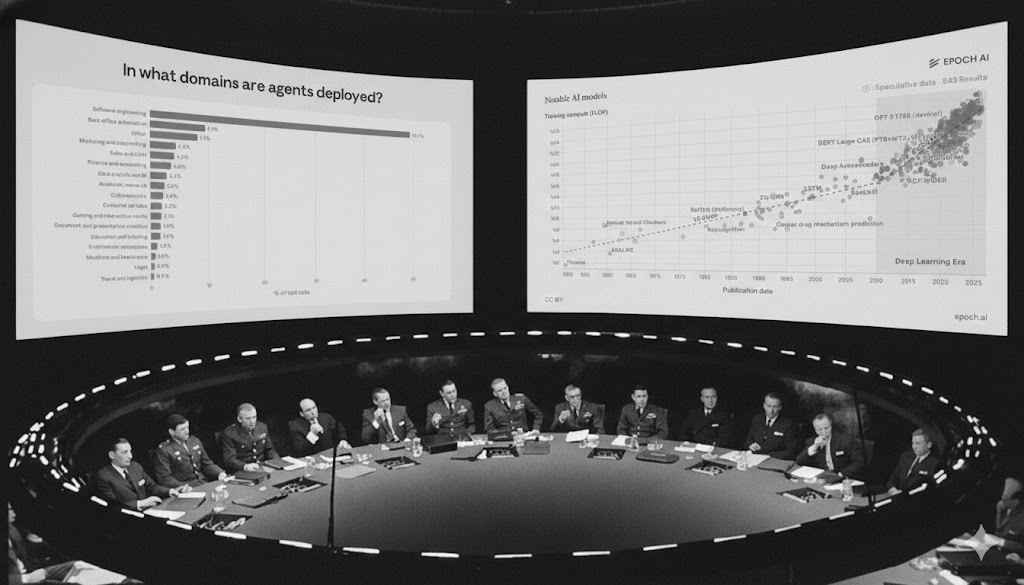
In the time since Footnote 5, the Author’s wife has further threatened a bill of divorcement if he fails to achieve incrementally more informality. So, at the cost of $25K, I have acquired the usage rights this visual memetic device. My Nephew’s alcoholic friend has informed me these are referred to by their Christian given name alone; a “meme.”
Aaaaand, scene. If you’ve stuck with me through, not only this very long mock essay, but all the way to this very final footnote, I applaud you. You may be as confused as I am. I can understand that. Let me attempt to, as briefly as possible, explain what I tried to do here. First, I am a big fan of Dr. Strangelove or: How I Learned To Stop Worrying And Love The Bomb. If you’re a die hard fan of that dark comedy about nuclear deterrence from the 1960s, then you had a lot of nice little easter eggs in this essay. If you’ve never heard of the movie (as I assume most of you haven’t) then hopefully this wasn’t too confusing for you. 🤷♂️.
The struggle that led me to write this is the obstacle of infinite optimism. I genuinely, with all of my heart, want to be optimistic. I want to do whatever I can to enable the builders who will cure all diseases, build a better world, enrich our souls infinitely, remove the obstacles that don’t make us human and enhance the struggles that define what “being human” truly means. But I have this itch. This nagging at the base of my skull. This phantom feeling that optimism to me is optimization to many of the Powers That Be. The Wielders of Capital, the Leaders of Free Worlds and Free Markets, the Agenda-Setters of Big Tech, Big Pharma, Big Everything. I don’t think we’re marching in the same direction. And the sinking feeling in my stomach is that where I march primarily just has an impact on me. Where they march is what actually shapes the world.
Perma-Bulls are, in fact, very persuasive. There is raw, unfiltered excitement in the vision of the world they portray. They are the “stop worrying and love the bomb” crowd. But their visions, unfortunately, require the “somber science of acceptable casualties.” Will lots of bad things happen? Yes. But its for the greater good. And whether its progress for progress’ sake, or American Maximalism, or the more honest mentality of “get while the gettin’s good,” none of the arguments feel like they have wiggle room for what could wrong, let alone an interest in trying to avoid the negative externalities.
It reminds me of a Slate Star Codex piece that I can’t find, but he tells the hypothetical story of going to a party and hearing a founder talk about a new materials he’s building with. The author asks the question, “I heard that stuff explodes at a certain temperature.” And rather than engaging with the merits of the argument, the founder defaults to exasperation. “Wow, what a Luddite!” When there is limited room for attempting to solve problems while deploying solutions, you either to have to have your head in the sand (more common) or (more diabolically)… you have to come to a place of acceptance, even comfort, with the negative externalities.
And I’m… just not willing to do that. I’m not willing to pull a Lord Farquad; “Some of you may die… but that’s a sacrifice… I am willing to make!” I want progress, I want optimism, I want productivity. But I want responsibility. And I’m not sure I’m seeing very much of it. At least not to a level of balance with personal partisanship.
This week is a perfect example. Anthropic is refusing to change its parameters to let the US DOD do whatever it wants with their technology. On one side of the ideological “aisle” you have people saying, “how dare these corporate overlords think they can dictate to the US Government what they should be allowed to do with this technology?” On the other side of the line, you have people saying “what the f*ck is the US government doing threatening a US company to either comply, or be seized?” Whether or not I agree with the conclusions, I, at the very least, appreciate what feels like a values-based stand. But the extreme partisanship of the events is, like everything else going on in the world… jarring.
There’s a line in this Essay that, as it came out of me, broke my heart:
“Now, you may start to feel your analysis turning inwards. “Where do I fit in?” you ask yourself. Are you a rounding error (i.e. a retail investor, a small business owner, a pensioneer)? The Author sympathizes. Genuinely. But the framework has accounted for you! You are in the model; never fear! You are in the spreadsheet with a highlighted row of your very own, in a color that indicates “acceptable variance.” Isn’t that nice?”
How many people see the negative externalities of what we’re building as “acceptable variance?” It struck me as comparable to General Turgidson’s declaration of needing to strike with a scenario of “acceptable human casualties.” On pushback, he responds offhandedly, “I’m not saying we wouldn’t get our hair mussed. But I do say no more than 10-20 million killed; tops. Depending on the breaks.” I hate to draw direct comparisons between nuclear fallout and the AI Singularity, but you can’t help but notice the comparable language that so many people discuss this stuff with.
So where does this leave me on the obstacle of infinite optimism? Is becoming a Perma-Bull an honorable, worthwhile pursuit? I’m reminded of the words of my Mother from, now, 17 years ago, that I never thought would be as impactful as they have been in my life. “Prepare for the worst, and expect the best to come.” I just can’t, in good conscience, turn a blind eye to notable problems. Perverse incentives, inadequate preparation, a lack of accountability, disregard for taking into consideration as many first, second, and third order effects as possible. Instead of blind, partisan, world-view Maxxing, I feel obligated to stand for nuance. To be willing to earnestly look at the bad and contend with it, despite the good that can also come from it. No worthy cause can be hurt by the pursuit of truth. And if it can be, then it deserves to be.
Referenced in
- It's Still 1995 note
- NFTs note
- Techno-Optimist Manifesto note