The Internet Wants Me Dead
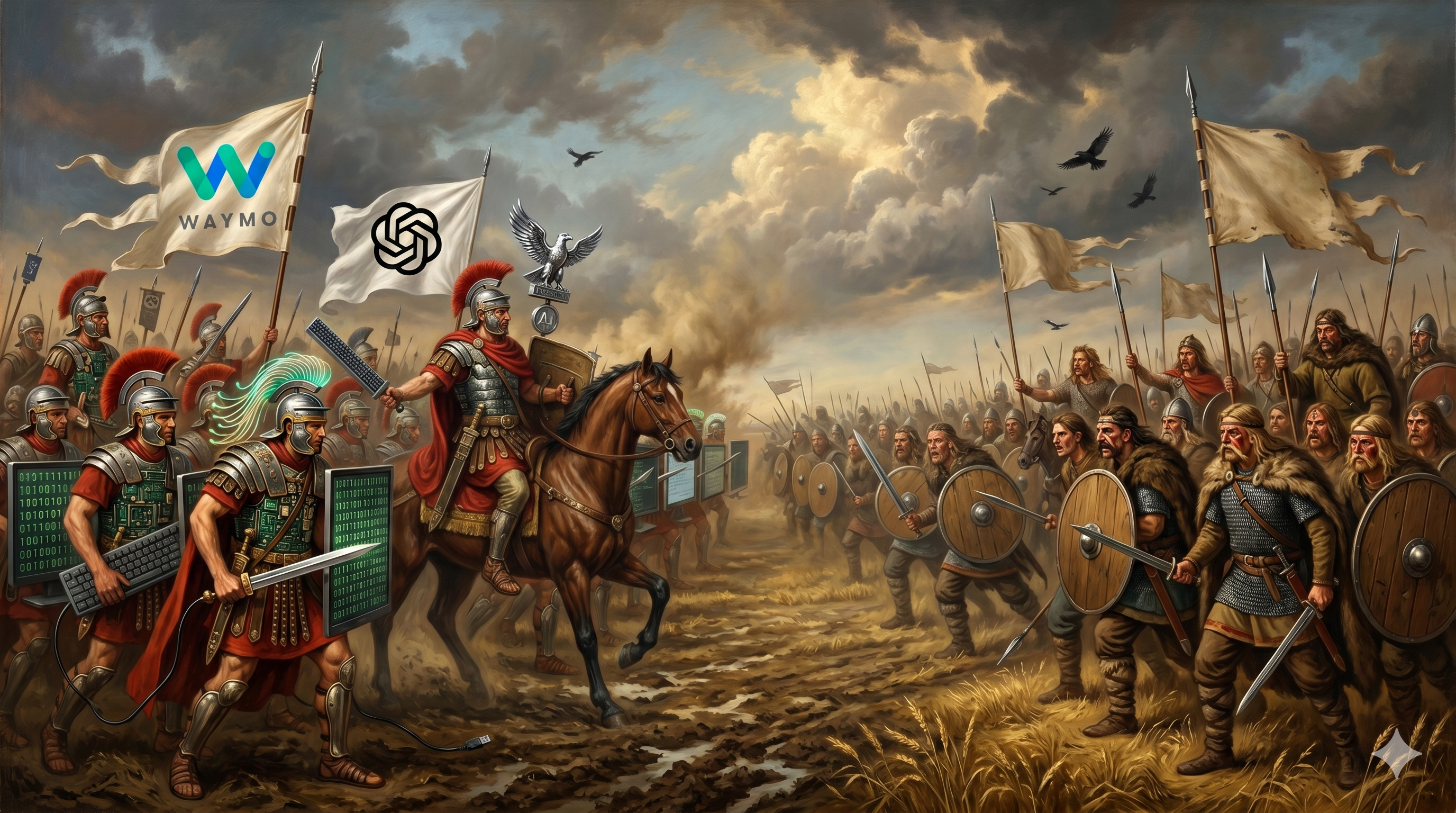
This week, I got my first death threats on the internet.
Now, some of you might be surprised. But I’ve got quite a Twitter addiction, so homicidal commentary is nothing new to me. It’s just never been directed at me. And those of you who are maybe even more chronically online than I am are nodding their heads with this kind of response.
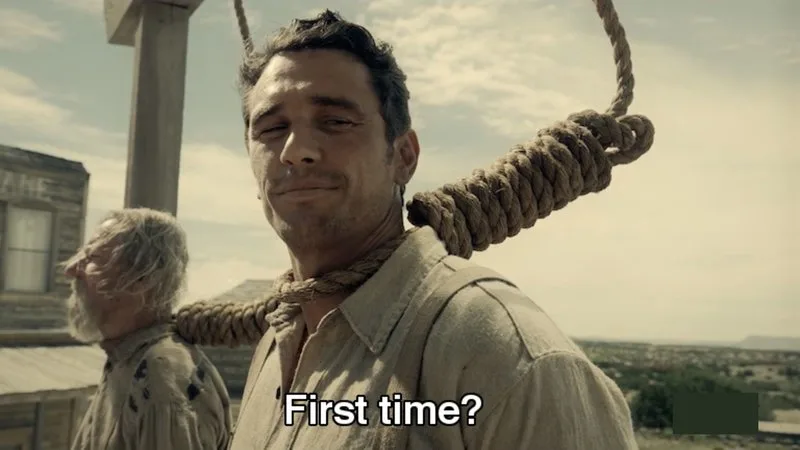
So what was my crime? I made the mistake of firing off a tweet of a casual thought I had when I got to my destination in a Waymo 20 minutes early and wished I could push a button, and pay a little more to just sit in it for a bit.
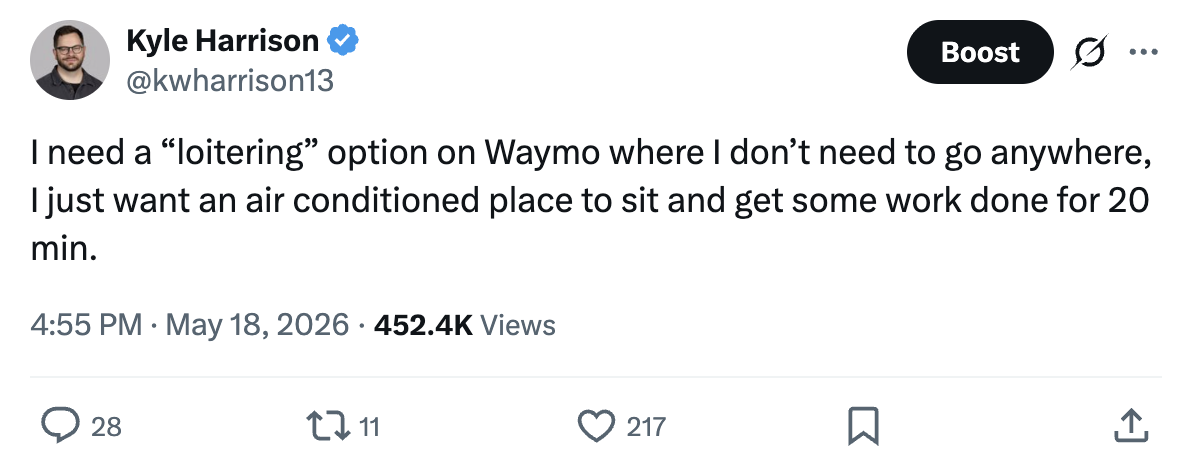
Like many (many) of my tweets, it sat for a bit. Casual commentary. Limited engagement. Exactly my sweet spot for content creation. Maybe a few snide comments rolled in. “That’s called a library.” “Have you tried a cafe?”
Then, a particular retweet sent a lot of people into my comments. The retweet said, “these people aren’t human like you and me.” 2.5K likes! Others piled in. “You seem like a waste of humanity.” “You are a lobotomized tech slave.” Eventually, took a turn with “Put this guy in the ground.”
This turned out to be the perfect segue into a topic I’ve wanted to think about for a bit anyways: violence. But it drove it home far more personally that I would have expected.
Now, don’t get me wrong, I don’t think anyone is going to kill me because of my Waymo tweet. But the thought crossed my mind when I read some of those comments at 3 AM and thought “…am I sure I locked the front door?” And what’s more, it triggered a growing fear that violence is increasingly being presented as a justified response to disagreement. What struck me about these people’s responses was that it had nothing to do with me as a person; it seemed, to them, an appropriate response based just on my worldview.
That led me through an intellectual exploration of violence’s place in the human story.
Violence As Default
Everybody’s journey is different. But one “ice breaker” question I don’t think I’ve ever been asked is, “have you ever been punched in the face?” My answer would be only once when a kid in high school decided he didn’t like me and hauled off between classes. Before and since, my experience with physical altercation was limited to football, wrestling, and the occassional fistless fistacuffs with my neighbor friends. With kids, I’ve got some pretty rip-roaring wrestle sessions, but no one has thrown a punch (other than my 4-year old daughter).
But over the course of my entire adult life I have never gotten in an actual physical fight. I honestly wasn’t sure if that would be something I had in common with most people, but turns out it is. One survey I found indicated that 83% of American’s say they never get in fights. Even growing up, the survey said only 58% of people said they occasionally got in fights as kids.
That being said, I can’t say that I don’t ever think about violence. When I’m in more volatile situations, or on sketchier roads at night, especially when walking with my wife, or with my kids in crowded places. I think about our physical safety. With the ever-present loom of shootings, who doesn’t? But even more than mass casualty events, I think about individual conflict. In disagreements with strangers, like car accidents, I find myself wondering what I would do if this person swung at me.
By and large, I find that violence is not a common part of my life. But the more you read history, the more it feels like that’s an anomaly more than a natural state. I wrote last week about how I’m reading Will Durant’s Story of Civilization and one thing, in particular, that has struck me is just how unapologetically violent most civilizations were.
Impalement, mutilations, flaying, ritualized human sacrifice of men, women, and children, dismemberment as routine judicial practice, public torture as entertainment, graphic methods of intense suffering for execution.
I came across a book recently that tried to make the argument that “organized brutality” has actually enabled an increase in violence, contrary to perspectives like Steve Pinker’s book, The Better Angels of Our Nature, where he makes the case for a “long decline of violence.” Organized brutality is talking about how violence at higher volumes is possible. But I’m talking about micro violence; not macro violence. And granted, this is coming from a place of intense privilege; not everyone in the world has escaped violence the way someone like me has.
But I think it’s fair to say that, on an individual level, generally speaking, our lives are less violent today than they would have been at any other time in human history. The question, then, for me, becomes one of whether that is a new normal or a temporary status? Protected, as I am, from the threats of my opponents who have been defanged by the digital distance our computer screens render. Because, for many, there is the rising sense that maybe violence could solve everything.
The Natural Meritocracy of Violence
The natural meritocracy of violence isn’t a phrase I came up with. And I am, by no means, a capable historian of violence, or anything else for that matter. I’m just reacting to sources that have been put in front of me. That phrase, instead, comes from a great follow on twitter; Roman Helmet Guy. He put it quite eloquently:
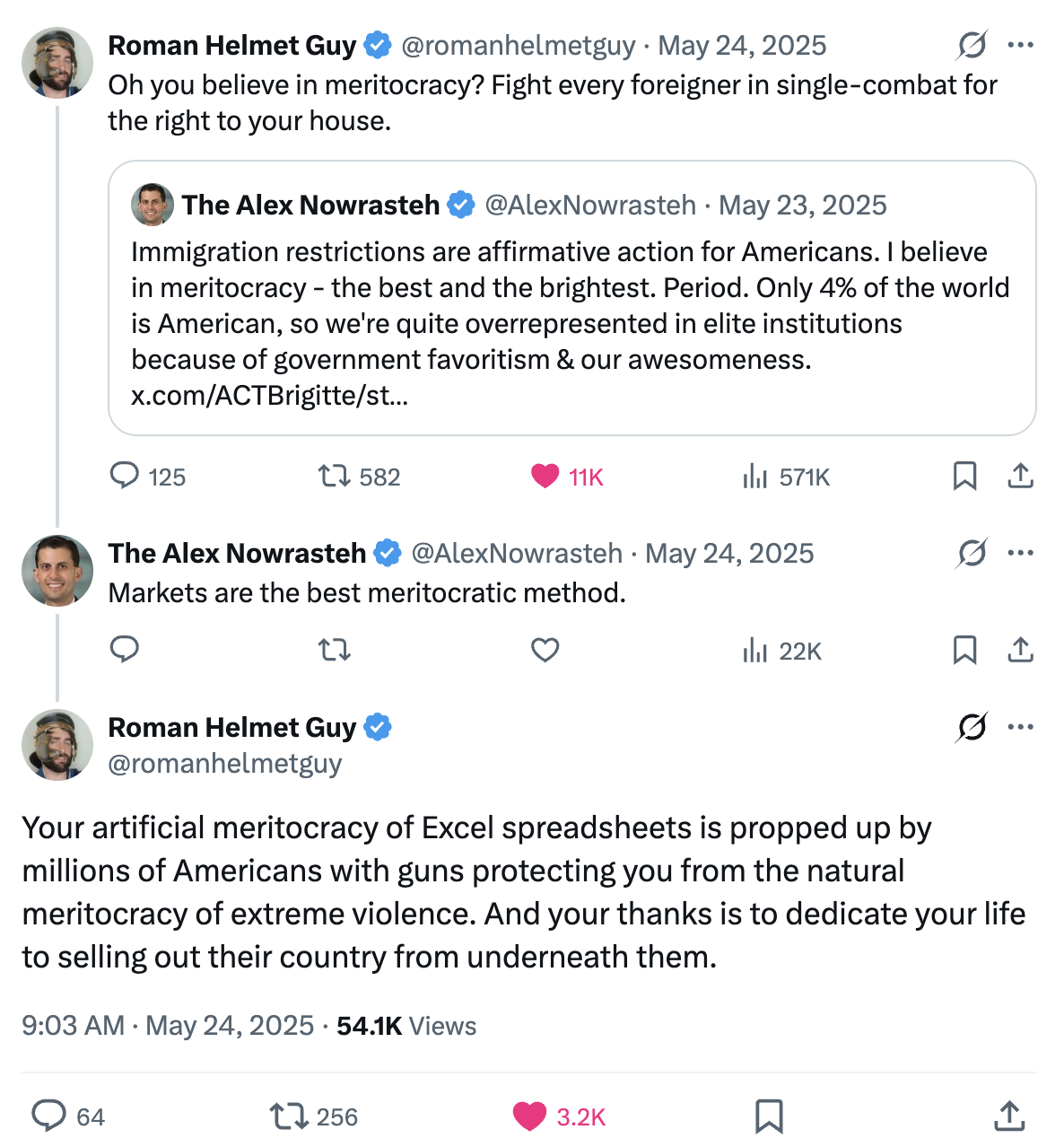
There’s a lot of nuance in the immigration debate here, but the core point about violence is an important one. Civilization is an active protection against the “natural meritocracy of extreme violence.” Every aspect of our nations, laws, standards, and morals have wrapped themselves around us to give us an unfair advantage. Unfair in the sense that, compared to those left naked from the womb to fend for themselves, we start on protective third base.
Another classic line comes from Margin Call in an exceptional monologue:
“It’s just money. It’s made up. Pieces of paper with pictures on it so we don’t have to kill each other just to get something to eat.”
We have hundreds, if not thousands, of years of fighting and bleeding upon which to build a foundation that lets us have any semblance of “meritocracy” atop a floor that has been set for our physical safety. Someone can compete with me in the free market, can even engage in cutthroat competitive dynamics (figuratively speaking), but they CAN’T kill me to get an edge on my lemonade stand.
I’ve written before about a common idea I return to:
“Compare the thinking of John Adams vs. Thomas Jefferson. There’s a lot of meat on the idea so I’ll just summarize it. On the one hand, people will act in their own self-interest and should be left free to do what they want, giving unfettered power to the people (Jefferson). On the other hand, people are riddled with inadequacies and easily swayed by misaligned incentives. They need guard rails, guidance, and systems to ensure people are protected from each other and themselves (Adams).”
This contrast of unfettered human freedom vs. guard rails gets to a fundamental question I think about constantly around human nature. Unfortunately, I think, I fall on the side of people needing guardrails; protections from themselves. “The lesser demons of our nature.”
And lately, it feels like people are increasingly giving into those lesser demons.
At the time of Charlie Kirk’s assassination, I wrote a reflection on the impact that violence had on me. First, there was a quote from Charlie Kirk, himself, that felt representative of what happened to him:
“When people stop talking, really bad stuff starts. When marriages stop talking, divorce happens. When churches stop talking, they fall apart. When nations stop talking, civil war ensues. When you stop having a human connection with someone you disagree with, it becomes a lot easier to want to commit violence against that group. Whether it be the horrible genocides of the last 100 years; people stop talking with each other because they lose their humanity. What we as a culture have to get back to is being able to have a reasonable disagreement where violence is not an option.”
My conclusion was this:
“When you have people declaring that any alternative expression of perspective represents violence akin to actual violence, and merits the return of physical violence? I am not convinced by that argument.“
The rhetoric of violence as an appropriate response to disagreement continues to rage on. Recently, there was a video I saw making the rounds of some “journalists” responding to the murder of Brian Thompson, the UnitedHealth CEO. Here was their position on violence:
“F—k Brian Thompson. “His children are better off without him. They need to learn to not be like their dad. And enjoy the blood money, kids. He’s responsible for more deaths than Osama bin Laden, and I remember Americans celebrating when Osama bin Laden was killed. It’s not like we don’t understand heroic violence, or, like, when violence is good.”
I can feel that protective shell of ensured safety starting to fade. Those people cheering its evaporation appreciate the validation of their violent worldview its disappearance offers.
I don’t mean to frame this as a political evaluation either. It’s not that liberals are suddenly becoming more bloodthirsty. January 6th was also violent. Police brutality, riots, vigilante street justice with backwards baseball caps, firebombing CEOs. Violence, violence, violence. Some of its structural, like more dangerous streets with lenient drug policies. Some of its political, like disagreements, such as the case with Brian Thompson or Charlie Kirk. But, increasingly, I believe it could become a default for many people.
The more we establish a framework for justified violence in the face of disagreement, the more our problems start to look like they fit perfectly into a “violence solves everything” framework. And the next hotbed opportunity for “justified violence?” Anti-technology.
The Artificial Meritocracy of Excel
René Girard’s book, Violence and the Sacred, is a Peter Thiel classic. The TLDR is this framework of “mimetic desire.” I’ll summarize it poorly. He proposes that people don’t want what they want because of “who they are” and the deepest desires of their heart of hearts. We desire what others desire, imitating them as models. This leads to violence because when two people desire the same object through each other, they become rivals and then mirror-image antagonists, locked in escalating reciprocal conflict that spreads contagiously through a community.
The book is dense and filled with sacrificial theory and explorations of why all of religion is framed around this attempt at superseding mimetic desire; temporarily placating the demand for conflict. But let’s focus on this simple ideological flow: desire stems from envy, envy leads to competition, competition leads to violence.
Juxtapose that framework against recent events. Former Google CEO, Eric Schmidt, was giving a commencement address at ASU, and started talking about AI. Unfortunately, he dramatically misread the room and was booed, as one outlet put it, “into oblivion.” Ashlee Vance said this is one of the most confusing things he’s ever seen in tech. How can the rising generation be so angry about AI?
Like any complex social issue, I don’t think it is just one thing. There’s plenty of Chinese (and domestic) misinformation about data centers, water, and energy. You have the unforced error of Sam Altman and Dario Amodei scaring the bejeezus out of everyone they talk to. But more than any of that I think you have Girard’s mimetic desire supercharged by economic, technological, and cultural envy unlike anything any of us have seen in our lifetime.
Millennials own 1/5 the assets of boomers. Millennials and Gen Z are making 20% less in wages than boomers did at the same age. The share of first-time homebuyers has plummeted to 21%; the median home price has risen 400% since 1990. Nine out of ten graduates in 2026 are nervous about AI replacing their job prospects. Entry level jobs have dropped by 15% while the number of applicants to any given job has increased by 30%. Gen Z are now three times more likely to report that the American Dream is out of reach, jumping from 11% in 2017 to 36% in 2024.
While the average young person is watching every social, economic, cultural, and technological opportunity dim, you have the pleebs in San Francisco chittering about the “permanent underclass.” While we in the tech community marvel at the capabilities of the latest AI models, we’re unknowingly surround by a deep cultural resentment of any technical enablement for a critical reason; most people enviously believe they will not be enabled or advantaged by any technological progress. Enter violence-inducing envy.
First They Ignore You, Then They Fight You
Tech, as an industry, was once a playground of outcasts and misfits. They were largely ignored as starry eyed dreamers; hobbyists hoping for a better world.
But today, technology can no longer be relegated to the fringe. It has eaten the world. Congratulations to all who drove forward the unstoppable arc of progress. It has arrived. But, as many before me have pointed out, it is not evenly distributed.
The people who felt immediately inclined at the glimpse of an eye and a click of the thumb to wish me violence for ideating around autonomous vehicles? Those are the people who are very much no longer ignoring us. They are now prepared to fight us. One person’s response to my Waymo tweet was “you need to be attacked.”
Whether we like it or not, technology is poised to be at the top of everyone’s hate list. Supposedly AI is polling at lower approval ratings than Trump or ICE. This, intuitively, makes sense to me because of all the multi-faceted ways it threatens people that I mentioned earlier. And, unfortunately, we have very few general audience charismatic leaders in tech who can turn the tide on sentiment towards technology. So what are we to do?
Humanity’s Violence Formula
I’ve come to the conclusion that I just don’t believe violence will go away. That may be unsurprising. I just wrote a 300+ page book on conflict deterrence. The very first sentence of the book is this: “There have always been people willing to use violence to pursue their interests.”
So instead of trying to fight against those fundamental elements of human nature, I think there is value in reflecting on some of the components behind it and trying to wield them for good, rather than for conflict. Because, while violence is likely unavoidable, I don’t think violence needs to be physical. And it doesn’t need to be weaponized in cultural disagreements.
I tried to think through some elements of the violence formula and what, if anything, we could do to try and redirect that energy in healthier ways, both within ourselves, and those within our circle of influence.
Revenge
I read an essay by Will Sloan on Quentin Tarantino recently that played into some of the themes of justified violence. Tarantino’s films are, obviously, famously violent. But this essay made the point that Tarantino’s personal framework for violence often revolves around revenge.
In 2009, when he was promoting Inglorious Basterds, he made this comment about the Holocaust:
“Holocaust movies always have Jews as victims. We’ve seen that story before. I want to see something different. Let’s see Germans that are scared of Jews. Let’s not have everything build up to a big misery.”
He’s done similar things in other movies, like Django Unchained, where he inverts victimhood into positions of power. Sloan was reminded of this comment when, recently, Tarantino made the comment that the only thing stopping There Will Be Blood from being a near perfect movie is Paul Dano.
“The flaw is Paul Dano. Obviously, it’s supposed to be a two-hander, but it’s also drastically obvious that it’s not a two-hander. [Dano] is weak sauce, man. He is the weak sister… He’s just such a weak, weak, uninteresting guy.”
For those of you who haven’t seen There Will Be Blood, its important to note that the purpose of the two main characters is to contrast cruel strength (Daniel Day-Lewis) and vindictive weakness (Paul Dano). But Tarantino’s comments seem to hold a “contempt for weakness.” Tarantino believes violence can be straightforwardly good when directed at the right targets. Revenge is a fitful framework for why violence is merited; because violence has been done to me. And, rather than being a “weak” victim, violence is the mantle that can be lifted up and leveraged for empowerment.
The same is true of many, many people. “An eye for an eye” is still going strong. Of course, we can have the desire for transcendent civilizational repentance where everyone can seek out a higher law, like Christ saying “turn the other cheek.” Or the line, supposedly from Gandhi, that “an eye for an eye will make the whole world blind.”
But the classic problem is that our solution can’t rely on “if people would just…” because they often won’t. Instead, we have to acknowledge that revenge is a fundamental part of people’s psychology. And in our messaging we should strive to humanize everyone, apply as much mercy as possible, and compromise where possible. In the words of Peggy Carter:
“Compromise where you can. Where you can’t, don’t. Even if everyone is telling you that something wrong is something right. Even if the whole world is telling you to move, it is your duty to plant yourself like a tree, look them in the eye, and say, ‘No. YOU move.’”
On those things that cannot be compromised we must help the victims who would seek revenge understand their own victimhood. If they have been wronged, help them seek rightings without proportional violence. If they haven’t been legitimately wronged, help them avoid the intellectual sinkhole that is unjustified victimhood.
Glory
Robert Fagles describes this idea of violence being a “permanent factor in human life” for more high-brow reasons than just achieving your aims:
“The Iliad accepts violence as a permanent factor in human life and accepts it without sentimentality, for it is just as sentimental to pretend that war does not have its monstrous ugliness as it is to deny that it has its own strange and fatal beauty, a power, which can call out in men resources of endurance, courage and self-sacrifice that peacetime, to our sorrow and loss, can rarely command. Three thousand years have not changed the human condition in this respect; we are still lovers and victims of the will to violence, and so long as we are, Homer will be read as its truest interpreter.”
People want to fight for what they believe in. To demonstrate endurance, courage, self-sacrifice. What we have lost sight of in the US is the mechanized war engine that has become impersonal. Basically post World War II, we’ve lost the moral high ground because our conflicts are rarely out of justice.
But that hunger for pursuit; what Fagles calls a “strange and fatal beauty, a power,” is, I don’t think, necessarily coupled with physical violence. It is connected to pursuit. To striving. People need things to believe in. To fight for. To be grateful that they are pushing forward, and that make them feel they are being tested. The loss of religion, patriotism, communalism, and most other forms of organized commitment have left us as empty shells. Still filled with the hunger, but with no outlet to quench it.
People need to be engaged with missions. You see a lot of this in mission-driven startups; people feel like they’re building towards something. But so many people feel aimless. And the way they quench that uncomfortable thirst for meaning is by identifying an enemy. And if the tech industry doesn’t hold up a mission worth pursuing then we will become the enemy worth attacking.
Goodness
Finally, I want to emphasize that this isn’t meant to be a defeatist formula. “We’re all gonna be violent, so why not bank and cool the masses as best we can with video games and opioids?” That is the furthest from my point. My point is that people have passions; rightfully so. But those passions have been ill-fitted to modern society, both economically and technologically. So those passions need to be acknowledge, addressed, and assuaged.
I think about this Annie Dillard line that Michael Dempsey shared once:
“In the deeps are the violence and terror of which psychology has warned us. But if you ride these monsters deeper down, if you drop with them farther over the world’s rim, you find what our sciences cannot locate or name, the substrate, the ocean or matrix or ether which buoys the rest, which gives goodness its power for good, and evil, its power for evil, the unified field: our complex and inexplicable caring for each other, and for our life together here. This is given. It is not learned.”
Violence is there. But deeper down you find “the substrate…which gives goodness its power for good and evil its power for evil.” We have an intense caring for people that gives us power. The problem is individual caring doesn’t scale. In the words of Jimmy Carr, “you’re a communist with your family, a socialist with your community, but then you get to nation state level and you go, ‘…f*ck those guys.’”
But that doesn’t mean we emphasize the loss of empathy at scale. It means we need to lean into the power of empathy in close proximity. That was Jesus’ point with the parable of the Good Samaritan. When He says “love your neighbor,” the question is “who is your neighbor?” And the answer is everyone.
Cultural Paradox
There is so much nuance in the human experience. Nitya Prakash said, “do you understand the violence it took to become this gentle?” Richard Siken makes the point that “gentleness comes, not from the absence of violence, but despite the abundance of it.” Intense contrast.
Violence exists and should be watched. But it doesn’t need to define us. We don’t need to live in fear. But we also cannot live in ignorance. Hence, the John Adams school of thought when it comes to human nature. It isn’t that people are fundamentally wicked or default evil. But they need guard rails and protections, both against themselves and against others.
But the deeper truths are that humans will tend to have finely developed senses of revenge and glory, but also goodness. How do we maximize the natural tendency towards avoiding the need for revenge, offering capable, worthy outlets for glory, and incentives to maximize goodness?
Technology can, and should, play a role in that higher discussion. Unfortunately, as of right now, we very much are not. We are dramatically more focused on capability over cause. In the famous words of Ian Malcolm, “so preoccupied with whether or not [we] could, [we] didn’t stop to think if [we] should.”
We are not addressing difficult issues with technology. We are developing unnerving capabilities with technology. And then assuming that the unnerving capabilities will work out what to do about the difficult issues. I think, in the same way that we are no longer ignored by society as rebels and outcasts, we can also not afford to disconnect ourselves from negative externalities. We have to start thinking about the interconnection our technology has to the fundamental elements of the human experience. Because if we don’t, violence may be the logical response.