Finding Product-Market Fit as a Venture Firm
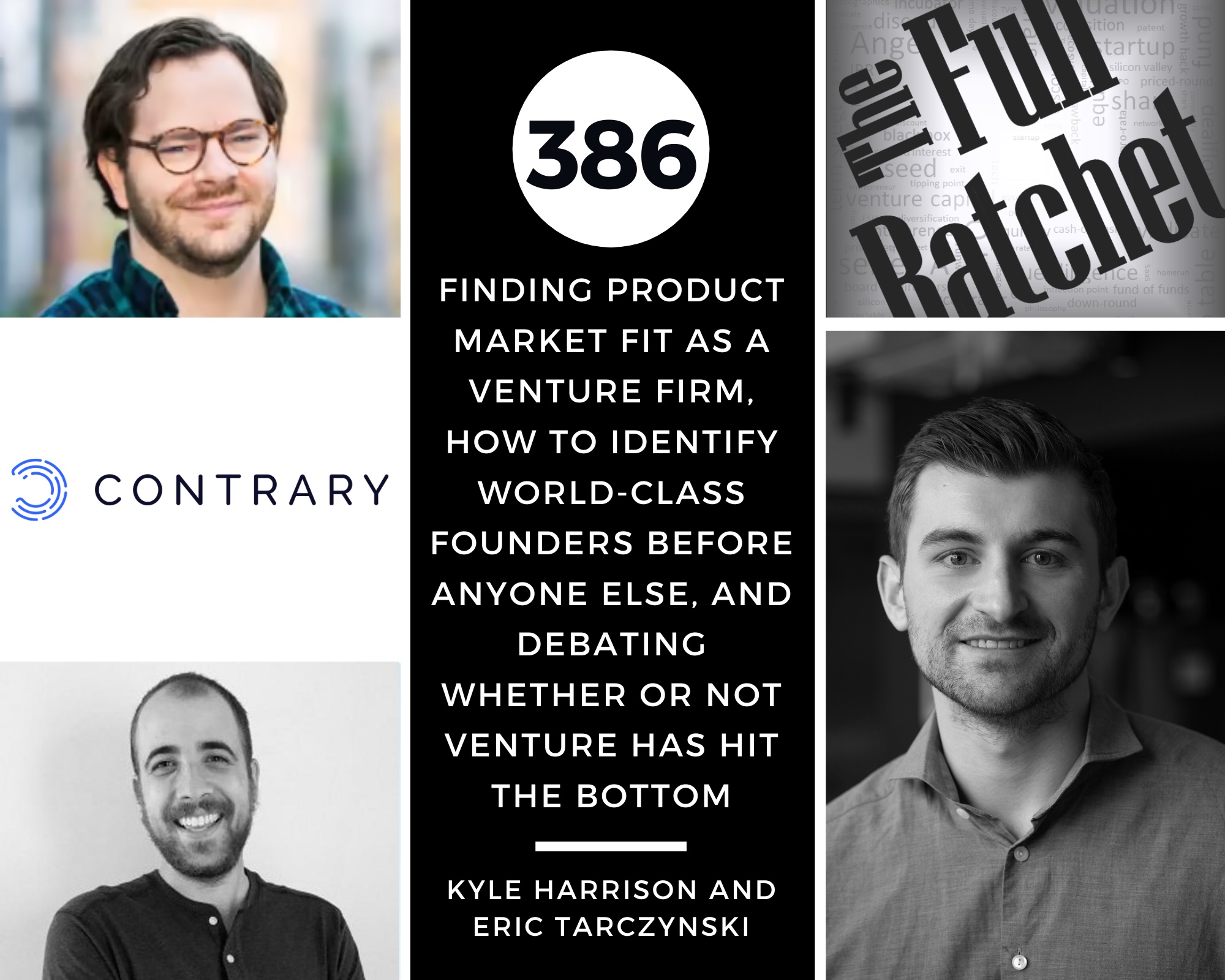 Listen on Apple Podcasts ↗
 Summary
The only appearance in the corpus where Kyle and Eric Tarczynski are interviewed together — episode 386 of The Full Ratchet, hosted for this one by Nate Pierotti of New Stack Ventures (the show is Nick Moran’s), ~44 minutes, released June 5, 2023. Recorded at the very end of March 2023, a few weeks after the SVB collapse and about a year into Kyle’s time at Contrary. The title question runs through the whole conversation: a venture firm is a product, most of them have never found product-market fit, and the ones that “languish in being everything and nothing at the same time” are the ones that will die.
Two origin stories, told in stereo. Eric’s is the founding insight — that “the next chapter of venture would be focused not on the company, but on the person.” The people he’d spent a decade around went on to start unicorns and become GPs, “that success felt largely predictable,” and yet “nobody was actually doing anything in a systematic way to identify and invest in those people.” Venture says it is about people but is really the transaction: waiting for a founder to raise their hand and then “it devolves into this bloodbath.” Go one notch earlier and build a real relationship, and “you could do something really powerful.” Kyle’s is the familiar film-major-to-videographer arc, with a detail this telling adds: he started farming out excess clients for a 2% cut and “eventually I realized I was much better at getting business than I was at making videos.” He ran that company for four years and sold it. The two met when Eric, two weeks into Contrary, cold-emailed the guy teaching an entrepreneurship class at BYU asking who the most entrepreneurial people in Utah were — Kyle introduced him to John Koelliker, who became a Contrary venture partner and, years later, a founder whose first check was Contrary’s. Five years of staying in touch followed before Kyle joined.
Why he left Index, in one phrase: “hurry up and wait.” Kyle’s line on the frustration of classic venture is the cleanest in the corpus — “I like this person, I think they’re really sharp, start a company — whenever you start a company I’m ready to go. But all I can do is invite you to a monthly dinner before that.” What sold him was the Ramp case study: “five of the first 50 employees were Contrary community members, and we were able to invest in the Series B.” That is the talent vortex thesis as a deal, and it is why Contrary broadened past seed. His Goldilocks tour of TCV (“very private equity… almost a value investing approach”, which taught him to swing only for the absolute best companies), Coatue (“very hedge fund… this big idea”) and Index yields a distinction worth keeping: market sizing and product-market fit are muscles, but the constant is the exceptional person — “even in a massive market with perfect product-market fit, a so-so founder is really going to struggle.”
The thesis, in Eric’s words. Contrary is “in the business of identifying the brightest people in the world one notch before the rest of the world recognizes how special they are.” The firm has “more engineers on the team than we do investors.” Sourcing is framed by substitution: friends at Sequoia treat not seeing every company as the cardinal sin, so Contrary treats not seeing every interesting person as theirs, and builds infrastructure — engineering and data science, “the couple hundred scouts,” the talent team, inbound — to see them all. The unit of work is a one-to-one conversation with “Senior Engineer X at Top Company Y” three years into a four-year vest: what’s next, start something or join something, how can we help. “It’s a can’t-lose deal for that individual.” Kyle’s gloss is the product frame: “we are built a lot more like a company than a venture fund,” constantly asking “what products could we build that keep us relevant throughout someone’s career.”
Where Contrary Research came from. Not from marketing. Community members with three or four offers kept asking “what’s the investor’s perspective on those companies?”; the team answered ad hoc, then productized it. Open-sourcing it was the second decision, and the reason is epistemic: “by putting this content out into the world, we allow people to effectively tell us when we’re wrong.” The stated vision — “the best starting place in the world for anybody to understand any private tech company” — is the same line as the March 2023 essay.
Run like a startup; “nothing is too good to be killed.” Eric’s structural claim: most firms are “consensus-based decision-making partnerships,” which is why venture hasn’t changed; their people are “mercenaries,” which is why “venture salaries are generally so above market.” Contrary’s counter-example is the early-COVID Slack community with Steve Huffman of Reddit dropping in — active for a few months, then wound down, because “communities are really, really hard.” Everything is announced to the network as an experiment. The single success test, repeated to the team: “does this, has this, or will this lead to high-quality investments? That’s it.” Kyle adds the operating layer — product roadmaps, three leading indicators per launch, and the flywheel (connect to the best people → offer them products → build a high-quality experience → be their first call). On time allocation, Eric says everyone is “exceptional in their swim lane” and Kyle is “the lone exception” who splits investing and research; Kyle describes “sine waves of involvement” — heavy at launch, then handed to a VP of product, a growth manager and an editor.
“They will, or they will die.” Asked whether other firms will build sub-areas beyond investing, Eric predicts that technology in the stack becomes “table stakes in 10 years,” with a carve-out for sub-$100M funds with a niche. His macro frame: venture is still “10x larger today than it was in 2009,” so the pullback is “a period of higher lows,” not a reset — competition only rises. Kyle’s version is about focus rather than tooling, and it is the thesis of the episode: the firms in trouble “tried to be everything for everyone… it’s this feature creep in venture funds, where you’re doing too much and you’re doing all of it a little bit poorly.” Founders have noticed: “you take the logos off these things and you describe them, and you might not know what you’re describing.” The fix is a defined product — “this is the job to be done that you hire my money for” — and the willingness to say a great company is not a fit. (The same argument, sharpened, is the closing beat of Investing in People, Talent Vortexes, Writing, & Tradition vs Progress four months later.)
The survey that proves it. A friend at a top firm anonymously asked ~90 founders why they took the firm’s money; “85-plus percent said just the brand.” Talent offering? “Not even a little bit.” Events? “Couldn’t care less.” Kyle’s reading: brand value is real, but that result “is a lack of product-market fit… ‘yes, sick, I just want you to stand there and look pretty’ — that is the best example of your product not finding product-market fit that I’ve ever seen.” Contrary’s difference is that the products follow the person, not the company: things built for people four or five years from founding, then for early founders, then for founders with revenue — versus “here’s 200 résumés. Godspeed.” Nate adds the part that “isn’t talked about too often”: at a 100-partner firm the product you get is whichever partner you drew.
Has venture hit the bottom? “We’re going to keep digging.” With Series C counts at post-2008 lows, Kyle’s answer is that the late-stage freeze is the after-image of the spike: every company with meat on the bones raised, and now “1,000-plus unicorns… billion-dollar valuations for single-digit millions of revenue, if revenue at all” are avoiding the market because they cannot grow into the number. Companies pre-empted two or three times can triple burn and still have five years of runway. What comes next is “dramatic down rounds,” structure from firms whose “marketing is very founder-friendly,” pulled term sheets and “exploding term sheets with 12-hour deadlines.” His advice is the pragmatist’s: down rounds “are not the end of the world,” and the partner worth having is the one who helps you through one rather than blocking a raise to protect their own marks. Eric’s macro: 2023 and probably 2024 soft, most LPs “on ice this year,” the multi-stage firms fine with smaller funds, and “emerging managers are going to be crushed.”
Closing. Kyle nominates Amjad Masad as a guest — “in the last few months he’s written probably 30 angel checks,” gut-driven and passion-led (developer tools, AI, education) — and signs off as “kwharrison13 on Twitter, much to my wife’s chagrin.”
Transcript
Episode 386 of The Full Ratchet, ~44 minutes, hosted by Nate Pierotti. Cleaned from the publisher’s AI transcript: ASR errors and names fixed, speaker attribution added, text paragraphed and pure filler dropped — nothing reordered, tightened or summarized. Corrections applied: Contrary (throughout — rendered “country”/“contract”), Coatue, John Koelliker, Ramp, Steve Huffman, Amjad Masad, Replit, SVB, intros, product-market fit.
Introductions
Nate Pierotti: On today’s episode we have Eric Tarczynski, the founder and general partner at Contrary, who’s joined by his colleague Kyle Harrison, who is also a general partner at Contrary. Collectively the two have made investments in Ramp, Zepto and Hallow, among many others. Guys, it’s not too often that we have two guests on the show at the same time, but thank you so much for joining me today.
Eric Tarczynski: Yeah, thanks for having us.
Kyle Harrison: This is gonna be fun.
Nate Pierotti: Awesome. Eric, can you start by giving us a one-to-two-minute background on yourself and how you came to found Contrary?
Eric Tarczynski: Yeah, for sure. Quick background on me: I grew up in New Jersey, went to school in Boston, really found my interest in tech and startups while I was in school — started a payments company there. A few years after that I moved out to SF and was an early employee at a startup that got bought by Lyft. I knew that I wanted to build another company, and I kept coming back to this idea that had been in the back of my mind for several years — this idea that the next chapter of venture would be focused not on the company, but on the person.
I’d spent a lot of time over the past decade or so around a lot of people that were super sharp, ambitious, entrepreneurial — the kind of folks that we thought would inevitably go on and do great things. Fast forward a decade later to today, and that’s exactly what’s happened. They started unicorns, they’re GPs at great venture funds, everything that you would expect. But what was really interesting for us was that when you took a step back, even though that success felt largely predictable to us, nobody was actually doing anything in a systematic way to identify and invest in those people and the companies that they were building.
So we said, okay, we feel like there’s an opportunity here to build a really, really special venture firm off of that insight — of the person before the idea, in many ways. Especially in an industry that might say that they’re focused on people, but oftentimes it’s really the transaction. They’re waiting for a founder to put their hand in the air and say, “hey, I’m raising,” and it devolves into this bloodbath. It’s really a point-in-time, deal-oriented endeavor. But if you go just one notch earlier than that and focus on building a deep, authentic relationship with someone, you could do something really powerful. That was the framework and the bedrock of it, what we built Contrary on top of. We jumped right in, hit the ground running, and the rest is history. And actually, I met Kyle in the very, very early days of the Contrary journey as well — maybe it was two weeks after we started.
Nate Pierotti: Oh really, that early? Well, I’m curious to pick your guys’ brains around the community portion of Contrary in a moment. But Kyle, why don’t you share one to two minutes on your background, how you met Eric — and I know you were at Index prior to joining Contrary, so I’d be curious if you could quickly share what prompted you to take the leap from such a storied firm as Index to join Contrary.
Kyle Harrison: Yeah. So my background: when I got into college, I was a film major. I had every intention of going to Hollywood and making movies, and I was making videos to pay the bills — weddings, commercials, whatever. As I was doing that, it got to the point where I had too many clients, so I just casually started farming them out to other creatives and saying, “hey, can I take 2%, whatever, I got you the job.” Eventually I realized I was much better at getting business than I was at making videos. I was actually never a very good videographer. That quickly became — I found myself running a company. I didn’t even know to call it a startup; I always just referred to it as a project. But I ran that company for about four years and then sold it.
Around the time I sold my company, I was helping teach an entrepreneurship class at BYU in Utah, and that was when I got connected to Eric. He had started Contrary and reached out to basically say, “hey, I’m just trying to connect with the most entrepreneurial young folks in Utah, who do you know?” Funny enough, I introduced him to a friend of ours — a good friend now, John Koelliker — who at the time became a venture partner at Contrary, went on to work at LinkedIn and Uber, went to the GSB, started a company, and we were able to be their first check. So there’s this long history over five, six years of Eric and I staying in touch. We didn’t work together at the beginning, but stayed very close.
And then I had a Goldilocks experience of tasting a lot of different types of investing. I spent a couple of years at TCV and cut my teeth, then spent a little bit of time at Coatue before I joined Index, and for the last few years before Contrary I was a partner at Index. Each of those firms has a very different style of investing: one is very private equity, one is very hedge fund, one is sort of venture classic. So I got a lot of different tastes. But in the back of my mind, even when I was at those firms — and Index is a great firm, I worked with a lot of great people — there was always this feeling that Eric described, which is that venture is, as I like to joke, a hurry up and wait game. You’re like, “I like this person, I think they’re really sharp — start a company! Whenever you start a company, I’m ready to go.” But all I can do is invite you to a monthly dinner before that. There’s not that much I can offer you. I always felt that.
Then when Eric and I caught up once, we were talking about how Contrary was broadening, where it wasn’t just doing pre-seed and seed rounds; they were also investing in Series A, Series B, where even if they weren’t the first check, they were identifying these really exceptional talent vortexes — companies that are attracting exceptional people. Ramp was an example of that. I think five of the first 50 employees were Contrary community members, and we were able to invest in the Series B. When I saw that case study, I thought, man, that is exactly what I want to do: be able to invest in these exceptional pockets of people, especially if we know the people well in advance. That sold me on Contrary. So about a year ago, after five years, Eric finally got me to join, and it’s been killer ever since.
What each firm taught him
Nate Pierotti: I’m curious — we’ll go into Contrary in a moment — but you said Index, Coatue, TCV. Most people know those names, and you’ve alluded to each style being very different across them. What would you say are the principles that you’re taking away from your past experience, having seen success at some of the largest names in VC, and what parts would you say you’re leaving behind?
Kyle Harrison: I think that every firm had a style that is a fit for them. Every firm has a different way of doing things and works in different ways, and that’s fine. I sort of built this framework for myself as I went through each firm. TCV, at least when I was there, had a very private equity mindset — almost a value investing approach to investing in tech companies a lot of the time. And I come back to this idea that if you’re going to do anything, it’s going to cost a lot of time and effort, and there’s a lot of risk around whether or not it’s going to succeed. So you might as well try for a big outcome and try to be the absolute best that you can be. That was one of the things I decided for myself: if I’m going to be investing in companies — there are a lot of interesting businesses out there doing a lot of interesting things — but for me, I wanted to be investing in the absolute best companies that I possibly could. So I evolved where I focus and things like that.
Then Coatue has this very hedge fund mindset, where it’s very much about the big idea — finding this massive market that other people aren’t appreciating and going after that. I learned a lot from that in terms of appreciating what’s going on. But what shaped my perspective as an investor is that those are muscles you can have: thinking about the size of a market, thinking about product-market fit. All of those are muscles that I appreciate getting exposure to, but it ultimately comes back to this idea that you have to invest in an exceptional person. Because I think that even in a massive market with perfect product-market fit, a so-so founder is really going to struggle to take full advantage of that business. So I feel like each of those styles crafted my way of thinking.
The thesis: one notch before the world notices
Nate Pierotti: Got it. And I know Contrary is very focused on the person, and we’ll talk more about the community in a moment. But Eric, can you tell us, just more generally, about the thesis and your investment approach at the firm?
Eric Tarczynski: Yeah, for sure. Really the way we think about it — our entire north star at the firm — is that we think about ourselves as being in the business of identifying the brightest people in the world one notch before the rest of the world recognizes how special they are, and then building the infrastructure that allows us to continue to invest in them and support them for their entire founder journey. And in some cases even beyond as well. Like Kyle said, it can be beyond, or it can sometimes be a couple of years before. We sometimes get to know people one, two, three, four years before they’re even starting something. So it extends on both sides, but ultimately we’re looking to invest in them continuously throughout their journey. That’s conceptually how we think about it.
And then we’ve built our entire firm around being the best in the world at doing just that — identifying those folks one notch before everyone else. So we have an entire engineering and data science team, a talent team, an events team. We have more engineers on the team than we do investors. This is very much the ethos with which we operate the firm, and everything cascades from that — whether it’s the programs that we have, the kinds of people that we’re talking to, the kinds of companies that we invest in. It all stems back from us doing our absolute best to have an unfair advantage with an individual that we think is exceptional.
Now, as Kyle mentioned, the entry point can vary over time. Sometimes we can write that first check and be their largest investor at the seed, let’s say, which we really enjoy doing and do quite a bit of. But if we miss for some reason — obviously, we’re imperfect as well — we still continue to systematically track both individuals and companies across stage. So if we miss at the seed, maybe we get a crack at the A or the B, and actually, over time, build even more conviction in those kinds of companies based off of tracking the talent flows as well. So everything that we do, whether it’s the seed or the A or the B or the C, all stems back to talent as that first pass, and then making a decision from there.
How the talent actually gets found
Nate Pierotti: So how do you guys actually go about identifying the talent? I know technology has evolved — as you said, you have more engineers on staff than investors, and that was something I was going to pick your brain on as well. But how do you find the talent? What is the hook to join the Contrary community? And then what is the recourse to keep them involved?
Eric Tarczynski: Yeah. So look, I think there’s no one silver bullet. On a very high level, the way we think about it — I know from talking with a bunch of friends at Sequoia over the years — is that they think about their cardinal sin as not seeing every company that comes out. They expect to be fallible when it comes to company selection; they expect to not always pick the exact right companies, and all that kind of stuff. But if they’re not seeing all those companies in the first place, they feel like they’re doing something wrong — whether it’s maybe the brand is suffering, or their process is suffering, who knows. That is their north star as a firm.
For us, we can basically substitute companies for people. We want to be building infrastructure that allows us to see essentially everybody — every unique or interesting person in tech — through some way, shape or form within the Contrary infrastructure. Whether that’s our engineering and data science team, whether that’s the couple hundred scouts that we work with, whether that’s our talent team, whether that’s inbound, you name it. There are many, many different prongs that have helped us build that top of funnel. Then ultimately we’re doing our best effort to narrow that down, based off of lots of different criteria — whether it’s recommendations, or what people have to say, or what our software is telling us — and then we’ll go out to those folks individually, quite often, and just get to know them on a one-to-one level.
So you ask the question of, why would somebody do this? Why would they want to be a part of this? The reality is we’re going in and finding Senior Engineer X at Top Company Y, who has been there for three years, maybe they’re on a four-year vest, they know these four other people in our network very well, they’ve worked at these companies that we, as Kyle said, rate very highly as talent vortexes. And we say, hey, let’s get to know you. Tell us about you. You’ve been here for three years — what are you thinking about next? Are you thinking about starting a company? Are you thinking about being an early employee at the next hyper-growth startup? How can we help you? Let’s get to know you. And then we make a decision from there. If they want to start a company, cool, maybe we’ll sit down with them and help them brainstorm, or we’ll connect them to a founder. If they want to go join the next hyper-growth startup, awesome, we’ll make some intros there.
So we’re able to triage based off of their interest level and what they want to do, and also use that as a great opportunity to get to know them on a personal level — and get to know how we feel about them as well: is this the kind of person that we would back with conviction, or not, or whatever it might be. That’s really how it works. From that point of view, it’s a can’t-lose deal for that individual. I think that’s really why folks are excited about it. And then you marry in all the other events and the community and the network — there’s really no downside for the individual.
Kyle Harrison: I’d also say we’ve built a really specific organization. A lot of the time it does feel like we are built a lot more like a company than a venture fund. There are other people doing other things in terms of talent and events and engineering, and what we try to do is identify what, quote, products could we build that keep us relevant throughout someone’s career — whether it’s very early when they’re getting exposed to tech, whether they’re getting their first job, whether they’re going to their first startup, whether they’re starting their own company, and throughout. We’re constantly trying to think about how do we build products to stay relevant.
Contrary Research, and content as a product
Nate Pierotti: Got it. Kyle, is that where Contrary Research came about? Because where I want to segue next is: as you guys are thinking about these products within the venture firm — community being one of them — you then have content, which Contrary Research is a part of, and I know that’s been an effort for you over the past year. I’m curious, is that also part of that same strategy? How do you guys think about content in general fitting into this broader strategic focus that you have for Contrary and cultivating the community?
Kyle Harrison: Yeah, that’s exactly right. And Eric can speak more to this, because he’s really articulated this vision of where are the areas we need to build most effectively. But Contrary Research came out of this idea — originally, it formed because we have this broad community of really talented folks. It’s not often that we are helping them get jobs, per se; we are often just helping them think about things, because they are highly sought-after folks. And so one of the questions we often get is, “hey, I have offers to these three or four companies. I met the people, I liked the people, I’m interested in the product. But what’s the investor’s perspective on those companies? How do I understand this from a different lens?” We would do that ad hoc, but it was like, hey, we can productize this and turn this into a valuable perspective.
And then the reason for open-sourcing it and putting it out into the world is because we can see a lot of companies and know a lot of things, and I’ve worked with a lot of these companies that we’re writing about, but I obviously can’t know every company super well. By putting this content out into the world, we allow people to effectively tell us when we’re wrong — to say, “hey, that’s actually not how I would frame that company,” or “this isn’t the right way to think about their market.” They come back to us with feedback, and so we have that iteration loop where we can build the absolute best content.
Now the vision of Contrary Research as a product is to be the best starting place in the world for anybody to understand any private tech company. That’s the vision that we build towards. That can be helpful to people if they want to join a company, if they want to start a company and potentially compete with some of these businesses, or even partner with some of these businesses, or whatever. Throughout their career, this is a valuable product for them that keeps them engaged with Contrary.
Running a venture firm like a startup — and killing what doesn’t work
Nate Pierotti: Yeah, well, you guys do a great job with it. I always enjoy reading them. I know you’ve been pumping them out, and I would recommend anyone that hasn’t taken a look at Contrary Research definitely do so, because they’re very interesting. So we’ve talked about a lot of the things that you guys have done: community, which is sort of the foundation that Contrary is built upon, and talent. Content seems to be more new over the past year or two. What are some of the ideas that you guys had but didn’t pursue? Is there anything you tested and found just didn’t work well? How do you guys in general go about ideating, creating the MVP, if you will, and then saying, okay, we need to productize this, let’s scale it?
Eric Tarczynski: Yeah, I think the short answer is, for sure. One of the things that really makes Contrary unique is that we run Contrary like a startup. I think the vast, vast majority of venture firms do not operate that way, to put it lightly. They operate as what I’ll call consensus-based decision-making partnerships. People ask why venture hasn’t changed all that much, and I think that is a large component of the equation.
With us, as I mentioned, we have an entire engineering and data science team, a designer, a director of product, a talent team, an events team, writers, an investment team. All of these folks are working together as one. And I think this is why, number one, we’ve been able to hire great folks like Kyle and others — our team is filled with people from a bunch of the top venture firms in the world. But also, there’s real purpose, there’s real mission there. In a traditional venture firm, for the most part, people are just mercenaries. It’s why venture salaries are generally so above market: there’s no other motivating factor other than “let me just pay a lot of money.” At Contrary, we all understand that we are building a really special, unique firm together that does lots of different things at the same time as we’re making high-quality investments. We’re doing things like research, we have the community network, we have all of these things. So the energy feels like that of a startup.
To answer your question around what are some of the things that haven’t worked out — generally, they tend to be around what I’ll call the programs front. For example, we had an initiative that we launched during the early days of COVID. It was an online, Slack-based community network. We brought in cool speakers — we had Steve Huffman from Reddit drop by — and people did co-working groups together. This is in the very early days of the pandemic, probably three years ago now. It lasted and was pretty active, I’d say, for a few months. But over time — communities are really, really hard. Having something that lasts in perpetuity, where people’s energy and engagement levels stay very high for a multi-month period of time, can be challenging if we as a team aren’t investing a lot of our own time and effort and energy into intensive maintenance. So we made the decision to wind that down after a couple of months and move on.
We communicate everything to our network and our broader community as an experiment. Nothing is too good to be killed, essentially. Knowing that from day one gives everyone a certain degree of comfort. Sure, if you invested a lot of time and effort and energy into something, can it be bittersweet? Can it be frustrating if at times it might not work out? Of course. But by the same token, we also embrace the failure, and are constantly reallocating our resources to things that are working. Research is a great example of that. You spend six months working on research, you launch it, you see what happens. If it works, great — you pour a lot more time, effort, energy and resources into it and keep it going. If it doesn’t, you pull the plug and you move on. That’s it. You embrace that kind of culture. That’s how we operate as a firm, and I think most folks would take probably years to make a similar decision as to whether or not they should.
Nate Pierotti: Yeah. And do you guys actually define what success looks like for a particular initiative? So for example, if you’re launching Contrary Research, is it as discrete as saying, “hey, if we get a few deals from this,” or “if we have website traffic go from 10,000 visitors per month to 50,000 over six months — this is success”? How do you actually make the decision: we want to double down on this, or, you know, it was a fun experiment, we tried, but let’s move on to something else?
Eric Tarczynski: Yeah, I was gonna say, I think the short answer is yes. At the end of the day, I remind the team very often that everything that we are doing needs to tie back to one unifying thing, which is: does this, has this, or will this lead to high-quality investments? That’s it. That’s the only thing that matters. That could be research, that could be talent, that could be any of the programs, that could be anything that we’re doing. It all needs to tie back to that, because at the end of the day, we are a venture capital firm. At the end of the day, we are focused on investing in the best companies in the world, full stop. So there needs to be a tie back to that with everything that we do. I don’t know, Kyle, if you’re gonna mention anything there — but yeah, that’s how we think about it.
Kyle Harrison: Yeah, I think it’s another piece of evidence in terms of us running this very much like a startup. There’s the global view of “this needs to allow us to invest in the best companies,” but it’s like, okay, how do you get from A to Z? How do you get from A to B to C? We have very specific product roadmaps that we lay out, that we get feedback on, that we go test. We think, okay, if we launch with a little bit of this, how do we make sure that that’s successful? And what are the three things that we’re measuring that are the most likely indicators of this leading to enabling us to invest in great companies down the road?
We think about it as this big Contrary flywheel, where everything we want to feed: is this connecting us to the best people? And if we get connected to those people, do we have other products that we can offer them to bring them into the community? And if we bring them into the community, are we building a high-quality experience? And if there’s a high-quality experience, then hopefully we’ll be their first call when they raise money, when they start a company. We’re constantly trying to think about the long game of how do we increase the number of positive touch points we have with people. That’s success in the micro.
How investors at Contrary spend their time
Nate Pierotti: Yeah. Personally for you guys — how much time are you spending per week on some of these other areas outside of new investments, versus the content or the community, from just an investor standpoint? Eric, you mentioned most firms are not doing this stuff. They’re solely doing investments, or they’re consensus-based, and that’s the same model that’s rinsed and repeated for 90% of firms. For you guys, taking on so many different areas within the firm, how do you allocate your time? And generally, how do investors allocate their time in terms of what percentage is focused on investments versus some of these other areas?
Eric Tarczynski: Yeah, I think the good news is we’ve built a team. Everyone is exceptional in their swim lane. Kyle, frankly, might be the lone exception here on the team, where he spends definitely most of his time — the vast majority of his time — investing, but a little bit on research as well. But I think that’s only because it’s very complementary to the work that he’s doing. For really everybody else on the team: if you’re our designer, Ryan, you’re spending all your time designing. If you’re Jason and Will on the early-stage team, you’re spending essentially all of your time going out and meeting with early-stage founders. If you’re our talent team, you’re spending all of your time talking to folks that we should be engaging in our broader network. Even for me, I spend quite a bit of my time investing still, and working with our founders. I think there’s a fair question around ensuring that you are not being pulled in too many different directions. But the reality is we’ve built a team at this point to enable us to do the things that we were hired to do, essentially.
Kyle Harrison: Just in terms of — take research as an example — there are these sine waves of involvement, because we are effectively going through product launches. I was super involved in framing what is research, and why are we doing it, and what are our standards, and things like that. But then we have a great VP of product who has built the website and thinks about all our tracking, and a growth manager who helps us think about how we get distribution, and an editor who makes sure that our content is exceptional. So to Eric’s point, that’s an example where I was very involved, but it’s because then I have a team that can come in and support the thing we’ve launched. And then I can use it as it supports my investing ability. It’s not that I have this side job that’s totally unrelated to what I’m doing. It very much works hand in hand with going and working with companies.
Will venture firms have to change — or die?
Nate Pierotti: Yeah, makes a lot of sense. More broadly, do you guys think over the next couple of years more venture firms are going to go this route and adopt sub-areas within the firm outside of solely making investments? How do you see venture capital changing over the next couple of years?
Eric Tarczynski: I think they will, or they will die. Look, I think venture didn’t change much for its first 50 years or so, until probably 2016, 2017, around the time when Contrary started. Some of the manifestations, some of the changes, are peak-bull-market kinds of things — everybody and their brother raising a fund while they were being the CEO of a startup full-time. Those kinds of manifestations are kind of wild, and I think you’re already seeing most of those dial back. But I still think there are some structural changes to venture writ large as an industry.
The short answer is we fully expect, for example, over the next decade, technology to become a pretty important part of the stack of any venture firm. Today there are relatively few firms doing something like that — I can probably count them on one hand. But our view is that that will be table stakes in 10 years, and if you don’t have it, you’re probably toast. Now, I think there’s a case that sub-$100 million funds can continue to operate off of the old model — if you have a particular niche, if you’re not always focused on leading rounds. Of course there’ll be room for folks that have smaller funds to do things the more traditional way, let’s say. But once you get over that — once you try to start building, if your goal is to build an institutional-grade venture firm — you’re just going to have to play ball. Because the reality is the bar and the level of competition rise every single day in venture. Including right now, when we’re in the trough of the worst pullback we’ve seen in 10 or 15 years, venture is still 10x larger today than it was in 2009. So this isn’t — we’re going to have this period of higher lows, basically, but venture as an asset class is just going to continue to get more competitive. If you want to stay relevant, if you want to win deals, if you want to compete, you’re just going to have to have these kinds of things.
Which firms are most at risk of disappearing
Nate Pierotti: Kyle, what firms, from your perspective, do you think are the most at risk of disappearing?
Kyle Harrison: Yeah. I mean, I think the reality is — and I mentioned this a little bit in terms of some of the firms that I’ve worked with — every firm has a very different style. The framework that I use to think about it, because I’ve done a lot of this in my writing on my blog, is thinking about the business of venture capital and different approaches to it. We have a very specific model and a very specific product that we offer people. And I think the thing that got a lot of people in trouble is that they tried to be everything for everyone: we have a fund for every stage and sector, we have specialists, we have a million people doing talent things, we have all these different pieces — there’s not a company out there that we won’t be the perfect fit for. I think that’s a mistake, because it’s this feature creep in venture funds, where you’re doing too much, and you’re doing all of it a little bit poorly.
The framework is not “every venture fund is going to have to become Contrary or they’re going to die.” I think our product is unique, and we’re pretty good at recognizing, hey, this is not a good fit for us. There are certain companies — they might be great companies, they might be great ways to make money and generate returns — but they don’t fall within this defined parameter that we’ve crafted our product around. And I don’t think that product has to be what everybody else does. But I think that other venture funds have to justify their existence more than they ever have before. Because it used to just be like, hey, if you have some capital, go nuts, whatever — you can probably get into some decent deals, and things are going up and to the right. That’s not necessarily true anymore. In part because times are harder and leaner and more companies are going to struggle, and you have to fight tooth and nail. But also, I think that founders have become much more conscientious of the fact that all these venture funds look and sound identical. You take the logos off these things and you describe them, and you might not know what you’re describing.
I think more venture funds are going to have to lean into having a very specific, defined product, where they can say, “hey, this is the job to be done that you hire my money for. If you need that job, great, I’m a good fit for that. If you don’t, that’s okay — we’ll go find the folks that are a good fit for us.” But it’s these people who languish in “we’re everything and nothing, all at the same time” — those are the people that I think are going to die.
”Just the brand”: the survey
Nate Pierotti: That’s why we love asking founders how they differentiate their companies — and then they ask the same of us, and we largely say our brand.
Kyle Harrison: [Off-mic interruption.] Sorry about that.
Nate Pierotti: That’s fine. Anything worth sharing on that end?
Kyle Harrison: Yeah, I do have a good story about this. A friend of mine did this survey where they — a top firm — went and talked to all their founders, basically trying to answer this question of: how do we differentiate? Do other people see us as different? They did this pre-emptive “here’s what we think is different about us” — all these different things, like, “people take our money because of this thing that we’ve done, and this thing we’ve built, and blah, blah, blah.” And he went and surveyed, I think, 90 different people, asking the question, “why did you decide to take our money?” It was totally anonymous, so nobody had to worry about blowback or anything, and they could say something very honest. And I think 85-plus percent said: just the brand. “We just wanted to attach this brand to our name. We don’t care.” “Would you care about our talent offering?” Not even a little bit. “Do you care about these events that we put on?” Couldn’t care less. It was 100% “we just wanted the brand” — that halo effect.
And there’s a reality — that’s true. There is value in that. Companies see the value of having this big brand, and it helps with customers and partners and all this stuff. But what that is indicative of, in this future state that we’re talking about, is a lack of product-market fit. When it’s like, “hey, we’re doing all these things for you,” you’re exerting all this effort and energy on all these things, and they’re like, “yes, sick — I just want you to stand there and look pretty.” That is the best example of your product not finding product-market fit that I’ve ever seen. And that’s the kind of stuff that venture funds are going to have to fix.
Nate Pierotti: Yeah. It’s interesting too, because if you want the brand, there’s a derivative reason, right? To your point — you said it helps with partnerships, helps with customers, helps with talent. But if you can fill in some of those other gaps, do you think that is the path to finding product-market fit for some of these firms?
Kyle Harrison: I think that’s right. And it’s less about balking at brand in general. We certainly work to build our brand, because if nobody’s ever heard of you, it doesn’t matter if you have the absolute greatest product in the world — they’ve never heard of you, so they’re not going to come ask you for that great product. So brand is certainly important. I think it’s the conversion. If you go talk to a lot of founders — again, you have to do this in a very safe, anonymized, very friendly way, because nobody wants to piss off the people that are giving them money — but if you go ask them very honestly, “how has it been working with so-and-so?” it’s like, “oh, it’s fine.” And there’s probably a lot of after-the-fact disappointment: “I actually thought that the product would be good. The brand was great, and that’s one of the reasons I maybe made the decision. But I thought that all these things would be really meaningful in my business, and they just haven’t been.”
The way that we take that — because it’s also difficult to build a product. Companies are different, they need a lot of things, it’s very hard to build a business. I think one of the reasons that Contrary is unique in that regard, even among people who do build products for specific companies, is that we’re not just focused on the company itself. We are focused on the relationship with that person throughout their life. To Eric’s point, there are people that we have built products for who are four or five years away from building a company. We’re doing specific things with them to help them be more prepared to be a founder. And then when they become a founder, great — we have specific products for people who are in the early days of that founder journey. And then, great, they’ve built customers, they’re generating revenue, awesome — we’re building products for those people too. That is very different than the people who say, “I don’t know, people need talent — here’s 200 résumés. Godspeed, hope that works out.” That’s not a good product. That’s an afterthought.
Eric Tarczynski: Yeah. I think there’s a lot of buyer’s remorse.
Nate Pierotti: We see the same in our portfolio too. From the outside looking in, the name is great. A lot of times you speak directly and you get it from the horse’s mouth, and it doesn’t live up at times. It’s also interesting because some of these firms have just gotten so large, with 100-plus investors, and — I’m not going to name names — partnering with the large firm that has 100 partners is very different based off of the partner that you’re ultimately working with. So that influences the product that you ultimately receive from the firm that you’re backed by. That’s not talked about too often.
Has venture hit the bottom?
Nate Pierotti: I do want to switch gears prior to wrapping up, though. I’m curious to get your perspective. We just reached the end of March, and I think we’ve seen the fewest Series Cs since the ‘08 financial crisis. We did a data pull the other day — I believe it was 44 Series Cs across the US — the lowest count that we’ve seen. I’m curious, from your guys’ perspective, have we reached the bottom yet? As you look at Q2, what do you forecast just in terms of the broader ecosystem and the fundraising environment?
Eric Tarczynski: Kyle first, and then I’ll give more of the macro thoughts.
Kyle Harrison: Yeah. Within specific rounds in particular, I think that unfortunately — if we’ve hit a bottom, we’re going to keep digging into the negative. One of the reasons you’ve seen such low activity at the later stages is because there was such a spike: basically every company that had any meaningful meat on the bones that could raise a later-stage round effectively did. And so you have — look at the numbers — 1,000-plus unicorns, and a huge chunk of those businesses were billion-dollar valuations for single-digit millions of revenue, if revenue at all. So many of those companies are desperately trying to avoid having to raise a down round, knowing that if they do go out to raise, there’s no way they’re going to get anywhere close to the valuation they got. And in many instances they got pre-empted two or three times. So we’ve seen companies that — even if they tripled their burn — have five-plus years of runway, because they have hundreds of millions of dollars in the bank, and they’re still fairly tiny.
You have a wide variety of different companies, but none of those companies want to go back out to raise unless they absolutely have to, because they know that there’s going to be that markdown. And I guarantee you that a lot of those companies are not going to be able to grow into their valuation, to grow fast enough to get out of this negative correction. So you’re going to see a lot of stuff where — we’re going to start to see more rounds, but you’re going to start to see dramatic down rounds. And I’m already hearing about firms, even top firms whose marketing is very founder-friendly, where it’s just filled with structure on the round. You’re going to start to see a lot of bad behavior. Term sheets get pulled. We’ve seen exploding term sheets with 12-hour deadlines. Just really awful behavior, because VCs see themselves as having the power, and founders see themselves as desperate. That’s a really crappy situation to put people in.
I think the focus for a lot of founders who are in that situation should very much be managing expectations. Down rounds are not the end of the world. There is a way to come back from these massive valuations. It’s very uncomfortable, it can be really bad for morale, but there are ways to do that. It’s great, in this instance, to have a partner who will help you through that, rather than just desperately trying to keep you from raising another round because they don’t want to have to mark down their own portfolio. You should be much more pragmatic and realistic about the situation you’re in.
Eric Tarczynski: Yeah. On a broader macro point of view, our view is that really this year and into next year is going to be quite challenging for folks. Pre-SVB, our view was that, in some ways, we might already be having the worst behind us — oftentimes official declarations of recession, for example, are lagging indicators. So yes, the rest of this year was going to be soft, but for the most part people were taking half of last year and all of this year to recalibrate, get their ducks in a row, figure out their path ahead, and slowly and surely start building comfort in slowly deploying capital. Are we getting back to 2021 next year? Obviously not. But the pace would at least increase a little bit. Now our view is that next year will probably be relatively soft as well. That’s what happens when you have a 15-year bull market, like we had since 2009.
And there’s an entirely separate conversation, probably, that could be had around how this affects managers from an LP point of view. The vast majority of LPs that I know are on ice this year, for example. Those that I’ve talked to have expressed hope or desire to get back to more of a semblance of normalcy next year, early next year, the first half of next year. But the ripple effects of that are going to be tremendous as well. The Andreessens of the world and the top multi-stage firms will of course be fine, though even they might have smaller fund sizes. But I think emerging managers are going to be crushed in this kind of environment, which is really unfortunate. But that’s just how the LP cookie crumbles.
Wrap-up
Nate Pierotti: Kyle, if we could feature anyone on the show, who should we interview, and what topic would you like to hear them speak about?
Kyle Harrison: I think it’d be great to see you guys interview Amjad Masad, who’s the CEO of Replit. Replit is a portfolio company, but just from an investment perspective — I was hanging out with him again yesterday at this conference, and he was telling me that just in the last few months he’s written probably 30 angel checks. Still just super, super active as an angel. And it’s kind of interesting, because his approach is a little bit spray-and-pray, where he trusts his gut, and he is really focused on working with people who are building in areas that he’s really passionate about. So obviously developer tools and AI, but also education — we’re co-investors in another company with him, an ed-tech company. He’s just a super thoughtful investor to have, and I would love to see him on the show.
Nate Pierotti: Awesome, cool. Hopefully we can get him. And last, what is the best way for listeners to connect with you guys, and with Contrary?
Kyle Harrison: So for me — kwharrison13 on Twitter. Much to my wife’s chagrin, I’m probably too active on Twitter, so that’s a great place. And then contrary.com — we’ve got a lot of ways to work with us and get engaged with us.
Eric Tarczynski: Great. Yeah, I think probably the best place is Twitter. A lot of the team’s pretty active on there — Kyle more so than me — but I do my best as well.
Nate Pierotti: Awesome. Well, guys, appreciate having both of you on today. Again, it’s rare that we have two general partners, but appreciate it, and hopefully we can do it again sometime.
Kyle Harrison: Thanks, Nate. Yeah, this was fun. Thanks.
Nate Pierotti: All right, that’ll wrap up today’s interview. If you enjoyed the episode or a previous one, let the guests know about it. Share your thoughts on social or shoot them an email; let them know what particularly resonated with you. I can’t tell you how much I appreciate that some of the smartest folks in venture are willing to take the time and share their insights with us. If you feel the same, a compliment goes a long way. Okay, that’s a wrap for today. Until next time, remember to over-prepare, choose carefully, and invest confidently. Thanks so much for listening.
Connections
The show and the people
- Nate Pierotti — hosts this episode of The Full Ratchet (Nick Moran’s show, out of New Stack Ventures). He closes with the observation that at a 100-partner firm “the product you receive” depends on which partner you draw.
- Eric Tarczynski — the only recorded conversation where he and Kyle are interviewed side by side. His founding framing (person before the idea, one notch before the world notices) is the spine of the first half; his macro read (higher lows, LPs on ice, emerging managers crushed) is the second.
- John Koelliker — the friend Kyle introduced to Eric in Contrary’s first weeks, who became a venture partner, went to LinkedIn, Uber and the GSB, and then founded Leland, where Contrary was the first check. The corpus’s Leland investor updates are the other side of that story.
- Amjad Masad — Kyle’s guest nomination; ~30 angel checks in a few months, gut-driven and passion-led. Kyle has called him “an absolute oracle” as an angel before (20VC, October 2022).
The firm
- Contrary · Contrary Research — the fullest joint articulation of the model: talent as the first pass at every stage, more engineers than investors, products for each phase of a person’s career, research as a productized answer to community members’ “what’s the investor’s view?” question.
- Contrary — My Renegade of Choice (May 2022) — the essay version of Kyle’s move from Index, written a year before this recording. The Ramp “secret hiring weapon” quote and “product offerings for different phases of their career” are the same argument.
- Contrary Flywheel · Contrary Product Road Map — the internal framings Kyle captured in 2022 calls; here he describes them out loud (roadmaps, three leading indicators per launch, connect → offer → experience → first call).
- Talent Vortex · The Talent Vortex — Mafias and Magnets — the Ramp case (five of the first fifty) that sold Kyle on Contrary is the thesis applied to a Series B.
- Open-Source Knowledge (September 2022) · Contrary Research (Essay) (March 2023) — the launch and 100th-memo essays; the “best starting place in the world to understand any private tech company” line is verbatim across all three.
- Ramp · Zepto · Hallow · Replit · Leland — portfolio companies named.
- TCV · Coatue · Index Ventures — the Goldilocks tour, with the private-equity / hedge-fund / venture-classic labels that recur in every later retelling.
- Sequoia — the “cardinal sin is not seeing every company” framing that Contrary inverts into not seeing every person.
Ideas
- Product-Market Fit — the episode’s title claim: a venture firm is a product, and “just the brand” is what a product with no PMF looks like.
- Brand · The Unbundling of Venture Capital — the 90-founder survey (85%+ took the money for the brand alone) is the best single datapoint in the corpus for the brand-vs-product argument.
- Jobs To Be Done — “this is the job to be done that you hire my money for.” Restated four months later on Investing in People, Talent Vortexes, Writing, & Tradition vs Progress as every venture firm should have to justify its own existence.
- The Productization of Venture Capital (January 2022) · Why Most VCs Suck At Talent (March 2022) — the “200 résumés, Godspeed” line is the talent-as-afterthought critique from those essays, spoken.
- Let Me Know How I Can Be Helpful (April 2023) · You Don’t Want My Value Add (October 2023) — the founder “buyer’s remorse” Kyle and Nate describe is the subject of both.
- The Death of a Venture Fund (May 2022) · Revisiting The Death of a Venture Fund (December 2023) — “feature creep in venture funds” and firms that are “everything and nothing” are the causes of death he’d already written up; the December revisit measures the mortality.
- Is Now a Bad Time To Be a VC (June 2022) · Dreaming Of Dry Powder (February 2023) · Building an Actual Unicorn (April 2023) — the down-cycle argument: cash-rich, valuation-heavy companies with no path to their number, and the myth of oncoming capital.
- Down Rounds — “not the end of the world,” and the test of a partner is whether they help you through one.
- Emerging Managers — Eric’s read that they will be “crushed” while multi-stage firms shrink but survive.
- VC Contagion — published two days before this episode aired; the “hunger” framing is the essay counterpart to the exploding-term-sheet bad behaviour described here.
- Silicon Valley Bank — the macro pivot point; Eric dates his pre- and post-SVB views.
Other appearances that cover the same ground
- Venture Capital, Mormonism, and Driving Your Own Life (March 2024) — the same origin story and the same exit-reasons for TCV/Coatue/Index, in more detail.
- Investing in People, Talent Vortexes, Writing, & Tradition vs Progress (October 2023) — the “hire your money” argument, sharpened.
- 20VC: Why 75% of Active Investors Will Disappear (October 2022) — the firms-that-will-die thesis, one recording earlier.
- Contrary GP on Talent & Research-Driven Investing (October 2024) · Investing in People Years Before They Start Companies (July 2026) — later solo tellings of the model Eric lays out here.
- VC Contagion: Is Venture Capital Killing Itself? (May 2023) — recorded in the same window, on the same cycle.