Product-Market Fit
Product-Market Fit
The recurring definition across Kyle’s sources frames product-market fit as more than a great product — it is the fit between product, distribution, and customer. Product Led Growth (PLG) states it directly: “There are three elements to product-market fit: the product, distribution and customers… achieved when you have a product with a clear value proposition that resonates with customers whom you know how to reach and convert.” The same book’s practical corollary recurs in Kyle’s highlights: don’t hire too senior a first salesperson, because “early sales is about finding and refining product-market fit rather than closing as many deals as possible.”
Playing To Win grounds the concept in consumer-needs-first product design — building “only what they need” (the white-sheet diaper) rather than piling on bells and whistles, with resonance with the customer as the win condition. Todd McKinnon — Creating and Defining a New Market Category adds the timing dimension: “You have to thread the needle between building something before everyone else knows it’s obviously needed, but… not so early that it kind of falls on a world that doesn’t need it.” Okta sold cloud security/identity — the later-adopted layers of cloud — so its market took until ~2012 to catch up, tying PMF tightly to Timing. Kyle’s Historical Futurism - Research reframes the same idea as “hype vs. product/market fit”: how good is the thing at actually doing the job (the fax machine appears in Back to the Future but was never that good at the job).
Kyle also diagnoses PMF through the lens of capital efficiency. The framing comes from The Burn Multiple (David Sacks) and the Burn Multiple concept page: a low burn multiple suggests “the market is pulling product out of the startup,” while a high multiple suggests “the startup is pushing product onto the market.” On Kyle’s pages the Burn Multiple is explicitly “a proxy for product-market fit” — the cleanest quantitative tell that a startup has it. Sacks’s tactical corollary: keeping early salaries and expenses low “strengthens [the] PMF signal for fundraising.” PMF also sits upstream of Capital Efficiency in Kyle’s investing cluster — fit is the condition that lets a business convert capital into revenue efficiently in the first place.
Context: “Product-market fit,” a term popularized by Marc Andreessen, describes the point at which a startup has built something a market genuinely wants — typically felt as demand outrunning the team’s ability to serve it. It is widely treated as the single most important early-stage milestone.
Saved LinkedIn posts
-
Jyoti Bansal on LinkedIn (Jun 13, 2022): “How not to build a startup”. Lack of product/market fit is one of the top reasons startups fail; make sure the market is large and growing first, then build the best product in it. Illustrated with a Tom Fishburne (Marketoonist) cartoon:
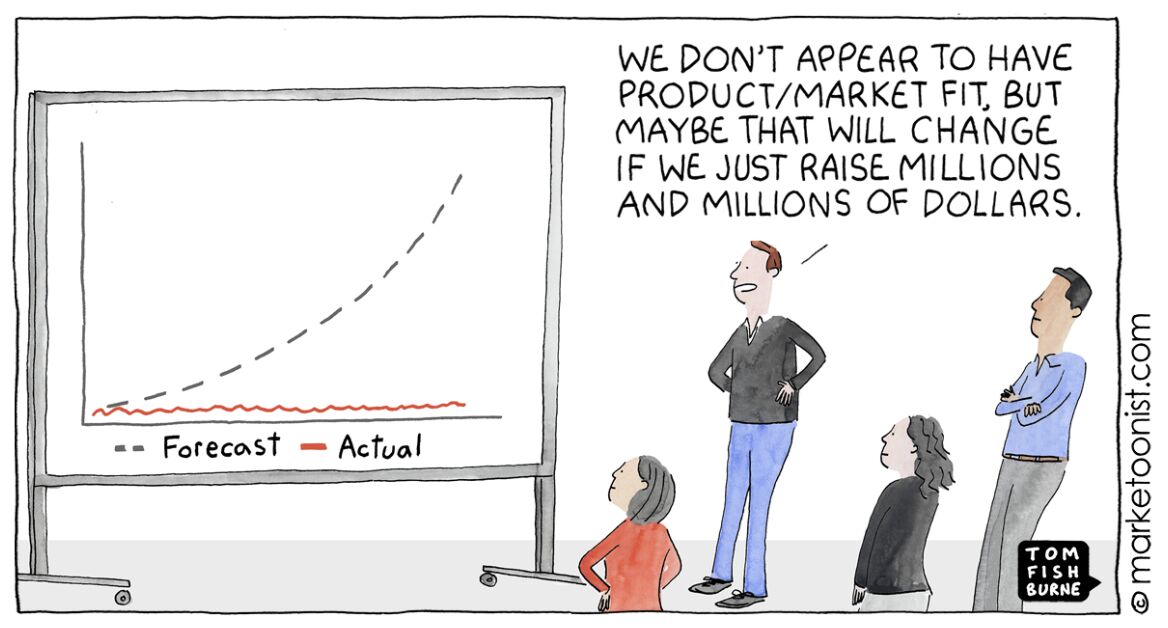
Cartoon © marketoonist.com, saved 2026-10-03. (Read 2026-10-02 in Kyle’s LinkedIn session; summarised, not copied.)
Where this appears
- Playing To Win — building “only what they need” over feature bloat; consumer-needs-first as the win condition.
- Product Led Growth (PLG) — the three-element definition (product + distribution + customers); early sales as PMF-refining, not closing.
- Todd McKinnon — Creating and Defining a New Market Category — threading the timing needle; Okta’s cloud-security market took years to catch up.
- Historical Futurism - Research — recast as “hype vs. product/market fit” — how good is the thing at actually doing the job.
- The Burn Multiple — PMF diagnosed as market-pull (low multiple) vs. product-push (high multiple); low early burn as a PMF signal.
- Burn Multiple — the metric defined as “a proxy for product-market fit.”
- Capital Efficiency — PMF as the upstream condition for converting capital into revenue efficiently.
Referenced in
- 3 Mistakes (and Lessons) Building a Digital Health Company note
- A.G. Lafley note
- Capital Efficiency note
- Figma - Worth the Hype- Absolutely note
- Finding Product-Market Fit as a Venture Firm note
- Nail It Then Scale It book
- Playing To Win book
- Product Led Growth: The End User Era book
- The Burn Multiple note
- The Hierarchy of Engagement, Expanded (Sarah Tavel) note
- The Most Important Growth Metric for Early Startups note
- Timing note
- Your Fund Size Is Your Strategy note