Zoom's Meteoric Rise
| Author | Jake Singer |
|---|---|
| Published | September 4, 2020 |
| Format | Article |
| Original | Read the original |
Zoom’s Meteoric Rise
The second issue of The Flywheel, written days after Zoom’s first full pandemic quarter, when revenue grew 355% year on year and the stock jumped almost 40% in a day.
Summary
Singer asks how Zoom, in an already crowded market, became the default video tool. His answer starts with two unglamorous facts. The product “just works,” which he traces to Eric Yuan spending years on video conferencing at Webex before founding Zoom, against competitors for whom video was a side project. And it needs no download or account, which he calls “the lubricant on the flywheel.”
He then describes two interlocking flywheels, borrowing Max Olson’s typology of flywheel types. In the network-effects loop, every call is a free product demo, so more successful calls bring more users and more calls. In the proprietary-tech loop, more users surface more edge cases, and the cash funds infrastructure and new use cases like webinars, which produce more successful calls.
Each loop has a weakness. Users won cheaply could leave cheaply if the form of video calling changes in a way Zoom cannot build for, and video quality may eventually become good enough everywhere, after which Zoom could lose users to inertia because Microsoft and Google own the email and calendar where meetings begin. His remedies are a real developer ecosystem, so that startups like Miro build inside Zoom rather than against it, and distribution of its own, ideally by acquiring or merging with Slack.
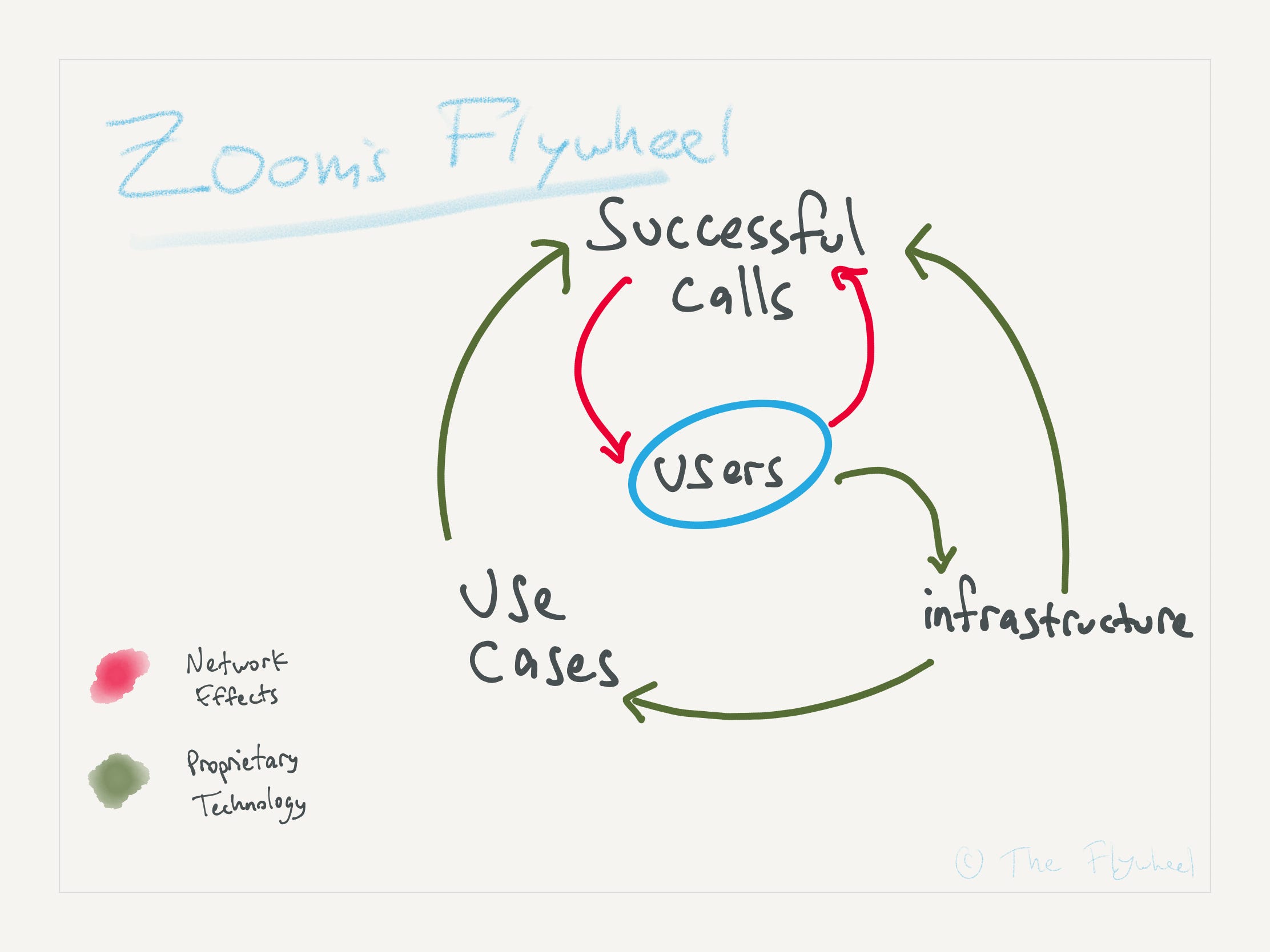
Zoom’s flywheel: the network-effects loop and the proprietary-technology loop (image: Jake Singer, The Flywheel).
Key points
- Zoom won on reliability and zero-friction joining, both rooted in founder focus rather than luck.
- Network-effects flywheel: each call is a free demo, so successful calls → users → more calls.
- Proprietary-tech flywheel: more users → more edge cases handled and more infrastructure → new use cases → more successful calls.
- Risks: a shift in what video calling looks like, commoditized quality, and competitors that control calendar distribution.
- Prescriptions: a deeper app platform and API, and acquiring distribution, with Slack as the named target.
Connections
- The Flywheel · issue #2; follows Peloton’s Food Network Opportunity, followed by Robinhood’s Bull Market
- Companies: Zoom, Slack, Miro, Cisco
- People: Eric Yuan, Max Olson
- Concepts: Flywheels, Network Effects, Moats