Peloton's Food Network Opportunity
| Author | Jake Singer |
|---|---|
| Published | August 25, 2020 |
| Format | Article |
| Original | Read the original |
Peloton’s Food Network Opportunity
The first issue of The Flywheel, Jake Singer’s 2020 newsletter that broke down one company’s business model per post by drawing its flywheel. Singer disclosed a small position in PTON.
Summary
Singer starts from a data point that surprised him: average monthly workouts per Peloton subscriber kept rising, which suggested the product was pulling people to work out more over time rather than gathering dust. He sketches the flywheel behind it. Live content plus high-quality hardware create a strong customer experience, which drives more workouts. Workout volume then throws off four offshoots that feed back into the experience: community among riders and instructors, ride data used to improve recorded classes and personal suggestions, brand value, and the ability to attract instructor talent who make the live content better.
The problem, in his reading, is that the flywheel spins for the bike and sputters for everything else. He doubts the treadmill sold well (far fewer reviews and ratings than the bike, and near-immediate delivery while bikes were backordered) and argues the digital-only subscription was weak, since its churn went unreported and its classes felt interchangeable with free video. That leaves Peloton dependent on hardware sales just as the first bikes age.
His prescription works through the three underused parts of the wheel. On talent, he finds a handful of instructors carrying most ride volume and proposes Peloton act like the Food Network: treat customers as “an audience not just a user base,” build stars, give them equity, and cross-program them into digital classes. On community, he says Peloton is “only scratching the surface” and suggests real social features and an acquisition of Strava. On data, he argues the product barely improves from the data it collects and suggests leaning into wearables, for example by acquiring WHOOP.
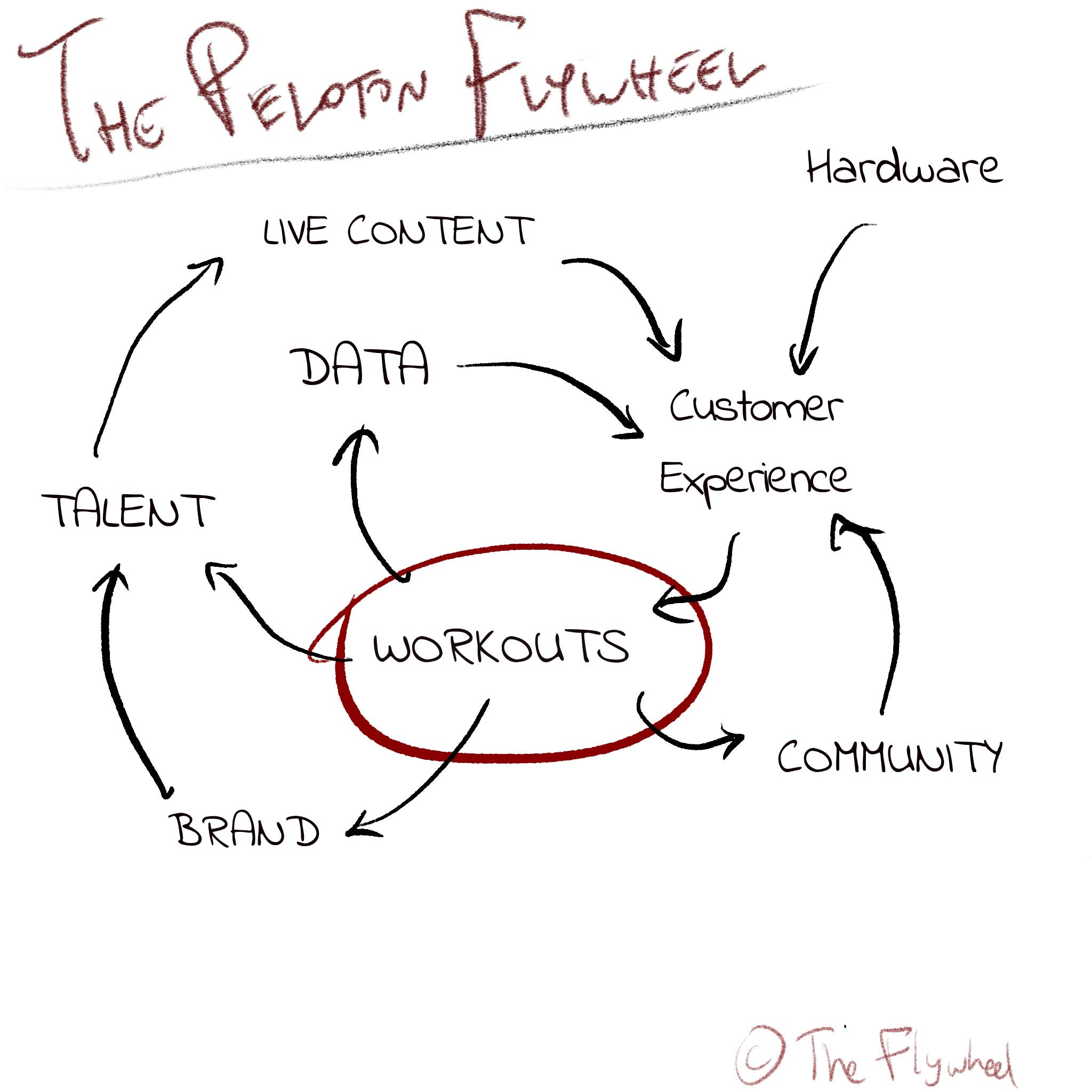
Peloton’s flywheel as drawn in the post (image: Jake Singer, The Flywheel).
Key points
- Rising workouts per subscriber is the evidence that a flywheel exists, not just a gym-membership purchase.
- Core loop: live content plus hardware → customer experience → more workouts; offshoots are community, data, brand and instructor talent.
- The tread and digital-only products are not yet benefiting from the bike’s flywheel, leaving Peloton reliant on hardware.
- Talent: cultivate star instructors like Food Network hosts and use them to make the digital tier worth paying for.
- Community and data are the most underused levers; Strava and WHOOP are named as possible acquisitions.
Connections
- The Flywheel · issue #1; followed by Zoom’s Meteoric Rise
- Companies: Peloton, Strava, WHOOP
- Concepts: Flywheels, Business Models, Community, Network Effects