Robinhood's Bull Market
| Author | Jake Singer |
|---|---|
| Published | September 29, 2020 |
| Format | Article |
| Original | Read the original |
Robinhood’s Bull Market
The third issue of The Flywheel, written as retail trading surged during the 2020 market recovery and Robinhood raised over half a billion dollars amid IPO speculation. Singer calls it the first company in the series where “good for the company” and “good for customers” are different questions.
Summary
Singer explains that commission-free trading is paid for mostly by payment for order flow: high-frequency trading firms such as Citadel and Virtu pay Robinhood for the right to execute its customers’ orders, and they pay more for options trades than for stock trades. So Robinhood earns more when users trade more, and more still when they trade options.
From that incentive he draws the flywheel. The first trade is made nearly frictionless: free trades, a free share on sign-up, instant deposits and margin, fractional shares, and crypto. A delightful and, critics say, addictive interface then nudges users toward more trades and into options. A rising market keeps balances going “up and to the right,” which feeds the fear of missing out that brings in the next wave of first-time traders. He notes that two pieces of this loop, the bull market and public appetite for trading, are outside Robinhood’s control.
The second half weighs the ethics. He presents both sides of the PFOF debate without picking one, but flags that Robinhood reportedly received far more per share from trading firms than Schwab or E*Trade did, and that its options incentive is unusually strong. Since frequent trading tends to hurt small investors’ returns, he expects a possible “real reckoning” when the market turns. He closes on genuine ambiguity: the same facts support a story of democratized investing and a story of a product built to supply trading firms with retail order flow.
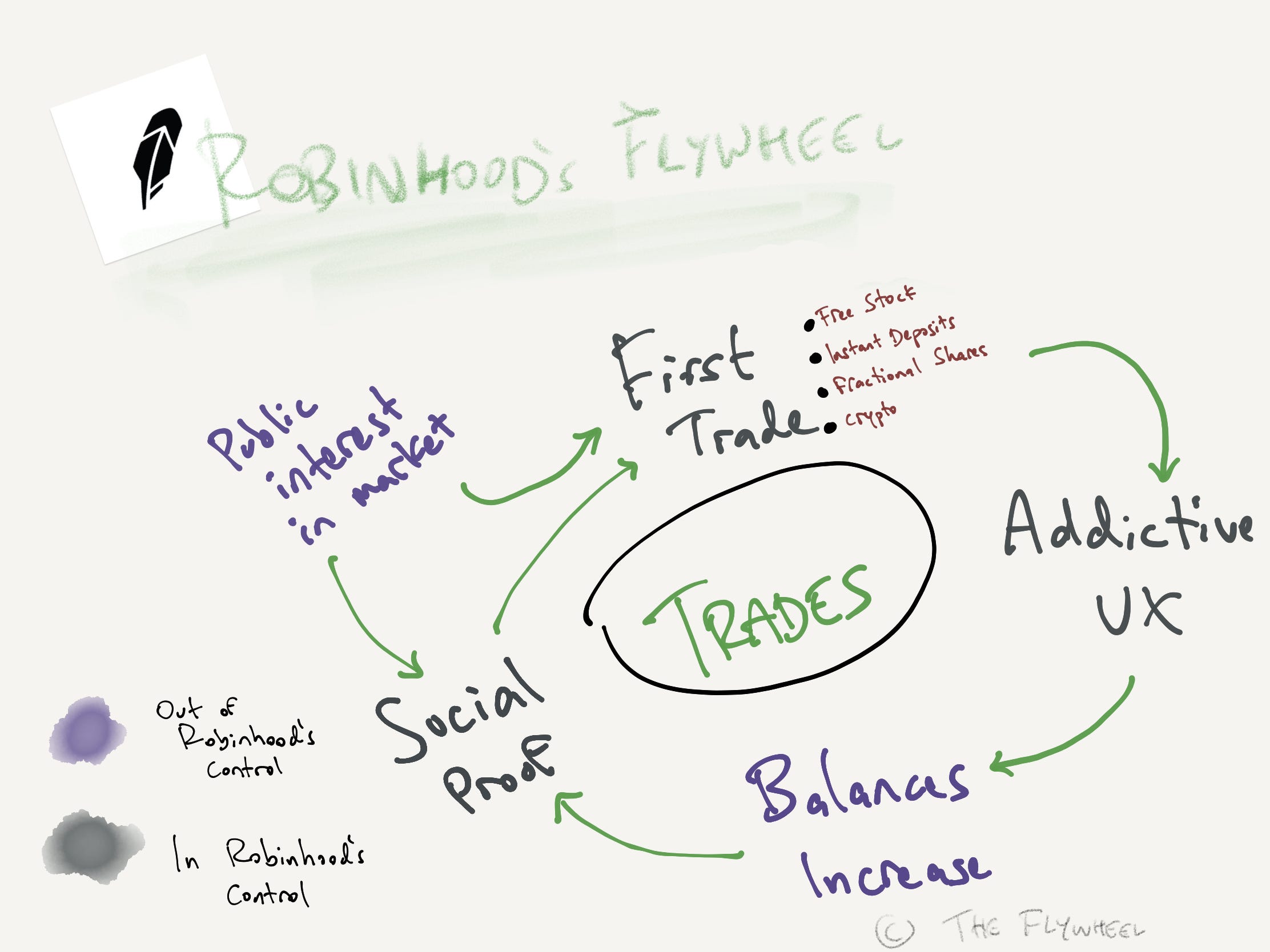
Robinhood’s flywheel as drawn in the post (image: Jake Singer, The Flywheel).
Key points
- Revenue model: payment for order flow, which pays more for options, so more trades and more options trades mean more revenue.
- Flywheel: frictionless first trade → engaging UX → more trading and options → rising balances in a bull market → FOMO → new users.
- Two inputs (the bull market and demand for market access) are external, which makes the wheel vulnerable to a downturn.
- PFOF is contested; Singer’s focus is how it shapes Robinhood’s incentives rather than whether it is good or bad in itself.
- The founders’ Occupy-inspired origin story and their prior work building software for trading firms support opposite readings of the company.
Connections
- The Flywheel · issue #3; follows Zoom’s Meteoric Rise, followed by Stitch Fix’s Long Thread
- Companies: Robinhood, Citadel (Company)
- People: Scott Galloway (cited on Robinhood’s design)
- Concepts: Pay For Order Flow (PFOF), Flywheels, Business Models