Kyle Harrison
article
The Hierarchy of Marketplaces — Level 2 (Sarah Tavel)
The Hierarchy of Marketplaces — Level 2 (Sarah Tavel)
Author: Sarah Tavel (Benchmark) URL: https://medium.com/@sarahtavel/hierarchy-of-marketplaces-level-2-f1c44ed4a39 One-line: Level 2 is tipping: be so much better than any substitute that the market tips toward you, by finding growth loops and happiness loops — and by clearing six hurdles.
Key claims
- Tipping means a new happiness threshold where you are so much better than substitutes that the market moves; the work is finding scalable, systematic tipping loops.
- Two kinds of loop: growth loops that drive down CAC by leveraging existing buyers and sellers (Kyle: the metric is CAC on both sides; Network Effects), and happiness loops that sort supply so buyers find the best sellers (Airbnb’s Superhost badge codified what a great host does). Reducing transaction friction never ends.
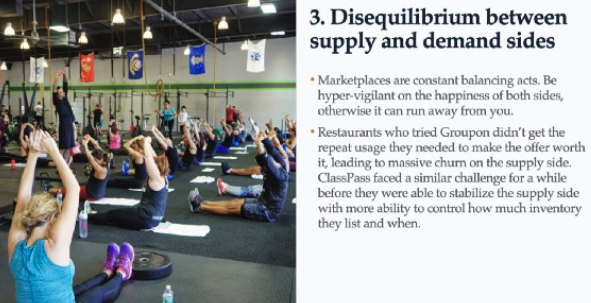
- Six hurdles to tipping a market: competition (subsidies are a happiness crutch your competitors can copy too), low fragmentation on either side, disequilibrium between supply and demand, regulation, homogeneity of buyer needs (commoditized supply makes scale matter less — look for supply nobody else has), and inability to corner the buy side (be the Systems of Record for the buyer, like Coupa).
- Kyle’s two prepared questions for Tavel — Spotify sitting next to the labels as a less-fragmented consolidator; Airbnb’s host tooling as disintermediation defence — were asked on a July 2020 call with Tavel (private meeting note in the wiki).
- Cal Newport’s So Good They Can’t Ignore You tagged to the anti-library from the framing.
Notable quotes
- Read Hierarchy of Marketplaces — Level 2 by Sarah Tavel Marketplaces
- 2. Tip: Identify / Maximize tipping loops
- Introduction
- If your goal in Level 1 was to kickstart transactions and reach “Minimum Viable Happiness”, Level 2 is about reaching a new happiness threshold where you are just so much better than any substitute that the market “tips” in your direction.
- So Good They Can’t Ignore You by Cal Newport books-to-read
- To do this, you need to find a scalable and systematic way to grow that lets you create better and better matches between buyer and sellers over time. This means identifying and maximizing “tipping loops” — loops that create momentum for you systematically.
- If your goal in Level 1 was to kickstart transactions and reach “Minimum Viable Happiness”, Level 2 is about reaching a new happiness threshold where you are just so much better than any substitute that the market “tips” in your direction.
- Tipping
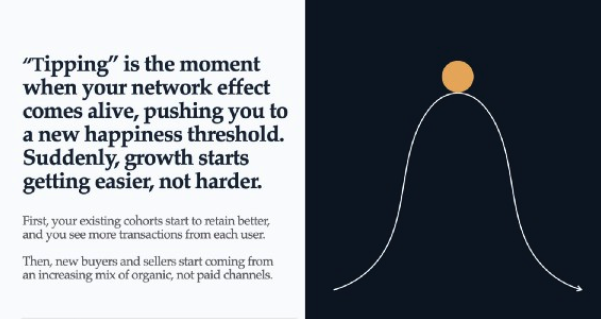
- “Now is the time to grow” Unit Economics
- Two Kinds of Tipping Loops
- Growth loops help you drive down your cost of acquisition by leveraging your existing buyers and sellers to help you grow. Customer Acquisition
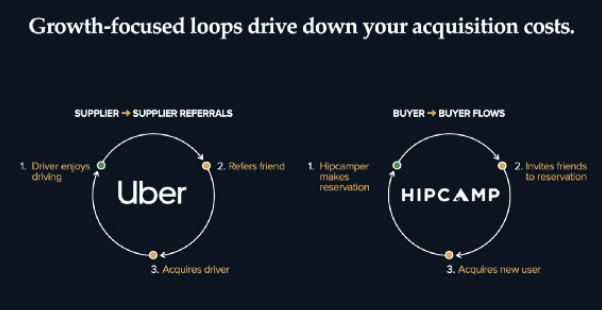
- You could argue that the metric to hone in on here is CAC for both supply and demand; e.g. Network Effects
- Happiness loops act like a sorting function on your supply, helping your buyers find the best suppliers (and avoid the bad ones). Social Scoring
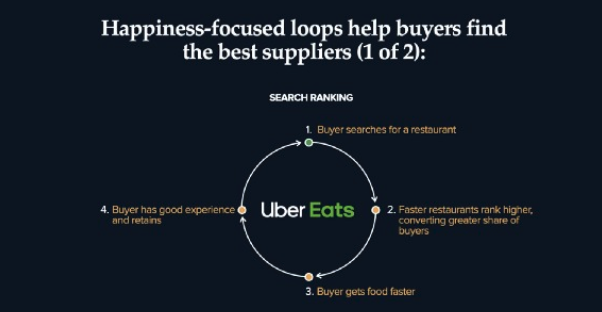
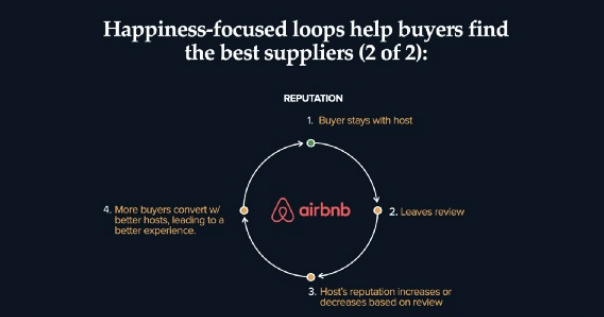
- Here the metric is self-contained; my happiness and positive experience may push growth in that I’ll be more likely to engage in word of mouth and community support, but mostly it’s in my retention and expansion as a user
- You can create incentive systems to better drive those “Happiness Loops” #Incentives
- Airbnb ($ABNB) actually introduced the Superhost badge as a way to help their best hosts feel “recognized”. But in doing so, they codified what makes a great host, reinforcing what hosts need to do to create a great guest experience.
- Driving happiness loops:
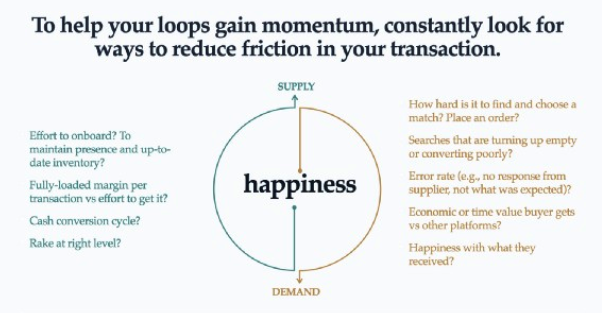
- This truly is a never-ending process. For the life of your marketplace, there will be ways to reduce friction in your transaction. Never stop looking for and prioritizing those opportunities. Opportunity Canvasing
- Growth loops help you drive down your cost of acquisition by leveraging your existing buyers and sellers to help you grow. Customer Acquisition
- ^^Six Hurdles To Tipping a Market^^
- Competition

- Subsidies may be a temptation here (as it was for Uber and Lyft), but be careful: subsidies are a happiness crutch and if you can use them, your competitors can too. Better to unlock more sustainable means if you can.
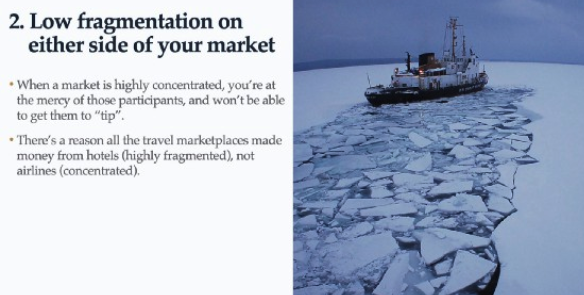
- Low fragmentation on either side of your market
- ^^Question for^^ Sarah Tavel: If you think about the components of Spotify bringing together labels, artists, and audiences, there is a struggle because they’re sitting next to an existing consolidator / aggregator, so even though there is a fragmentation of artists and audience members, Spotify is still at the mercy of labels (much less fragmented.)
- Disequilibrium between supply and demand sides
- Regulation
- Homogeneity of Buyer Needs
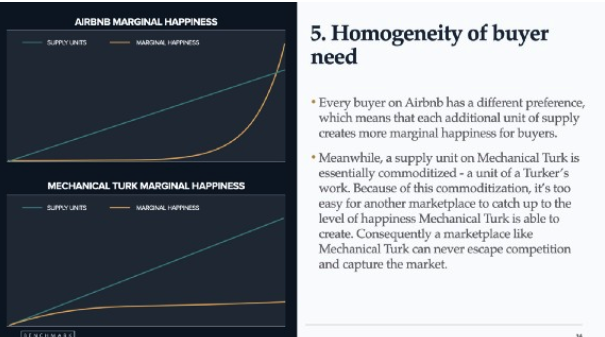
- Commoditization of your suppliers will mean that scale doesn’t matter as much because the end “product” is fungible and therefore easily replicated; look for the Marketplaces that have supply that no one else in the world does.
- Inability to Corner the Buy-Side

- You want to be the Systems of Record for the buyer (e.g. Coupa) because then it’s incredibly difficult to remove you from the equation.
- ^^Question for^^ Sarah Tavel: Airbnb ($ABNB) offers more functionality for hosts. Not as good as adding unique value to the buyer, but makes it less likely that the suppliers will as willingly disintermediate Airbnb ($ABNB) from the transaction
- Competition
- Introduction
- 2. Tip: Identify / Maximize tipping loops

How it connects
- Hierarchy of Marketplaces
- Six Hurdles To Tipping a Market
- Marketplaces
- Sarah Tavel
- Network Effects
- CAC
- Customer Acquisition
- Unit Economics
- Systems of Record
- Commoditization
- Incentives
- So Good They Can’t Ignore You
- The Hierarchy of Marketplaces — Introduction and Level 1 (Sarah Tavel)
- The Hierarchy of Marketplaces — Level 3 (Sarah Tavel)
- a July 2020 call with Tavel (private meeting note in the wiki)