Kyle Harrison
article
The Hierarchy of Marketplaces — Introduction and Level 1 (Sarah Tavel)
The Hierarchy of Marketplaces — Introduction and Level 1 (Sarah Tavel)
Author: Sarah Tavel (Benchmark) URL: https://medium.com/@sarahtavel/the-hierarchy-of-marketplaces-introduction-and-level-1-983995aa218e One-line: Marketplaces that climb the hierarchy build winner-take-most value — but the way up is happiness, not GMV: kickstart minimum viable happiness in a thimble-sized market, measured by net revenue retention.
Key claims
- GMV is a vanity metric. No incumbent is safe from a new entrant that makes buyers and sellers happier — “happiness, not scale, is your moat.”
- Growth follows happiness, not vice-versa: treat growth as a means to raising happiness per transaction and you get quality growth; engineer GMV and it works, briefly. Kyle tags it leading-vs-lagging.
- Pick a thimble, not the ocean: if you worry the market is too small you are probably on the right track, provided adjacent markets are a natural outgrowth — Amazon’s books, Square’s POS, Uber’s black car. Think it through from the buyer’s side: what’s the one thing they’d buy first, and is there an ocean of logical next things?
- Measuring happiness: Net Revenue Retention is the best single measure Tavel has seen; she is unconvinced by Net Promoter Score and curious about Sean Ellis’s “how disappointed would you be” question.
- The three levels — Kickstart (minimum viable happiness), Tip (identify and maximize tipping loops), Dominate (become #1 by a wide margin) — with Kyle’s chart and three reads-to-follow filed to the queue.
Notable quotes
- Read The Hierarchy of Marketplaces — Introduction and Level 1 by Sarah Tavel
- Marketplaces that are able to scale the hierarchy build dominant “winner take most” value. What is required to get there is a focus not on GMV, but on creating happiness.
- GMV is irrelevant — a vanity metric that can lead you down the wrong path if you chase it.
- Hierarchy of Marketplaces
- Overview
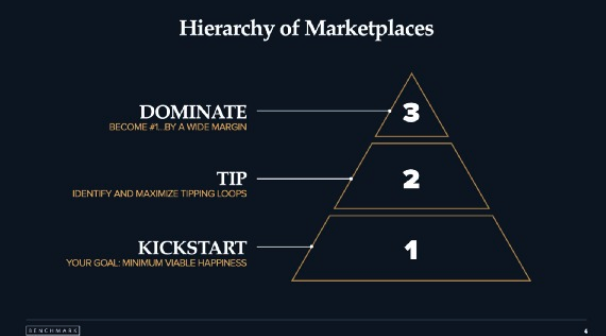
-
- Kickstart: Minimum Viable Happiness
-
- Tip: Identify / Maximize tipping loops
-
- Dominate: Become 1 by a wide margin
-
-
- Kickstart: Minimum Viable Happiness
- “Doing Things That Don’t Scale”
- Things to Read: #articles-to-read
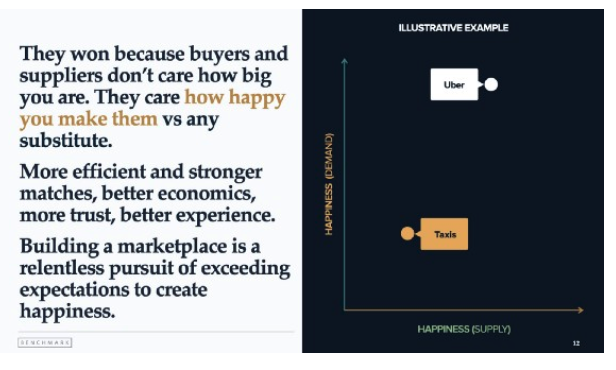
- Why did Uber ($UBER) win? Why did DoorDash ($DASH) beat Postmates? Why did GOAT beat eBay?
- ^^“GMV is a vanity metric.”^^
- “No matter how large an incumbent may be, they are always vulnerable to a new entrant that makes buyers and sellers happier. In other words, happiness — not scale — is your moat.”
- Growth vs. Happiness
- “This is not to say that you shouldn’t grow. In marketplaces, saturation of a market is critical, and the only way to do that is to grow. But if you think of growth as a means to increasing the average level of happiness per transaction (instead of the goal itself), it will focus you on quality growth over vanity growth.”
- In other words, growth is a lagging indicator that will follow happiness. You may be able to engineer growth by focusing on GMV, but not for very long. leading vs. lagging Growth Hacking
- By pursuing happiness, you’ll achieve growth. But not vice-versa.
- Picking a Market Market sizing
- If you pick the right thimble, you can win the ocean. But you’ll never win by going after the ocean first. Pick wisely.
- If you’re worried you may have chosen too small a market, you’re probably on the right track. Just make sure it’s not a dead end. The best marketplace founders I’ve seen are brilliant at knowing which opportunity to go after first, and how to sequence from there.
- Ask yourself: Are there adjacent markets that are a natural outgrowth of your thimble and consistent with your mission? Good. If not, reconsider your starting point. I find it particularly useful to think through this from the buyer’s perspective.
- What is the number one thing the customer would want to buy from me?
- Amazon: Books
- Square: POS
- Uber: Black Car
- Then is there an ocean of logical next things they would want to buy from me?
- What is the number one thing the customer would want to buy from me?
- Net Revenue Retention
- “How do you know if you’re creating enough happiness? It’s all about net revenue retention.”
- Net Promoter Score
- First, I’ll admit that “Net Revenue Retention” is not a perfect measure of happiness, but it’s the best single measure I’ve seen. Some people ask about Net Promoter Score, but I’ve never been convinced that it’s useful.
- There is a chance that Sean Ellis’s “How [disappointed] would you be if you couldn’t use [company name]?” might be, but I don’t have enough data on this. I recommend you try it and please let me know if it’s more useful!
- Overview
How it connects
- Hierarchy of Marketplaces
- Marketplaces
- Sarah Tavel
- Net Revenue Retention
- Net Promoter Score
- Minimum Viable Happiness
- Things That Don’t Scale
- Growth Hacking
- The Hierarchy of Marketplaces — Level 2 (Sarah Tavel)
- The Hierarchy of Marketplaces — Level 3 (Sarah Tavel)
- a July 2020 call with Tavel (private meeting note in the wiki)