The End of Nvidia as the Central Bank of AI (Note to the Slow Team)
| Author | Yoni Rechtman |
|---|---|
| Published | November 12, 2026 |
| Format | Article |
| Original | Read the original |
With Jensen Huang stepping down, Nvidia can no longer act as the lender of last resort for the AI buildout, so the unwinding of the AI trade has begun; of the three historical playbooks (buy the panic, keep pace, retrench) Slow should mostly retrench, slow its deployment and do thesis work for the deployment phase.
The End of Nvidia as the Central Bank of AI (Note to the Slow Team)
Rechtman posted this on November 12, 2026 as “the quick note i wrote to the slow team this morning,” with the line “jensen ran nvidia as the central bank of AI and that era is clearly over.” It is an internal memo written the morning of the news, so it is a positioning argument, not a reported piece; the catalyst itself is referred to but never described in the note (he calls it “profoundly stupid”).
Key claims
- The unwind was always going to start at Nvidia. The AI capex trade is so interconnected, and so much of that interconnection runs through Nvidia, that a shock there cannot stay contained (see AI Capex).
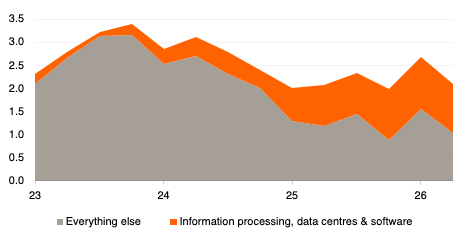
- The economy is the AI trade. Rechtman cites an ING chart showing information processing, data centres and software as a growing share of US GDP growth through 2026, and concludes the unwind will hurt the macroeconomy, not just tech portfolios.
- Nvidia had become a bank run on one man. It ran “on his singular charisma, relationships, dealmaking, and recursive access to capital.” An interim CEO drawn from finance will not be able to “muster $100B in credit agreements and guarantees to prop up the neoclouds, model labs, etc.” (see Neocloud, Jensen Huang). Intraday swings (Nvidia recovering some pre-market losses, the S&P up on the day) do not change that.
- Option 1, be greedy when others are fearful, has worked before. During FTX/SVB, Greenoaks Capital and others provided fast liquidity to companies like Rippling at stale, marked-down valuations; in 2022 Kleiner Perkins bought discounted Rippling and SpaceX shares and Thrive Capital and others led a large down round in Ramp; in early Covid Silver Lake invested in Airbnb as revenue collapsed and a16z and others did Stripe at $36B. For Slow this would mean harder terms on existing and new names (“we’ll do it at $25M today or not at all”) and a shopping list of special situations.
- Option 2, dollar-cost average, is the Y Combinator model. Fixed valuations and terms, adjusting only class size and dollars out; seed funds that kept investing through the GFC produced some of the best vintages (he cites “FRC’s Uber and Square fund,” i.e. First Round Capital). But “in a crisis correlations go to 1”: portfolio companies must raise, valuations track the market, and Slow’s own capital base is levered long, so blindly staying the course is not viable.
- Option 3, retrench and reposition, is how franchises got built. Fred Wilson spent about two years out of the market before launching USV on a web 2.0 thesis after Flatiron Partners; Founders Fund and Accel look similar; a16z launched into the GFC; Sarah Guo started Conviction as a crypto fund and repositioned early to AI. They made their gains on the deployment phase after the installation phase “got entirely blown up.”
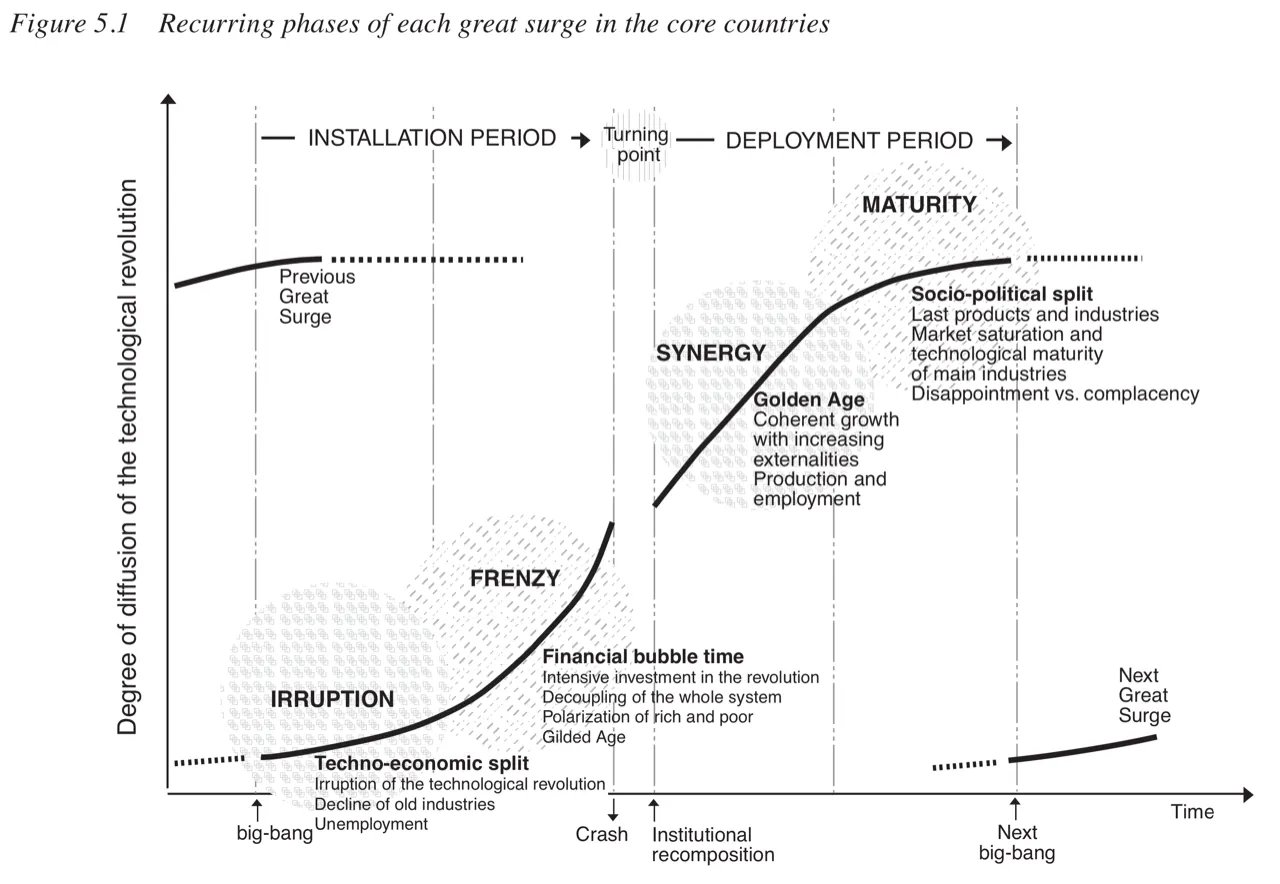
- The frame is Carlota Perez’s. The note embeds Figure 5.1 from Technological Revolutions and Financial Capital and argues AI is moving from frenzy and financial bubble to synergy and the deployment period (see Carlota Perez, Technological Revolutions).
- The recommendation is five rules. Slow the pace and lengthen fund life; do not blindly follow on; be valuation sensitive and assume the market corrects down; be opportunistic where conviction is high; do more thesis work.
- The long-term view is unchanged. Rechtman still wants to bet on the application layer and the “neoeconomy” (new businesses made possible by AI), the closest parallel to web 2.0, and links Slow’s Our 2Q Letter to LPs and Our 2026 LP Meeting as the existing thesis: “Arguably, we already have that. We just need to wait to action it.”
Notable quotes
“It was always obvious or likely that the unwinding of the AI boom would start with Nvidia. It just never seemed possible that the catalyst would be so profoundly stupid as this.”
“And it’s been clear for a long time that the unwinding of the AI trade would be painful for the macroeconomy; the economy IS the AI trade at this point.”
“Nvidia has functionally become a bank running on his singular charisma, relationships, dealmaking, and recursive access to capital.”
“I think we will wind up looking prescient for trying to be “beta neutral” in AI but now we need to reposition.”
“But in a crisis correlations go to 1 and it would be a mistake to believe that we’re truly neutral beta just because we’re not super levered long.”
“It is my strong belief that we are about to move from the frenzy and financial bubble to the synergy and the deployment phase of AI.”
“Do not blindly follow on. Treat every dollar as precious.”
“But the next few years may be really bumpy.”
Charts and figures
How it connects
- Our 2Q Letter to LPs and Our 2026 LP Meeting: the Slow thesis this note says the firm should “wait to action”; the note links both.
- Technological Revolutions and Financial Capital / Carlota Perez / Technological Revolutions: the installation-to-deployment frame the whole recommendation rests on.
- Dot-com Bubble and Hype Cycles: the precedent for “fiber and networking companies” being blown up before the internet application winners.
- AI Capex, Neocloud, Nvidia, Jensen Huang: the financing loop the note says just lost its center.
- Y Combinator, USV, Fred Wilson, a16z, Sarah Guo: the case studies for options 2 and 3.
- Greenoaks Capital, Kleiner Perkins, Thrive Capital, Silver Lake, Rippling, Ramp, Stripe, Airbnb: the case studies for option 1.
- Long-Term Optimistic, Short-Term Pessimistic: Jay Vas’s framework from two days earlier is the same posture in one line, long-term bullish on the arc and defensive about the next few years.
- Saved by Kyle as the quick note i wrote… (tweet).