Our 2Q Letter to LPs
Our 2Q Letter to LPs
Author: Yoni Rechtman (Slow Ventures; 99D newsletter) URL: https://99d.substack.com/p/our-2q-letter-to-lps One-line: Every general-purpose technology runs from Frenzy to deployment, value capture is gated by how fast customers can refactor rather than by how good the models are, and the long-term winners are the technology’s users — so Slow is “looking for the planes and the cars (and the businesses relying on the planes and the cars) not the oil and steel.”
The post is a lightly edited section of the quarterly letter Slow Ventures sent its limited partners the week before.
Key claims
- Every horizontal technology follows the same arc. Euphoric money floods in to fund the infrastructure buildout and create paper wealth; then the bubble bursts — railways in 1847 and 1873, utilities in 1929, fiber in 2001, crypto in 2018 — leaving infrastructure for the next generation to build “newly possible companies” on. Rechtman frames it with Carlota Perez’s surge cycle from Technological Revolutions and Financial Capital, and says that “clearly we are in ‘The Frenzy’ today.”
- “It’s different this time” is a supply-side claim. Scale, speed, sophistication and the fact that it is “finally coming for knowledge work” are all true in some sense, but they are claims about vendors (fast, cheap, high quality) and orthogonal to how businesses work and who decides.
- Value capture is gated by “the customer prerogative.” The binding constraint is how long it takes a hospital, a bank or a law firm to refactor around the new tool. A better model doesn’t buy a faster customer: “the cycle of diffusion is slow, even if its onset is sudden.”
- “AI breaks the economics” is not an investable idea on its own. Slow are “long-term bulls” who think AI is breaking the economics of industries assumed untouchable, but the real questions come after: who is organized to rebuild the broken economics and win, where the value sits long term, and who can defend it and at what cost. Anything short of answering those is a trade — and trading is “not our bag.”
- Consumer surplus, not vendor surplus, is the historical norm. The biggest long-term winners have been users, not developers, of a technology: steel producers and oil majors vs. cars; ISPs vs. internet platforms; electric utilities vs. electrified industry; and “datacenters vs AI, ironically.” Given a venture fund’s hold period and illiquidity, “the long view is all we have.”
- The value stack is recursive. The market cap of steel is a fraction of that of planes and cars, which is a fraction of all the businesses planes and cars made possible; the same holds for rare earths vs. chips vs. the computerized economy (“functionally, global GDP”).
- The mandate: newly possible companies that sell outcomes. Slow wants things newly possible with AI infrastructure, talent and technology that also meet its tests for a good business (terminal value; durability, defensibility, value prop). AI increasingly moves businesses toward selling outcomes rather than workflow, across B2B and consumer.
- Time to first revenue doesn’t predict growth. A “Big Things Take Time” chart of portfolio revenue curves, anchored on Slow’s first check, shows that time to first revenue “is rarely a meaningful predictor of future growth rates” — “but once you get going you gotta really go!”
Notable quotes
“Clearly we are in ‘The Frenzy’ today.”
“A better model doesn’t buy you a faster customer because the binding constraint doesn’t move. The cycle of diffusion is slow, even if its onset is sudden.”
“Accepting that the economics break doesn’t tell us enough about where to put the next dollar. The real questions come after.”
“Everything short of answering those is a trade. Trades can make great money if you know when and how to get out. But that’s not our bag; we want to call the shot on what is durably valuable along the way and after.”
“Consumer not vendor surplus is the historical norm. And given our hold period and presumption of illiquidity, the long view is all we have.”
“Increasingly, we think/see/can prove that AI brings businesses closer to selling outcomes not workflow. The best businesses have always sold outcomes and now there’s more surface area to do that in big markets.”
“To the users go the spoils.”
Charts and figures
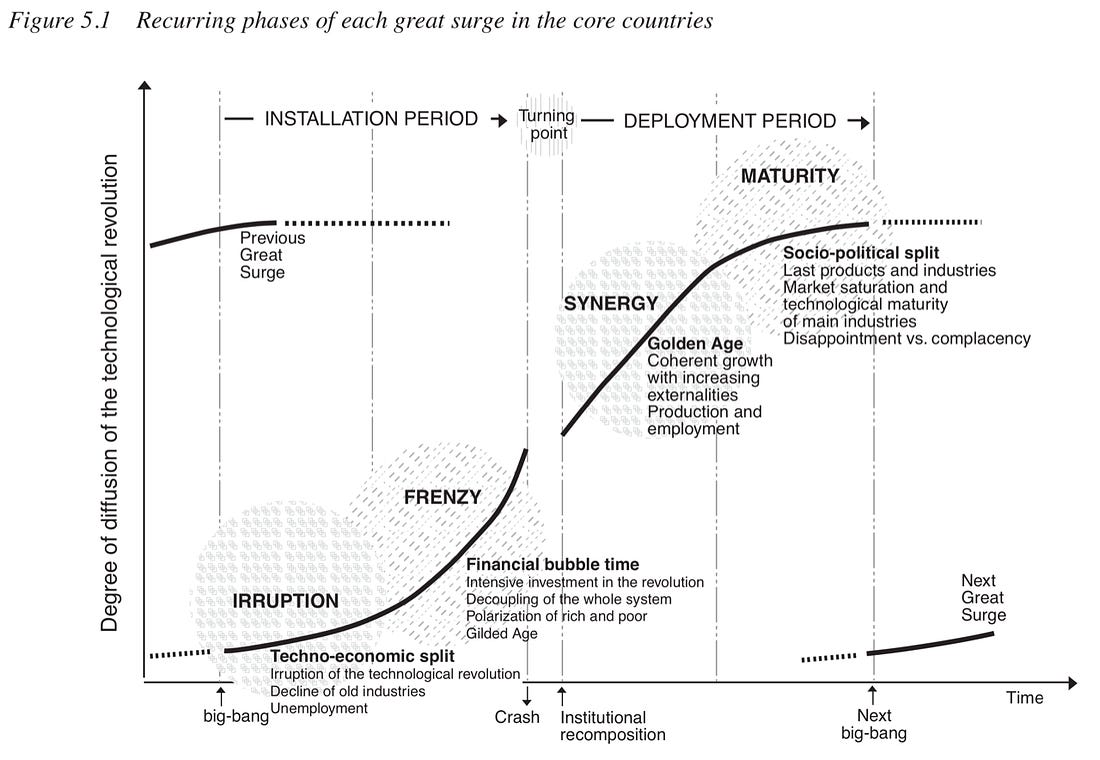 Perez’s surge cycle from Technological Revolutions and Financial Capital — “a very familiar image to longtime readers.” Rechtman places AI in the Frenzy, just before the crash and turning point.
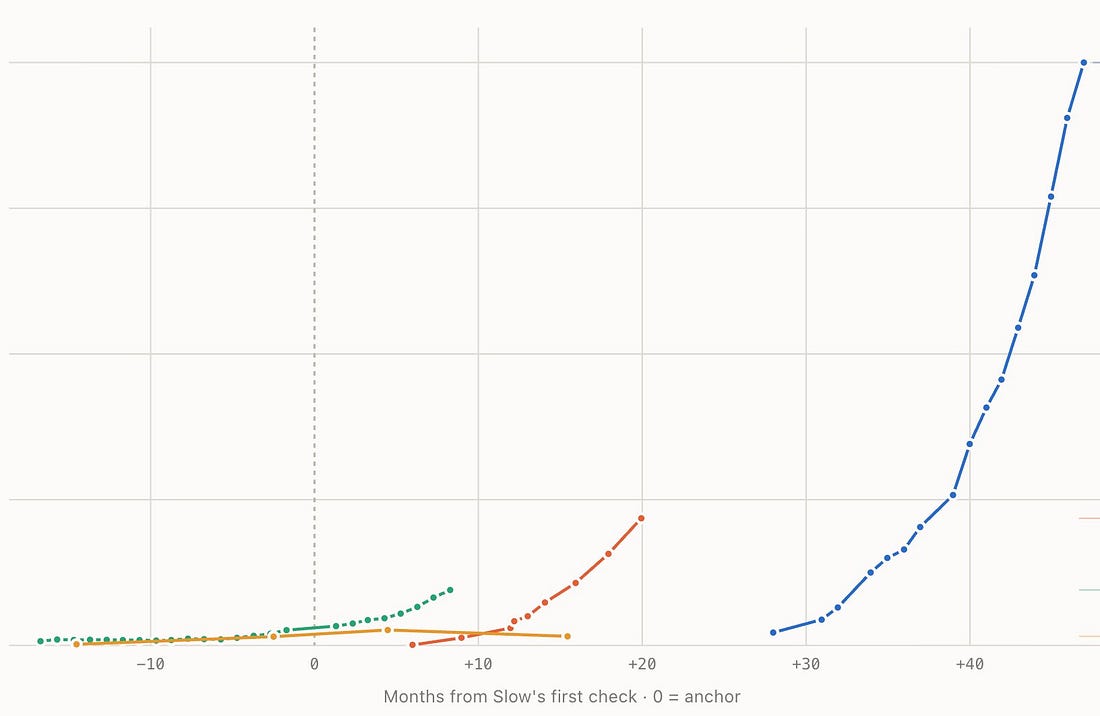 “Big Things Take Time”: time to first revenue is rarely a meaningful predictor of future growth rates. The y-axis is unlabelled in the source.
How it connects
- Carlota Perez — the framework structuring the entire piece: installation/Frenzy → deployment, with value accruing to technology consumers.
- Technological Revolutions and Financial Capital — the Perez book the letter’s lead chart comes from (Figure 5.1); it sits in Kyle’s anti-library.
- Technological Revolutions — the historical pattern (steel/cars, ISPs/internet platforms, electric utilities/electrified industry) that anchors the AI analogy.
- Venture Capital — the investment context; this is Slow Ventures’ Q2 LP communication, and its argument against “trades” is about a VC’s hold period and illiquidity.
- AI Infrastructure — the enabling layer analogized to oil, steel and electric utilities — necessary, but not where the biggest returns accrue (“datacenters vs AI, ironically”).
- Slow Ventures — the fund authoring the letter, focused on “newly possible” companies built on AI infrastructure; Rechtman leads pre-seed and seed from a ≈$325M fund.
- Yoni Rechtman — author; partner at Slow Ventures and writer of 99D.
- It’s Still 1995 — a direct counterpoint on the same Perez chart: that piece places AI in the Irruption phase even though it feels like the Frenzy, where Rechtman says it is “clearly” the Frenzy.
- Dr. Tokens or — How I Learned to Stop Worrying and Love the AI Bubble — Kyle’s essay built on the same Perez installation-then-deployment frame for the AI buildout.
- Updating The Hype Cycle — Kyle’s essay on venture hype cycles, the same euphoria-then-hangover pattern applied to AI.
- Hype Cycles and Market Bubbles — the railways/utilities/fiber/crypto busts Rechtman lists are the bubble pattern these pages track.
- Tomasz Tunguz — his “Valuing AI Harnesses” is the first link in the post’s Elsewhere list.