Stitch Fix's Long Thread
| Author | Jake Singer |
|---|---|
| Published | October 20, 2020 |
| Format | Article |
| Original | Read the original |
Stitch Fix’s Long Thread
The fourth issue of The Flywheel, and the first about a company the pandemic hurt rather than helped: Stitch Fix had just reported its first-ever revenue decline. Singer disclosed a small position in SFIX.
Summary
Stitch Fix does not let clients browse. A client fills out a style profile, stylists with algorithmic help pick a box of five to seven items (a “Fix”), and the client keeps some, returns the rest, and leaves feedback on everything. That feedback loop is the company’s core capability; Singer quotes CEO Katrina Lake that data science “is our culture.” His own experience was poor, which framed the question: the service needs effort and patience from new clients before recommendations get good, a chicken-and-egg problem.
The flywheel runs from style profile to first-Fix success. Clients whose first Fix lands enter what he calls a “single player flywheel,” where each round of feedback improves their next box, and the shareholder letter’s data shows success rates rising from a client’s first Fix to their third. The change in his view came from 2019 data showing first Fixes 17% more successful than in 2018. That means data from existing clients is improving recommendations for new ones, closing the loop back to the start of the flywheel.
If first Fixes become reliably good, Stitch Fix could spend far more to acquire customers, for instance by waiving styling fees. Drawing on Ben Thompson’s 2017 Stratechery piece contrasting Stitch Fix with network-effect aggregators, Singer proposes a third category, the “not-yet aggregator”: a company that looks like a normal, linear business until its data advantage crosses a tipping point. He thinks that point is years away and names the main risk as the team losing patience.
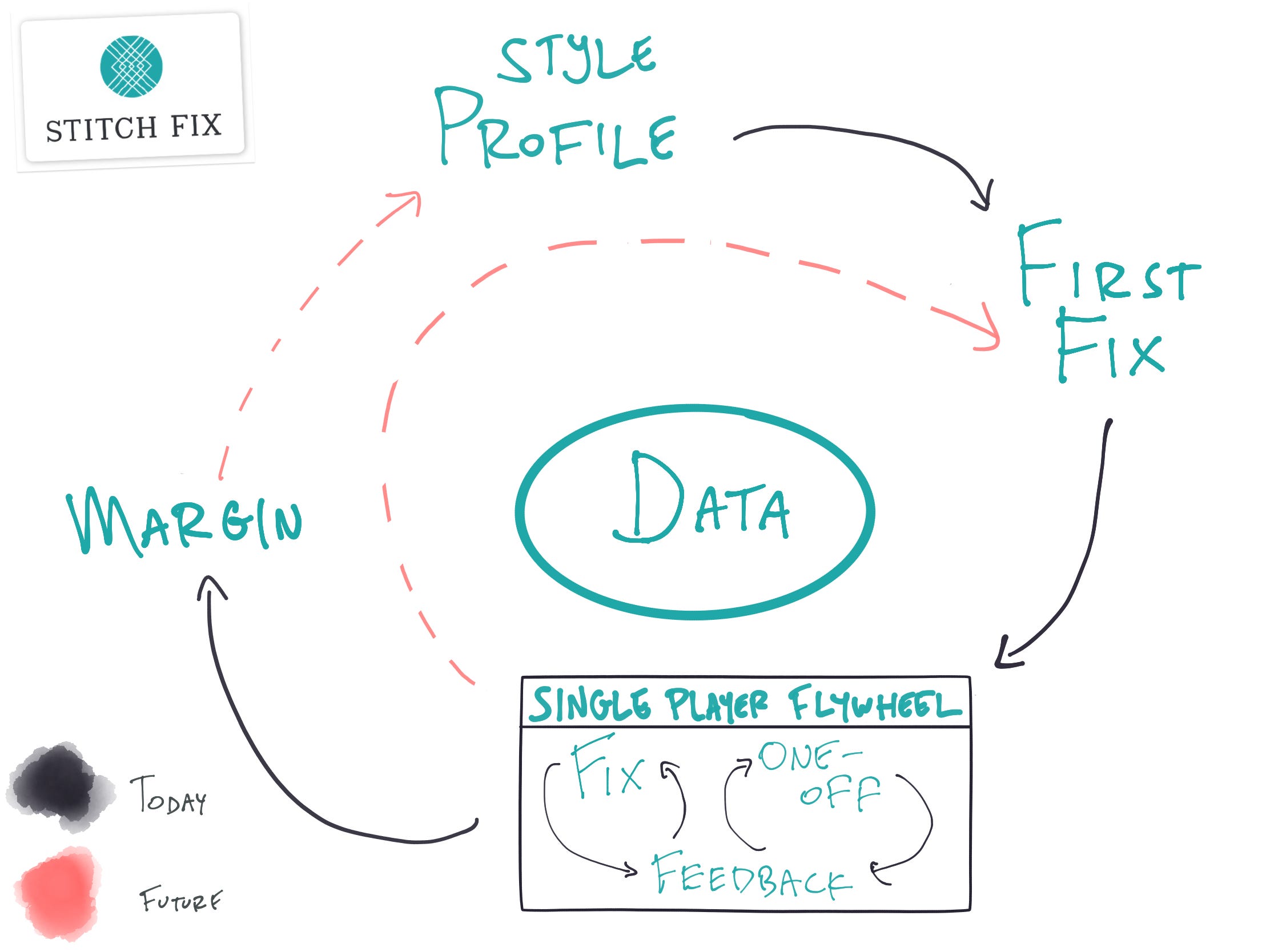
Stitch Fix’s flywheel as drawn in the post (image: Jake Singer, The Flywheel).
Key points
- Feedback on every item, kept or returned, is the data engine; recommendation quality is the product.
- Single-player flywheel: each client’s success rate improves Fix by Fix.
- 2019 first Fixes beat 2018 first Fixes by 17%, evidence that the single-player loop now benefits new clients too.
- Better first Fixes would justify much more aggressive customer acquisition spending.
- “Not-yet aggregator”: a business whose network effect looks linear today but compounds over a long horizon.
Connections
- The Flywheel · issue #4; follows Robinhood’s Bull Market, followed by Zillow and the Innovator’s Dilemma
- Companies: StitchFix
- People: Katrina Lake, Ben Thompson
- Concepts: Flywheels, Aggregation Theory, Network Effects