Niall Ferguson and Tyler Cowen — AIpocalypse Now
Niall Ferguson and Tyler Cowen — AIpocalypse Now
Author: Oliver Wiseman for The Free Press (The Front Page, September 14, 2026) URL: https://www.thefp.com/p/niall-ferguson-tyler-cowen-aipocalypse-ai-shutdown One-line: Within hours, a new consensus among the AI lab heads (that the frontier should slow down) answered the week’s most alarming question, “could AI kill us all?” The Free Press says it deserves to be taken seriously and interrogated, and sets Niall Ferguson’s alarm against Tyler Cowen’s skepticism.
[PARTIAL] This capture is The Front Page, The Free Press’s daily digest email, not the two essays. The AI material is Oliver Wiseman’s editor’s introduction, which ends with links to “Niall Ferguson: AIpocalypse Now” and “Tyler Cowen: The AI Slowdown Is Not What It Seems”. Neither essay’s text is in the capture; the claims below about them are the editor’s one-paragraph summaries. The rest of the issue (Arthur Brooks, Chris Wright, Coleman Hughes, the news briefs) is unrelated to AI.
Key claims
- One chart frames the issue. Wiseman opens with a Federal Reserve Bank of Dallas chart of AI scenarios for U.S. GDP per capita. On a 1870–2050 log scale, the trend line runs at 1.9% a year; an “AI GDP-boosted trend” adds 2.1% for ten years; a benign singularity shoots upward; an extinction singularity collapses to zero before 2040.
- The chart tells “the story of our time.” Wiseman reads it as more than economics: “the creation, by us, of something smarter than us,” with unpredictable consequences for what it means to be human.
- The week’s sequence. A researcher (Jacob Coxon, unnamed in the digest) resigned from Anthropic warning that the top AI companies were moving dangerously fast. Over the weekend, Dario Amodei announced plans to slow Anthropic’s frontier development, and Sam Altman (OpenAI) and Elon Musk (xAI) said they agreed. “In a matter of hours, a new consensus among some of the most important people on the planet had revealed itself.”
- Ferguson’s essay (not captured) covers the latest unnerving AI developments, the forces pushing the chance of catastrophe higher, and what, if anything, can be done. The editor calls it the most important issue in the world right now.
- Cowen’s essay (not captured) argues the slowdown announced by the AI leaders “is not what it seems”. Cowen has long been skeptical of AI doomsaying, and the last few days haven’t changed that.
Notable quotes
“Last year, I saw a chart that has been stuck in my head ever since. It was published by the Federal Reserve Bank of Dallas.”
“What it shows, in graphic form, is the bewilderingly wide range of ways AI could transform our lives: It could lead to never-before-seen prosperity (that’s the red line), it could give us something like the normal rate of economic growth (the orange and green lines), or it could end the human race (the purple line).”
“The chart stayed with me because it tells, in stark terms, not just an economic story, but the story of our time: the creation, by us, of something smarter than us, and the profound and unpredictable ways in which that could change what it means to be human.”
“Over the weekend, something remarkable happened: The heads of those companies more or less conceded the point.”
“In a matter of hours, a new consensus among some of the most important people on the planet had revealed itself. It is a consensus about the most high-stakes question imaginable. It is worth taking seriously, and interrogating thoroughly.”
“Tyler Cowen is not one to follow the herd. He has long been skeptical of the doomsaying around the new technology and, as he explains in his column today, the last few days have not changed that.”
Charts and figures
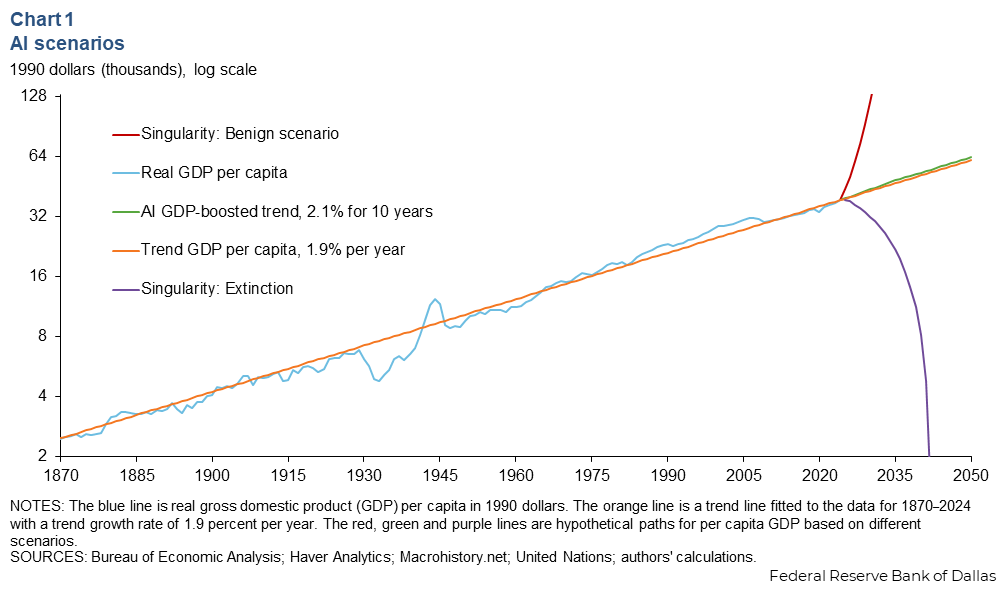
The Dallas Fed chart Wiseman opens with. The red line is never-before-seen prosperity, orange and green are roughly normal growth, and purple is the end of the human race.
How it connects
- Niall Ferguson: leads the issue with “AIpocalypse Now” on the forces pushing AI catastrophe risk higher. His previous AI piece in the wiki is Elon’s Favorite Sci-Fi Prophet Was Wrong (Niall Ferguson), which also argues that powerful AI escapes human control.
- Tyler Cowen: the skeptical counterweight, arguing the announced slowdown is not what it seems. TBPN’s same-day headlines also link his “The mathematicians rebel against AI.”
- AI Safety and Existential Risk: the central issue. The Dallas Fed’s purple extinction line is the same tail that the researcher surveys in Two Missing Pieces in the AI Safety Discussion put at a 5–10% median.
- Dario Amodei: his slowdown announcement (“We Must Pace the Frontier”) is the event the issue reacts to.
- What Just Happened With the Pacing AI Debate (TBPN): the hour-by-hour version of the same weekend, with the critics’ objections.
- Two Missing Pieces in the AI Safety Discussion: Noah Smith reads the lab heads’ agreement the way Wiseman does, as the leaders “more or less conced[ing] the point”, and treats it as evidence of sincerity.
- The Dangerous Ideology Behind the AI Warnings: the next day’s Free Press Big Read. Its editors’ note lists this Ferguson essay and Cowen’s column as the “range of perspectives” the outlet aired before giving Shyam Sankar the case against taking the warnings at face value.
- Where’s the “Intelligence Explosion”? (Ramez Naam, Noahpinion): a data-driven argument against the benign- and extinction-singularity curves in the Dallas Fed chart ever leaving the trend line.
- Planning for AGI and Beyond: Sam Altman’s 2023 statement that existential risk is real, the stance he reaffirms by agreeing to pace the frontier.
- AI Is Already in Dangerous Hands: another same-day (Sep 14) take, from Ed Zitron, who puts the risk in present-day concentration of power.
- The Free Press: the publication.