Nothing Gambled, Nothing Gained
| Subtitle | Building a company is increasingly being treated like buying a lottery ticket |
|---|---|
| Published | November 14, 2026 |
| Length | About 3,550 words |
| Newsletter | Investing 101 |
| Tags | gamblingprediction-marketsspeculationventure-capitalfaithwork |
| Read on | Substack |

I keep seeing people talk about startups the way people talk about lottery scratchers, and this week Kalshi went looking for a $65B valuation. So I wanted to work out why the lottery ticket has become the default way we think about risk, money and success, and why I think the gambler’s spirit costs more than anyone’s losing at the table.
This week, Bloomberg reported that Kalshi is in talks to raise money at a $65B valuation. That’s a few weeks after it closed a round at $40B, a round that (for some silly reason) everyone assumed would be its last before an IPO. Apparently not. Monthly trading volume on the platform went from $40B in August to nearly $100B in October, and the annual revenue run rate just crossed $5B. Most of that volume, by the way, is people betting on sports.
My friend, Michael Dempsey, had the reaction I keep thinking about: “Respectfully, I don’t think any of us want to live in a world in which Kalshi is a $100B+ company [but] the underwriting is starting to need that as a moderate downside case.”
His point, I think, was that if Kalshi really becomes worth $100B, that number starts to become a measurement of what our society spends its time and money doing, and we probably won’t like the implications.
When I think about what that society looks like, I picture Howard Ratner. Adam Sandler’s character in Uncut Gems spends two hours making worse and worse bets with other people’s money, and at the moment it all might pay off, he just grins and wants to bet on it.
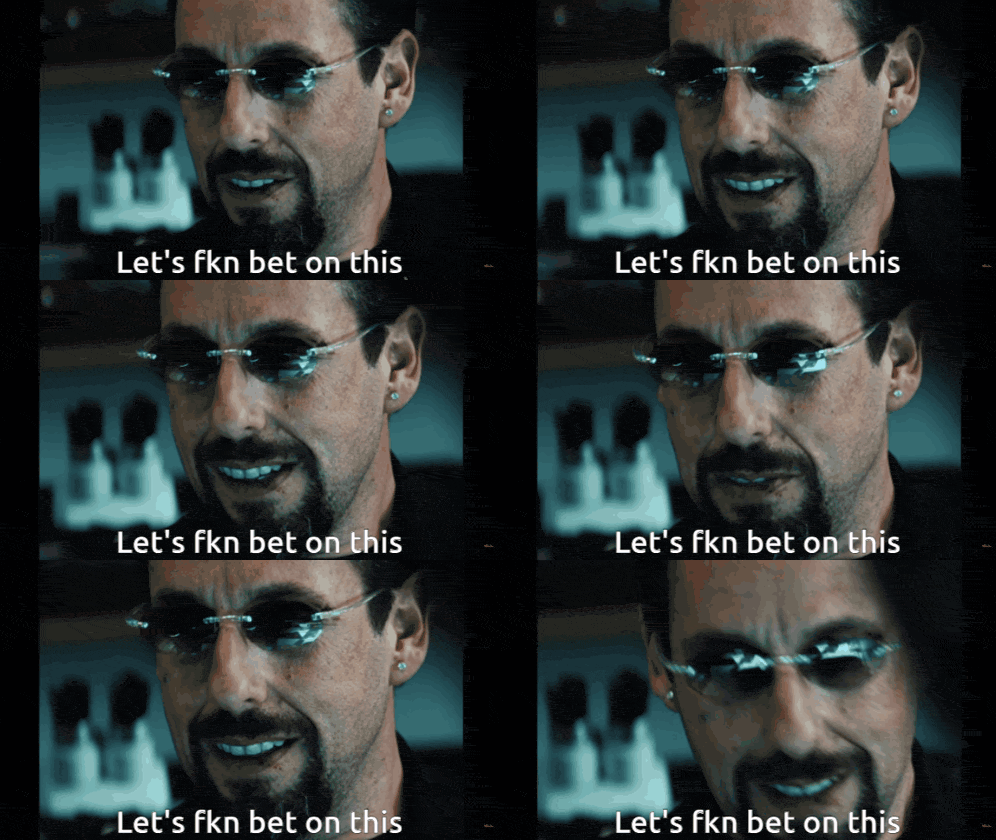
Not for nothing, but that’s also the face I see every time someone tweets “how can I short a startup?” More on that later. That “bet on this” face is the gamblification of everything, and I think we’re all slowly turning into that guy.
Venture is experiencing the same cultural malaise. The odds of building a successful company, venture-backed or not, have always been low. About half of new businesses in the US are gone within five years, and only about a third make it to ten. Venture-backed companies are even more extreme by design: roughly three out of four never return their investors’ money, about three-quarters of founders walk away with nothing at exit. Something like 1% of seed-funded startups ever become unicorns. Low odds, but it’s important to note that is NOT a lottery ticket. The odds of hitting the Powerball jackpot are 1 in 292.2M.
So in comparison, venture isn’t a lottery ticket. However, increasingly, building a venture-backed company feels like it’s being treated like one. The old proverb says “nothing ventured, nothing gained.” Somewhere along the way we swapped it out for nothing gambled, nothing gained.
Reflecting on that vibe shift, I wanted to pull a classic 8th grade english speech move and walk through the definition of what a bet actually is. From there, look at how far the gamblization of society has spread, why capital keeps funding it, what it’s done to venture, and why so many people keep playing anyway.
The Ancestor Of Risk
Gambling is as old as money. It is the spiritual descendent of risk. And risk is life; you wake up in the morning and you risk it being your last. Probability theory itself was born out of a gambling dispute, and over a few hundred years we domesticated the gambler’s instinct into insurance, joint-stock companies, public equity and, eventually, venture capital. So I don’t want to pretend there’s a clean, moral wall between the casino and the capital markets.
Charlie Munger embraced it wholeheartedly when he said: “You’re looking for a mispriced gamble. That’s what investing is.”
But there are two questions that I think separate a venture from a bet. The first is who loses when you win. When a real venture works, something exists that didn’t exist before, whether it’s a product, a job, a customer who’s better off… some nice swag? I dunno, usually something. But when an honest-to-goodness bet works, the money came out of somebody else’s pocket, minus the house’s cut. A venture is positive-sum when it works; a bet is negative-sum by design.
The second question is how long you’re willing to wait. A venture asks you to sit with the uncertainty for years before you find out whether you were right. Bets usually settle much more quickly. A huge part of what makes something gambling vs. investing is just impatience, priced in. Classic “get rich quick” vibes.
Back in February 2023, I wrote that if you’re gambling with a career in venture, then that’s a bad gamble, because not only will you probably not do well, you’re also unlikely to do good. But gambling has gone SO much further into our cultural programming then I ever thought possible. Which, granted, is probably in part because of my Mormon naiveté when it comes to gambling.
Running It Backwards
Gambling culture has a pretty rich family tree. OG Ponzis gave way to get-rich-quick schemes, and on and on into MLMs, crypto pump-and-dumps, NFTs, meme stocks, and now prediction markets. Another friend, Pratyush Buddiga, summed it up well:
“One big mega-trend of the past 20 years is ‘young men trying to make money come out of their computer.’ Online poker, daily fantasy, crypto, Robinhood trading, and sports betting were all different waves of this trend.”
The funny thing is that the people building the latest wave of that same trend describe it exactly the same way, but they articulate it as the bull case. 😬
This week I took a pitch from a young founder building tools for retail traders to write prediction-market algorithms. He was smart, sincere and genuinely impressive, and he knew exactly which wave he was riding: “I understand the get-rich-quick schemes. I understand that mentality.” But when I pushed on whether what he was building was really just a smarter approach to a gambling market, he pushed right back:
“Wait, how is it a gambling market though? Like… you could say that for stock market too, right? You’re predicting the future… I don’t look at it as gambling whatsoever. … it feeds off the degeneracy too, right? But it does it in a positive way.”
The power of prediction markets, in particular, is that they’ve whitewashed gambling so that they feel like investing to the point where a smart, young engineer can’t see the difference. And it’s paying dividends (not literal dividends, what is this 1955?) When I wrote about Kalshi back in June, it was a $22B company. That felt big at the time. Five months later, it’s raised at $40B and now it’s out raising at $65B.
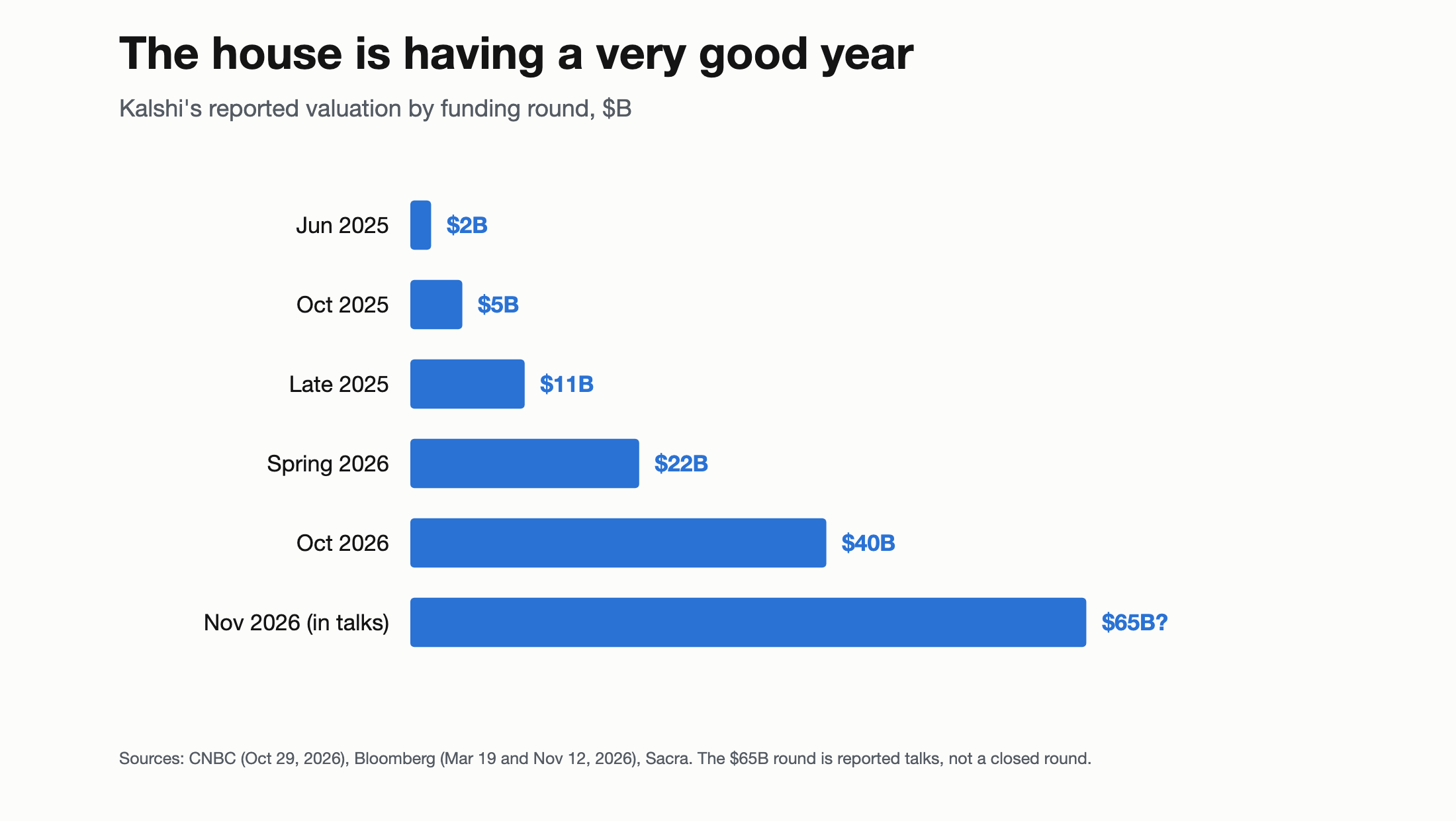
That’s roughly 30x in about 17 months. And it’s not because the market discovered some deep new truth-telling machine, much to my young friend’s chagrin. Sports betting makes up ~80% of Kalshi’s trading volume since July 2024. The fastest-growing “market” in America is mostly just a sportsbook convincing you your bracket is actually just reflective of your “world view.”
It’s also not staying in its lane. In May, Polymarket launched markets on the private valuations of OpenAI, Anthropic, SpaceX and Stripe. So the answer to “how can I short a startup?” is now, literally, “download an app.” Public markets have never been more efficient on paper, yet so maniacally nonsensical in practice, and now private markets are getting their own casino on the side.
And it goes all the way up. The President of these United States reported at least $1.4B of crypto income for 2025, much of it from a memecoin that’s down 90%+ from its peak, which means a lot of other people lost what he won. His son advises Kalshi and sits on Polymarket’s advisory board, while the administration argues in court that prediction markets aren’t gambling.
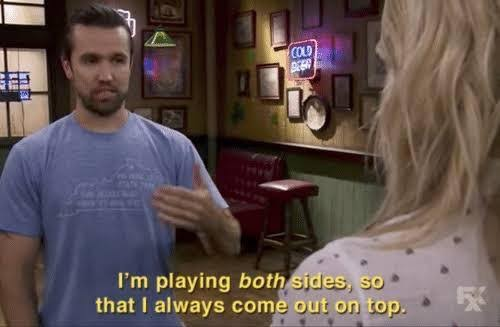
For a lot of people, corruption on levels that used to be inconceivable now gets hand-waved away as getting while the getting’s good… and, by the way, what about Hunter Biden’s laptop? That’s the gambler’s ethic applied to public office; nobody’s hands are clean, so why not make hay while the sun is shining?
Sin Sells
There’s a reason the money keeps flowing in this direction. Sin is easier to sell than salvation. Making people feel good in the short term is far easier than helping them change for the long term, and capital often follows what’s easy to see.
If you look at the consumer companies that venture has made the most money on lately, a startling number of them are basically seven-deadly-sins investments: DoorDash (gluttony), OnlyFans (lust), Instagram (envy), X (wrath), Robinhood and Coinbase (greed) with sports betting and prediction markets now picking up that mantle. An investor can look at a sportsbook and see a $10B outcome in a spreadsheet and have no qualms about the individual losses that has to represent on the back-end. Ask that same investor to underwrite a company that helps people spend less time on their phones, and the question doesn’t compute. No money in it; back to my sins!
In June I called this the gamblification of everything. Gambling has always been corrosive for young people, but now, post-prediction market rebrand, it’s kids getting addicted to gambling under the guise of intellectual arbitrage. Granted, we’ve all got our vice. I’ve been battling doomscrolling with the Twitter app on my phone… but… it’s legitimately also how I’ve found a lot of great founders and have deployed millions of dollars! Hard to call that net negative. See, but that’s the thing. The things that are hardest to quit are the ones that feel good and feel productive.
(Side note: Pray for me, I’ve had the X app deleted from my phone for the last several weeks and it hurts.)
Being the contrarian that I am, I love the counter-examples. In 2018, Contrary became the first institutional investor in Hallow, a Catholic prayer app, back when only a handful of users were completing their first prayers in it. The contrarian bet was that there are people who ARE willing to pay for spiritual tools, and that they’re a community worth building for. Hallow has since grown to ~$100M+ of revenue on the strength of that community that was worth serving.
We don’t HAVE to build technology with the lowest common denominator in mind, even if that lowest common denominator is super profitable.
Shots On Goal
So why does venture keep drifting toward the lottery ticket, even when it knows better?
Two weeks ago I wrote The McDonaldization of Venture Capital about how a series of perfectly rational optimizations (efficiency, calculability, predictability, control) add up to an irrational outcome. You might think that’s the opposite of a lottery. McDonald’s is about making everything the same; a lottery is about the one-in-a-million outlier. **But I think they’re the same machine. You want legibility in the process because you want to replicate the lottery outcome. **“How do we make a trillion the new billion?”
The process gets standardized so you can buy more tickets. And the soul-crushing part is the mindset that comes with it. “If I miss that one, then nothing else matters.” That’s the gambler’s spirit at work.
In Networked Conviction 008, I started working through this as the death of patience. In March 2000, Julian Robertson shut down Tiger Management rather than keep playing in a market he didn’t believe in. His letter to investors said:
“There is no point in subjecting our investors to risk in a market which I frankly do not understand.”
He handed money back rather than roll the dice. The Tiger cubs that grew out of his fund certainly had a similar talent machine for investing, but nothing like that particular kind of temperament. Tiger Global turned speed-centric lack of temperament into a product; by 2021 it was closing $6.7B funds and playing a different (stupider) game than everyone else. Counter-positioned virtue to their predecessor.
At the other extreme is Steve Edmundson, who runs Nevada’s ~$54B public pension basically by himself, almost entirely in index funds, making about one change a year. Over the 10 years to June 2025 he returned ~9% net of fees vs. 7.1% at CalPERS. Doing nothing worked.
I’m frequently reminded of Buffett’s punch card where you’d do better with twenty punches for every investment you’ll make in a lifetime.
The idea I keep coming back to is that shots on goal decrease your reverence for each individual shot. The more bets a fund is built to make, the less any single one has to matter, and the less patience anyone has for one that’s taking its time to compound. It’s like scratchers. Meanwhile, that programmatic VC machine for building what’s fundable is turning founders into coked-up “get rich quick” trillion chasers.
Is impatience akin to a moral failing among VCs? I think it’s inherent in the venture model that activity is rewarded over inactivity, regardless of outcomes. No VC gets rewarded for sitting out a cycle.
It’s the same principle as the idea that sins of omission are worse than sins of commission, just flipped into a business model. In venture, the deal you missed is the sin that gets you fired. The deal you did that went to zero? Eh, that’s the power law. The next cycle will be here before you’re called to account for that, anyways.
Back in November 2024, I wrote about the incentives pulling capital into a handful of giant firms, and I’m still not sure anyone is to blame per se. I just think a myriad of perverse incentives, supercharged by a rapidly advancing technology super cycle, has blown everything out of proportion. Firms I really respect, like Altos and USV, show real patience. But it feels like a flavor rather than a feature, something they choose despite their incentives pushing them the other way.
If No One Ever Won
If the incentives explain why capital engines and allocators alike feel more like gamblers, they don’t explain why everyone else has started acting like one too.
Last year, I wrote that the presence of success maintains the prevalence of hope. If no one ever won the lottery, then eventually people would stop playing. The flip side is that people only keep playing because somebody, somewhere, keeps winning.
The inherent hopelessness of so many people’s economic situation has given root to a toxic, fundamentally viral disassociation between inputs and outputs. Nobody sees the data that hard work equals success. They see the “they got lucky” outcomes. One of the most heartbreaking books I’ve read, Evicted, describes what that does to people at the very bottom:
“Instead, they tried to survive in color, to season the suffering with pleasure. They would get a little high or have a drink or do a bit of gambling or acquire a television.”
But I don’t think it’s just gambling VCs and founders on one end and people in poverty looking for a high on the other. It’s so much more common than that. I see it in almost every aspect of life. Why have kids cause the world is going to crap? Why not lie a little? Everybody’s doing it. I’m the CEO of the most valuable company in the world; don’t I deserve to help my Chinese spy girlfriend become a billionaire?
This culture of gambling seeping into every aspect of life is, at its core, about envy. Wealth has become a function of relative envy. I’m not poor because I’m poor, I’m poor because I’m poorer than you.
Imagine you worked super hard, built something you’re proud of, employed hundreds of people, created shareholder value and satisfied customers. Then Anthropic runs an employee tender, and suddenly a building full of people in their late twenties are paper millionaires. Does that make your hard work trash? If you live in universal relativity, working hard and achieving something gets blasted into a crater. But that’s a gambler’s mentality.
It’s also what the “permanent underclass” meme is really about. It says less about AI and more about the gambler’s mentality of what it means to be successful; either you got in early or you lose forever, and effort is irrelevant.
And the winnings are what sort of seals the deal. Gambling on secular tailwinds doesn’t require you to be right more than once. Alex Atallah co-founded OpenSea, stepped back in 2022 after the NFT boom busted, then co-founded OpenRouter as AI took off, and the internet’s verdict was that he “might be the luckiest founder of all time.” Maybe so, but the story everyone tells is about luck rather than inputs.
And you can’t argue with cold, hard cash. Honest-to-god winnings. Cash in your pocket. I’ve never placed a bet on a prediction market, but I’ve traded enough stocks to know the feeling. When I read Crypto Confidential, I could literally feel the author’s blood pulsing through the pages, and I anxiously went for my phone to check my own brokerage accounts more than once. Once you’ve felt the winnings, it’s really hard to go back to believing in the slow stuff.
Hate The Game
On a podcast a while back, I said that I’m a believer, for the most part, in “don’t hate the player, hate the game.” Alex Atallah clearly has a nose for building pipelines for things that are popping off (NFTs, AI tokens, I hear his next company is for tax-loss harvesting). That founder who pitched me this week also isn’t a villain. He’s a smart kid doing what the market rewards.
I told him as much. His framework for democratizing programmatic prediction market trading is not stupid. Going from people playing roulette to people counting cards is better; it’s more systematic, more mathematical than a straight-up game of chance. If you’re going to have a gambling market, at least have a competitive gambling market, I guess.
But at the end of the day, it’s still a gambling market. And that’s true of, basically, the vast majority of prediction markets. Even stuff like weather contracts; that’s not a worldview, it’s just a smarter bet than rolling a random dice. Still just a bet. I’d rather people put their money into something that represents a fundamental value. When I think about the energy being exerted by people who want to get rich quick, I don’t know that I want to be the one funding the scheme.
So I passed and left the player to play. Which leaves the game.
In October, D. Todd Christofferson, one of the senior leaders of The Church of Jesus Christ of Latter-day Saints, gave a talk about gambling and prediction markets that got picked up by the AP. He put the problem more plainly than most economists:
“Gambling is built on the desire to obtain something for nothing… Its structure requires that any gain comes at others’ expense.”
And in a footnote, he drew the same line I was trying to draw at the start: “Investments tend to make money on average over time, while bets tend to lose money… the winnings from betting come from the losses of someone else.”
Venture can be the positive-sum version of risk, but only if the people doing it are willing to wait for the thing to actually get built. When we treat a company like a lottery ticket, we turn something that could create value into one more way of taking it from someone else. I don’t think the founders or the VCs or the LPs deserve all the blame for that; they’re living inside a culture that’s decided the primary successes worth talking about are the ones that come fast and cheap.
You’ve probably seen this chart, right?
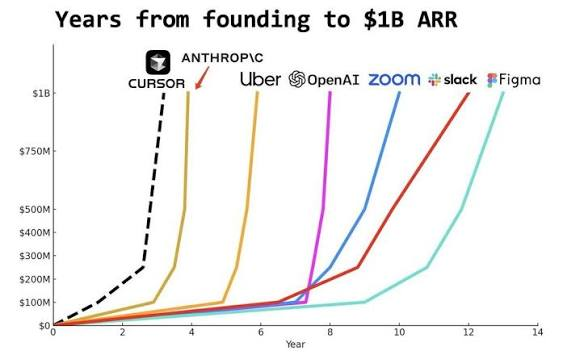
The vibe from a lot of the investors and founders and early employees I meet feel like they’re chopping this chart up and snorting it; it’s all that matters. Techno-drenched Ricky Bobby’s: “if you’re not first, you’re last.”
In Mark, chapter 8, Jesus Christ asks: “For what shall it profit a man, if he shall gain the whole world, and lose his own soul?” The real danger so many people are running is losing their soul. I don’t just mean, “come to Jesus” though that’s not bad advice. I mean our ability to believe anything worth building is worth working hard. That sense of personal sacrifice for personal outcomes. That your work and your striving is not lessened because somebody else hit a jackpot. That self-contained sense of satisfaction… we could lose that.
And I don’t mean that even the founders and early employees and VCs who are effectively gamble-pilled aren’t working hard. I know, for a fact, they work long hours at Kalshi. But there is clearly a mentality that is drifting across everything we do. Not just in tech, but across the spectrum of life. Chalk it up to economic frustration, geopolitical anxiety, cultural skepticism, institutional distrust; whatever it is. It feels like we’re losing the light of optimism that used to make building things to last feel more worthwhile than building things fast.
This week in Networked Conviction 009, my investing journal for paid subscribers: I’m working through why we should make startup valuations public, plus a Request for Startup for knowing what you own. The first section is free for everyone; read it here.