Kyle Harrison
← Bookshelf 
The Innovation Blind Spot
Related from this site
Key Takeaways
Kyle, in 2018 in Books: I first heard about Village Capital when I was an intern at the University Venture Fund in 2015. From there, I’ve always respected them as a firm from afar and had the chance to go to one of their events at Autodesk this year to better connect investors and social entrepreneurs. As part of the event, I was given a copy of Ross Baird’s book. If you’re looking for a perspective on impact investing, this is an incredibly valuable one.
Connections
No cross-book interconnections identified yet.
Highlights
Roam capture metadata — Author: Ross Baird · Reading Status: Books Read · Source: https://medium.com/@kwharrison13/2018-in-books-c4f812a37bd5 · Recommended By: Ross Baird · Tags: #Books
- ==Highlighted Quotes==
- ==START REVIEWING HERE>>>==
- “Investors everywhere have blind spots, and as a result, we’re overlooking most great ideas. Three quarters of venture capital goes to founders in just three states: New York, California, and Massachusetts. Some 10 percent goes to women founders, and just 1 percent to African Americans. That’s not right — and it’s not smart. We need everybody on the playing field if we’re going to remain the most innovative, entrepreneurial nation in the world.”
- “Huge parts of the system aren’t working. New firm creation in the United States is at a thirty-year low. The biggest investment firms in the country’s wealthiest cities aren’t delivering the best financial returns. And the structural problems in the system make all our other problems nearly impossible to solve. Even though we have more computing power in our pockets today that the entire world did fifty years ago, our food systems struggle to feed the world’s growing population, and our health and education infrastructure an’t take care of the current generation, let alone prepare the next one to lead.”
- “The idea that entrepreneurship is a meritocracy is a myth. In the real world, money flows to the ideas that are the most convenient to find or the most familiar, not necessarily those that are the best. Simply put, the blind spots in the way we innovate — the way we nurture, support, and invest in new ideas — make all our other problems even harder to solve.”
- “The blind spot: we artificially separate our jobs and our careers from our values.”
- “Instead of solving the biggest problems of the day, we’re putting billions of dollars into how to make mobile advertising and clickbait news more effective, and nudging people to buy more stuff.”
- “The [2016] election illustrates one basic truth that no poll can capture in full: many people feel that the basic social contract of the American Dream — if you have a great idea, solve problems, and work hard, you’ll be successful — is not true in an ever-globalizing world.”
- “Investors like to follow patterns; they often use the phrase ‘pattern recognition’ to justify decisions regarding where to invest their money.”
- “Because venture funds are under extreme pressure to deliver quick profits to investors, they prioritize short-term value capture over long-term value creation.”
- “Over time, smaller funds significantly outperform larger funds.”
- “If you’re unable to raise the money you need, investors often say you should ‘bootstrap’ — self fund your company. But most founders don’t have enough cash on hand to start their dream company — particularly since the Great Recession of 2008. Nor do founders necessarily have wealth in the form of home equity: the US home ownership rate in 2016 fell to its lowest since 1967. To add to the problem, student debt has grown over 100 percent in the last twenty years, particularly among graduates from for-profit and two-year colleges, which low-income people disproportionally attend. And founders who are in debt are less likely to start their own business after graduation.”
- “If you invest outside the hotbeds where everyone else is, and the company succeeds, on average you’ll pay 35 percent less to get the same end financial result.”
- “From a customer’s perspective, it doesn’t matter what a company’s founder looks like or where they went to school, only whether they make a great product.”
- “Many people describe their personal philanthropy as ‘giving back.’ But as eBay founder Pierre Omidyar once said, ‘Giving back implies, at one point, that you were taking. We’re dissociating what we do from what we value, and it’s becoming very difficult to improve the world as a result.”
- “I had an economics professor at the University of Virginia who said, ‘Decisions are a combination of information and values. This class teaches you the information. You have to develop your own code of values.”
- “The financialization of the economy means that what we invest in is no longer entrepreneurs making goods and producing services, but the creation and leverage of intermediaries who extract tolls, rents, and capital gains. The most valuable companies in the world, from Amazon to Walmart to Facebook to Google, do not produce goods or services but instead are trading companies who mediate financial transactions between producers and consumers.”
- “The simple fact is that selling YouTube to Google or Instagram to Facebook realizes success more quickly than investing in a clean energy company that will require years of research and development, or a healthcare company that needs to wait for FDA approval. ‘Investment’ for the short term is capturing value quickly. ‘Investment’ for the long term is creating value that lasts.”
- “It’s now who you know, it’s who you get to know” (Chris Matthews, Hardball)
- “Experts blamed economic cycles and cautioned the industry to ‘wait and see,’ but Bob hit the road and started talking to his customers” — reminds me of Warren Buffet’s ism of “be greedy when others are fearful and fearful when others are greedy.”
- “Bob understood that when your’e investing where no one else is, you can outperform those who are following the same patterns.”
- “Makers were better evaluators of new ideas; they tended to view their peers’ ideas not through a lens of ‘How well does this act resemble what has worked in the past?’ but rather ‘How likely is this to succeed in the future?”
- “The Maker looks at the idea and thinks of all the reasons why it will succeed. Whereas an assessment is an evaluation against a fixed framework, a forecast evaluates a probability that a certain outcome will happen.”
- “Later-stage venture capital and private equity investors deploying tens of millions of dollars in growth capital have years of evidence of a company’s performance and are able to make decisions based on assessing a company’s growth trajectory. But investing in new ideas is a forecasting decision, and we have substantial evidence that entrepreneurs are better at predicting whether an idea and its early execution will be successful.”
- “Whether it’s changing the funding process or encouraging a different pipeline, innovations around who gets a chance to access capital yield better outcomes.”
- “Have you ever heard of someone telling a middle-schooler they expect them to be a great entrepreneur.” (Jim Clifton, CEO, Gallup)
- “Broader societal trends back up what I’m seeing at a ground level: 69 percent of millennials value the impact of their investments over their financial returns.”
- “Buffett and other two-pocket thinkers are making two arguments. First, they’re arguing that nonprofits are better than companies at addressing social problems. Second, they’re arguing that companies without a social mission are better than mission-driven companies at making money. I believe these are both myths. Even if the first argument were true — if nonprofits were better at solving the world’s biggest problems — we would still run into another problem: the philanthropic sector is so small that even the most effective philanthropy in the world wouldn’t solve systemic problems. But the second argument is problematic, too. There is growing evidence — from customers, founders, employees, and investors — that it pays off, on the bottom line, to have a long-term mission that matters.”
- “In both the cases of Ben & Jerry’s and SKS, as the firm grew, the company often faced difficult decisions between company growth and social capital. But bigger may not always be better: I asked Vikram Gandhi, an investment banker who handled the SKS IPO, what went wrong, and he said, ‘The company wasn’t growing like a bank. It raised all this Silicon Valley money and was trying to grow as fast as a tech company. In its desire to look like a Silicon Valley tech company, it lost an understanding of the problem it was trying to solve.’”
- “Kim remembers, ‘I learned that the most important way to be happy is to codify what you want to be: What do you care about? And how can all aspects of your life — work, family, home — reflect that?” Kim recognized early on that the secret to happiness was one-pocket thinking.”
- “Do you wish to be great? Then begin by being. Do you desire to construct a high and lofty fabric? Think first about the foundations of humility. The higher your structure is to be, the deeper its foundation.” (St. Augustine)
- “Investors’ blind spots are almost always the result of good people trying to do the right thing and getting overloaded, rather than someone trying to be actively harmful.” — similar to heuristics in behavioral economics.
- “Type 1 errors occur when you pick the wrong idea; type 2 errors happen when you don’t ever look at the right idea.”

- “Type 2 solutions share a common trait: they are proactive. They involve going out and finding ideas — and the people and places from which they come — as well as viewing those ideas through a different and possibly unfamiliar lens. There are no shortcuts to avoiding type 2 errors; you have to invest the time in building the pipeline you want to invest in.”
- “The trait most strongly correlated with success was self-awareness. Let’s say an innovator is disorganized, but she’s aware of it. Or an entrepreneur is a jerk, and he knows it. Both are fine — and positively correlated with success. The second trait most correlated with success is whether a firm has a female cofounder. Based on the data, here’s my top piece of advice to any guy starting a company: be more self-aware, and get a woman as a cofounder.”
- “Know what you own, and know why you own it.” (Peter Lynch)
- “Bryce noticed something curious: the organizations Blue Sky was supporting were more interrelated than he would have thought. He imagined a woman who used to work at a strip club instead working for a living wage at Scarlet’s Bakery, which an investor could support, and living in an affordable home in Louisville, which an investor could also back. He had unintentionally created a portfolio in his mind. Bryce saw the future. To invest in this portfolio, he founded a firm he would call Access Ventures, in the process of becoming one of the world’s foremost one-pocket thinkers that you’ve likely never heard of.”
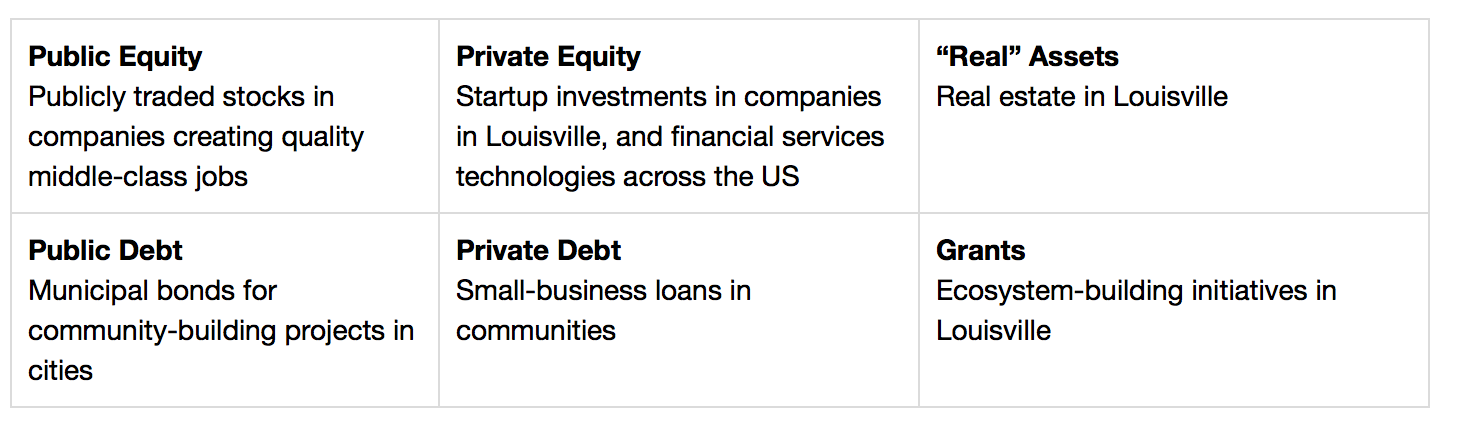
- “Most investors don’t price social and environmental risk in public equities until it’s too late.”
- “But many of these apps are dependent on venture capital subsidies. Uber lost $1.2B in the first half of 2016 — and passengers paid only 41 percent of the cost, with the rest subsidized by venture capital. Blue Apron has raised $200M, and Zeel has raised $13M. And the pensions of most Americans are subsidizing these perks. Venture capital funds are often raising capital from teachers and firefighters in New Mexico and Minnesota to subsidize food and massages for tech employees in San Francisco. In my experience, the kinds of technology that venture capital is investing in today is doing a tremendous amount for well-educated people on the coasts while doing little for middle-class America.”
- “In a one-pocket world, the cities, states, and countries that are managed with the lowest social and environmental risk are the ones that are the most prosperous.” (How do you measure this though?”
- “We don’t see more ESOPs because our current investment world is ‘one size fits all.’ One investment banker I spoke to at a well-known bank investigated how ESOPs could create more middle-class wealth. He discovered that ESOPs, if structured thoughtfully, are relatively a straightforward model for founders who want to sell shares in their company to members of their team. He asked his bank, ‘Why don’t we do this more often?’ He learned that the fee incentives that investment bankers received from ESOPs were substantially lower than they would be for a straight transaction: as a result, investment bankers had no incentive to do the hard work of helping founders sell their companies to their team members.”
- “We know that diverse teams have a competitive advantage: teams in the top quartile of gender diversity outperform teams in the bottom quartile by 15 percent, and teams in the top quartile of racial diversity outperform teams in the bottom 35 percent.”
- “Government has historically played a major role in economic development; federal, state, and city governments have offices that provide cash and tax incentives to bring in new jobs. But although we know that small businesses and new businesses create the vast majority of new jobs, economic development offices tend to focus on getting big businesses to move to their city or state. Government should build, not buy.”
- “The problem: most businesses that create jobs are highly illiquid for a while. These startup businesses are often too risky for a bank to lend to, and usually aren’t going to grow fast enough, or big enough, to fit into the venture capitalist’s box.”
- “The wrong way to find innovation, Hwang and Horowitt maintain, is to look for the next great idea; instead, investing in the right ecosystem creates an environment in which unexpected ideas can arise and thrive. Topophilia (From Greek topos “place” and -philia, “love of”) is a strong sense of place, which often becomes mixed with the sense of cultural identity among certain people and a love of certain aspects of such a place) is one way to describe why an ecosystem works: people love and invest in where they are.”
- “People don’t write books because they’ve got a great deal of wisdom to impart to somebody; they write books because they want to find the answers for themselves and share the search. It’s not ‘I have a thing to tell you,’ even if you say it is. It’s an exploration and a discovery.” (Shelby Foote)
- “Our heads-down drive for progress has hollowed out many communities. The thinking behind Peter Thiel’s maxim for entrepreneurs — ‘Be a monopoly’ — has caused a lot of people to lose their livelihoods and their dreams.”
- “The problem: When large conglomerates touch every part of everyday life, local problems are harder to solve. Today Walmart executives in Bentonville, Arkansas, and Facebook leadership in Palo Alto make centralized decisions about highly sensitive local problems, and we have fewer local leaders with an independent base and the knowledge of our communities’ problems needed to be able to solve them. As Justice Louis Brandeis once warned, we are becoming a nation of clerks.”
- “And big institutions don’t necessarily need to be the enemy — they just need to not be “too big to fail.” Google and Facebook will have better news and content and more relevant ads if they empower, rather than crowd out, local content producers. Banks, venture capital firms, and financial services institutions need to figure out how to invest at the topophilia level if they are going to get truly different, interesting, and profitable ideas. For our innovation economy to succeed in creating a better future, we need to create conditions where everyone is able to play in the innovation game.”
- “Do we change the system, and then hope that people’s values change? Or do we change people’s values, and then hope that the system changes to match?”
- “But I think the question assumes a false choice. The economic decisions we make are composed of values plus information. But in a big-data world where we are pushing to maximize quarterly earnings and focusing on the most perfect information possible, we have lost sight of the values we care about. We prioritize the quarterly share price of Lowe’s, Walmart, and Home Depot and then later worry about the social fabric of Orange, Virginia, but we don’t recognize that they are interconnected. We can’t price the long-term social and environmental risks that we create with a two-pocket world, so we don’t value them.”
- “I didn’t start Village Capital — or write this book — because I think I know all the answers to what’s wrong. I do know that the system isn’t working, and I hope that my career can help me figure out how to make things better.”
Referenced in
- Ross Baird note