What's On Deck for Business School
| Author | Jake Singer |
|---|---|
| Published | November 17, 2020 |
| Format | Article |
| Original | Read the original |
What’s On Deck for Business School
An issue of The Flywheel arguing that On Deck is on its way to disrupting the MBA. Singer, an MBA graduate, disclosed that he had been attending On Deck programs since that October, unpaid and with no stake in the company.
Summary
Singer argues business school is “not really school.” Students pay roughly $200,000 for three Jobs to Be Done: a network, career opportunities, and a credential. A challenger would need to deliver all three at lower cost with a better business model. He reviews earlier attempts: income share agreements like Lambda School’s and equity models like Y Combinator’s realign incentives, and MOOCs like Coursera change delivery, but none replaces the full package.
On Deck began as in-person dinners for tech talent and became an online founder fellowship (ODF) run by founder Erik Torenberg and CEO David Booth, charging an upfront fee and taking no equity. Singer describes each fellowship as two linked flywheels. The generic community flywheel, adapted from Nick deWilde, runs FOMO → applications → selectivity → quality → engagement → alumni satisfaction → referrals. The ODF-specific one runs companies formed → perks and partnerships → good outcomes → more companies, and outcomes feed FOMO. Around that sits a multi-fellowship flywheel: by asking what founders need next, On Deck spun up angel, VC, hiring, no-code, writer, podcast and scale fellowships, each of which, in Booth’s phrase, “bootstraps the supply to another fellowship’s demand.”
Measured against the MBA, he finds On Deck strong on network (bonds formed around shared identity rather than shared circumstance), improving on jobs, and weakest on credential, citing Byrne Hobart and Torenberg on peer-to-peer credentials. Its online cost structure lets it iterate faster, and its business model of many smaller purchases across a career beats tuition plus donation requests. He does not predict the end of business school, but expects some schools not to survive.
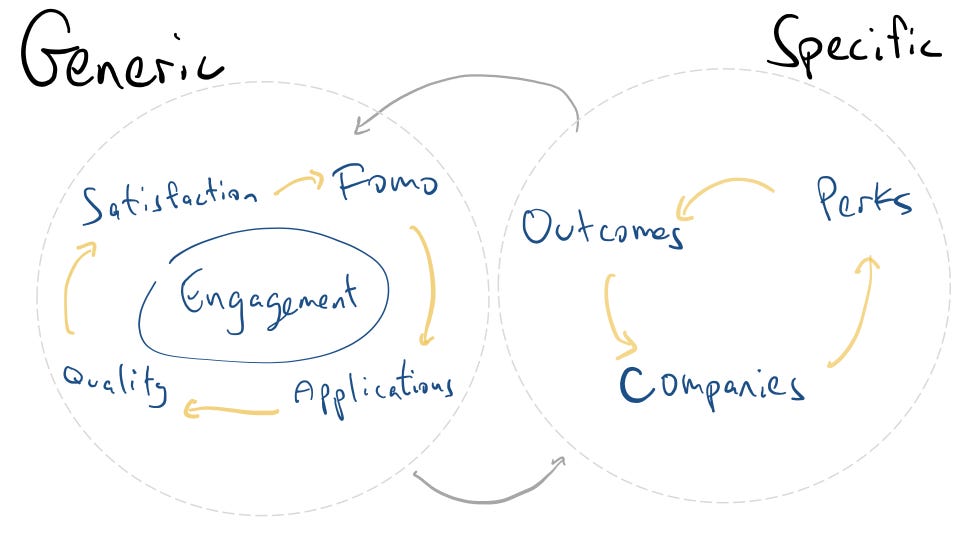
On Deck’s generic community flywheel linked to the founder-fellowship flywheel (image: Jake Singer, The Flywheel).
Key points
- Business school’s real products are network, jobs and credential, not classes.
- ISAs, equity models and MOOCs each fix one piece; none replaces the bundle.
- On Deck’s fellowships each run a generic community flywheel plus a specific one, and new fellowships supply each other’s demand.
- Versus the MBA: stronger network, growing job pipeline, weaker credential, much lower cost, better long-run business model.
- A follow-up interview with Booth and Torenberg ran three days later.
Connections
- The Flywheel · follows Zillow and the Innovator’s Dilemma; follow-up: On Deck Follow Up — Interview with David Booth and Erik Torenberg
- Organizations: On Deck, Lambda School, Y Combinator, Coursera
- People: Erik Torenberg, David Booth, Byrne Hobart, Nick deWilde, Jack Butcher
- Concepts: Jobs to Be Done, Income Share Agreements, Credentials, Community, Disruption, Flywheels