Warren Buffett — Capital Camp Talk (David Perell)
| Author | David Perell |
|---|---|
| Format | Talk |
| Original | Read the original |
Good ideas are not enough; Warren Buffett has die-hard fans because his letters are personal, observational and playful, so they relate to, teach and entertain the reader, and any investor can borrow that “POP” formula.
Warren Buffett — Capital Camp Talk (David Perell)
[PARTIAL] This is a slide deck, not a transcript. Captured on 2026-11-18 by stepping through all 80 slides in a browser and reading the text layer; about 20 slides are image-only (podcast covers, paintings, decorative frames) and slide 72 is an embedded video of Howard Marks answering “What do you admire about Warren Buffett’s writing?”, which was not transcribed. Whatever the speaker said aloud is not in the source. Delivered at Capital Camp.
Key claims
- Ideas lose to communication. The deck opens on four slides in sequence: “Your ideas are great.” / “But the way you’re communicating them is not.” / “The world doesn’t reward the people with the best ideas.” / “The world rewards the people who are best at communicating ideas.”
- A 2x2 of clear vs. memorable. A deliberately bloated sentence (“Only in the eventual abatement of market exuberance does the clarity emerge…”) is labelled “Unclear and not memorable.” A plain restatement (“There are lots of people who appear to have been skillful, but until they’re tested by adverse circumstances…”) is “Clear, but not memorable,” and gets a “BORING.” slide. Buffett’s “you only find out who is swimming naked when the tide goes out” is the “Clear and memorable” corner.
- Information isn’t enough; you need connection. “People aren’t die-hard fans of Buffett just because he’s rich or smart… People are die-hard fans of Buffett because they feel a connection to him.”
- Writing is not secondary to doing. A “Doing Things vs. Writing Things” slide is followed by “This is a myth.” A build of slides layers the labels Author, Founder, Pioneer and Leader (under the heading “Archegos”) onto Buffett, ending “It’s not just that Buffett’s ideas are good. It’s that he communicates them well too.”
- The POP framework. Buffett “relates to his readers,” “teaches his readers” and “entertains his readers,” which the deck names Personal, Observational and Playful, “Write with POP.”
- Personal = insert yourself and tell a story. Using a worked example in Buffett’s voice about his grandfather Ernest’s $1,000 bill, the instructions are “Tell a story. Share a personal experience that helps your reader picture a scene,” then “Insert yourself. Why does this matter to you? How did this experience change the way you live?”
- Observational = distill your wisdom, teach a lesson, make it actionable. “Give your reader a clear next step. Answer: ‘What does this look like in practice?’”
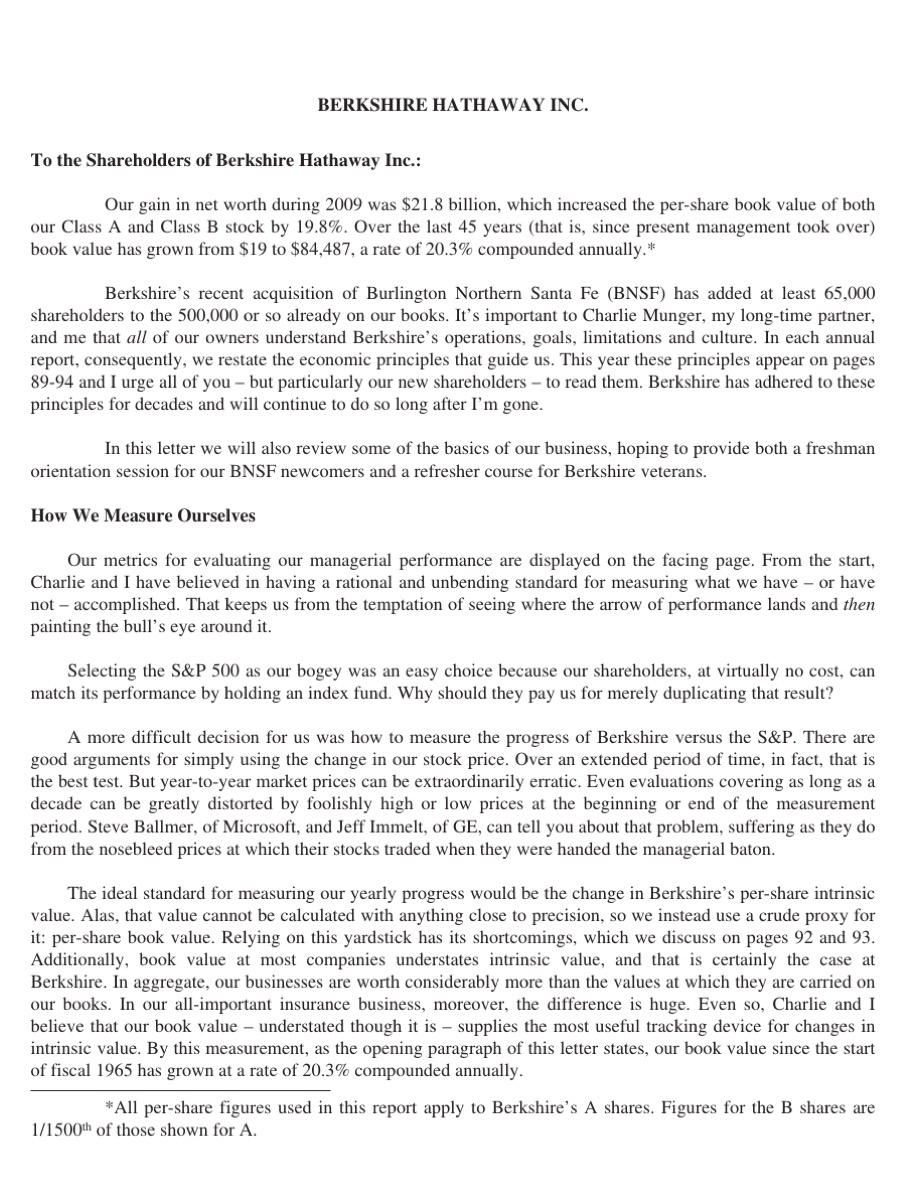
- Playful = entertain. The jargon sentence is called “complicated jumbo”; the simpler version is “not going to create a connection with your reader”; the payoff is the Berkshire line “whatever the world’s problems, our checks will clear… you only find out who is swimming naked when the tide goes out.”
- The ask is to read differently, not to do anything new. “What do you do now?” / “Nothing… just read differently.” The closing slides recap Personal, Observational, Playful and end “Write with POP. (But don’t swim naked).”
Notable quotes
“The world doesn’t reward the people with the best ideas. The world rewards the people who are best at communicating ideas.”
“People aren’t die-hard fans of Buffett just because he’s rich or smart. People are die-hard fans of Buffett because they feel a connection to him.”
“It’s not just that Buffett’s ideas are good. It’s that he communicates them well too.”
“He relates to his readers. He teaches his readers. He entertains his readers.”
“Insert yourself. Why does this matter to you? How did this experience change the way you live?”
“At Berkshire, we retain our risks and depend on no one. And whatever the world’s problems, our checks will clear. After all, you only find out who is swimming naked when the tide goes out.” (quoted on the slides as Buffett’s)
“What do you do now? Nothing… just read differently.”
Charts and figures
How it connects
- Capital Camp — the event; the companion deck from the same speaker is Write Like a Comedian — Capital Camp (David Perell).
- Warren Buffett · Berkshire Hathaway Annual Letters · Shareholder Letters — the letters are the whole case study.
- Howard Marks — appears in an embedded video on what he admires in Buffett’s writing.
- David Perell · Online Writing · Clear Writing — the clear-vs-memorable grid is a compact version of the case for plain, personal prose.