State of Venture (Makena Capital & Carta, Feb 2026)
| Author | Carta Insights, with Makena Capital |
|---|---|
| Published | February 2026 |
| Format | Deck |
| Original | Read the original |
Three conversations dominate venture in early 2026 (early-stage prices, portfolio strategy, liquidity), and Carta’s data says prices are bifurcating at the top, the Bay Area is its own market, and exits are finally reopening, mostly through M&A and secondaries concentrated in a few companies.
State of Venture (Makena Capital & Carta, Feb 2026)
A 29-slide Google Slides deck titled Makena Capital & Carta Present: The State of Venture, marked “Published: Feb 2026” under Carta Insights. The deck says “Yes. You can have this deck.” Most of the substance is in chart images; the claims below are read off the charts. A PDF export is kept in the wiki’s private attachments as an anti-link-rot copy.
Key claims
- The framing is three conversations “among many.” Early-stage prices (“valuations and round sizes in perpetual growth mode”), portfolio strategy (“does the strategy you raised on make sense in today’s market?”) and liquidity (“IPOs? M&A? Secondaries?”). The deck opens on a Peter Walker quote, “What the hell is happening?”, and the portfolio-strategy section opens on Josh Kushner of Thrive Capital: “We do not hedge.”
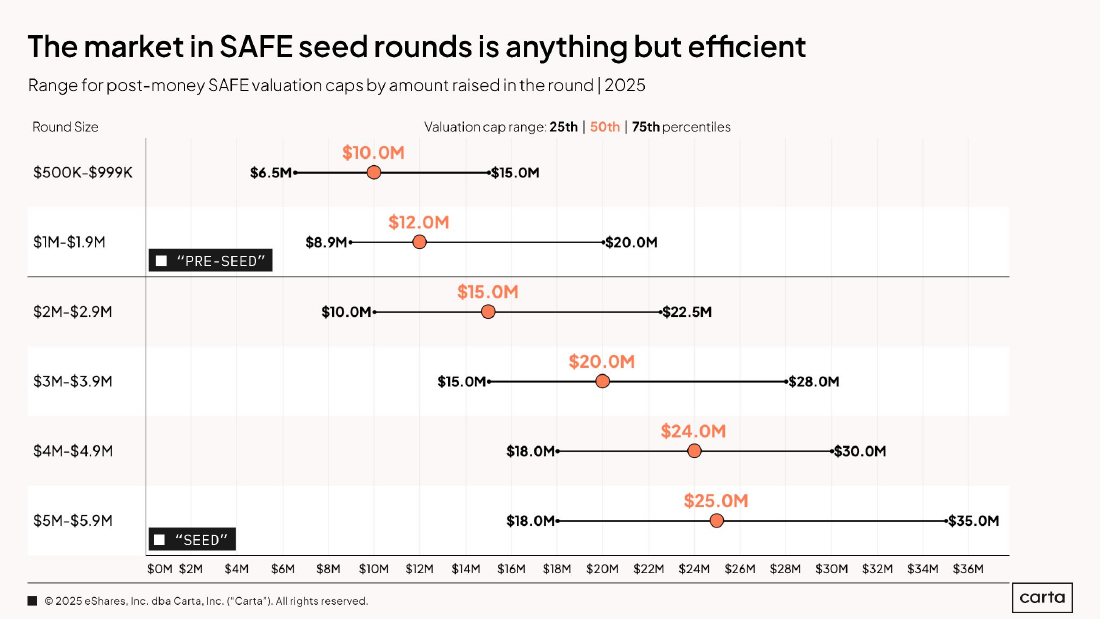
- SAFE pricing at seed is noisy. 2025 post-money SAFE caps by round size: a $500K–$999K round has a median cap of $10.0M (25th–75th: $6.5M–$15.0M); $2M–$2.9M, $15.0M; $5M–$5.9M, $25.0M with a range of $18.0M–$35.0M. The deck’s headline is that the market “is anything but efficient.”
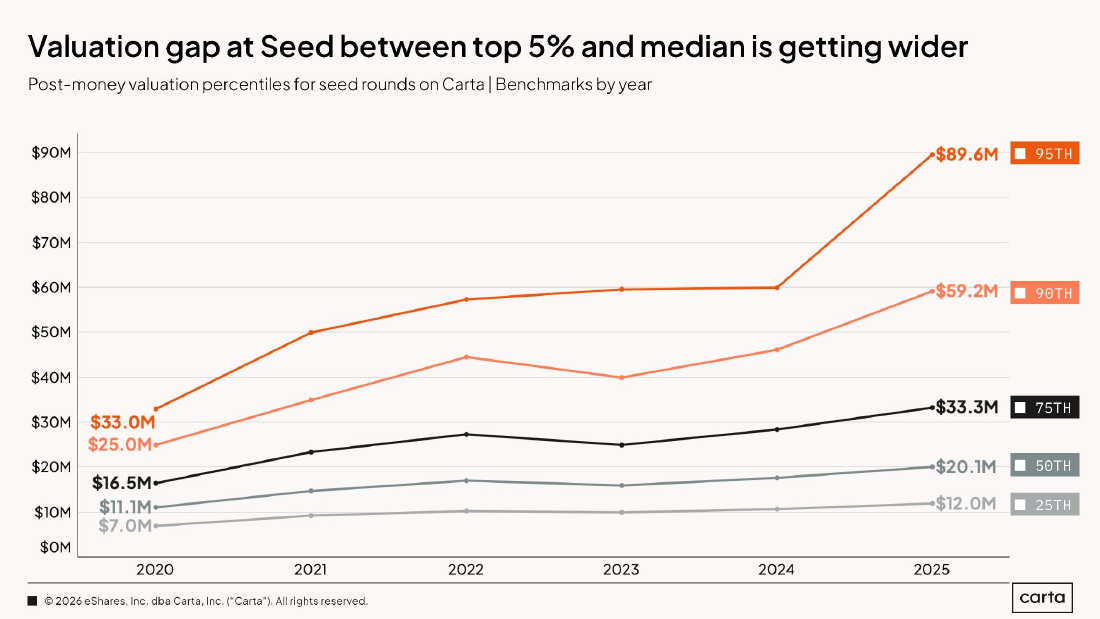
- The top of seed has pulled away. Seed post-money valuations from 2020 to 2025: the median went $11.1M to $20.1M, the 75th percentile $16.5M to $33.3M, and the 95th percentile $33.0M to $89.6M, with most of that jump in 2025. Series A shows the same shape: median $39.0M to $61.6M, 95th percentile $143.0M to $300.0M.
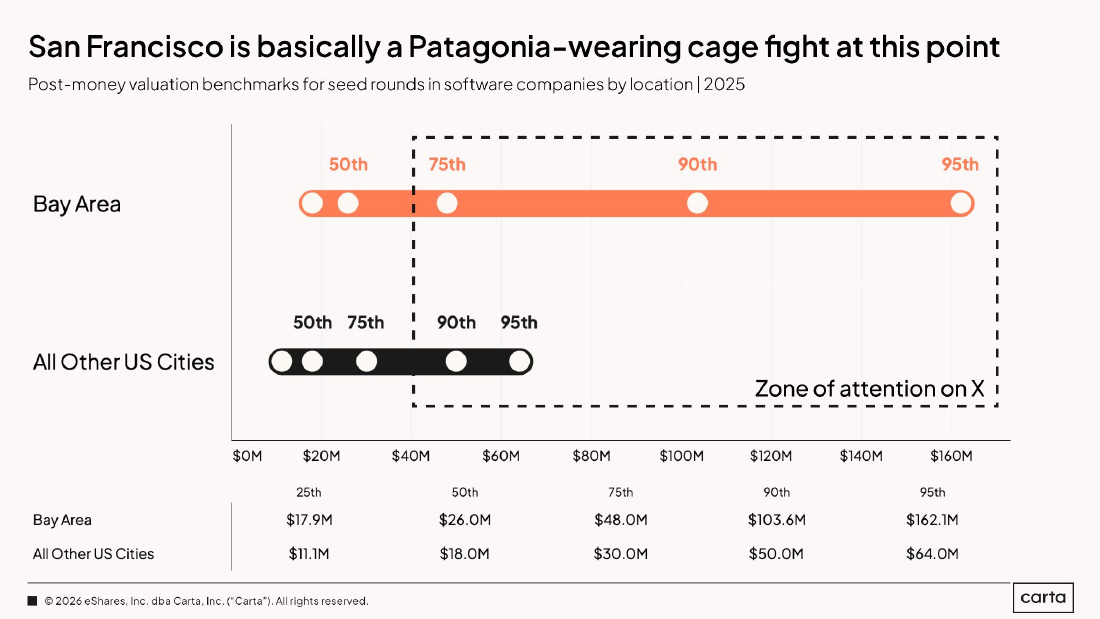
- Geography is a price. 2025 seed medians by US region: Midwest $12M, South $19M, Northeast $20M, West $23M (90th percentiles $37M, $51M, $50M, $70M). For software seed rounds, Bay Area percentiles run $17.9M / $26.0M / $48.0M / $103.6M / $162.1M (25th to 95th) against $11.1M / $18.0M / $30.0M / $50.0M / $64.0M for all other US cities. The slide title calls San Francisco “a Patagonia-wearing cage fight,” and labels the upper band the “Zone of attention on X.”
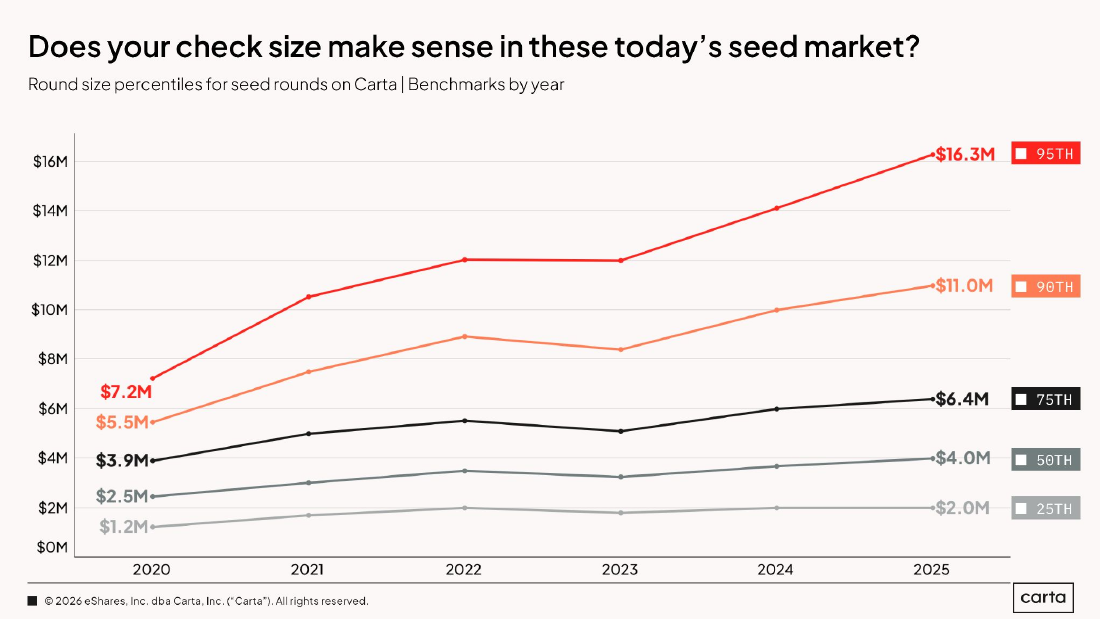
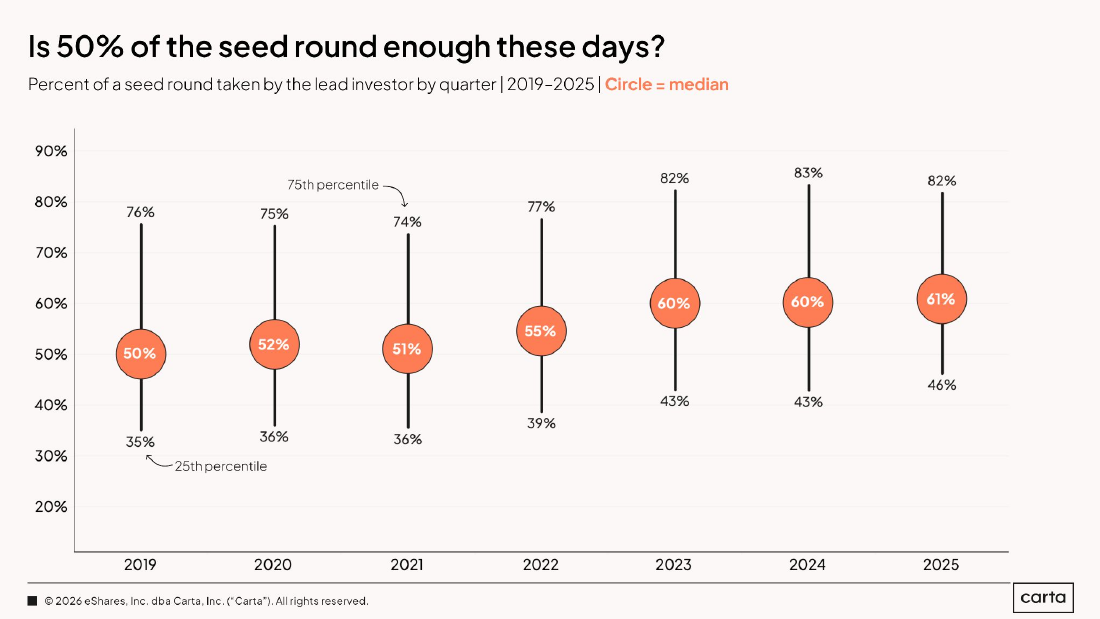
- Rounds are bigger and leads take more of them. Median seed round size rose from $2.5M (2020) to $4.0M (2025), the 95th percentile from $7.2M to $16.3M; the 2025 median lead check was $2.0M against a $4.0M median round. The median lead investor took 50% of a seed round in 2019 and 61% in 2025. Bridge rounds are common: 29% of seed companies and 28% of Series A companies raised one in 2025 (averages 27% and 26%).
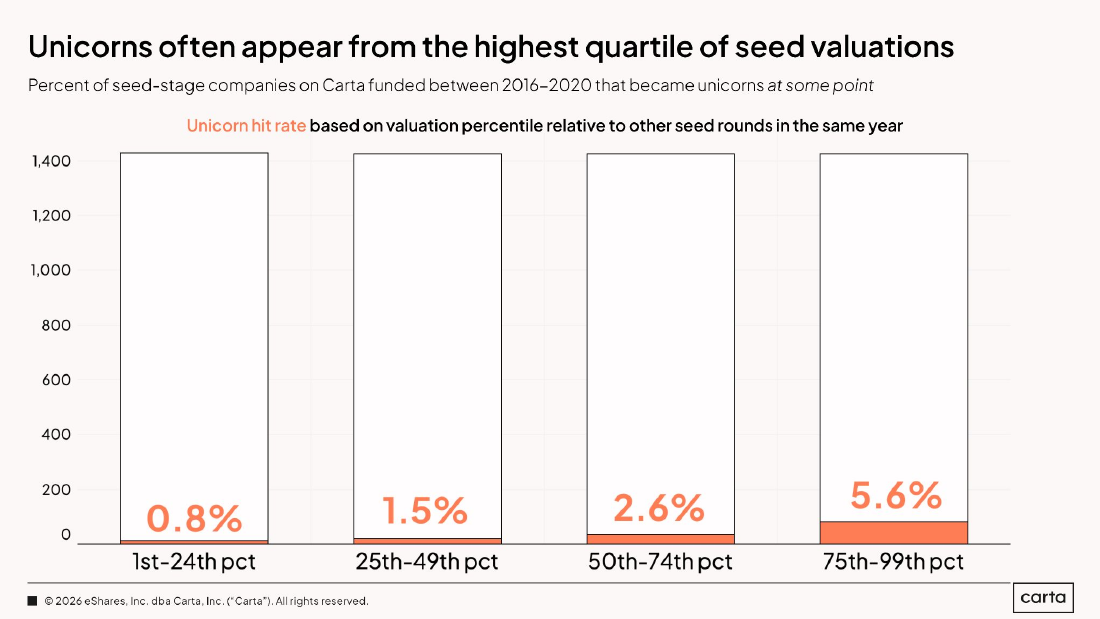
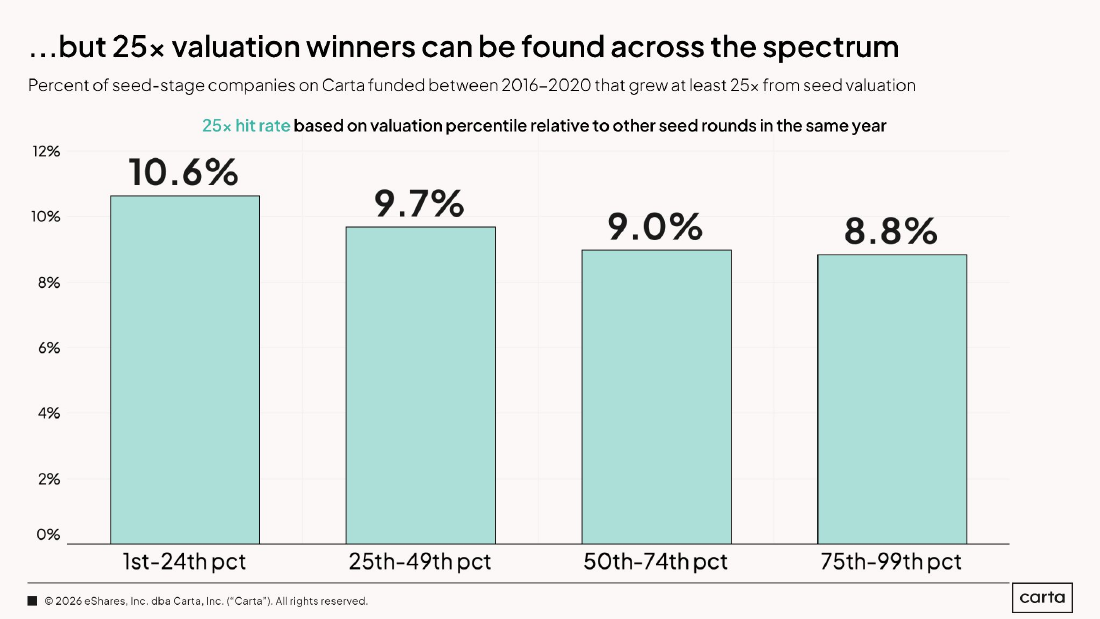
- Price predicts unicorns but not multiples. Of seed companies funded 2016–2020, the unicorn hit rate rises with seed valuation percentile, from 0.8% (1st–24th) to 5.6% (75th–99th). But the share that grew at least 25x from seed valuation runs the other way, from 10.6% in the cheapest quartile to 8.8% in the most expensive.
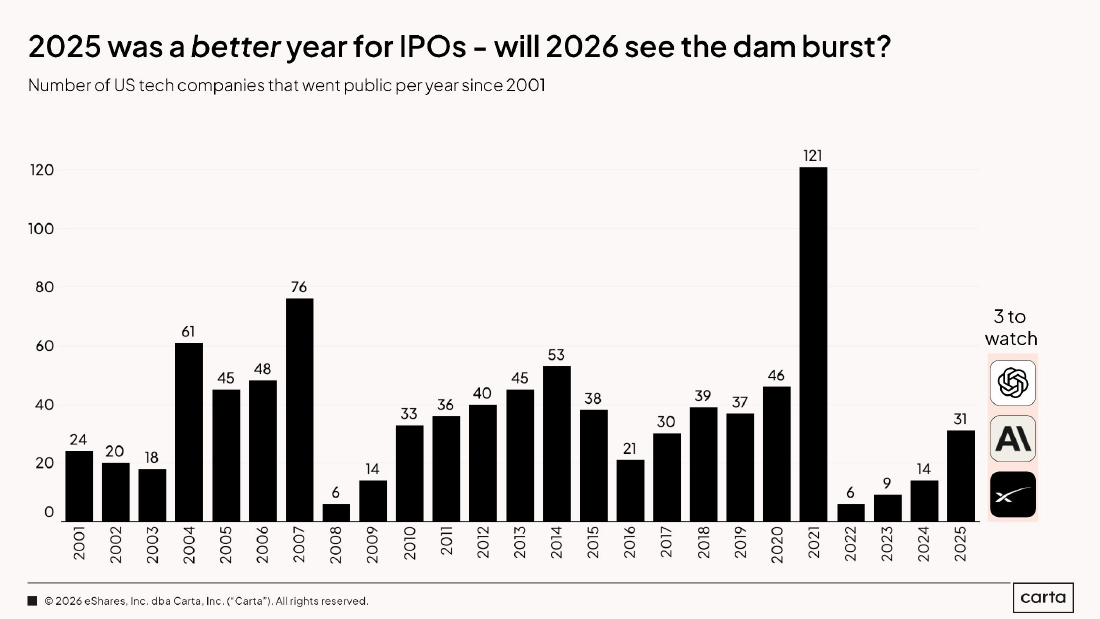
- IPOs recovered but remain thin. US tech IPOs: 121 in 2021, 6 in 2022, 9 in 2023, 14 in 2024, 31 in 2025. The slide asks whether 2026 “will see the dam burst,” with OpenAI, Anthropic and SpaceX shown as “3 to watch.”
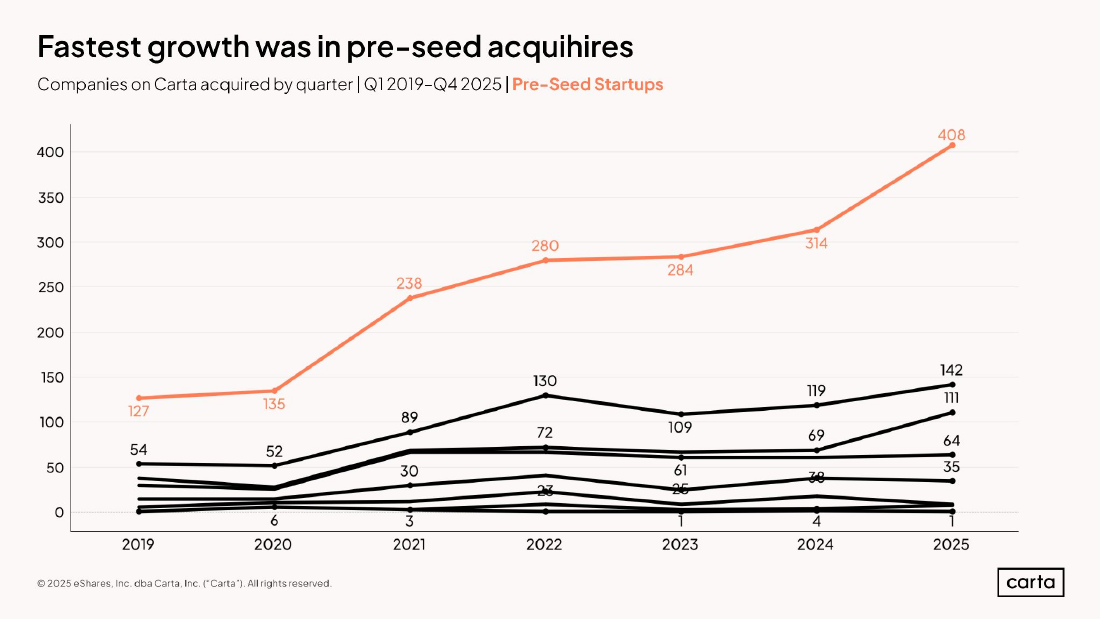
- M&A is the exit that is working, especially tiny ones. Carta companies acquired per quarter climbed from 180 in Q1 2025 to 232 in Q4 2025. Pre-seed acquisitions grew fastest, from 127 (2019) to 408 (2025); by stage in 2025, Series A had 142, Seed 111, Series B 64, Series C+ 53. See Acquihires.
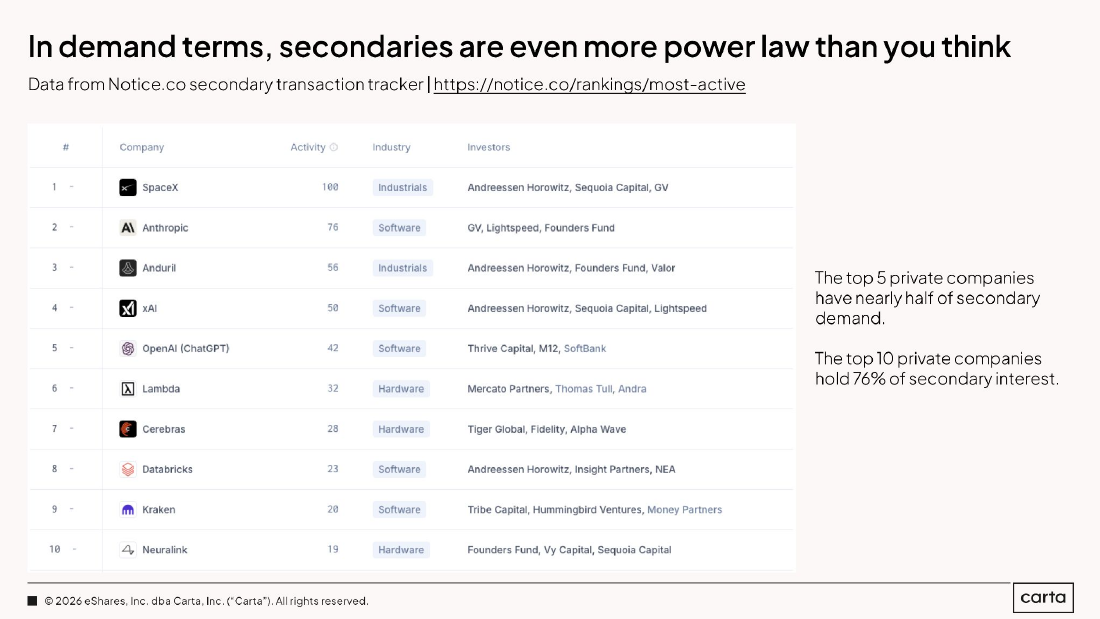
- Secondary liquidity is back and concentrated. Tender offers hit 47 in Q4 2025, above the 46 of Q4 2021. Institutional secondary transactions touched 754 companies and $11.0B of notional value in 2025 (vs. 855 and $12.6B in 2021, 504 and $6.0B in 2023). Citing Notice.co’s tracker, the top five private companies (SpaceX, Anthropic, Anduril, xAI, OpenAI) draw nearly half of secondary demand and the top ten 76%, which the deck calls “even more power law than you think” (Power Law).
Notable quotes
“What the hell is happening?” — Peter Walker, Head of Insights, Carta (slide 4)
“We do not hedge” — Josh Kushner, Thrive Capital (slide 12)
“The market in SAFE seed rounds is anything but efficient” (slide 6 title)
“San Francisco is basically a Patagonia-wearing cage fight at this point” (slide 10 title)
“Unicorns often appear from the highest quartile of seed valuations …but 25x valuation winners can be found across the spectrum” (slides 17–18 titles)
“In demand terms, secondaries are even more power law than you think” (slide 26 title)
“The top 10 private companies hold 76% of secondary interest.” (slide 26)
“We are an ERP for Venture Capital, Private Equity, and Private Credit.” (slide 29, Carta describing itself)
Charts and figures
How it connects
- Carta and Peter Walker: Walker’s Carta Insights charts are the data layer under a lot of 2025–2026 venture discourse.
- Seed Rounds, Seed Stage Valuation and SAFE: the price data. The unicorn-vs-25x split (slides 17–18) is the deck’s most useful finding for a seed investor, since paying up correlates with unicorns but not with multiples.
- Secondaries, IPO Market, M&A and Acquihires: the liquidity section.
- Power Law: secondary demand concentrating in ten names is the same distribution showing up in the exit market.
- Josh Kushner and Thrive Capital: “We do not hedge” is the epigraph for the portfolio-strategy section.
- The McDonaldization of Venture Capital and The Bifurcation of Capital is Inevitable: Kyle’s essays on the split between scale players and everyone else, which this deck’s percentile spreads illustrate.