Don't Die a Point Solution
Don’t Die a Point Solution
Author: Evan Armstrong (The Leverage) URL: https://www.gettheleverage.com/p/dont-die-a-point-solution One-line: Podium survived ServiceTitan’s attempt to cut it off because it had already stopped being a point solution: an early, all-in bet on agents let it become an agent-native system of record — and coding agents now make the old system-of-record moat far easier to cross.
[PARTIAL] This capture is the free email preview. It cuts off at “Podium is a case of SaaS theory becoming a competitive reality. Here’s how it shakes out…” — everything after that (Armstrong’s account of how the shift plays out) is behind “Keep reading with a 7-day free trial” and is NOT in this capture.
Key claims
- The ultimatum backfired. Roughly 1,000 HVAC contractors got an email from ServiceTitan, their system of record, giving them 30 days — in August, their busiest month — to rip out Podium, the point solution that handled their messaging. Within 24 hours Podium booked over 100 demos from those exact customers. In a “pre-AI, 2021 world,” Armstrong says, the system of record would have held all the data and all the power.
- The two are now direct competitors. ServiceTitan’s president says it is building “the AI operating system for the trades”; Podium’s product is literally named the AIOS. Podium is trying to become the system of record — in this vertical a field service management platform (FSM) — so “one of the two companies has to die in the arena.”
- Podium’s turnaround came first, then the AI bet. Months after raising $201M at a $3B valuation and doing “all the ZIRP stuff,” Podium — with over $100M in ARR — realized churn and burn would leave it out of money or customers within 18 months. Eric Rea and co-founder Dennis Steele cut staff and spent 18 months rebuilding department by department, emerging profitable. In 2023 they shipped their first agent, stopped all other product work, and pivoted the entire engineering team to agents. Armstrong groups Podium with Notion and Intercom as rare legacy SaaS companies that became fully AI-native.
- ServiceTitan had AI early but not conviction. It launched Titan Intelligence in 2022 as a product suite, but didn’t commit to an “agentic operating system,” driven by an AI-first CTPO poached from Figma, until March 2026 — a nearly three-year gap that let Podium build agent-first.
- Agents 5x’d contract value. Podium’s contracts went from roughly $6,500 a year in the SaaS era to $30–40K once agents could do a customer service rep’s work (median US CSR pay: $42,830), tapping bigger budgets. ServiceTitan also sells voice agents, but as an incumbent product bolted onto an expensive system-of-record platform. Neither sells its own models — both rely on tech from places like OpenAI — “but tech debt and legacy define destiny.”
- No SMB wants to click around in a product. Podium’s FSM is agent-first: an HVAC rep tells an orchestrator agent called Operator what they want and it schedules, routes and does the rest. ServiceTitan’s equivalent, Atlas, is by its own copy a “sidekick” living inside the existing dashboard. Refound around agents and “the dashboard becomes the legacy interface you check occasionally.”
- Coding agents erode the system-of-record moat. Rea says a system-of-record migration used to take 3–4 months on average and now takes about one; a large customer recently moved onto Podium in three days. The moat moves to a combination of agent infrastructure, communication tools, and payments/financial flows.
- The platform itself gets redefined. Rea’s old law of SMB SaaS — “You either die a point solution or live long enough to see yourself become a platform” — still holds, but with coding agents raising the ambition and speed of roadmaps 10x, the platform can grow from a revenue tool into an all-encompassing “do everything for me” product.
Notable quotes
“There is a specific kind of email you do not want to receive in August if you run an HVAC company.”
“…our churn was so high and our burn was so high that you’d either run out of money or customers in 18 months.” — Eric Rea
“18 months prior we were going out of business. We weren’t going to fall for sunk cost fallacy, and just went for it.” — Eric Rea, on pivoting all of engineering to agents
“Neither company is selling its own models — both rely on tech from places like OpenAI — but tech debt and legacy define destiny.”
“When you refound around agents for SMB operators, the dashboard becomes the legacy interface you check occasionally.”
“You either die a point solution or live long enough to see yourself become a platform.” — Eric Rea
“Coding agents mean that system-of-record migration is suddenly much easier.”
Charts and figures
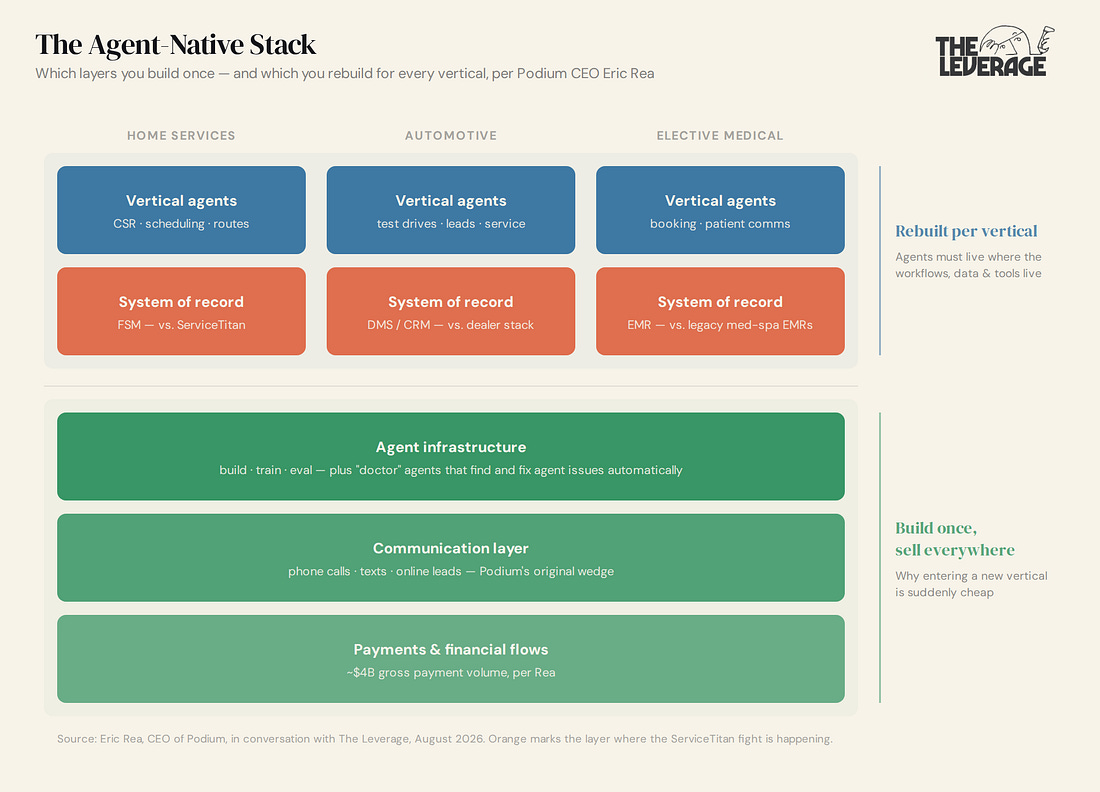 “The Agent-Native Stack,” per Podium CEO Eric Rea — Armstrong’s picture of “the new system of record.” Orange marks the system-of-record layer where the ServiceTitan fight is happening; the green layers (agent infrastructure, communication, ~$4B of payment volume) are why entering a new vertical is suddenly cheap.
How it connects
- Podium — the company that survived by rebuilding as a full AI operating system (the AIOS, with its Operator orchestrator).
- ServiceTitan — the vertical SaaS incumbent that tried to use its system-of-record position to force out a point solution, and whose Atlas “sidekick” is the foil to Operator.
- Eric Rea — Podium CEO and co-founder; Armstrong’s source for the turnaround story, the ACV numbers, and the migration-time collapse.
- Evan Armstrong — author; also cited in Kyle’s Updating The Hype Cycle and co-author of Building Informational Leverage (with Evan Armstrong).
- SaaS — the vertical SaaS vs. point solution dynamic is the central tension of the piece.
- AI Agents — Podium’s pivot to an agent-first architecture is what enabled its transformation and the 5x jump in contract value.
- Vertical SaaS — ServiceTitan exemplifies the vertical SaaS platform threatening point solutions.
- Point Solutions — the category at existential risk from both AI and vertical platform consolidation; the title’s warning.
- Systems of Record — field service management systems (ServiceTitan, Podium’s AIOS) are the systems of record at stake, and coding agents shrink their migration moat from months to days.
- Moats — Armstrong’s claim that the moat “moves” from the system of record to agent infrastructure, communications and payments.
- Revisiting Competitive Moats — Kyle’s essay treating Salesforce as the system of record that everything else builds on; Podium is a case of that position being contested.
- The Vertical AI Playbook — argues vertical AI winners will redesign workflows rather than bolt on copilots; Podium vs. ServiceTitan’s “sidekick” is that argument in a live market.
- Control Points 2.0 — maps the control points inside a vertical; the agent-native stack is a new map of where control sits.
- The Vertical SaaS Knowledge Project — Introduction — the vertical SaaS frame this piece updates for agents.
- Zero Interest Rate Phenomenon (ZIRP) — Podium’s 2021 $3B round and “all the ZIRP stuff” are the excess its 18-month rebuild burned off.
- Notion and Intercom — named alongside Podium as the select few legacy SaaS companies that became fully AI-native.
- Figma — where ServiceTitan poached its AI-first CTPO in 2026.
- OpenAI — the kind of model provider both Podium and ServiceTitan build on rather than training their own.