WikiTruth: Why We Suck at Caring What’s Real

Written with a Junto. By Kyle Harrison, as a result of the intellectual rigor of a Junto with Tim Riser, Erik Hansen, Rachel Wortmann, and Minna Wang.
We’re losing our checks and balances. I’m not talking about the branches of government and the Constitution. I mean it more personally. We, as people, are losing our checks and balances on reality. And no, I don’t mean virtual reality or the simulation we’re living in. Woof. Let’s start again.
In 2014, I had the opportunity to participate in the Pembroke-King’s Programme at the University of Cambridge where I enrolled as a Cambridge student, lived on the grounds, had access to the library, pondered the lives of the ducks as they waddled across the grass that we couldn’t walk on. While there, I took a class called “The New City.” The premise of the class revolved around urban innovation and what goes into making a community, what defines the spaces that we live in. (Side note: I’ve told this story before.) ‘In one of my class sessions, we were talking about population, and my teacher explained that the birth rate in Japan was dangerously low. Later, I was having a conversation with a colleague, and I mentioned this to her and she said, “Yes, but the abstinence rates of Japan aren’t going up. So people are still having sex, they’re just not having children.”
My initial reaction was, “…how could you possibly know that that’s true?” But then I realized…how did I know that what I had said was true? I had just heard it in a class, I hadn’t checked into it. So I mumbled, “you’re probably right.” And we moved on. Well, I decided to look further into the question. Turns out, she was totally wrong. In fact, 59% of Japanese women have “no interest in sex.”
That experience has always stuck with me. As a smart, well-spoken person, she had taken advantage of my ignorance on that topic to say something that wasn’t true. And that’s not inherently evil, she’s a good person. But at a time when we have direct access to the knowledge of all mankind via the internet, we have a responsibility to understand and support what is observably true and to try and become educated as to what is and isn’t real.’
Sometimes, we can have a conversation about being informed, responsible thinkers, and leave it at that. But there’s more to it than that. Another experience I had while in England was the opportunity to go to Wikimania 2014. I’ve never edited Wikipedia in my life, but for some reason when I was in the library and the ad popped up telling me I could go, I went. And that has made all the difference. Okay, not all the difference. But like, a part of a difference.
Don’t believe me?
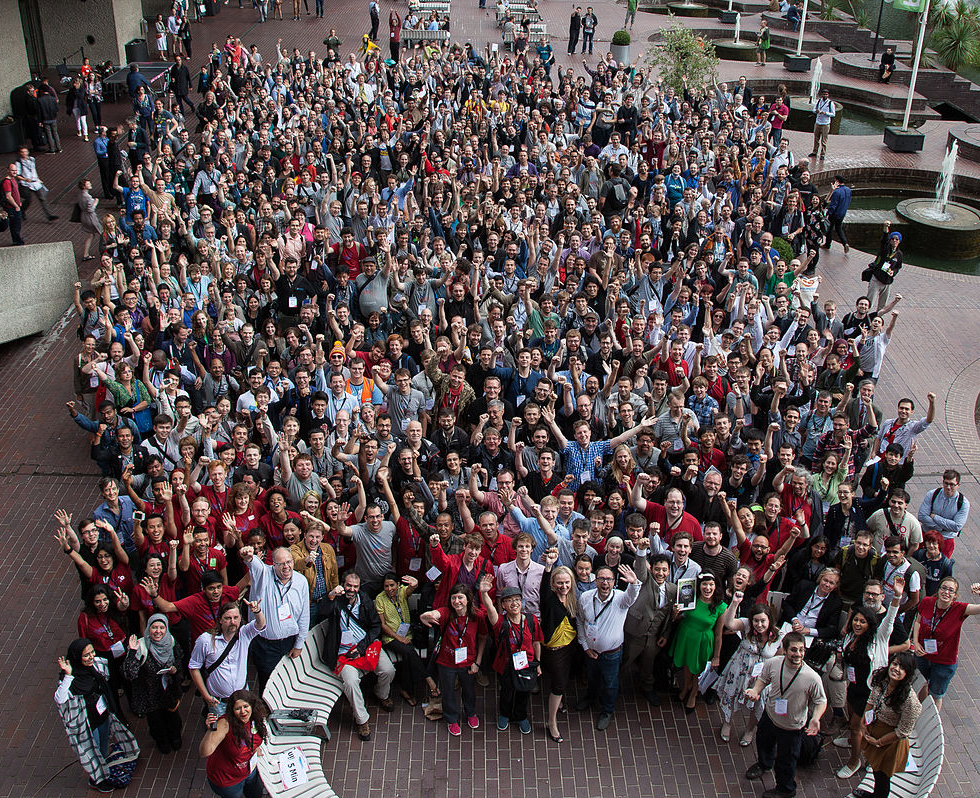
Look closely…
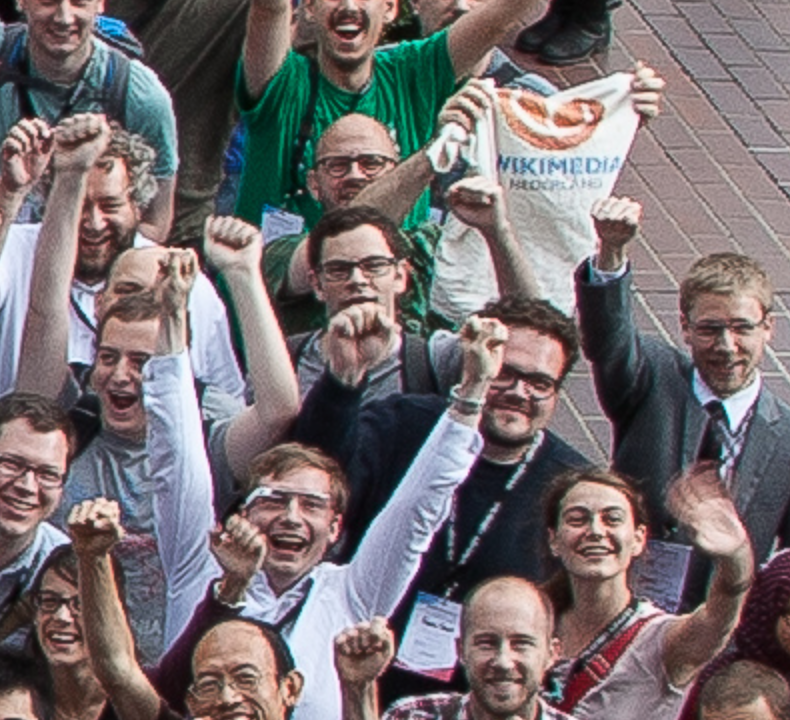
Boom. Right in front of the nerd wearing Google Glass.
What I learned at Wikimania was something I had felt for a long time but never had great words for. When I was in high school, the school librarian had edited the Wikipedia page for a small island kingdom in the south pacific and made himself the king of it. The post stayed that way for years. He thought it was hilarious. I always felt bad about it. Here we have a free, open-source project to leverage communal learning and catalogue the sum total of human knowledge, and this guy comes along to say “yeah, but you suck, so… now I’m a king.”
And as I would come to learn, Wikipedia hoaxes like this have been a bit widespread, from making up details about a children’s book series to straight up fabricating a war between two actual nations. The perpetrator of one of these hoaxes, who claimed to have done it “accidentally,” was pretty nonchalant about it. “In the end, I don’t feel as bad about my…Wikipedia lie, and what it might say about my integrity both as a journalist and as a person, as I do about what it says about the future of information in the digital age.”
While I was at Wikimania, I got two very clear messages: (1) we need to be more collaborative and inviting, and (2) we’re not taking the full advantage of the wonderful thing we have here. There were tons of presentations about how to more effectively use Wikipedia in classes, including using an simplified offline version of WIkipedia for a project called One Laptop Per Child, wher they would give a cheap, durable laptop to children in developing countries, and they could use them to learn. One such Wikipedia-fluent educator, Audrey Watters, talked about this new digital literacy and how we can teach more people to more capable of handling the information world we live in.
But first, it is important to make absolutely clear that this is not just about Wikipedia. Watters makes that clear when she quotes Mike Caulfield:
“In a world where Elsevier was recently discovered to have published half a dozen fake journals for drug companies, a world where more recently 60 articles were retracted from the Journal of Vibration and Control due to a ‘citation ring,’ and a world where med research postdocs are faking anti-cancer trials and still working, I’m not sure to what we’re comparing this [Wikipedia] ‘hoax.’”
There is so much more to this than unidentified mistakes, or knowledge vandalism, on Wikipedia. People are willfully and deliberately deceiving, bending, shaping reality, and claiming whatever they want with no basis in truth, everyday, all over the internet (and the real world). The news has gone from ‘inform the citizens’ to ‘excite the citizens,’ and finally have landed on ‘who will pay me to get the citizens to believe whatever the crap you want them to believe?’ John McIntyre of the Baltimore Sun writes:
“In the early years of the Republic, newspapers were so recklessly partsian that they published lies and slanders that would make Fox News blush, all for an audience marked by the will to believe… People know, or ought to know, that those supermarket tabloids are given to invention. People know, or ought to know, that Wikipedia is neither authoritative nor reliable. People know, or ought to know, the proverb that a lie is halfway around the world before truth has got its boots on. But people, by whom I include pretty much all of us, tend to be credulous, especially about what we are predisposed to believe, and usually too lazy to check.”
Fun fact: You can only think of one thing at a time. Your brain can only process one thing at a time. Even if it feels like your mind is jumping all over the place, it’s still only ever jumping from one thing to the next at a time, just really fast. Even 3D glasses, you feel like you’re seeing a combination, but you’re actually seeing red, then blue, then red, then blue, etc.
Hugh Nibley, who was an anthropologist, and historian, laid it out this way in a theological reasoning to justify why humans can only think of one thing at a time:
“It is precisely this limitation that is the essence of our mortal existence. If every choice I make expresses a preference, if the world I build up is the world I really love and want, then with every choice I am judging myself, proclaiming all the day long to God, angels and my fellowmen where my real values lie, where my treasure is, the things to which I give supreme importance. Hence, in this life every moment provides a perfect and foolproof test of your real character, making this life a time of testing and probation.”
In other words, what you decide to do with your thoughts, to think about, believe, dwell on, tell other people about, demand that other people understand is shaping the world that you think is worth the few thoughts you have to give.
Anything finite can be budgeted, weighed, measured, and limited. If we really can only think one thing at a time, even if each thought is a millisecond, that means that within our lifetime, we will have a limited number of thoughts. Even if it’s billions and billions of thoughts, there is still less than infinity. So you could think about those thoughts as currency. And you have to decide what is worth your thought, because you can only think so many of them.
In 1984, the dystopian novel of dystopian novels, The Party is the dictatorship that controls every facet of life, embodied by Big Brother, the ever-watching authoritarian.
“Who controls the past,” ran the Party slogan, “controls the future: who controls the present controls the past.”
Right now, we’re free. We control the present. We can demand that the past be as thought out and considered and evaluated as it can be. As long as we do that, as long as we demand that the past, that truth, that history be told as objectively and clearly as possible, then we can control our futures. As long as we refuse to believe anything until we’ve applied logic, research, and sound reasoning to it, then we decide. We can make the future. But if we’re too lazy, if we hear something in a class, or a from a friend, or on Facebook, and decide that it fits with what we want to believe and defend it until the very end, then we are letting slip our control on the present, and with it, our conception of the past, and our hope for the future.