The Magic of World Building
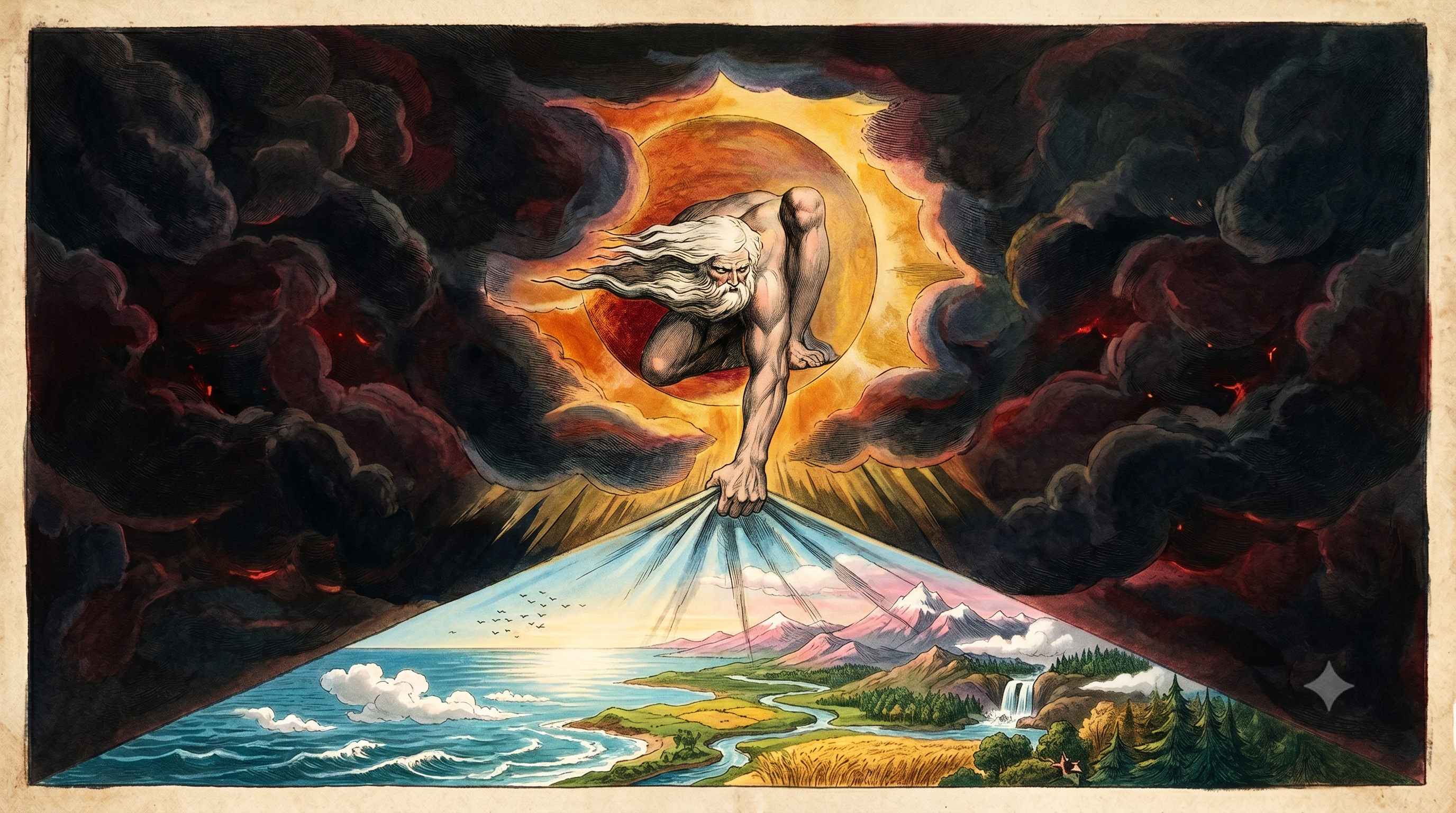
“You might say, ‘I’m not the creative type.’… If that is how you feel, think again…** and remember that you are spirit [children] of the most creative Being in the universe**. Isn’t it remarkable to think that your very spirits are fashioned by an endlessly creative and eternally compassionate God?” (Dieter F. Uchtdorf)
Recently, I was listening to the Binge Mode podcast where each season is an in-depth exploration of a specific universe. Marvel, Game of Thrones, Star Wars — this particular season was about Harry Potter.
Theirs is a spoiler-full approach, so from the very beginning they’re reading into the subtext. In the first few chapters, Albus Dumbledore is discussing with Minerva McGonagall how exactly Voldemort died when trying to kill the infant Harry Potter. Dumbledore’s response? “We may never know how he survived.”
“Aha,” the hosts exclaim. Armed with the knowledge from later in the series that Dumbledore was very aware of Voldemort’s work with horcruxes that would have informed Harry’s survival, the hosts came to the conclusion that “from the very beginning” Dumbledore is selectively withholding information from even his closest confidants.
Maybe. But in my opinion I think that’s giving J.K. Rowling too much credit.
More often than not, I don’t think most authors have an intricately woven universe perfectly connected in detail and planned from the beginning of a series.
There are, of course, exceptions.
J.R.R. Tolkein famously spent ~40 years developing the Elvish language and the massive canon of lore that eventually became his Legendarium. Brandon Sanderson, similarly, planned out his Cosmere across 35 novels more than 20 years in advance. But these hypernerds are the exception, rather than the rule.
One obscure example of “discontinuity” in world building from my own childhood comes from a Lord of the Rings-esque source. Growing up, my brother and I read and re-read a series of books; the first portion of the series called The Belgariad and the second, The Malloreon. I’ll spare you all the intricate details, save but one.
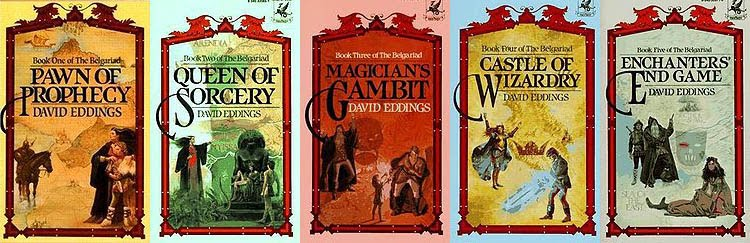
A core narrative arc through the series is a royal bloodline that controls an important orb of power. A dark god steals the orb and attempts to wipe out that bloodline. But two critical characters to the series, Belgarath the Sorcerer, and Polgara the Sorceress (father and daughter) intervene to preserve the bloodline, taking the sole surviving heir and raising him in obscurity.
In the very first book of the series, we don’t know much of that. We meet Garion, an unassuming farm boy who is raised by his Aunt Pol. Occasionally, an old man comes to visit who Garion knows as “Mister Wolf.” But one night, Garion overhears Aunt Pol confessing to Mister Wolf, “I’m not suited for this task you and the others have given me. What do I know about the raising of small boys?”
You come to find out that Garion is the descendant of that last bloodline whose fate is tied to the orb. And Aunt Pol is Polgara the Sorceress, raising him in obscurity.
But here’s the thing. Years later in the series, the author also wrote two “prequel” books. A biography of sorts, one for Belgarath and one for Polgara. In those books we find out that Garion isn’t the son or grandson of that last heir they saved from destruction. In fact, Polgara has been helping to preserve that bloodline for 1,000 years! So you’d think by the time she got to Garion she would know quite a bit about “the raising of small boys.”
That random example has always stuck with me as just one of millions of nitpicky continuity errors across fiction that a legion of Redditors have made it their life’s work to point out and grumble about.
But nitpicky fantasy lore isn’t what set me on this quest today. All of these various appreciations of world building, from Harry Potter to the Legendarium or the Cosmere or the Belgariad, shine a light on the intricacies required to build a competent world. Whether you’re building a world in fantasy or in fact, world building requires intricate imagination and near-flawless execution.
Competent Creation
When it comes to good stories, people want intricacy and cleverness. They want the creator to be smarter than them. One of the reasons a lot of people like the writing of Aaron Sorkin (The West Wing, A Few Good Men, The Social Network) is because the characters feel very competent, endlessly quippy, and typically a couple steps ahead of you.
But there is a delicate balance between audience delight and disappointment. In The West Wing, President Josiah Bartlett’s staff make up the main characters. They’re often smart, clever, biting. But occasionally, they lose an argument. Then, someone on the opposing side makes a disparaging comment about how “Bartlett crewed up big time.” But instead of taking their licks, they often abandon the intellectual debate, devolving into moral grandstanding: “…that’s PRESIDENT Bartlett.”
You feel cheated of the cleverness. Disappointed by the lack of payoff.
The secret to a good story, holding in balance that cleverness and clarity, is akin to what makes a good magic trick. Being able to follow along but not knowing where the ending will take you.
In Christopher Nolan’s The Prestige, there is a scene when Christian Bale, an up-and-coming magician, is being implored by his wife to explain a particular magic trick. He showed her that he could catch a bullet fired from a gun. She presses him to explain it, but when he finally does, she admits with almost condescending dismissiveness, “once you know… its actually very obvious.”
The magic is gone. The creative compact is broken.
Good mysteries are the same. There have been a handful of plot twists that have rocked audiences over the years, from Sixth Sense to The Usual Suspects, and always the recipe for a plot twist is perfectly walking that line of cleverness and clarity; bringing the audiences along in their understanding while withholding conclusive answers.
If it’s predictable, you’re dismissive. But if it’s too dense then the reveal never lands. Christopher Nolan has done this well, not only with the aforementioned Prestige delivering a death defying twist, but his first breakout movie, Memento.
In contrast, take another Christopher Nolan “classic,” his odd passion project, Tenet. Even die-hard Christopher Nolan fans have to admit that they didn’t really understand Tenet. At the end, Robert Pattinson tells the Protagonist that he was recruited in the past by a future him who is still his future… him. See? It doesn’t land!
Cleverness, certainly, but balanced with clarity.
Free Market Creativity
The market for audience delight is a little bit like capitalism vs. communism, though my brainstorming conversation with Claude tells me this analogy is tepid at best. But stay with me.
In high-level simpleton economics, a key characteristic of capitalism is allowing the market to determine equilibrium. In communism, the Politburo “powers that be” unilaterally decide that equilibrium. But unless they’re all knowing, they’ll always be too inefficient.
Star Wars Case Study
Take Star Wars, for example, as a pot of intellectual property that has been shaped within both versions of the capitalist and communist Creative Markets.
George Lucas made the original Star Wars as a True Blue Creative Capitalist. High risk, high reward. He famously took a huge salary cut to keep merchandizing rights. Even after the success of the first film, George Lucas opted to self-finance Empire Strikes Back because the profits from the market enabled him to avoid studio overreach. Ultimate entrepreneurial capitalism; letting it all ride behind something you believe in and getting a big payout.
Once Star Wars had become large and established, Disney “seized the means of production.” Now, you have a centralized access point to any Star Wars stories, whether you like it or not. And, unfortunately, Disney has been proving the inadequacy of the communist model ever since. It’s been almost 15 years since Disney bought Star Wars and almost a decade since they started making new Star Wars stories, but it seems like they continue to be insulated from the market’s feedback that these new stories are not good.
Granted, you can call this communism or you can chalk it up to monopolism. Whether its communism and you can’t hear the market feedback, or its monopolism and you won’t hear the feedback; the result is the same. Inefficient market equilibrium. And that leads to audience disappointment rather than delight.
You can even look at the evolution of Star Wars. From the original trilogy to the prequel, despite criticism at the time, I think the prequel trilogy has held up incredibly well. People who were kids when they saw the Ewoks got pissed when they saw Jar Jar Binks as adults. But the reality is the movies are good for the same reasons! The same camp, same operatic mysticism, same wooden romance and galactic-politic tedium. George Lucas’ entrepreneurial dream enabled him to control something he believed in and to bring a competent reality to life.
Contrast that with the sequel trilogy. It’s a soulless departure from the original founding ethos. Where Han, Luke, and Leia presented a capable troupe, you instead have Rey who collapses the ensemble into one figure who is immediately excellent at everything and everyone else is just useless window dressing — classic Mary Sue problem. The centrally planned studio version of Star Wars is meandering and visionless. That’s how you get the whiplash of “who is Rey” “oh she’s nobody” “oh just kidding she’s a Palpatine, and by the way somehow Palpatine returned.”
Knives Out, In Contrast
Another instructive comparison comes from a great series of mysteries; Knives Out. Daniel Craig is an eclectic Southern sleuth; Benoit Blanc. In the first movie he solves the already-solved murder of a millionaire author, in the second he solves the murder mystery within a murder mystery propping up a tech empire, and in the third movie he addresses the unaddressable resurrection of a murderous priest.
Knives Out was also born in the “free market” where Rian Johnson, the director of the series, had control over his set of Agatha Christie-inspired tales. The first movie was a smash success and birthed a franchise. Arguably, the second one was not as good. But I would say Rian Johnson was able to react to the market pressure and improve some things for the third movie.
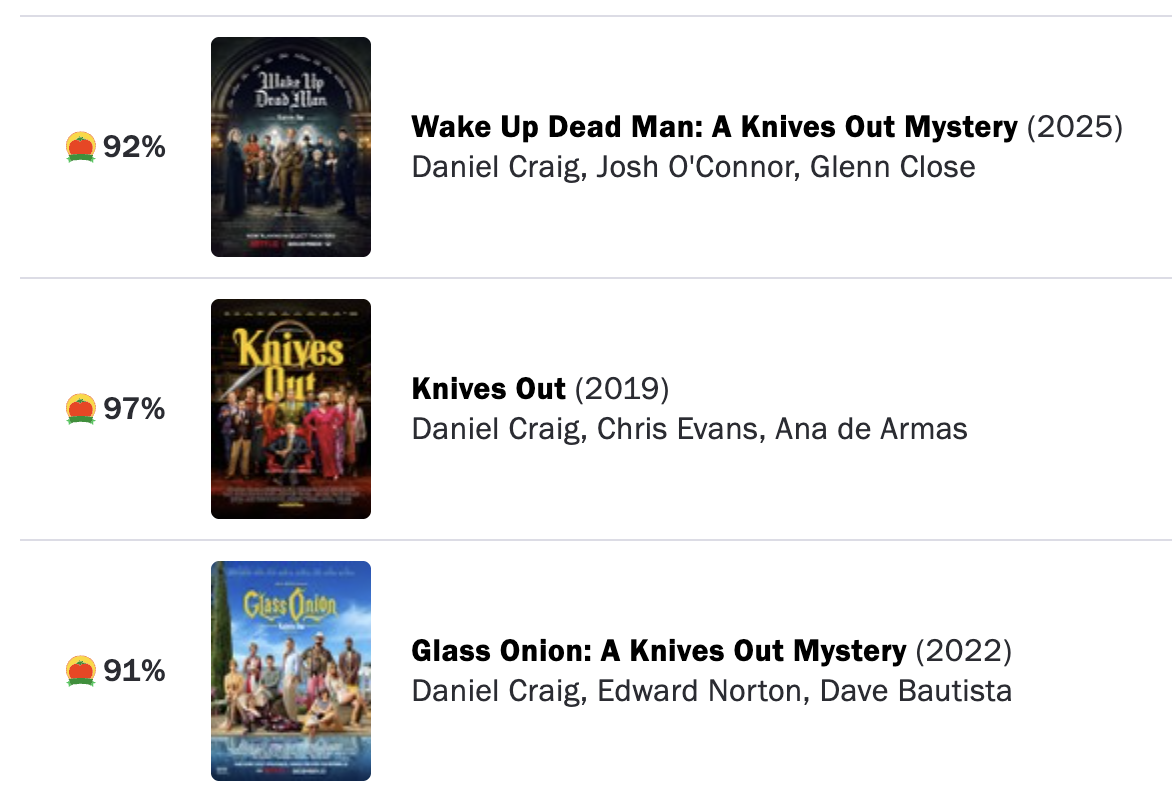
My take, that I’ll keep simple in case you haven’t seen all three movies, is that Rian Johnson puts up a very specific main character in each film. In the first, its an immigrant nurse named Marta. In the second, its a wronged twin sister named Andi. And in the third, a repentant former boxer turned priest, named Father Jud. The mistake that Rian Johnson made in the second movie was trying to make Benoit Blanc the main character. In reality, he’s like a narrative lens along for the ride. The first and third movies, by contrast, share a more palpable focus on the actual main character.
Here’s one key point I’m trying to make. The Last Jedi, one of the more hated of the Star Wars sequel trilogy, and the Knives Out series? They’re created by the same guy; Rian Johnson. The key takeaway is the characteristics of Free Market Creativity. In Knives Out, Rian Johnson had total control. Star Wars? None whatsoever; totally at the mercy of a centrally planned studio system. But most importantly, there is no time for reacting to “market signal” and feeling out a unique story vs. responding to fan service or studio fears.
I don’t believe this is simply big organizations = bad, small, high agency organizations = good. Big organizations can also tell compelling stories. Love ‘em or hate ‘em, I would argue The Barbie Movie and Oppenheimer were both big studio box office projects, but both successfully crafted a world and were successful in the free market.
Instead, it’s the Creative Capacity to tell a compelling story that the market will want. Not what you think they’ll SAY they want. There’s a fine nuance here between just doing fan service. If you ask an audience what they want, they’ll say cameos. But they also would have said a faster horse. What is the car-equivalent of a story that people want, and even need but don’t know to ask for? Nobody knew they wanted a three-hour talky physics tribunal or a plastic-doll movie that’s secretly about mortality and womanhood, but it turns out a lot of people did want that.
The Creative Capitalist Concoction
Skin In The Game
Lucas was exposed when he risked his own capital. Nolan and Gerwig were exposed when they put their reputations behind fairly odd big budget projects. Johnson was exposed when he tried to convince the world they were still interested in a small scope whodunnit in an age of Marvel Mania.
A few years ago, Will Manidis perfectly articulated something I had been trying to say for years. The defining term of the current generation of 20 and 30-somethings is “optionality.” Will described this as treating life like an index fund.
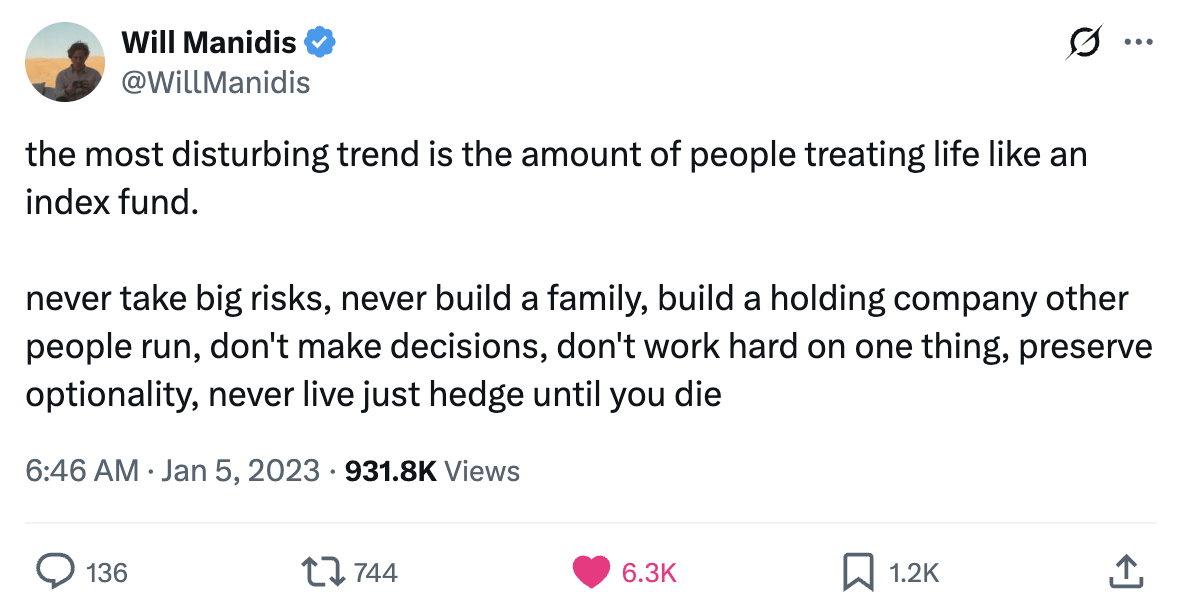
Putting skin in the game is the ultimate calling card of the Creative Capitalist. Just one massive example that comes to mind; Peter Thiel put up 76% of the first fund for Founders Fund himself. Since then, he has consistently put up ~20% of each fund himself on average.
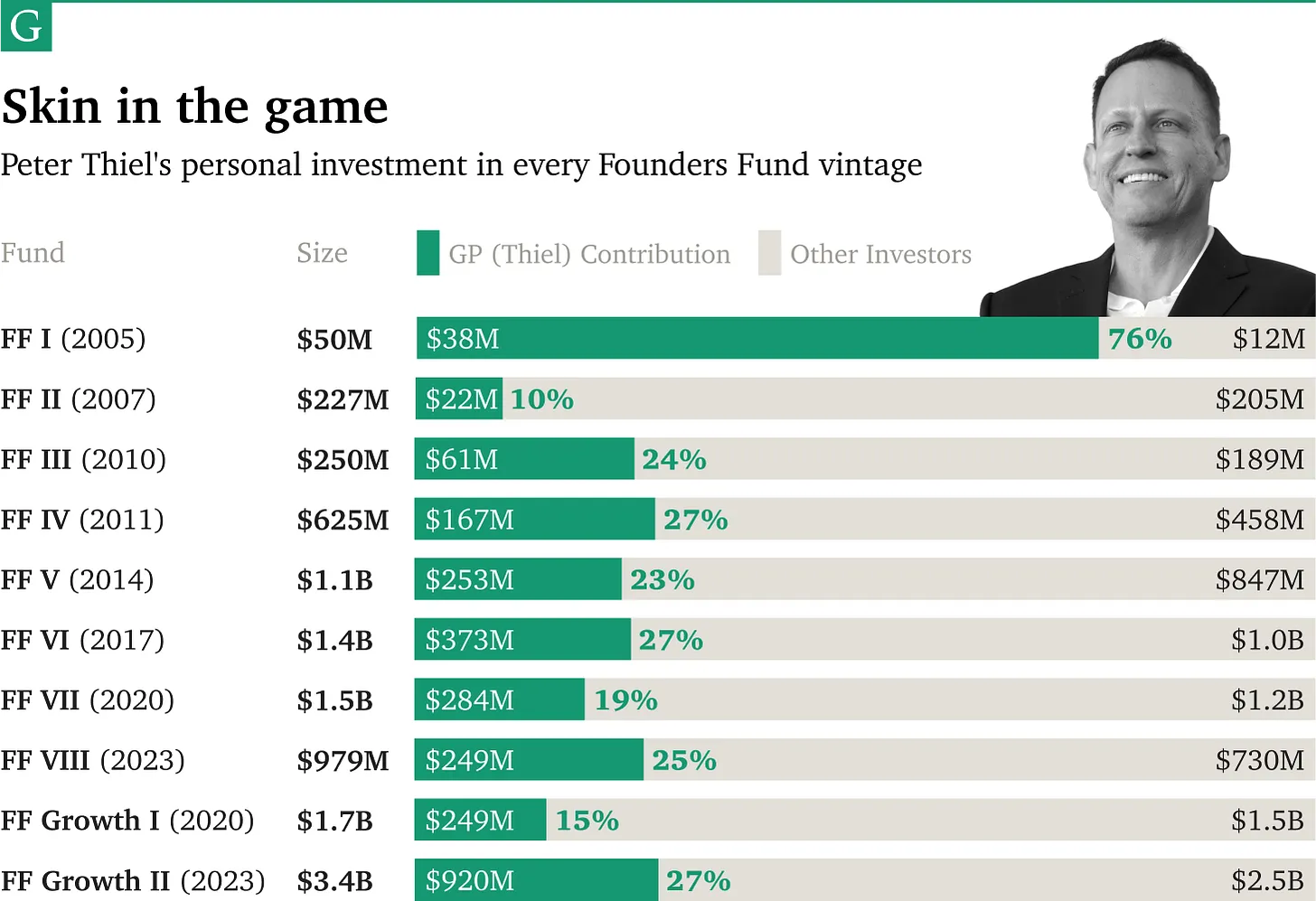
In any Creative endeavor, be it in the realm of imagination or reality, commitment more often leads to Competent Creation than does hedged decision by committee. Because when you know you’re committed, you care more deeply than anyone. No one cared about Star Wars more than George Lucas. Tolkien and Sanderson committed decades of their lives to their World Building. Elon Musk used $100M of his $180M after-tax fortune from the sale of PayPal to found SpaceX (another $70M he put in Tesla).
Iteration
While the villain of my prior section was consistently Disney, redemption comes from the unlikeliest of places; in this case, from the history of Walt Disney itself. In a quote I’ve written about before, Walt Disney himself articulated how he went about building some of the most durable worlds we still have today:
“There’s really no secret about our approach. We keep moving forward – opening up new doors and doing new things – because we’re curious. And curiosity keeps leading us down new paths. We’re always exploring and experimenting. At WED, we call it Imagineering – the blending of creative imagination with technical know-how.”
The story of iteration is a fundamental element of the free market. Disney’s belief was to keep moving forward, progressing, evolving. What could have stayed a set of worlds focused on the proverbial past, with things like Snow White and Cinderella, also embraced futurism, adventure, and embracing the physical world, not just the imagination.
The idea of planting a flag of the future you want to iterate towards is a function of opportunistic planning. I’ve written before about this idea of starting with the end in mind:
“Planning is an exercise in storytelling. Articulate the story that you genuinely believe (not just the one you’re selling to candidates, customers, or investors). And then constantly evaluate that plan to identify the dependencies you have.”
The exhaustive planning that goes into competent World Building doesn’t always have to be meticulously laid out decades in advance. Things like J.K. Rowling leaving Dumbledore as mysterious, or having things like Tom Riddle’s diary in the second book; those are breadcrumbs. Narrative anchors left as portals in time and story.
Startup narratives operate the same way. You plant a flag in the ground around your North Star vision. But then you build the details up along the way. A good story can flex to fit the details as they develop. Rowling’s horcruxes fit well into a world that was build around connective relationships and artifacts. SpaceX’s “expansion” into AI fits nicely into its core competencies; building Colossus is much more “them” even than competing with OpenAI or Anthropic.
The Stories We Need
Finally, I would say this comes back to the point of being exposed to the Free Market. Again, not as fan service to just toss slop to the piggies of public opinion. But identifying honest-to-god stories worth telling.
This, I think, is one of the hardest things because need and preference so rarely sound the same. How do you know what stories need to be told? What worlds need to be built? Most people find this too difficult and default, instead, to preference. What will people pay for? Finding willing buyers at the fair market price. Despite the buyers being incapable of imagining a better will and the market being, perhaps fair, but far from efficient.
Disney (the communist regime, not the capitalist creator) refuses to feel the need that people yearn for when it comes to Star Wars stories. In a prior piece I wrote about Disney (the capitalist creator, not the communist regime) I talked about what people yearn for in their stories:
“I think one of the reasons culture feels so repetitive and we’re drowning in reboots, remakes, sequels, and prequels is because we’ve lost hope for anything better than what we had. Unlike Walt’s ability to learn from the past by bringing its idealistic aura into the future, we pine for the yesterday’s today. “The way things used to be.” We wish for a world that was the way it used to be, rather than accepting the world as it is and trying to change it.”
People yearn for optimism. But they can’t find it looking forward, so they sulk backwards, looking for it in the past. But the solution is a story worth telling. Spin me tales of a future worth being excited about. One that merits people pouring out their heart and soul in pursuit of it. I touched on this theme previously when I tried to answer the question, “what is an extraordinary man?”
“If you are consumed by a company ‘mission’ for the sake of having a mission, then you have missed the mark. If you feel entitled to the life force of those around you because you put up your hand and started a company, you are not a good steward of the life force of others. But if you seek to do good. If you seek to make the world better. If you seek to lift up the broken hearted. If you seek to shape the world around you so that others who sit upon that world may sit a little higher, then you have found vision. The mission that you pursue will be worthy of your time and eternal potential. And don’t let anyone tell you that their value system is the only appropriate bar for measuring that mission. Whether it is raising a family, lifting up the sorrowful, demonstrating kindness, or transforming the way the world works with technology. It’s all a function of who you really are and what you really want.”
Worlds Without End
AI will make more software which enables more worlds. And that’s a good thing. The cost of conjuring up our dreams is collapsing. In some ways, the kind of World Building that Tolkien and Sanderson committed decades to is having all the barriers broken down for anyone with a prompt and a point of view. But, boy, is that last part the rub. We can all prompt… but can we opine?
When the cost of creation goes to zero, the concoction matters more, not less. A cheap plentitude of crass worlds formed without care emphasize, even more, the value of the Worlds Worth Building. Skin in the game. Iteration. Honestly building stories that people truly need. All of those are available to us; more available than maybe ever before. The question is do you care enough to create?
It has never been easier to mass-produce a faster horse that nobody asked for. Rather than unlocking creativity, AI will super-charge the race to strip-mine nostalgia, and generate the thousandth reboot nobody wants. The insulated incumbent who stopped listening a decade ago now has a machine that will let it “not-listen” faster than ever. The slop engine will start humming.
But, by the same token (lol) it has never been easier to Imagineer. Walt Disney’s way of framing Imagineering (e.g. creative imagination wedded to technical know-how) reads like a prophecy now. AI unlocks the technical know-how, but it can’t supply the imagination, the conviction, the exposure to the free market vibes, or the contact with that 90% of human feeling in which we are all the same, where Walt Disney thrived.
Whether you like it or not, worlds are going to multiply without end. The question left to us is which worlds will be worth living in? Plant your flag in a future worth being excited about. In the words of Signull:
“Storytelling is the only way to impose meaning on abundance, coherence on noise, and legitimacy on power. Strategy, operations, and capital are all downstream. Without narrative control, none it will ever stick. In a world of infinite output, story is the scarce primitive. Whoever can compress chaos into something people can feel, remember, forgive, and rally around actually runs the system. This skill is worth more than the entire C-Suite combined.”