The Anduril Thesis

In July 2020, Contrary invested in Anduril. In September 2022, I started Contrary Research. In October 2023, I started writing a book about Anduril.
The project started as a typical company deep dive for Contrary Research. But as I started to immerse myself in the rich history of the military industrial complex I came to appreciate that Anduril is unique among high growth tech startups. It was not just a group of hyper talented people building exceptional products. It was actually a deliberate counter-position to almost 100 years of military history.
So instead of a typical company deep dive, I decided it deserved a more thorough treatment. Granted, the project was on and off as I had other stuff come up. Plus the world kept changing around us. Plus plus Anduril kept launching new products. But after several years, 35 different drafts, and some exceptional help from the folks at both Contrary and Anduril, The Anduril Thesis is here. (Readers of this blog got a sneak peek a few weeks ago).
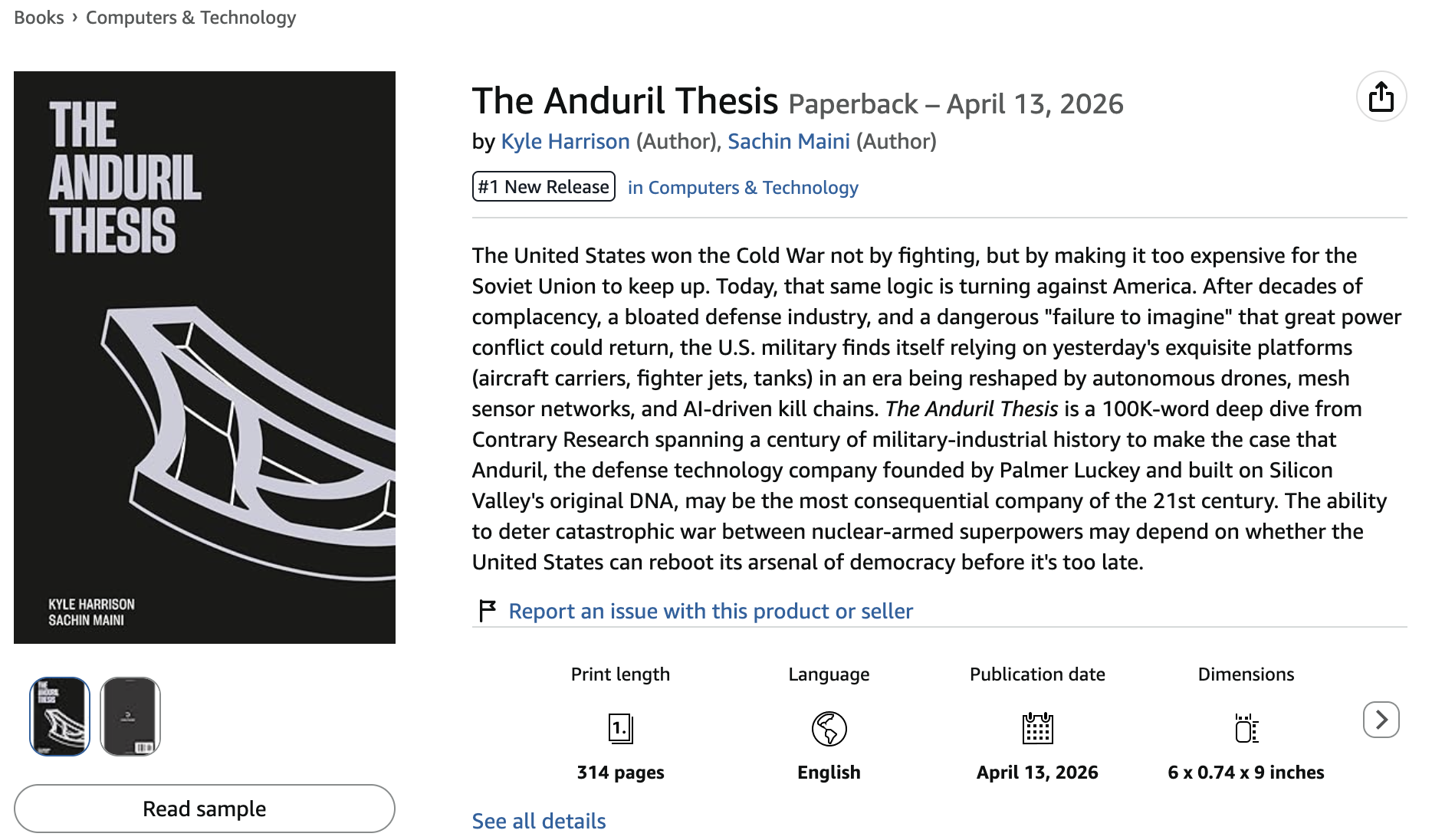
Below I’ll share what I see as the “greatest hits” of what became a 300-page, 100K+ word in-depth overview. But you can also see an even more thorough overview of Anduril as a company at our memo, which you can consider as The Anduril Thesis Lite. Then, obviously, you can order the full book of The Anduril Thesis here. Finally, you can check out this video interview that I did with Molly O’Shea at Sourcery.
Below is my “greatest hits” highlights of the book.
The Anduril Thesis
I believe Anduril may very well be the most important company of the 21st century. Not OpenAI or Anthropic, or SpaceX. It may be our best chance at deterring “Great Power” conflict with China.
But when we sat down to write the story of Anduril we realized that it merited an outsized level of attention.
Before you can understand what Anduril is building with the “future of warfare,” you have to understand the 100 years of military history in the US that Anduril is deliberately counter-positioned to.
Timeline
Industrial powerhouse
Around / during WWII the US represented 40% of global manufacturing capacity. You had Silicon Valley literally born from the aftermath of WWII industrialism when Frederick Terman set up Stanford Industrial Park. And the DOD was a first-in-line customer for that budding technology industry.
The DOD represented 36% of GLOBAL R&D! They had an incredible handle on technology and they put it to work over the course of the Cold War, with defense projects leading to the birth of dozens of innovations across the space program, the internet, and everything in between. A golden age of American industrialism.
Smothering the Golden Goose
Robert McNamara, who came in as Secretary of Defense and broke the golden goose in the 1960s
Planning, Programing, Budgeting Execution (PPBE) was his process baby and it represented a rats nest of process for military procurement. Ben Rich who ran Lockheed’s famous Skunk Works said it descended like a plague of auditors and bean counters
Everything was centrally planned. Matt Grimm jokes that “everyone, even Russia and China, has given up on communism, except for Cuba and the DoD.”
McNamara thought we should spend less, so he added intense bureaucracy. And that did control spending, for a couple years. But then you get Korea, Vietnam, the Cold War, and now we’re ramping up spending again but because of McNamara’s friction we’re getting way less bang for our buck.
Consolidation
Post Cold War we had a high friction machine but now with a much smaller market. William Perry, deputy defense secretary, held The Last Supper, where he congregated the leaders of all the defense contractors at the time and told everyone to consolidate or die.
So they did. And we went from 107 major contractors down to 5
Boeing is the poster child of consolidation woes. They want from gold standard engineering to buying a cutthroat profit-driven competitor in McDonnell Douglas that ruined their ability to innovate, have had tons of high profile failures, and may be engaging in a shadow cover up to silence a lot of would-be whistleblowers.
Broken Things
The result is a broken, bureaucratic nightmare that only knows how to make big expensive things that take 10 years longer and are 2-5x over budget.
The F-35 will cost $1.5 TRILLION to field, and by the time we get it it will be dramatically outdated!
Meanwhile we are actively in one of the most conflict-prone periods of time since the Cold War and the state of warfare has changed DRAMATICALLY.
Defense Industry Today
Palmer Luckey often talks about how “problems that took decades to make will take decades to solve.” Before you can start to get to some of the early improvements happening in defense today, you have to understand the decades that caused the problem.
- Cost-plus vs fixed cost: The government would rather have a $1B program with a 10% margin than a $100M program with a 50% margin for the same outcome
- Built-to-spec: “We know what’s best.” That worked when DoD was 36% of global R&D but now they’re less than 1%.
- Software allergic: Selling software to the government means you sign IP rights where, if they decide you suck, you could lose you your source code.
- Not picking winners: The government is managing capacity, not quality outcomes. There’s a story in Ben Rich’s SkunkWorks about feeling like Lockheed was a shoe-in for a bomber program, but the DOD gave it to Northrop; not because they were better, but because they needed it most. But that led to the program being years behind schedule and billions over budget.
- Special interests: The F-35 is built using 1.9K suppliers from 48 states (representing 350 different congressional districts). Far from a streamlined approach.
Modern Conflict
Day One Framing
The US military industrial asset base is built around “day one framing.” Have such a big stick that you demonstrate overwhelming force that could end the conflict on day one.
Extended Tactical Warfare
But that’s not how conflicts work today. Russia thought they would march into Ukraine and serve a decisive blow within a few weeks. Four years later it’s been death by a thousand cuts
Operation Spiderweb was a mission where Ukraine snuck $1M worth of small drones across the Russian border and autonomously delivered $7B worth of damage wiping out 1/3 of Russia’s long-range bomber fleet
In Iran we’re responding to a $50K Iranian drone with a $4.5M missile.
Ted Lieu just a couple days ago called this “throwing Ferraris at frisbees.”
Warfare, today, is defined by autonomous high volume, low cost assets.
Reintroduction of Urgency
Proving the “End of History” Wrong
Palmer loves telling this story about Norman Angell who wrote a book called The Great Illusion in 1909 saying war in Europe was incomprehensible. The world was too interconnected. It was a bestseller! Five years later, World War I started.
After the Cold War ended there was a triumphalist belief that became widespread in Washington that the whole world had converged around the idea of liberal democracy and there would never be any serious conflict between great powers again.”
Francis Fukuyama wrote an essay in 1989 entitled The End of History?” But now we are in the midst of what historian Niall Ferguson calls Cold War II, with China picking up where the Soviet Union left off.
There’s a great novel called 2034 that predicts what a conflict between the US and China could look like. There’s a line that says these great acts of violence, like Pearl Harbor, or 9/11 catch Americans off guard isn’t a failure of intelligence. It’s a “failure to imagine.”
Prophets of Urgency
What’s crazy is there have been people trying to shake the US out of its hubris for years.
In 1992, Andrew Marshall, who ran the Office of Net Assessment put out a report that completely nailed the future of high volume precision warfare we had today. But we didn’t listen.
Admiral William Owens, when he retired in 2001, warned that the US was too smug and that usually resulted in ending up as the loser in the next big conflict.
In 2012 Mitt Romney said our biggest geopolitical threat was Russia and Obama laughed at him because he didn’t say Al Qaida.
In 2017, Robert Work, the deputy secretary of defense, warned of a “reemergence of great power conflict” and that the US had a technological advantage that was rapidly eroding.
Wake Up Call
Ukraine was a wake up call for a lot of people, but not everyone.
But it’s starting to trickle. Chinese support of Russia or Iran are proxy wars. Chinese posturing around Taiwan are warning shots.
A conflict over Taiwan could be a $10 TRILLION hit to the global economy. That’s as real as it gets.
China: The Biggest Threat
In the history of warfare, industrial capacity is upstream of military strength, and right now China is eating our lunch when it comes to industrial capacity. Anduril’s approach is partially about working within those constraints, using commercially available components, developing low-cost weapon systems, and revitalizing America’s defense-industrial base.
From 1999 to 2017, the Chinese military budget increased 900%
They’ve developed missiles affectionately referred to as “carrier killers” that make it incredibly difficult for us to commit a large swath of our largest naval assets because a $20M missile could destroy a multi-billion dollar ship.
Contrary Research’s Tech Trends Report felt like a depressing scorecard of how well China is doing across shipbuilding, munitions, and just raw industrial output.
Military-civil fusion means the Chinese military gets the cutting edge of anything the commercial market can come up with.
War Games
Since 2001, we’ve had inklings that America could be denied the ability to fight in a large scale conflict.
In basically every war game pitting the US vs China since 2015, we’ve lost.
We have to fix this. As Palmer likes to say, “problems that took decades to cause will take decades to undo.” So time is of the essence.
Anduril’s Mission
Conflict Deterrence
Pacifism is a privilege of the protected.
In that same novel, 2034, there is an incredible line: “Inherent in all wars is a miscalculation because both sides have to believe they can win.”
Great power conflict is here whether we like it or not.
The idea of Thucydides Trap comes from a fifth century BC historian who chronicled the Peloponnesian War. In a book explaining the concept, it lays out 16 examples throughout history of an emerging power threatening to displace a ruling power; 12 of which resulted in war.
Making our allies, like Taiwan, into prickly porcupines that China doesn’t want to step on.
Founder-Led Innovation & Military Mavericks
History of military achievement is a story of exceptional pairing between founders and military mavericks.
William Moffett (founder) modernized the Navy, President Hoover (maverick) kept his political opponents from removing him.
Ben Rich (founder @ Skunk Works) made the U-2 spy plane that was critical during the Cold War with the help of Richard Bissell (military maverick).
Bernard Schriever (founder) developed intercontinental ballistic missiles with the support of President Eisenhower (military maverick).
Anduril’s Founding
Palmer and Trae Stephens, his Anduril co-founder, were both interested in journalism at one point early in their careers. Anduril is as much a propaganda engine as it is a product engine.
When those two met they literally bonded over both wanting to build a real-life Stark Industries.
Matt Grimm and Brian Schimpf worked together in college in 2006 on the DARPA Grand Challenge.
Chris Brose and Matt Steckman are the non-founder unsung heroes of the Anduril story. Brose worked with McCain in the Armed Services committee and saw, first hand, what people were getting wrong. And Steckman knows how to sell into the government like few people alive.
Anduril’s Product Philosophy
Mosaic Warfare
Described by DARPA in 2018 as individual warfighting platforms that fuse together into a larger “force package.” Anduril embodies that with having networked assets across every domain that can be fused together with Lattice.
Software-Defined, Hardware Enabled
Lattice + every hardware platform. Imagine an Eagle Eye AR helmet where you can fuse insights from a Sentry tower, a Sentry Seabed sensor, and a Ghost drone overhead and, based on that unified picture, you can deploy a Ghost Shark, and Roadrunner counterforce to stop certain approaching assets while also deploying Fury fighter jets to gather intelligence and ward off the second wave attack. All from one guy with a headset. That type of multi-domain, multi-asset action would require a room full of dozens of people today, if it was even possible.
Built-to-mission vs Built-to-spec
Palmer likes to say “we listen to our customers and trust them to understand their problems, not necessarily the solution.”
High volume, low cost
The designs for Fury and Anduril’s other products aren’t specially built where they can only be built at Arsenal-1. They can be made in any machine shop in the US.
Fixed-cost
“We only want to get paid if we do well.”
Rapid Iteration
Palmer has said there are things they won’t do because they’re not sure they could do it better than what’s out there and he’s not interested in competing with companies who are already doing something well. The example he gave a year ago was cyber. But then in a recent interview with Brian Schimpf, the CEO, he hinted that Anduril was starting to do cyber. That’s the mindset of Anduril. It doesn’t make sense for us to do this YET. But every product is sequential and building into a multi-modal integrated platform.
Policy-as-a-Product
In the early days, Anduril had more lobbyists than engineers. They understand it’s their job to educate the government on what’s possible. But it’s not their job to dictate to the government what they can and can’t do with their technology (ala Anthropic).
Importance of being first
Putin was saying in 2017 that “whoever controlled AI would control the world.” Imagine trying to dictate nuclear arms policy globally during the Cold War if you didn’t even have your own nuclear weapons.
Autonomy
Killer robots
We’ve had autonomous weapons for decades. Aegis missile defense weapons on ships can’t wait for people; they have to respond immediately. But we already have command-and-control frameworks for accountability. Just because someone isn’t firing, they’re still responsible for turning it on.
Ethical debate
There’s nothing moral about letting a worse solution stay in place because it’s human vs machine. Autonomous vehicles could save 40K+ people a year; there’s nothing moral about letting that keep happening for fear AVs might occasionally also accidentally kill people. As Palmer says, what’s the moral virtue in a dumb landmine that can’t tell a school bus full of kids from a Russian tank.
Trae’s Arc of Precision
Went from min to max destruction and now we’re focusing on precise destruction. “Enhance Just War Theory.”
Capability
Most categories of automation aren’t because we don’t like humans. It’s that humans struggle to do the job. Rooms of a dozen tired, distracted, stressed people switching back and forth between screens is NOT going to lead to an optimal outcome.
Anduril’s Products
Fun fact: Do you know what Anduril’s first product attempt was? It WAS called Sentry, but it wasn’t the towers. It was an autonomous firefighting tank.
Chris Brose, Anduril’s Chief Strategy Officer, talks all the time about a “military internet-of-things.” Think DARPA’s Mosaic Warfare. An integrated web of capabilities across domains, skill sets, and force levels (from as simple as stationary sensors to as complex as a web of loitering munitions.
Anduril has hinted at its products through anime demo videos. At the end of a video about Fury fighter jets it sunk into the water and hinted at Copperhead torpedoes. Then at the end of that video it hinted at autonomous surface vessels. Just this last week Anduril announced a partnership with Hyundai where now they’re doing that.
Some of the networking stuff Anduril has done can’t be overstated. These autonomous vehicles have to be capable of being networked to direct command-control, collaboration with other autonomous assets, have their network jammed and fly solo still sticking to their mission, and then post-jam recovery be able to resync with the network of assets and determine where they should be.
Anduril is officially working with the US government on the Golden Dome; a networked air and space missile defense response system.
Fun story: Anduril built a vertical takeoff and landing (VTOL) autonomous air vehicle and named it Roadrunner because Raytheon calls their comparable product “Coyote.”
Anduril has been increasingly getting into rocket motors and is now the third largest vendor of them in the US because it’s such a brittle supply chain. We invested in another company called Galadyne that uses liquid propulsion systems that can help alleviate some of that bottleneck
Eagle Eye is a fascinating example of Anduril calling its shot but waiting for the time to be right. In 2017, when Anduril started, Palmer wanted to compete for the IVAS contract that Microsoft eventually won. Now, almost a decade later, they’ve come full circle and won a $22B contract to build this shell helmet for warfighters. Story of soldiers using a combo of Eagle Eye + Ghost drones to literally see through walls.
Future Opportunities
Becoming the world’s “gun store.”
Great line from Palmer about “got ya” questions where journalists ask whether he’ll ever sell to China or North Korea. (1) He doesn’t get to decide who he sells to and (2) optimistically, he hopes he gets to sell to China because it would mean we are allies. Look at our relationship with Japan from WWII and now they’re one of our closest allies.
Say what you will about Trump’s threats to pull out of NATO, but the end result is pushing our allies to be more responsible for their own defense capabilities vs just relying on us.
Other Domains / Weapons
Palmer loves to talk about subterranean warfare. 3 years ago it was a joke, today there are companies doing this (including Anduril, supposedly).
Tactical nuclear weapons, biological warfare, human augmentation (eg super soldiers), energy weapons.
Key Risks
Reliance on Chinese manufacturing as a nation will continue to be an existential threat.
Political controversy will continue to impact the company; not just from a marketing perspective, but administration change, etc. will always cause volatility.
Misinformation is a critical battleground. The (former) CEO of Apple cant criticize China’s human rights violations because the company’s dependence on the country represents an existential threat.
The TLDR? America is bad at propaganda. We decided in the 50s that propaganda was something Nazis and Commies did. But today, Palmer openly acknowledges that part of his role is as a propagandist (throwback to him and Trae being interested in journalism.)
One Final Takeaway
We have over 500 different sources in the book, including dozens of interviews from the founding team at Anduril. Across all of those conversations, the word “hope” appears 44 times.
“We would not be doing this if all hope was lost.”
Anduril was deliberately built to counter position itself against the status quo of hubris and stasis that prevail in the defense industry.
Anduril’s mandate isn’t to defend a specific nation, but a set of ideals and values. Liberal democracy with checks and balances. A fundamental protective view of human rights. The belief in strong rule of law. Despite any flaws the US and its allies may had, Anduril believes they are worth defending.
Anduril, Flame of the West, embodied in the quote from the Two Towers:
“I do not love the bright sword for its sharpness, nor the arrow for its swiftness, nor the warrior for his glory. I love only that which they defend.”