Networked Conviction 005
I’ve written before (a couple of times) about how much I love Disney. I feel the Spirit of God when I walk down Main Street in Disneyland. Call me a consumerist shill, but I can’t help it! There’s something special about the world building on display there.
One thing, in particular, that I would love to spend more time drilling into is Imagineering. Disney’s version of a captive skunkworks; a permanent, multidisciplinary studio where everything from artists to architects, mechanical engineers, software developers, storytellers, lighting designers, and on and on all come together to translate creativity into physical manifestations.
Imagineering has always struck me as one version of a common mechanism that have happened in some of the most compelling ideation organizations. From Bell Labs to Lockheed’s SkunkWorks to IBM’s Wild Ducks; finding a mechanism to translate uncertainty through the lens of creativity into a vessel of productivity.
Yet another discovery mechanism has been proven out comes from Flagship Pioneering; the biotech incubator of sorts that birthed a $75B portfolio that includes the likes of Moderna. That’s what has my investor brain itching today.
In a world of AI, we’re getting exposed to exponentially more uncertainty. Across categories, I’m seeing an incredibly compelling opportunity to replicate the Flagship Pioneering model within opportunity discovery for AI deployment. So that’s what I wanted to unpack today.
The Flagship Pioneering Playbook
First, a caveat. I’m not really a biotech investor. I have a couple investments (like Valinor) that are adjacent. But its not my expertise. So I can’t claim credit for unpacking the model. I have some exceptional investor friends who are more familiar with the playbook whose feet I’ve learned at.
However, from what I understand about the Flagship Pioneering model, I think its an incredibly valuable analogue for opportunity canvassing amidst AI deployment. So how do they do what they do?
History
Flagship Pioneering was founded in 2000 and, since then, have founded over ~120 companies. In total, they’ve invested in 350 companies (so not all are founded within their org) and are typically originating ~6-8 companies per year.
By 2016, the value of their portfolio had grown to ~$19B before jumping to $90B in 2021. It had settled at ~$75B as of mid-2024, largely fluctuating alongside the value of its biggest outcome to date: Moderna.
Moderna originated in Flagship Labs back in 2010 as a collaboration with some MIT professors focused on synthetic messenger RNA that could be engineered to “instruct human cells to produce therapeutic proteins; turning the body’s own cellular machinery into a drug factory.” When the company went public in 2018 it was valued at $7.5B despite having no approved products and an accumulated capital deficit of ~$850M.
COVID was a massive boon for Moderna, which validated the mRNA platform thesis and drove $36B of cumulative vaccine revenue. In classic power law fashion, Moderna is probably 70-80% of Flagship’s overall success, but they’ve still had several other winners (e.g. Receptos acquired for $7.2B, Acceleron acquired for $11.5B, plus a few other publicly traded successes).
Here’s the playbook.
The Model
Flagship differs from a traditional biotech investor because rather than deploying pure capital, they’re executing a disciplined process they call “pioneering.” Small teams exploring speculative scientific hypotheses. Funded with conservative initial capital, the ones that show the most promise get spun out as independent companies, get access to downstream external capital, and supported through IPO.
What feels like the key insight is running a bunch of parallel explorations rooted in deep science within a model that can tolerate a high failure rate. The power law can advantage the model by pushing for winners whose returns cover the losses. But it’s more than simple incubation.
The institutional scaffolding around the discovery mechanism includes a permanent scientific team, IP ownership form inception, an established pool of capital relationships and strategic partners, and recycled learning across the discovery portfolio. One person I talked to called it “institutionalized exploration with venture economics.”
There are some key characteristics surrounding the model that make it work:
- Hidden Spaces, High-Value Prizes: The arbitrage is the ratio between how difficult the category is to understand from the surface relative to the size of the prize. If the solution is obvious, the arb is gone. But if the outcome is tiny, the discovery isn’t worth it.
- Power-Law Distribution Potential: In line with the “size of the prize” mentality above, the unavoidable reality of a high failure rate in discovery needs to be subsidized by the size of potential outcomes. We have to be able to pay for our failure rate somehow, whether through alternative monetization (e.g. AT&T’s communication business subsidizing Bell Labs) or through power law outcomes (one winner pays for all the losers).
- Expensive Physical Experimentation: The cost of discovery is a moat. If experimentation is easy, then everyone will do it (assuming the size of the prize is adequate). There needs to be real-world testing that is high-friction and amicable to an established playbook to improve odds of success, despite there being very few shortcuts for the actual experimentation.
- Compounding Proprietary Data Advantages: In a pure capital bet, only the cash in can cover the cash out. In an intellectual bet, you have an additional power law mechanism. The insights from the losers can actually subsidize the other bets. You learn on one dime where the dime is lost, but the learning compounds into the broader engine. This doesn’t work if you’re running completely disparate bets in structurally different categories that can’t learn anything from each other.
- Structurally Broken Incumbents: If the established players could leverage the same discovery mechanism within their existing incentive system, they would. The ideal arb is in categories where they can’t. Find their innovator’s dilemma, and twist. Whether its public market earnings conservatism, lack of capital flexibility, or cultural inertia.
- Ultimate Liquidity Outcomes: There’s a rich history of people doing things without being sure how they’ll get paid. That can work for some discovery mechanisms, but only if they have a very long time horizon and financial cushion. For a discovery-focused mechanism, there needs to be a clear path to how your successes can generate realized liquidity. Do they produce cash-flow generating assets? Companies that can go public? Products that can be sold?
What I see when I look at this list is an attractive playbook for what I described above: finding a mechanism to translate uncertainty through the lens of creativity into a vessel of productivity.
The AI Analogue
The ultimate source of uncertainty today is AI. Specifically, deployment. From nonsense reports like MIT saying 95% of enterprise AI pilots failed to more believable reports like S&P Global Market Intelligence saying 42% of companies abandoned AI initiatives in 2025, or BCG saying 60% of companies generated “no material value from AI, despite investments.”
What some people see is “AI is fake,” which is the dumbest take. What I see is a clear opportunity.
Similarly, I look at the Anthropic labor report where it showed not places for job displacement, but logical labor augmentation based on current and projected LLM capabilities. The blue areas can already be addressed with current AI capabilities. That doesn’t mean they are being addressed, just that they could.
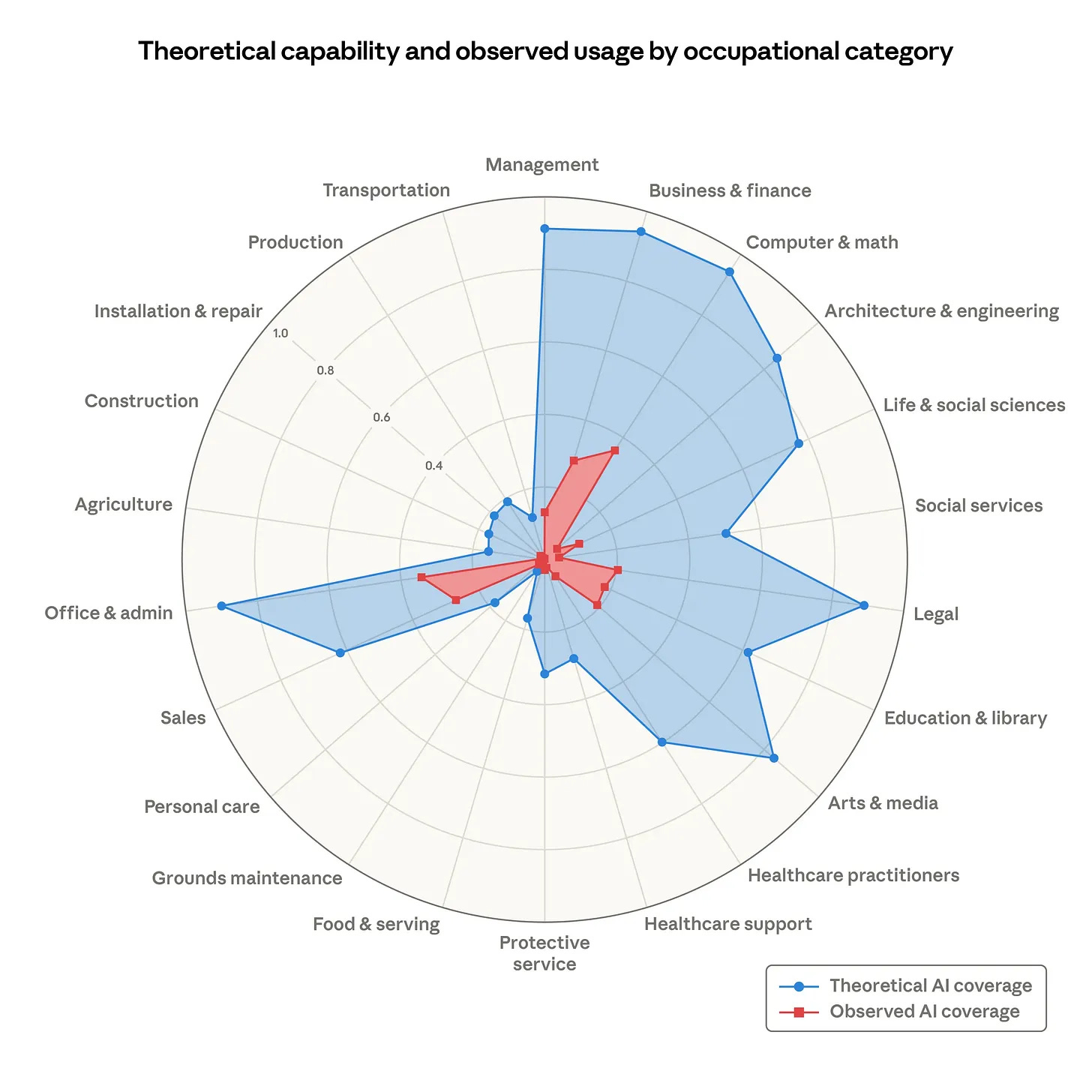 Source: Anthropic
So what I see, whether in the blue area or the open spaces, is a prime opportunity for discoverability. Some are more fertile than others, often based on some of the criteria for the Flagship model I listed above. But all in all, there is a lot to like about the application of the model in AI deployment.
First, I want to unpack some thought experiments of where AI Pioneering could play out in interesting ways.
Then, I want to think about the structural model. A fund? A holding company? To some extent, this is a continuation of what I wrote about in Networked Conviction 004: AI Rollups That Don’t Suck. A holding company model could be a really interesting structure for experimentation. But its not a prerequisite.
Enter: AI Pioneering
Some high level areas that feel ripe for rapid experimentation of AI’s most applicable surface area:
- Insurance Underwriting: Massive pool of human judgement that is shockingly manual. Underwriters at mid-market commercial insurers are still manually reviewing PDFs, pulling OSHA reports, and making gut calls on pricing risk. Commercial P&C represents a $300B+ pool of premiums in the US alone. We have an investment in a company called Corgi that is running this playbook right now.
- Permit Acceleration: There are huge swaths of the economy that are hampered by permitting speed, from real estate to physical infrastructure. Developers hire expediting firms to manage these headache processes and the process can take months, if not years, all while costing hundreds of thousands, if not millions of dollars. Clearly there is a data flywheel here. Every permit you process, you better understand the existing paradigm. And the size of the prize is attractive; shaving 6 months off a $50M development represents millions in carrying costs.
- Clinical & Coding Documentation: This is one of the of those categories that feels overdone and underdelivered with AI. Tons of AI notetakers for doctors and a bazillion revenue cycle management tools. I get it. But I think the biggest disconnect is that care-to-code experiments actually aren’t specific enough. Instead of doing all of elder care, drill into at-home care. Or better yet, focus on palliative care. The advantage of AI is that you can drill into otherwise unapproachable data problems, but the advantage of a portfolio approach ala Flagship is that you can afford to also go after niches that may not be big enough on their own.
- Crop Scouting & Agronomic Decisions: Farmers make dozens of critical decisions each year (e.g. when to plant, what seed varieties to use, when and how much to spray, when to irrigate, when to harvest, etc.) There’s a massive corpus of data across accounting, sensors, satellites, weather, historical yield maps, etc. The status quo is just pushing more product vs. optimizing existing product.
I could go on and on. Workers comp claims, municipal bond credit analysis, expert witness report generation, regulatory change management for financial services, title search and abstracting, etc. All of these feel like niche and / or opaque industries that a standalone SaaS application would give any investor pause.
But taking an exploratory basket approach to each of these categories and running dozens of experiments around AI deployment and efficacy is incredibly attractive. More so, even, than putting all your eggs in one methodology basket.
The reality of the current situation of uncertainty within AI is that we’re outside the bounds of the known. This is no longer asking customers what they want and them answering “a faster horse,” its them being asked, “what kind of Pixie Dragon Carrier do you want” and they’re like “… a what?!” You can’t ask. You have to try.
Pioneering Into The Great Unknown
I also don’t think this is limited to AI deployment, though thats a massively attractive pool of uncertainty. This is an exquisite model that, I think, could be deployed in a broad swath of use cases. Here’s just a few that are interesting to me:
- Mineral Exploration: The intense pressure for mineral deposits is changing the economic equation here. That, plus advances in geological AI models, make the whale-hunting inherent in the Flagship Pioneering Playbook super interesting. Atlas Park is doing some really interesting stuff in this category.
- Geothermal Prospecting: Similarly, subsurface search is a structural problem. You’re hunting for heat, permeability, fluid, etc. but it all requires expensive drilling to be sure. A portfolio of geothermal exploration projects supported by technology appeals to a category at need while being underserved by incumbent processes.
- Novel Battery Chemistry: So many of the bottleneck conversations I’m having these days are so anchored to established paradigms. It’s like its 1947, and everyone is convinced that the only way to make a semiconductor is with germanium. Where are the silicon alternative thought experiments? Batteries are similar; across cathode materials, electrolytes, solid-state compositions; there’s a huge opportunity to find fundamental points of differentiation.
- Ocean Biodiversity Prospecting: There’s a rich pool of opportunity lying dormant in the bioactive compounds of ocean species. We’ve only found ~5% of whats down there. Historically, its been a rich pool of insights for new drug candidates (ziconotide from cone snails, cytarabine from sea sponges, etc.). Sampling expeditions could unlock massive insights, or absolutely nothing. How are we distributing the risk of each search?
Again, I could go on and on. Adaptive clinical trial design, phytomining, engineered soil carbon sequestration, microbiome therapeutics, wildfire prediction and prescribed burns, modular nuclear reactor siting and preemptive licensing, cultural resource management, de-extinction.
Awakening The Pioneer Spirit
It’s also not to say that there aren’t already companies doing some (or many) of these things. They are! And in some cases they’ve discovered their own discovery mechanisms that work without having to take a Flagship-style portfolio approach.
But my perspective is that opening up more opportunity for rapid experimentation, not less, is actually how we solve the AI deployment limitations we’re facing. Getting people out and on the ground deploying. What problems come back, what are the shared insights from the model, and how do you compound those insights across the engine to increase both the hit rate and the overall outcomes? There’s something there.