Networked Conviction 002
My goal (read: hope) is to try and share these Investing Journal Entries as often as possible, whether about the companies I’m investing in (or, potentially, thinking about investing in? Maybe open sourcing some of my thinking about potential investments), the startups I want to see, and the broader universe of investing ideas / lessons / frameworks that I’m getting exposed to.
Another part of my plan is try and write these as quickly as possible. I see the value more in the rapid fire distillation and distribution of the ideas, rather than treating them as fully polished pieces to put out. So these may not always have a fully flushed out perspective or conclusion, but I’m trying to capture these raw ideas as quickly as possible and put them out into the world. As I wrote when I launched Networked Conviction:
“The critical element was unpacking how my ideas connected to each other… the goal is to offer a deeper, more unfiltered cut of my thinking and research.”
So keep all of that in consideration as we dig into the two ideas I’ve been ruminating on recently.
First? A recent conversation I had about the budding potential of the Indian technology market.
And second? An update on some of my public marketing investing perspective around software from last week.
History Rhymes
I’ve written before about this idea of history rhyming. Markets, while not identical, often share similar characteristics. The important elements are often in the differences, but you can shape your thinking around positioning by reflecting on what has been true in the past that may be true again.
In 2014, I sold my first company. It wasn’t that I’d made enough money that I never had to work again, but it gave me some room to breathe where, whatever I did next I felt like I wanted it to feel good. I wrote a few months ago about how, where I landed, was selling solar power in Africa.
One particular lesson I took away from that experience was how technology adoption looked similar, while also very different, in Africa. Today, we’re talking a lot about AI adoption and comparing it to internet, PC, etc. In case you haven’t heard, it’s very fast.
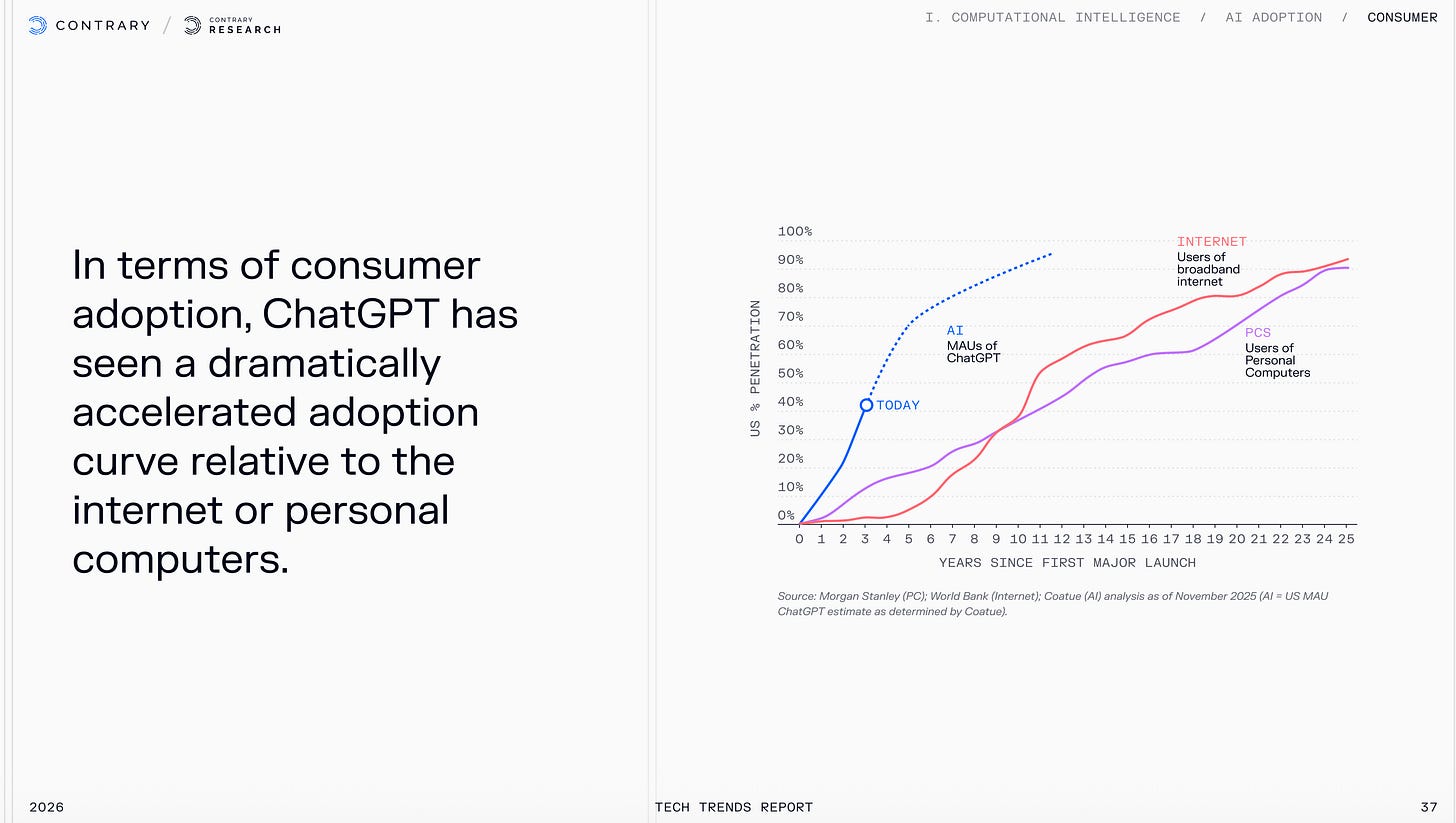 Sneak peek of the 2026 Contrary Research Tech Trends Report
When I started my company, first in Uganda, in 2014, one of the technology trends that had really played out in a way that differed from markets like the US was how African countries completely skipped over PCs. They went straight to mobile.
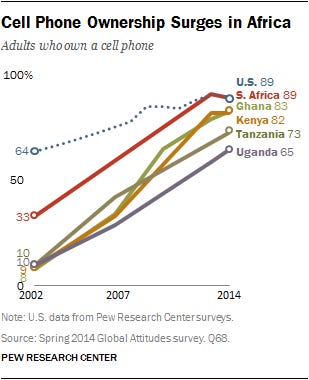 Source: Pew Research
As a result, many of the opportunities in Africa for technology revolved around mobile — MTN Group, Vodacom, etc. — particularly mobile payments; Flutterwave, OPay, Paystack. Understanding the infrastructure foundation of such massive, and rapid, mobile adoption would have given you insight into the following decade or more of where technology in the region would play out.
India vs. China
I had the chance to meet recently with Paavan Gami, the founder and Managing Partner of Raas Partners. After spending ~5 years at Greenoaks, which is a firm I have a ton of respect for, he started Raas with a particular thesis around India. That thesis really resonated with me, particularly as it relates to the rhyming of history.
Historically, India has not had a bustling tech industry despite (1) dozens of massive companies being run by Indians (e.g. Google, Microsoft, Albertsons, IBM, Adobe, etc.), (2) the dozens of massive acquisitions of Indian-founded US companies (e.g. Concur, Informatica, AppDynamics, Cvent, Aruba, etc.), and (3) having a technical university in IIT that has produced a significant number of millionaires.
Just within the last few years, India’s public markets have started to come into their own. The total market cap of listed companies in India grew from $5B USD in 1970 to $5 trillion in 2024.
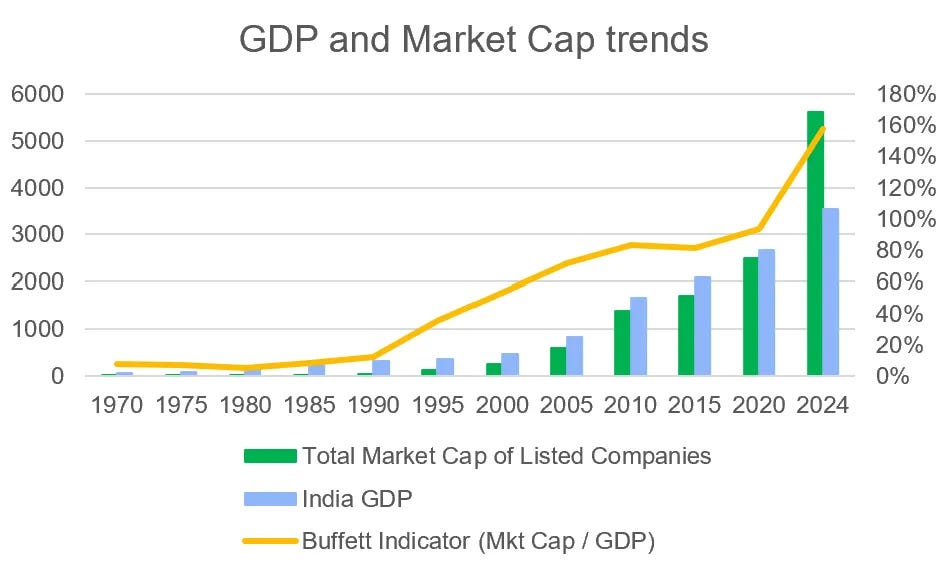 Source: Anirudh Arun
But when it comes to tech, India is just getting started. In 2023, only ~1% of public market cap was tech compared to ~34% in the US.
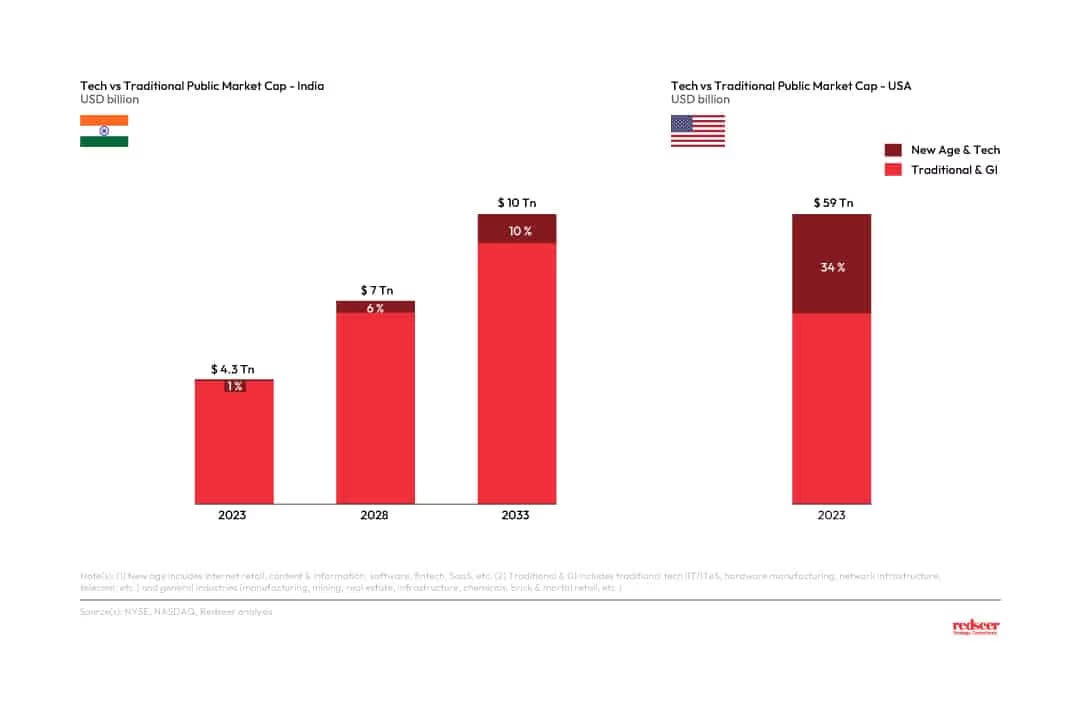 Source: RedSeer
There’s been a notable inflection in the number of tech IPOs: Meesho, Urban Company, Groww (neobroker), Lenskart (eyewear retailer), PhysicsWallah (ed tech), Ixigo (train and bus OTA), Swiggy (o2o business), Pine Labs (merchant acquirer), Firstcry (babycare retailer), TBO Tek (travel middleware software), Blackbuck (SMB trucking payments & software). On the docket, you have companies like Zepto, Zetwerk, Razorpay, and PhonePe as well. India’s tech market has gone from ~5 to over 20+ high growth tech companies. Paavan has done an excellent job covering some of these companies, including Meesho and Urban Company.
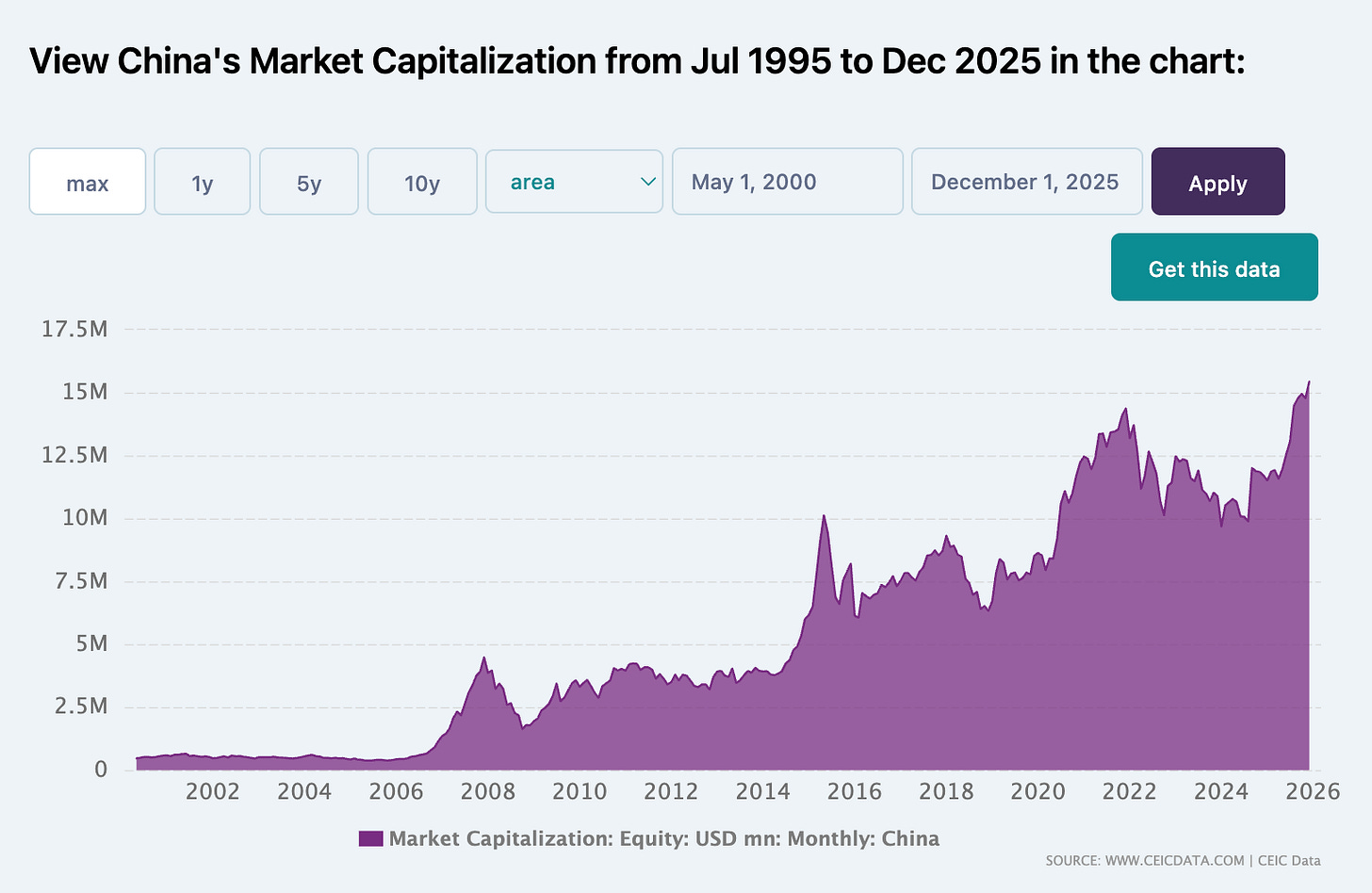
The point he made to me was the similarities between the Indian tech market today and China’s tech market in, say, 2010 or so. While China had a few IPOs earlier in the 21st century, like Baidu (2005) and Tencent (2004), there was a significant uptick as we entered the second decade of the century: Alibaba (2014), JD.com (2014), Weibo (2014), Qihoo (2011), Renren (2011), Meituan (2018), Pinduoduo (2018), etc. Around this same time window, there were also future behemoths getting founded. Shein (2008), Bytedance (2012), Ant Group (2014).
 Source: CEIC
You saw a steep inflection in broader market cap around 2008, then again in 2014 and that continued to compound. Now, no one is saying China’s tech ecosystem is perfect or its track record with publicly traded tech companies is ideal. But the reality is that an ecosystem of consumer adoption and technical capability shaped the foundation upon which generational technology companies were built. The same is happening in India.
The Arbitrage
Indian tech market cap has grown from ~$20B to ~$250B in the last few years. That means that, increasingly two things are happening: (1) public market investors are going to get more comfortable with high-growth financial profiles, and (2) more people in India are going to have been involved in building high-growth tech companies.
Today, public markets in India have a hard time with high-burn growth companies and, as a result, their multiples suffer. But a lack of understanding in public markets doesn’t automatically correlate with a lower quality business. They may suffer some upfront dilution, but in the long-run the size of the opportunity still exists.
Last year, when we published our 2025 Tech Trends report, there was one particular trend that struck me.
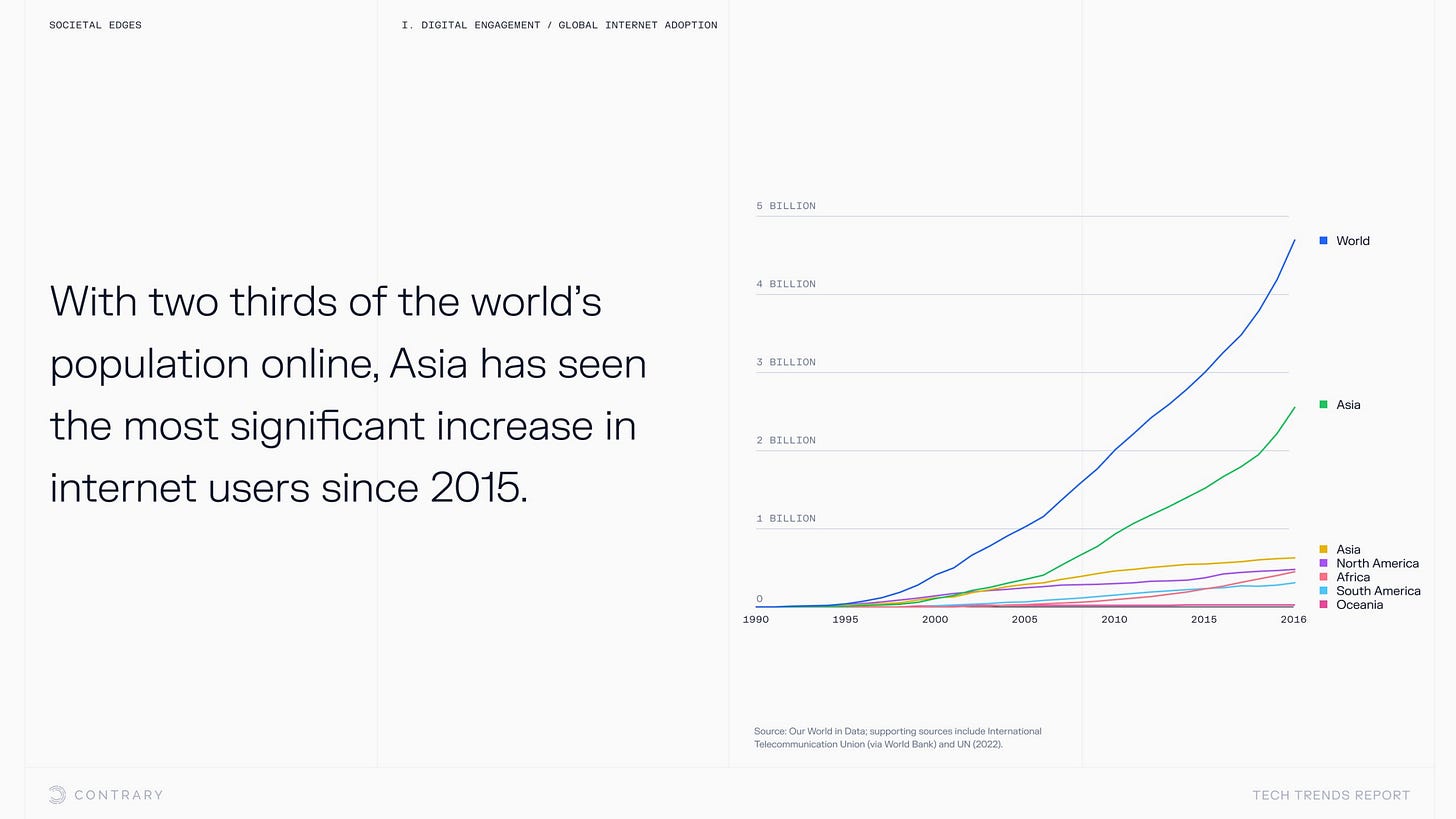
(1) Global internet adoption is only continuing to rise because Asia’s digital market is continuing to grow
(2) While China is an important part of that, India’s internet penetration has gone vertical
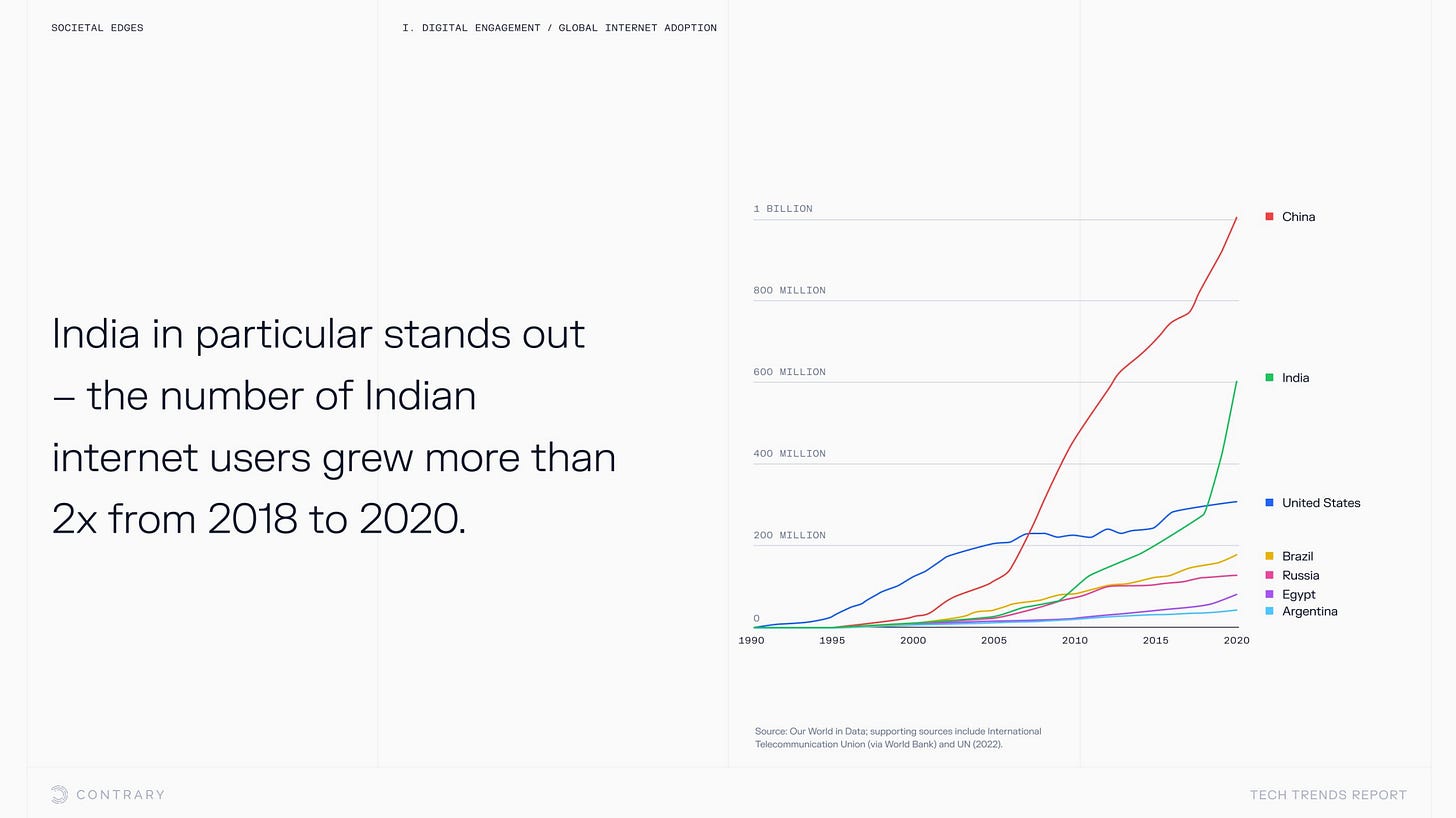
(3) Despite the insane growth, when you compare Indian internet adoption to the global average, the country is still under-penetrated
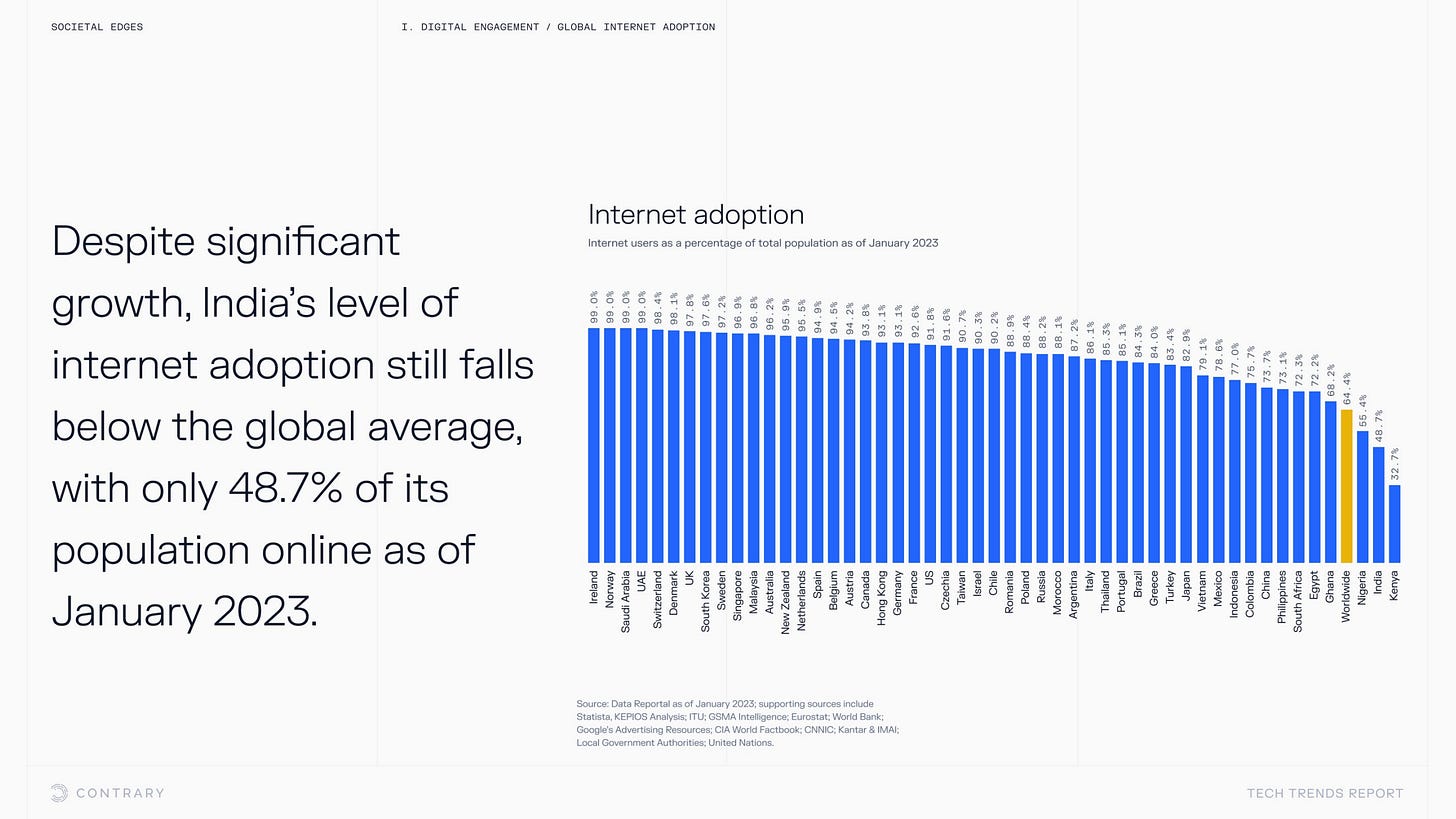
The digital penetration in India is just getting started. And, unlike China, this is a digital market that is dramatically more open to the outside world.
Another note. Paavan made what felt like an excellent point about software. The software market cap may never exist in India the way it does in the US; it certainly doesn’t in China. Labor costs are often the leverage point to justify automation. When your labor costs are so low, you get less focus there. That’s why the majority of the largest companies in China are consumer focused. India will likely follow.
But even more important than broader consumer adoption of technology, the most important indicator of a healthy budding technology market is the legibility of tech talent. As more and more of these large success stories get told, you’ll have more people building the next generation of tech companies. The rate of success and sophistication in the tech companies of the future will be more assured.
The Play
Like I said earlier, all of this is meant to be about idea distillation and distribution. As always, none of this constitutes investment advice and is for informational purposes only. That point is even more important when you consider the fact that, not only am I not a public markets investor, I’ve almost never invested in India and, in fact, have only been to India once. So take on several grains of salt at the very least.
But when you reflect on this particular market “rhyme,” if you have the aptitude and stomach for it, it feels like owning a basket of the current batch of compelling Indian tech companies will likely play out very well in the next few years. Maybe Eternal, Meesho, Groww, PhonePe, a few others. A company like Eternal (formerly Zomato) could end up as the Tencent of India as several additional business lines come into fruition.
There will still be plenty of friction investing in India. Blow-ups like BYJU will keep a lot of the tourists at bay. But having a thought partner like Paavan or finding great resources like Tigerfeathers, can be an exceptional way to sift through the alpha that exists in a budding, albeit Wild West-ey, tech market.
Update on Software is Oversold
Last time, I wrote about how software is getting absolutely demolished in the public markets. I don’t think everyone has the same experience, but I’ve found the X algorithm does a pretty good job for me. When I start to engage on a particular topic, I find additional context floating in my direction. The same happened as I engaged with the “oversold software” thesis. So I thought I would share some of them.
The first thing making the rounds was comments from Orlando Bravo, the founder of Thoma Bravo, saying the slump in software valuations represented a “huge buying opportunity.” On the one hand, no duh. But the key takeaway is that, as markets have become less efficient and more meme-soaked, it means that massive inflections, both up and down, are driven so much more by narrative than reality. That dislocation creates arbitrage opportunities.
That doesn’t mean that all software companies will be fine. Far from it, I strongly believe that, as Raging Capital Ventures pointed out:
“Legacy applications and middleware from companies like Constellation or IBM are most exposed as AI eliminates many of the historical ETL barriers-to-switch. Upgrading to modern SaaS solutions and systems of record will now be much easier.”
If there is one consistent thread I’ve seen from my own portfolio companies that are most effectively leveraging AI, it is very much that. The switching costs have been dramatically lowered because, if there is one thing that AI is uniquely good at right now, its taking unstructured data and making it structured. I made a similar point last time:
“Don’t get me wrong, there are a number of AI companies that will figure it out to great success (many already have). And there are many traditional software companies that will die at their hands. But the death of software more broadly is greatly exaggerated…the obvious idea is likely that there are a core subset of software companies that will be net benefactors of AI.”
My friend Shomik Ghosh wrote a great piece called “Software is Fine - Calm Down.” The one point I thought was most insightful was that a big piece of the sell off is hedge fund flows; as people look to hedge against so much hyperscaler and data center growth, software is a logical place.
Another important element is the reality of AI “killing” software.
There was a great post from Obsidian Capital summarizing the JPM internal IT call. A cleaned up summary of what he said:
Rather than displacing incumbents, they’re leaning into existing software vendors for AI functionality and paying for it. Time to market is critical, and internal developer resources are focused on driving revenue and advancing the core business, not rebuilding third-party applications in-house. As a result, there are no plans to displace vendors. In fact, spend is increasing with every vendor that comes up for renewal. Nothing has been downgraded; their top SaaS vendors are considered mission-critical. The idea of in-housing software and maintaining it internally is dismissed outright—they prefer to rely on third parties and outsource accountability and liability. Developer seat counts are unchanged. They laugh off Claude Cowork, though they do like Claude Code and expect it to meaningfully change developer workflows and boost productivity. Importantly, they are not reallocating any pre-approved enterprise software budget to LLM providers.
Bucco Capital emphasized the point, saying “Obviously, almost no serious business is going to internally rebuild their core systems of record/critical infrastructure. That literally makes zero sense. They have an actual business to run.”
Therefore, What?
I come back again to a quote that has taken up a lot of my thinking over the last few weeks. Most investors don’t just want to be right, they want to be “right AND clever.” Obvious ideas often don’t feel clever. But that doesn’t make them any less right.
India is big, rapidly digitizing, and poised to build its own foundational technology ecosystem.
Probably worth betting on.
Software will continue to be a fundamental delivery mechanism for automation. A subset of companies will have capable moats, products, and ability to benefit from AI.
Probably worth betting on.