A Tale of Two (Weird) Cities
| Subtitle | Why Austin boomed while Portland stalled, and what it says about scaling anything |
|---|---|
| Published | November 7, 2026 |
| Length | About 3,550 words |
| Newsletter | Investing 101 |
| Portfolio ideas | City Building |
| Tags | city-buildinghousingincentivesgovernanceaustinportland |
| Read on | Substack |
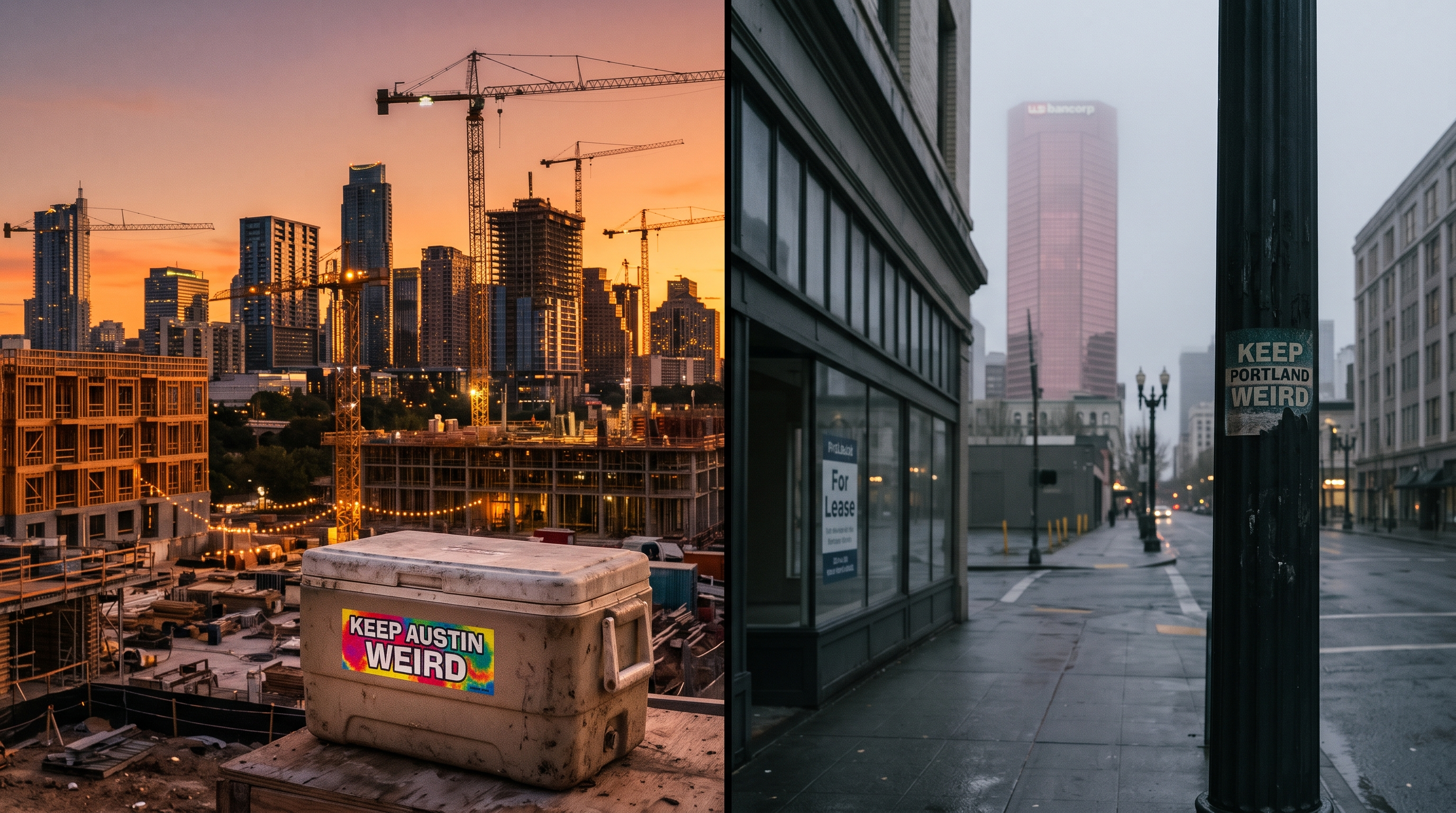
Austin and Portland started out with the same slogan, “Keep [Our City] Weird,” but then split real hard. Portland didn’t collapse, per se, but it sure lost a decade, and I think it lost the ability to correct itself. The cure is less about slogans and more about shovels: culture might be the most noticeable part of the brand, but supply and incentives are the operating model.
In 2003, the owner of a Portland, Oregon record store called Music Millennium heard from a friend at a record store in Austin about a bumper sticker that was making the rounds down there: “Keep Austin Weird.” So he did what any self-respecting indie record store owner would do. He printed ~500 stickers that said “Keep Portland Weird” and started handing them out. The most famous slogan of Portland’s identity is, quite literally, a cover song.
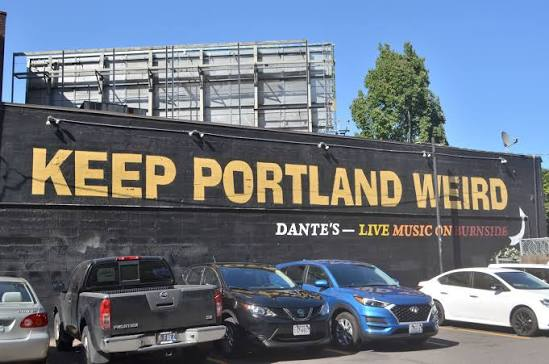
For a long time, the cover was as good as the original. Both cities were left-leaning college-and-music towns with a chip on their shoulder about the big city nearby. Both had the food trucks, the bike lanes, the tattooed baristas. Both were sold to the rest of the country as the place a creative 28-year-old with a little money would go to be young. Where millennials went to retire.
But then, they split pretty dramatically. Over the last decade or so Austin became a darling of a blueberry within a bowl of tomato soup that is Texas; a blue city that kept booming inside a red state. Portland became the city every cable news segment used as B-roll for urban decline. That divide is one of the most instructive things for understanding how cities ought to be built.
I have a soft spot for both. My wife’s family is from Portland, and, as someone who grew up with WAY too much sun in New Mexico, I thoroughly enjoy Portland’s gray. Meanwhile, 2 of the last 3 investments I’ve made are in Austin, riding the industrial wave playing out there now.
I’m not trying to crap on either city, nor do I think either of them are perfect. I just continue to come back to the reality of how instructive it is to diagnose how two places that wanted the same thing ended up so far apart. And, what’s more, how much it highlights about how anything should be built. Culture first, but growth always.
A couple years ago I read Richard Florida’s book, The New Urban Crisis, and this section stuck out to me:
“The clustering of industry, economic activity, and talented and ambitious people in cities is now the basic engine of innovation and economic growth. It is no longer natural resources or even larger corporations that drive economic progress, but the ability of cities to cluster and concentrate talented people, enabling them to combine and recombine their ideas and efforts, which massively increases our innovation and productivity.”
The footnote I wrote next to that paragraph was how people are the new coal, the new oil, the new industry. And if that’s true, then a city’s ability to attract people is the allocation mechanism for that innovation energy. Every company is impacted downstream by decisions cities make around them. Therefore, if we see our cities get better at allocating their “resources” then we’ll have more innovation hubs. And that’s good!
And that’s what makes these two such a clean comparison. Austin and Portland started with the same raw material and the same brand, a lot of young, creative, weird people, but ended up allocating them in opposite directions. Clearly, where Austin rode that potential to a rebirth, Portland drove it straight into the ground.
The insight here comes from identifying two pieces of the equation: (1) the diagnoses: Portland lost the ability to correct itself, while Austin had correction forced on it whether it liked it or not. And then (2) the prescription: collections of weird people have produced every major Revolution and Renaissance in the past. But those Cambrian explosions don’t survive on slogans alone; they require shovels.
Twins, By The Numbers
Let’s look at some numbers.
In 2010, the Austin metro had ~500K fewer people than the Portland metro. By 2024, Austin had passed it. Since 2010 Austin’s metro has grown ~52%; Portland’s has grown ~14%. Austin, the city, crossed 1M residents in 2025. Portland, the city, lost ~19K people between 2020 and 2023.
Follow the money and it gets worse. Austin startups raised a record $7.2B in 2025. In the first quarter of this year, Portland startups raised just $69.7M, Oregon’s worst first quarter since 2016. Different time windows, so it’s not a perfect comparison, but the order of magnitude is the point.
Just take one real estate example as an illustration. The US Bancorp Tower is the largest office building in Oregon, nicknamed “The Big Pink” for its rose-colored glass. In 2015 it sold for $372.5M, the largest real estate deal in the city’s history. In July 2025 it sold again, to the founder of a car dealership group, for $45M. That’s ~$38 per square foot for the most iconic office tower in the state. If you want a single number for what a city’s reputation is worth, an ~88% markdown on its signature building is a pretty good one.
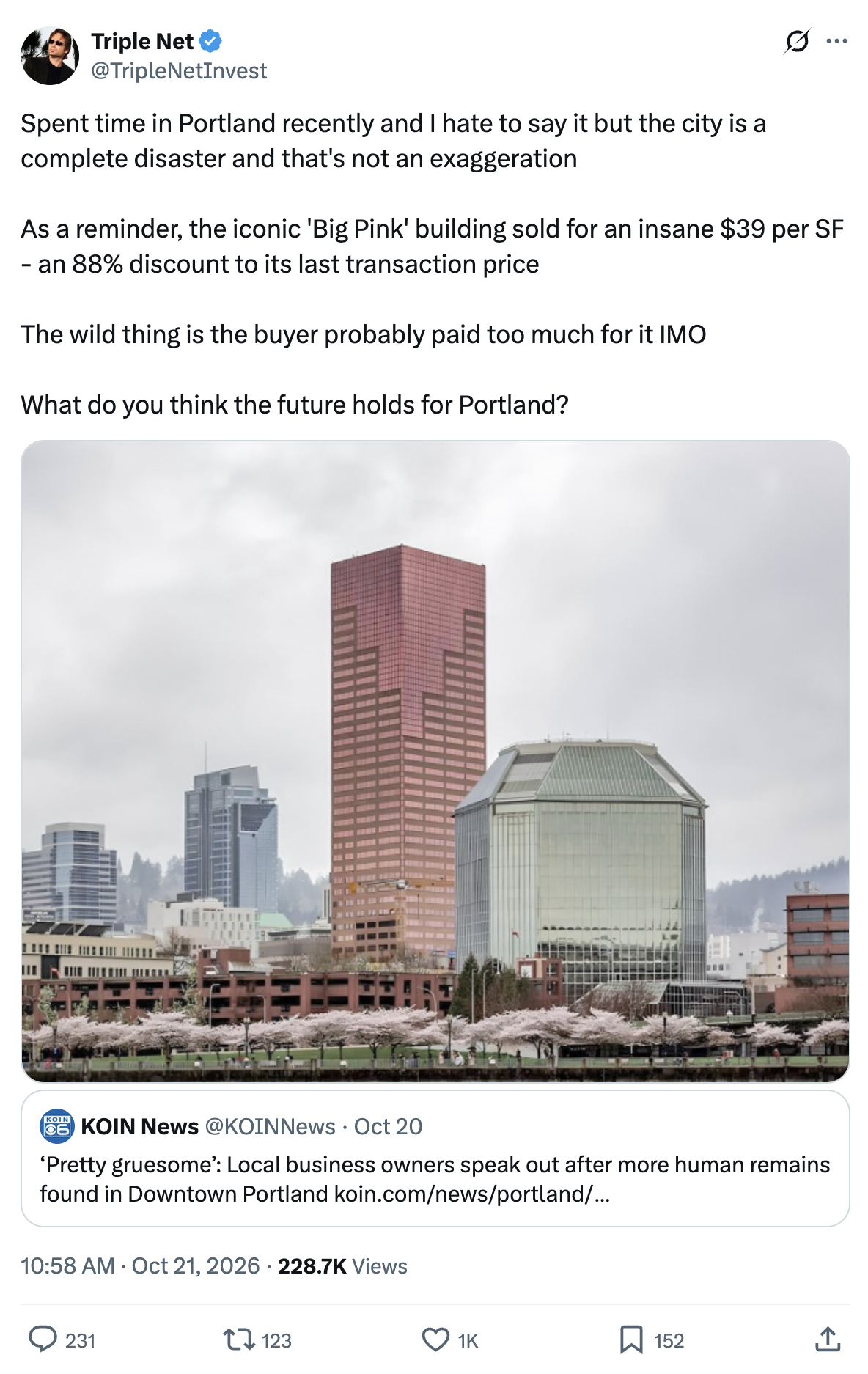
If you watch a lot of Fox News, your assumption could easily be that Portland is left for dead. But the city’s population bottomed in 2023 and has ticked up every year since. Downtown office vacancy is starting to fall, homicides dropped from 68 in 2024 to 51 in 2025. That doesn’t sound dead, per se. But it’s lost a decade of growth. And it’s unclear if they’re going to do the right things to reinvigorate the city or continue to fall behind.
So what happened?
Checks & Balances
Back in July, I wrote about Rat’s Nest Problems; complex issues with a massive web of interconnected dependencies that make them feel unsolvable. Sometimes we weave those Rat’s Nest Problems around ourselves and forget we got ourself into the mess. Basically this meme:

I think Portland is one of the clearest examples I’ve seen of a city doing that. And a big part of that is just because Portland has been operating like a baby with a gun; neither checks nor balances anywhere to be seen.
Start with the operating system. Until 2025, Portland ran on a commission form of government it adopted in 1913; the last major city in the country still doing it. Five elected commissioners each personally ran a slice of the city’s bureaus. No city manager. So there’s not a single person whose job was the city as a cohesive whole. Imagine a startup where every board member also runs a department and nobody’s the CEO. I can’t imagine that works great even when things are calm, but it sure as heck** falls apart the moment you need to make any hard trade-offs across departments.**
What broke their aged little system was layers upon layers of bad choices. Over the course of 8 years, Portland passed four new taxes in eight years. They piled up measure after measure and then the fifth one basically broke the camel’s back:
- An arts tax (2012): a flat $35 a head, rich or poor, that roughly a third of the city skipped paying in the early years, and that now spends ~$2M of the ~$12M it raises just collecting itself.
- A clean energy tax on large retailers (2018): pitched at ~$30M a year, it brought in ~3x that, but the city auditor found it had no clear oversight of how the money got spent.
- A regional homelessness income tax (May 2020): it raised money faster than the counties could use it, with more than $400M sat unspent by 2024 while the tent cities just got bigger.
- A county preschool income tax (November 2020): the layer that pushed Portland’s top rate toward the top of the country, and a program that was sitting on ~$610M by 2025 without making a dent in school enrollments.
- Then the big one… Measure 110 (November 2020): a statewide vote to decriminalize hard drugs on the promise of treatment. What could go wrong?
See, each of these might have had some semblance of a case for why they worth doing individually. But shove them all on top of each other, all with no one really managing the stack? And you get your very own home-grown Rat’s Nest Problem.
While the city broke itself, the state did nothing to check it. In any scenario, Oregon is as blue as they come. Democrats have held Oregon’s governorship and both chambers of the legislature every year since 2013 (and for most of the years before that). As a result, they just let Portland keep punching itself in the face. It took until 2024 for the legislature to recriminalize possession, more than three years after Measure 110 took effect. By then, downtown was a hollow shell of itself.
Meanwhile, Austin had the opposite problem. Its state government HATED Austin. In 2020 the Austin city council voted to cut the police budget by what it announced as ~$150M. Then, the next year, the Texas legislature passed HB 1900, which lets the state block big cities that cut police budgets from raising property taxes. Austin was forced to restore the budget within a year.
When Austin’s camping policy drew backlash, ~58% of Austin’s own voters reinstated a ban in May 2021, and the state passed a statewide one right after. In 2023 the legislature passed what critics nicknamed the “Death Star” bill, limiting how far any Texas city can regulate beyond state law.
Now, I don’t want to pretend every Democrat policy is stupid and Republican opposition was where the magic happened. And granted, a lot of Texas state efforts overrode things Austin voters chose. A state legislature steamrolling its biggest cities isn’t necessarily the picture of healthy self-government.
But I don’t think the policy-by-policy scorecard is what decided it. The visible street-level reality is what the rest of the country saw, and Portland had no mechanism that forced a fast course correction when the story started to suck and make you only park underground when you went downtown.
Back in August, I wrote about what made the American founding so remarkable. The Founders didn’t build a perfect machine; they built a machine that could be MADE better and better, later on, by people who had a vested interest in improvement. I think cities need the same trait. You can have plenty of partisan ideas that sound good at the time. But, in practice, a city with no one to argue with is a company with no board, no customers who can leave, and no competitor breathing down its neck. The friction Austin hated was the same friction that kept it from drifting too far.
Show Me The Incentive
The Munger classic applies to cities as much as companies: “Show me the incentive and I will show you the outcome.” And the cleanest incentive a city sets is its price.
Taxes are, effectively, a city’s price tag. Portland’s stack pushed its top combined income tax rate to 14.77%, second only to New York City. Meanwhile, Texas has no state income tax.
And the people with the most freedom to move are the same people paying the top rate, which means they’re also the ones most likely to vote with their feet. In 2020 and 2021, Multnomah County lost a net 14K+ taxpayers, and more than $1B of income went with them. One study earlier this year found a significant jump in people leaving Multnomah after the preschool tax kicked in. They didn’t even wait around for the legalization of ALL drugs…
It also doesn’t help that a lot of them didn’t have to go far. Vancouver, Washington, is right across the Columbia River, in a state with no income tax. You can keep your Portland friends, your Portland restaurants, and your Portland gray, and just stop paying Portland’s price.
I think about this the same way I think about LPs. A fund manager who raises fees every year can say their LPs are loyal, right up until the re-up conversation. When you combine increasing fees alongside horrible performance, who’s gonna stick around? Residents are the LPs of a city, and the ones with the most capital have the most options. What’s shocking is that Portland “fked around” by raising price and then “found out” when its best customers went shopping for alternatives.**
The encouraging part? The city has started to notice. The county has delayed the preschool tax’s next scheduled increase twice, and Oregon’s Democratic governor said out loud that the tax was “imperiling” the state’s tax base. Self-correction, late but real, is still self-correction.
Different Shovels
Here’s where I think the diagnosis starts to shed some light on the cure. Of all the incentives a city sets, the one that matters most is whether it lets people build.
Austin, unlike Portland, did, in fact, build. A lot! In 2021, the Austin metro permitted ~51K new homes, ~21.6 for every 1K residents. Portland’s best year of the entire decade was ~6.8 per 1K. Even in 2025, after Austin’s boom cooled off, it permitted ~6x as many apartment units as Portland, a metro of almost the same size. Portland’s apartment pipeline is down ~79% since 2017.
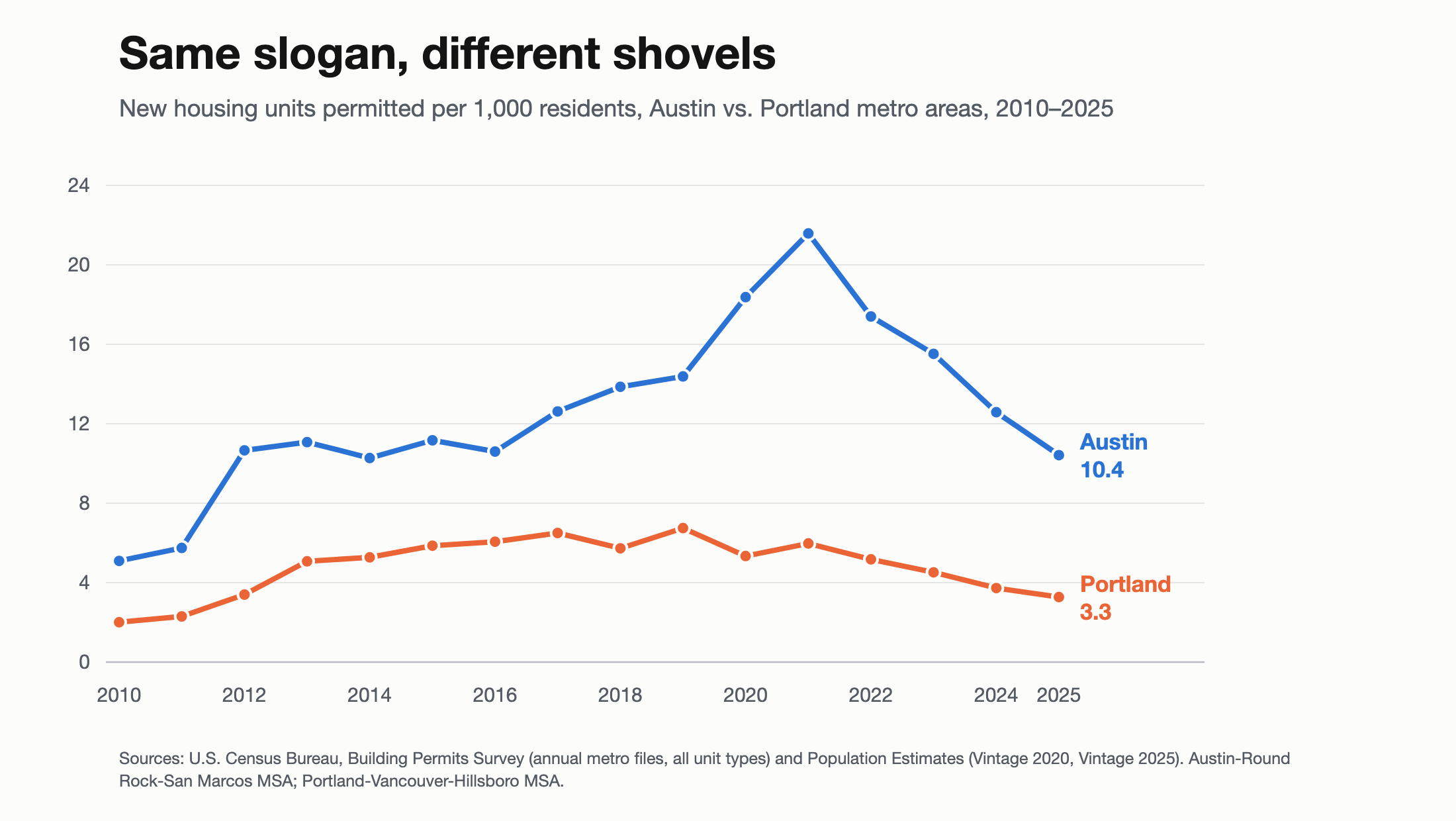
The gap opens in 2012, when Austin started out-building Portland by roughly 3:1, and it never really closed. Then came 2020 and 2021, when half the country was deciding where to move. Austin had the shovels in the ground right when the demand showed up. Portland very much did not; too busy taxing pre-schoolers and making Fentanyl as legal as it could be.
Despite the wailing and gnashing of teeth coming from the NIMBY’s, the other important part was the results. Austin’s rents went DOWN. Median rent fell from $1,546 in 2021 to $1,296 by January of this year, while the city kept adding people. Rents are more than 20% below their 2022 peak. One housing trade group summed it up nicely in a headline: “Austin’s rent drop isn’t weird, it’s economics.” Supply cured price. Something, something “the economy, stupid.”
Back in 2024 I wrote about another example of this; Utah communities refusing homeless shelters while offering no alternative. So I don’t mean this as a red-state victory lap (nobody red is feeling any kind of victory this week). Rather, the instinct to protect what you have by stopping anything new is bipartisan (not to mention human), and it shows up anywhere people are comfortable. In the margins of John Steinbeck’s Travels with Charley, where he mourns how much America had changed, I once scribbled that NIMBYs and Luddites will lose if they win and whine if they lose. Portland is what winning looks like when you have to reap what you sow.
Weird At Scale
All of which brings me back to the slogan itself. “Keep Portland Weird” was always a little bit of an instruction to stay the same. Protect the record stores, the food carts, the neighborhood character. And that’s a perfectly good instinct; I like most of those things too. But I think it got translated, slowly and without much deliberate preference, into a city that treated growth as a threat to its identity instead of the thing that could pay for it.
In The New Urban Crisis, Richard Florida has a chart that has always stuck in my head. It plots US metros on two things: how many people work in the arts (up the side), and how concentrated those jobs are compared to the rest of the country (across the bottom, where 1.0 means “average”). Most cities huddle together on the left. New York and LA float up top. And then, way out in the bottom right corner, all by itself, is Santa Fe, New Mexico.
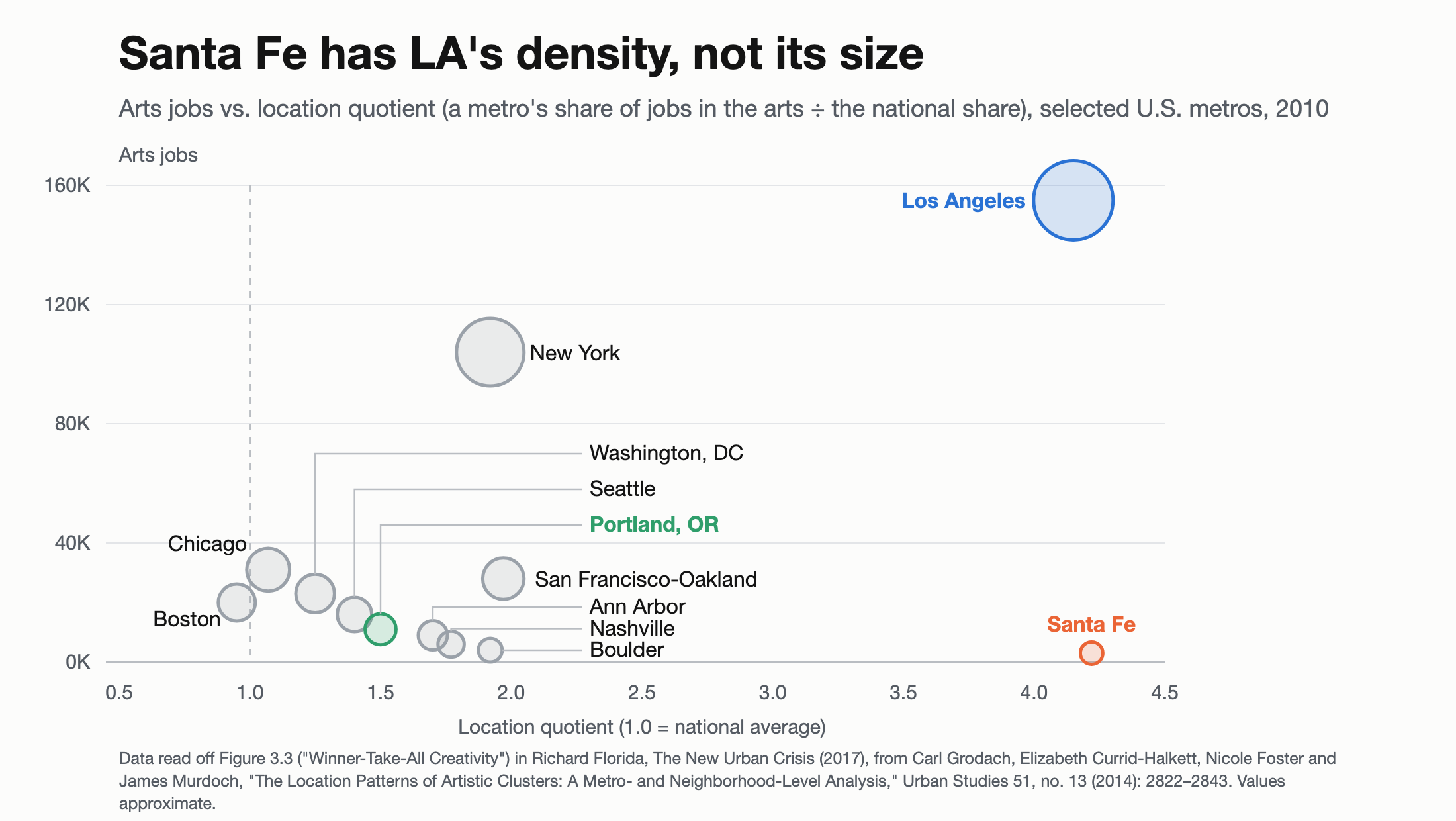
Little Santa Fe has about the same concentration of artists as Los Angeles; both sit at ~4x the national average. LA just has ~50x as many of them. When I first saw it, I scribbled in the margin: “Getting creative jobs there in the first place is the hard part. Now, just grow the city.”
See, Santa Fe already did the hard part. It built the kind of culture other cities try to manufacture with arts taxes and festival grants. It just hasn’t grown very big. Portland, for what it’s worth, sits at ~1.5x; weirder than average, but nowhere near Santa Fe. The trick is growing the city while keeping the culture, and Austin and Portland took that test in opposite directions. Austin took its culture and pushed for scale; Portland tried to protect its culture by siphoning all the money they thought their culture needed, while choking off the thing that made it possible to grow.
For a bunch of founders and VCs, this a known problem. The 10-person startup that’s terrified of becoming a “big company” so it refuses to hire a VP of anything, refuses to write anything down, refuses to build a process. Stay scrappy! Keep it weird! And then a bigger, more boring competitor eats its lunch because it ate everything required to scale. Culture is your brand but supply and incentives are the operating model. If you don’t optimize for growth, someone else will grow up around you, whether you like it or not. Any organization, be it a city, company, movement, or family, needs both a culture supported by a functional operating model. Otherwise you just get broken orgs and dysfunctional family Thanksgivings.
Don’t get me wrong, growth has a real cost, and Austin is currently paying the piper a little bit. In one of his old shareholder letters, Buffett pointed out, talking about newspapers, that a stable population is more invested in its community than a shifting one. Austin’s population is shifting like crazy, with plenty of breaking points. The city’s homeless count is up 36% since 2023, its police department is still hundreds of officers short, and city growth slowed to 0.4% last year. Ask anyone who lived in Austin in 2005 whether it’s still weird and they’ll have an “uh 👏 pin 👏 yun.”
Even the downtowns look similar right now. Austin’s downtown office vacancy is ~30%, same as Portland’s. But the cause is the opposite. Austin built too much and is waiting for tenants. Portland had tenants leave. Both can be problems, but they indicate fundamentally different directions; waiting for growth vs. embracing decline. Over-supply is a timing problem; a demand problem is a reputational issue. One can fix itself when the next wave of people shows up. But the other means you’re on the clock to figure out what went wrong.
Rose City Rising?
Portland is doing a lot of the right things nowadays. It recriminalized possession (solid), is trying to address it walking dead problem downtown, and it threw out its 1913 government and replaced it with a council elected by district and a professional city administrator. The city is also pausing tax increases instead of stacking new ones (meanwhile, Seattle is raging on… god speed). Portland is also seeing homicide rates falling fast (though they do keep finding human remains here and there, unfortunately). Who knows, maybe the car salesman who bought the pink building is bottom-ticking the Portland real estate market.
What I’d love to see next is Portland learning the second lesson, too. You can make all the corrections in the world to stop the bleeding, but putting shovels in the ground is the only thing that brings people back. Back in 2022, I wrote that the world needs more founders and investors willing to dream bold and ambitious dreams, and cities need the same thing: people willing to build the next version instead of guarding the last one.
I tried to anchor my random sister city comparison to investing fundamentals, but not sure how well I did. Here’s my takeaway in terms of what this means for building anything.
Culture always comes first because culture is the part you can’t buy. Santa Fe built the culture without having to force it; meanwhile, Portland’s arts tax spends $2M just to collect the tax, with very little efficacy on actually building a more artistic community. If people are the new coal or the new oil, then culture is what makes the weird, creative, ambitious ones show up in the first place.
But growth always has to follow culture. A culture that stops growing just becomes an exercise in preservation. You end up protecting the record store while the people who used to shop there move across the river to Vancouver. The people a culture attracts need somewhere to live, something to build, and a city that keeps getting bigger around them, or they leave and take the weird with them.
Austin and Portland started with the same sticker, and both are still plenty weird. I guess the next decade decides which one will live up to it.
This week in Networked Conviction 008, my investing journal for paid subscribers: I’m working through the death of patience, plus a Request for Startup for a new credit bureau. The first section is free for everyone; read it here.