Backing Bold Founders from Seed to Scale
 Listen on Apple Podcasts ↗
 Backing Bold Founders from Seed to Scale
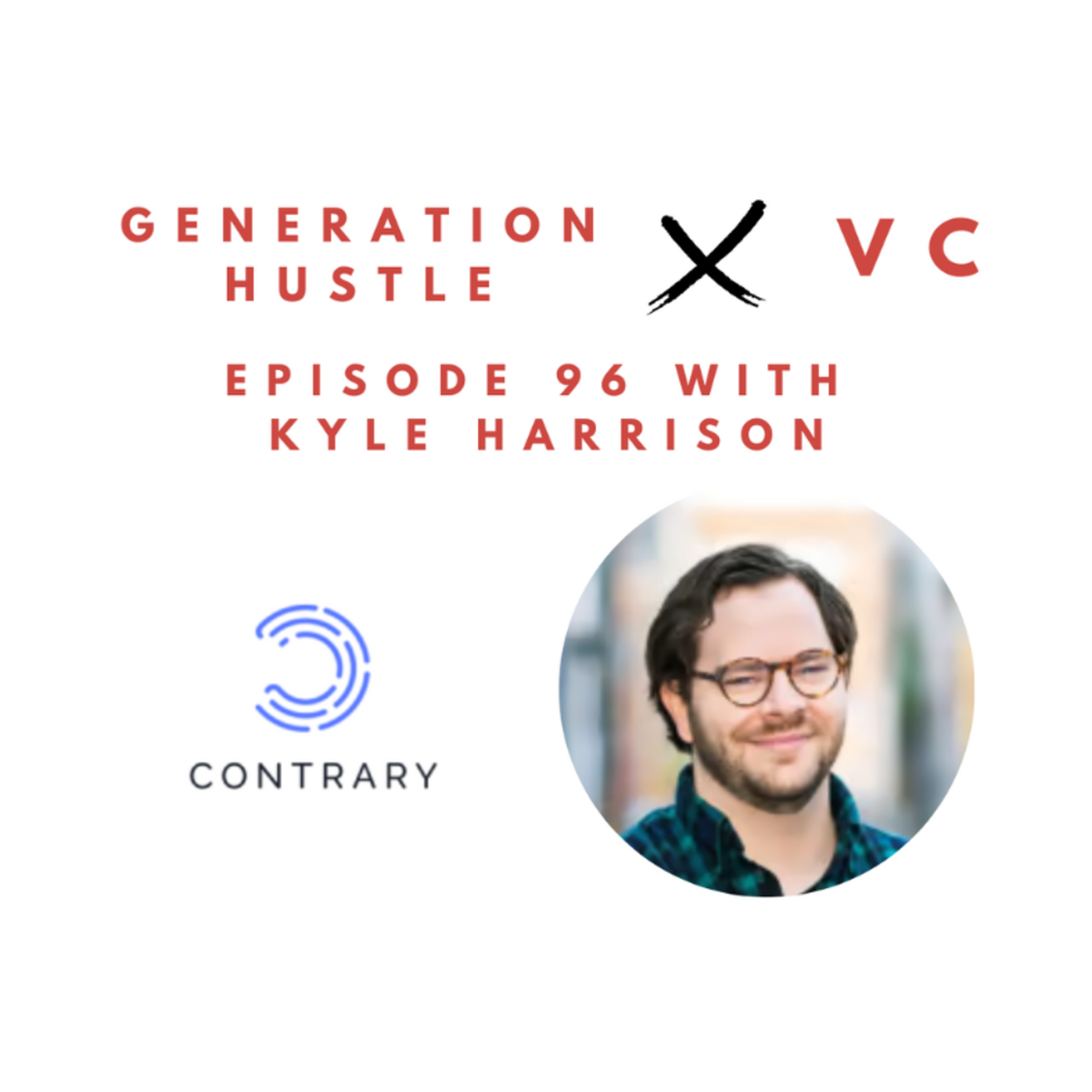
The Generation Hustle Podcast #96 (VC #18), hosted by Aman Samra. Recorded January 31st, 2023; released February 28th, 2023. 57 minutes. Listen on Apple Podcasts · Spotify
Summary
A conversation recorded at the bottom of the 2022–23 venture reset, covering how Kyle got into investing, what actually distinguishes one investor from another, and what he had been arguing in Thinning the Herd about why so many companies could not raise.
Four threads carry the episode.
Investors are not interchangeable. Kyle’s framing is that comparing “investors” as a single category is not instructive — different investors are good for different things, and whether you should take their money depends on whether you need that thing. He sorts them by the stage at which each is actually useful: idea engines at seed, talent magnets through Series A–B (on the argument that your first hundred people dictate the next thousand), execution machines from B onward, financial engineers pre-IPO, and accountability advisors once public.
Investor-founder fit is the useful question. Rather than asking how he won competitive deals, he inverts it: what founder would hire me, and what job can I do well for them? Part of the answer is the firm’s value proposition, part is his own history — and increasingly, he argues, the deciding factor is “vibes,” because the more of life that moves online, the more everyone is responsible for articulating what they are actually like.
Two things his peers would disagree with. That most venture firms do not justify their own existence — after fees, many funds leave their investors worse off than an index — and that fewer companies should raise venture capital at all, because venture-scale requirements leave genuinely interesting businesses unexplored.
Why the market froze. His diagnosis of 2022–23 is a misalignment of expectations rather than a disagreement about quality: founders accepted a haircut, but investors were benchmarking against public comparables that had fallen 80–90%. He adds a structural point about private markets that is easy to miss — in public markets a falling price attracts demand, but in private markets the absence of demand is self-fulfilling, since each VC who passes raises the odds the next one does too. From there, burn and layoffs follow from dependencies: the more dependencies in a business, the less likely it is to survive, and assuming a pot of VCs at the end of the rainbow is a real gamble.
On the layoffs themselves he is more optimistic than not — the 2008–09 pattern where three people who would each have started something separately instead join forces, plus the breaking of the big-tech job-security illusion. Some people will leave tech because what they wanted was security, not innovation, “and that’s fine.” On skills, he expects front-end work to be most exposed to automated code generation while backend complexity and design become the differentiators.
The most quotable exchange is about podcasts themselves. Asked about going on 20VC with Harry Stebbings, his takeaway was a complaint about the medium: podcasts and videos have enormous information density and almost none of it is accessible, because without transcripts you cannot search any of it. He points at Patrick O’Shaughnessy’s work with Colossus as the exception.
There is a pleasing irony in that, given this page has no transcript for exactly the reason he names.
Chapters
From the publisher’s episode notes:
- 2:12 — Intro to Kyle
- 7:13 — Storytelling drives the world
- 9:18 — What makes a good investor?
- 13:45 — Achieving “investor-founder fit”
- 17:57 — Contrary’s investment approach
- 21:47 — What is one contrarian opinion?
- 25:30 — “Thinning the Herd”
- 31:50 — Advice for managing a down round
- 36:15 — Downstream impact of tech layoffs
- 48:10 — 20VC with Harry Stebbings
- 51:35 — Proudest moment & biggest regret
- 54:45 — Lightning round
Preparation notes
Roam daily note, January 31st, 2023: “Did podcast with Aman Samra for Generation Hustle Podcast”.
Kyle’s own notes, written against the question list Aman sent ahead of the recording and reproduced verbatim from his January 31st, 2023 notebook. They are the closest thing to a transcript this episode has — and in places they are fuller than what got said aloud. Shorthand cues (“Sandbox”, “West Wing quote”) are his own memory prompts; the blank answers are questions he chose not to pre-write.
-
- Before we chat about all things VC, let’s talk about your early days.
- A. What experiences led you down the path of tech and eventually Contrary?
- Sandbox
- West Wing quote
- I wanted to be an investor before I wanted to work in tech
- I’ve always been most passionate about people that get me excited. And some of the smartest people are building in tech, so that’s where I wanted to be
- Goldilocks at different firms - lots of very different skills
- Contrary: The opportunity to build something; put my fingerprints on something
- B. What do you believe makes a good investor? Returns are obvious but as time goes by I’m finding more focus on communities, values, etc. as being key factors in the success
- I’m working on a piece talking about what types of investors there. I think it’s actually not as instructive to think about “investor” as an apples-to-apples comparison
- Different investors are good for different things. Whether or not you should take their money depends on if you need that thing.
- There are characteristics of good investors
- (1) Idea Engines (Seed)
- (2) Talent Magnets (Series A-B) - your first 100 people dictate the next 1K+
- (3) Execution Machines (Series B-Z)
- (4) Financial Engineers (pre-IPO)
- (5) Accountability Advisors (public investors)
- C. Ramp, Pave, Gitlab are just some names you’ve invested in. For most VCs, one of these companies would be amazing on their record. How were you able to get involved with these deals and win the founders over?
- I’ve been an investor for 8 years, and in that time I’ve filled different roles, being more junior and working for a partner, or being the partner driving the decision.
- Every investment is different. Some relationships run more deeply, some only have a few months to develop. Some you connect on a personal level, some it can be more transactional because you each want what the other has.
- One framework to think about this is “investor-founder fit.” What founder would hire me? What job can I do well for them?
- Sometimes, that’s a function of the value proposition of the firm I’m at. But when it comes to why they pick me, it often comes down to my experience as a founder or the companies I’ve been involved with, and the lessons that can be learned.
- Increasingly, the reason people will pick the investor they work with can be summed up as “vibes.” The more of life moves online, the more we’re all responsible for articulating our vibes to the people who might want to work with us. I do that through my writing, my twitter, and through Contrary Research
- D. What is one view you have in the world of VC that your peers would disagree with?
- Two that come to mind:
- (1) Most venture firms don’t justify their own existence. Either their returns aren’t good enough to justify the investment (for a lot of funds, after fees, you’d be better off putting your money in an index fund). OR their product doesn’t move the needle for founders. They say it does, and they have cash so people still pay attention. But the reality is their companies are, at best, neutral for having them involved. At worse, the companies suffer because the venture firm isn’t good enough to add value.
- (2) Fewer companies should raise venture capital. There are a lot of really interesting concepts that are left largely unexplored because they can’t justify venture scale outcomes. I’ve seen media companies, service businesses, fintech companies, and more raise capital and set themselves up for failure.
-
- I recently read one of your articles titled “thinning the herd” in it you describe the current landscape of unicorns and you drew 4 key areas to focus on. Love for you to highlight the topic at hand and detail the 4.
- A. The first is investor expectations.
- The reason a lot of companies couldn’t raise money in 2022, and the reason many of them won’t raise money in 2023, is because there is a dramatic misalignment of investor expectations and founder expectations.
- Founders understand that the markets have tumbled, so they should take a haircut on their valuations. But they’re not one of these big public companies that needs to shed 90% of their value! So they expect a 15-20% reduction in their expectations
- But VCs are benchmarking the size of their outcomes to those large public companies that have seen 80-90% reductions. And they’re realizing, “Oh… If I invest at $1B for a Series A, and I’m hoping for a 5x return, but the largest company in the category has hundreds of millions in revenue and is only worth $2.5B? Then I can’t make my return. So I can’t do this valuation.
- The existence of public companies trading at 50x revenue were what allowed investors to be so haphazard with valuations.
- B. Next you talk about down rounds and their relationship to demand and price
- That’s another aspect that founders often get wrong. They think that there will always be a market for their stock.
- But the reality is that venture doesn’t exactly work the same way public markets do.
- For most public companies, there is some kind of appetite for stock even if the value is low. In public companies, stock price going down usually increases demand for the stock, which allows for some kind of price equilibrium.
- But in the private markets, the lack of initial demand becomes a self-fulfilling prophecy. The more VCs who say no increase the odds that the other VCs will say no. Which means that equilibrium can be impossible to reach.
- Which means you don’t raise money. So you need to think about your business as a risk / reward calculation. WHY should an investor have demand for stock in your company?
- C. Third and Fourth, something I have been critical of with alot of founders I have chatted with, is an uncontrollable burn which has now compounded to layoffs, how does that relate back to this topic?
- I talk a lot about an economic engine. Every business has inputs and outputs.
- There are a lot of complex inputs and outputs around burn, and how that translates into layoffs.
- This week I wrote a piece about dependencies and controlling your own destiny. The more dependencies you introduce into your business, the less likely you are to survive.
- Assuming that you can keep burning, and keep growing, and keep hiring, and keep running out of money, assuming that there will be a pot of VCs at the end of the rainbow is a real gamble. You’re creating a business that is dependent on a cash infusion eventually, and that eventuality is more at risk now than it has been for years.
-
- Speaking of layoffs, we’ve seen FAANG companies minus Apple, make big changes.
- A. What are your thoughts on the ultimate downstream impact of all these layoffs?
- a. How does this impact the tech space as a whole from an innovation
perspective?
- I’ve referenced frequently this idea that became prominent in 2008 / 2009. In a boom time, you might have three smart people that would all start their own individual businesses. In a bust time, those three people will get together and create one business, and be better for it.
- I think we will see some of that.
- I think that the facade of big tech job security has also been broken. The reality is there are always risks in life, so what risks are you willing to take? There will be more people who reevaluate their own appetites for risk.
- Some of them will get out of tech in general, because what they really wanted was job security, not innovation. And that’s fine.
- But others will think, “well if I could lose my job anyways, why not start something? Or go join something I’m actually excited about?”
- b. How does this impact engineering salaries moving forward?
- There are a lot of forces at play in the way people get paid.
- I think certain skills will become more valuable than others. Front end dev work is probably at risk because its very form function and when you look at automated code production, a lot of that is used to replicate existing interfaces.
- I think that backend systems are still complex, and require a lot of optimization
- I also think design has increasingly become more of a differentiator. We just released a deep dive last week from Contrary Research about the landscape of design tools, and the rise of the citizen designer.
- The ability to communicate visually, and articulate interesting ideas; those will be incredibly valuable going forward.
- a. How does this impact the tech space as a whole from an innovation
perspective?
-
- Staying on the topic of labour markets, I have been fascinated by GenZs and their relationships with employers
- A. Do you have an opinion on how corporate America can work towards establishing a better relationship with GenZs? They will be a huge influx of talent but there are strong challenges with retention, engagement, and productivity
- There will always be an element of generations misunderstanding each other. I don’t remember growing up and feeling like age groups were so distinguishable, but technology has exacerbated that.
- B. Disagreements on capitalism, higher costs of living, and an online world, how do you see this group advancing the world of technology given their often troubled relationship with most things that enable innovation?
- I don’t think younger people hate technology, I think we’re becoming more aware of the nuance that surrounds it
- If you’ve seen The Good Place, its a TV show about how these people and realize no one has gotten into heaven (or The Good Place) in over 500 years because the world has become so complicated
- Choosing to eat a certain meal gets you so many negative points because of the layers of complexity around it.
- Younger people don’t hate iPhones. They hate sweat shops, and attacks on their mental health, and dopamine addictions, and online bullying.
-
- I would say a highlight for most tech professionals is going on 20VC
- A. What was the experience like chatting with Harry and what if any takeaways you got from him?
- Harry is a great guy. Loved chatting with him.
- My takeaway was actually something that I wish was different. Spending time talking with him made me sort of realize it, so its not a criticism of him but something I want more of in general.
- Podcasts and Youtube videos have SO MUCH information density, its insane. But I’m a big note taking nerd, and a lot of that information is inaccessible. Without transcripts, you can’t search for specific elements, or frameworks, or anything.
- I love what Patrick O’Shaughnessy is doing with Colossus; he’s trying to unlock all this goodness that he’s creating. But there’s so much more we could do to better unify all this interesting information we’re creating so quickly.
-
- Let’s ask you some more personal questions
- A. What do you say are you most proud of in your life till now?
- B. What is your biggest regret?
- C. When you are 80 years old, what do you think will matter to you most?
- Lightning Round:
- Favorite book of all time
- I feel the same way about having a favorite book as I do a favorite movie; they all have “jobs to be done,” and I hire them for different things
- John Quincy Adams
- The Stormlight Archive
- The Book of Mormon and the Bible
- If you could have dinner with 1 person who would it be
- The technology that you are most excited about, which is not Gen AI?
- Pineapple on Pizza, Yay or Nay
- Pineapple all the way
- Favorite book of all time
Connections
- Thinning the Herd — the essay the middle third of the episode is built on.
- Investing 101 2.0 — the blog the host introduces him through.
- 20VC · Harry Stebbings — the appearance he is asked to reflect on.
- Colossus · Patrick O’Shaughnessy — named as the person actually solving the information-density problem Kyle complains about.
- Contrary Capital — the firm, and the “opportunity to build something” he gives as his reason for joining.
- John Quincy Adams · The Stormlight Archive · The Book of Mormon — his answer to the favourite-book question, prefaced by the argument that books have “jobs to be done” and you hire different ones for different jobs.