Using Others To Think With (Rowan Williams)
Using Others To Think With (Rowan Williams)
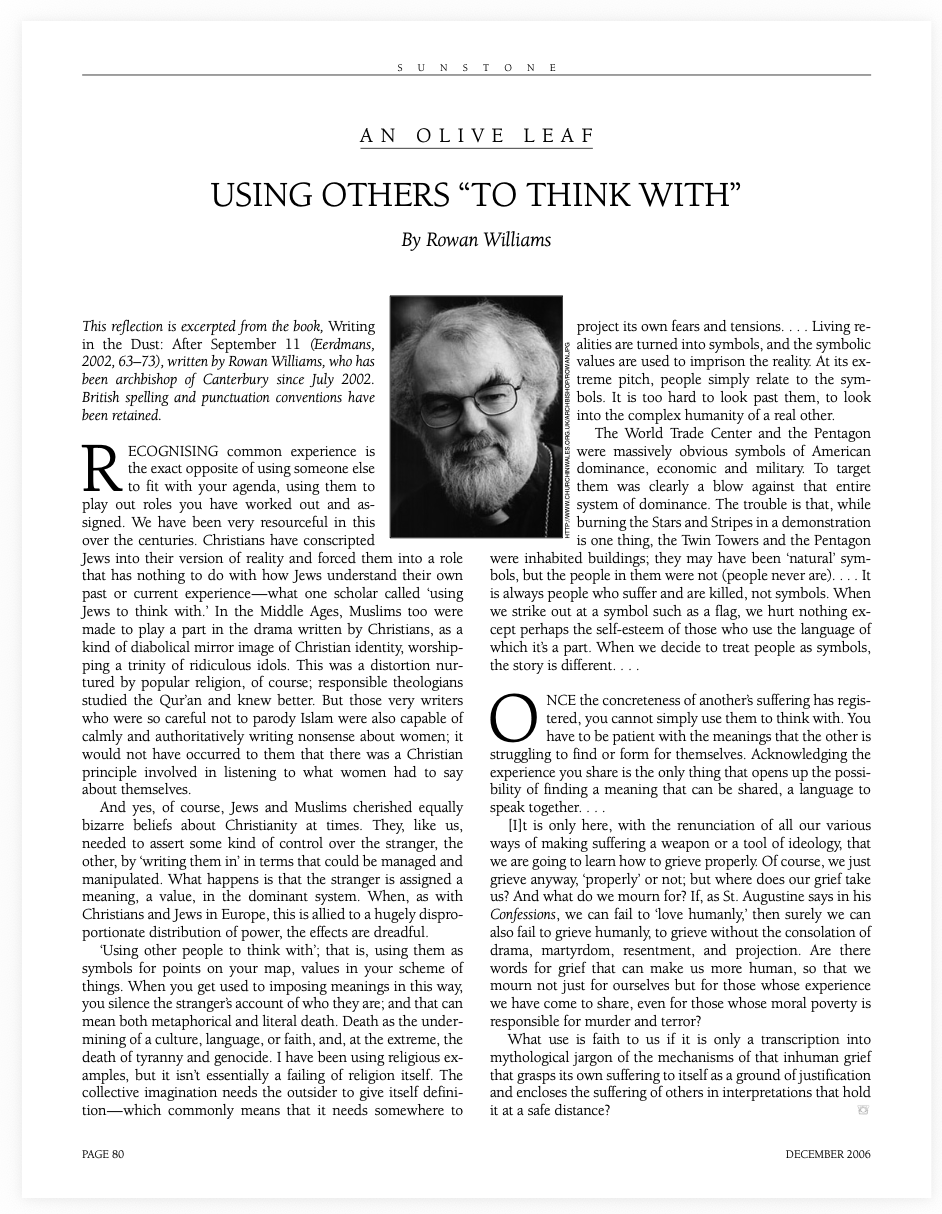
A one-page Sunstone reflection (the “An Olive Leaf” column, December 2006, p. 80) excerpted from Rowan Williams’s Writing in the Dust: After September 11 (Eerdmans, 2002, pp. 63–73). The magazine notes Williams had been Archbishop of Canterbury since July 2002.
Summary
The argument. Williams borrows a scholar’s phrase, using a group “to think with,” for what happens when you turn another people into a role in your own story. Recognising a shared experience is the opposite: it means listening to the other person’s own account of who they are.
The religious examples, applied to his own side first. Christians wrote Jews into their version of reality. Medieval Christians cast Muslims as a “diabolical mirror image” of themselves. Even theologians who knew better about Islam never thought to listen to what women said about themselves. Jews and Muslims did the same thing to Christians. His point is that this is not a failing of religion as such. Any collective imagination defines itself against an outsider, and when that is combined with unequal power, the results are “dreadful”: the slow death of a culture or language, and at the extreme, tyranny and genocide.
The turn to September 11. The Twin Towers and the Pentagon were obvious symbols of American economic and military dominance. But burning a flag is one thing; those were occupied buildings. The buildings may have been natural symbols, “but the people in them were not (people never are).” Only people suffer and die. Symbols don’t. Attacking a symbol harms nothing but the self-esteem of the people who use it. Treating people as symbols is a different act.
What follows for grief. Once another person’s concrete suffering has registered, you can no longer use them to think with. You have to wait for the meaning they are struggling to find, and acknowledging what you share is the only route to a language you can speak together. That, Williams says, is where we learn to grieve “properly.” He takes a line from St. Augustine’s Confessions about failing to “love humanly” and turns it: we can also fail to grieve humanly, falling back on drama, martyrdom, resentment and projection. Grieving humanly means mourning for those whose experience we now share, “even for those whose moral poverty is responsible for murder and terror.”
The closing challenge. Faith is useless if it only restates, in mythological terms, a grief that treats its own suffering as justification and keeps everyone else’s suffering at a safe distance.
Why it matters
- A defence against ideology that starts with self-criticism. Williams begins with his own tradition’s record before he says a word about the attackers. That ordering is the argument in practice.
- “People never are” symbols. A short test for any rhetoric (political, religious, corporate) that has turned a population into a stand-in for an idea.
- Empathy treated as patience, not sentiment. The work is waiting for the other person’s own meaning instead of assigning one.
Connections
- St. Augustine / Confessions (Augustine) — the “love humanly” line Williams turns into “grieve humanly.”
- Mimetic Theory — related ground: a community that defines itself through an outsider. Williams makes the point without Girard’s scapegoat machinery.
- Sunstone is the independent Latter-day Saint forum magazine. This is an Anglican archbishop printed in its “Olive Leaf” column, alongside the Mormon-studies material already in the wiki (Dialogue — A Journal of Mormon Thought).
Referenced in
- Writing in the Dust note