The Business of Anthropic (Michael Dempsey)
| Author | Michael Dempsey |
|---|---|
| Published | November 25, 2026 |
| Format | Essay |
| Original | Read the original |
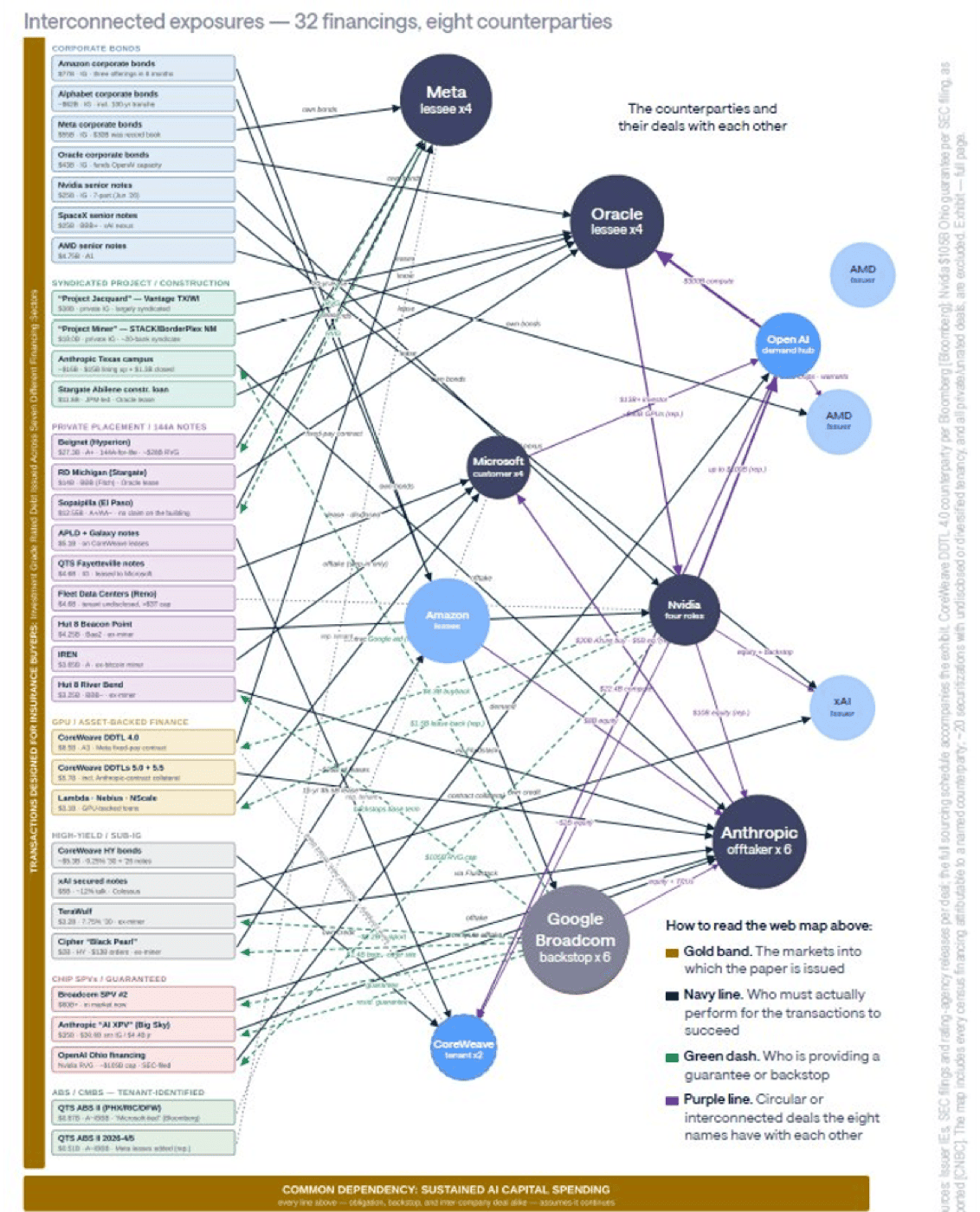
Strip away the financing web and Anthropic’s whole business reduces to one question: can it keep finding new use-cases for frontier tokens faster than the price of yesterday’s frontier intelligence collapses toward zero?
The Business of Anthropic (Michael Dempsey)
Announced by Dempsey on X in (New Essay) The Business of… (tweet), with the essay link posted as a self-reply (via tinyurl.com/anthropicsbusiness).
Key claims
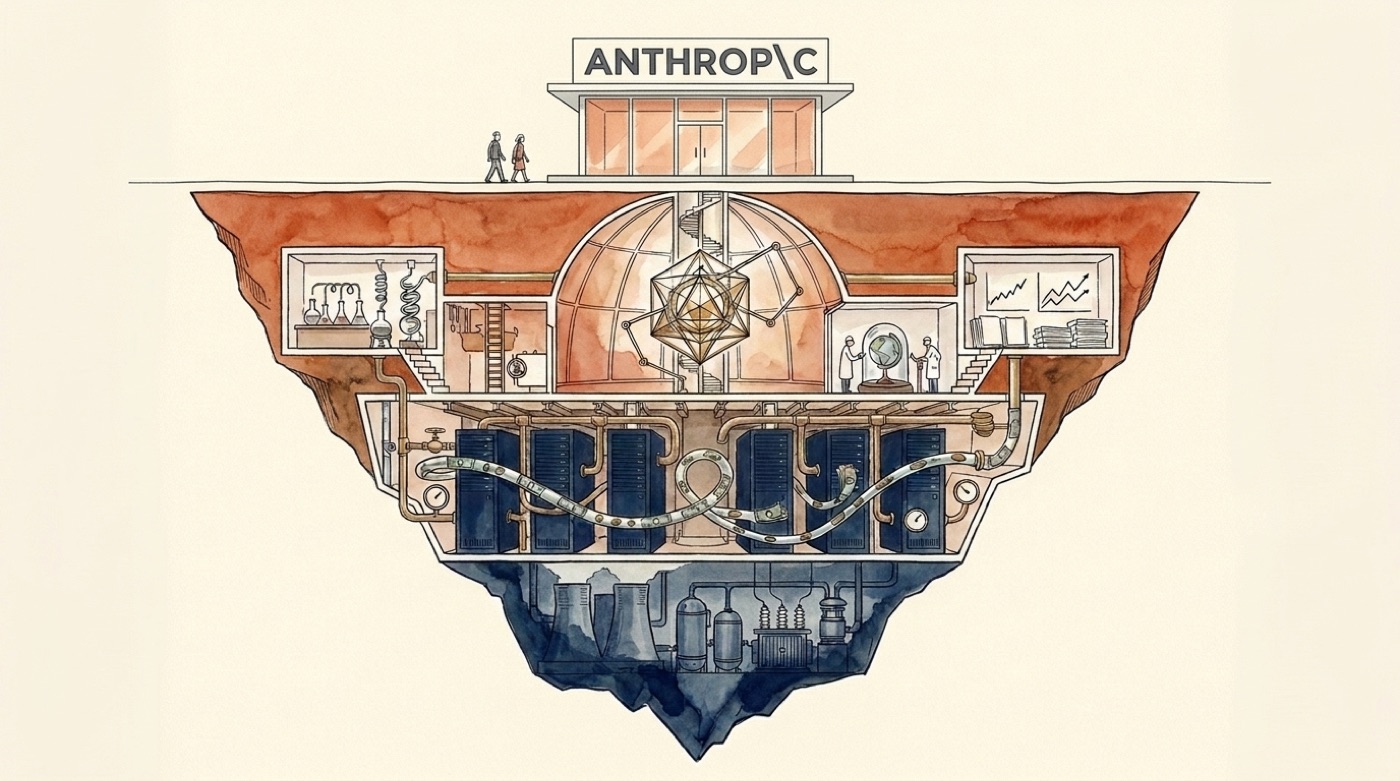
- The running joke is the structure. The essay opens by restating “Modeling frontier labs as businesses is incredibly simple” four times, each version adding a layer (selling intelligence through an API, renting GPU hours, raising capital to rent/buy GPUs, then equity, debt and compute commitments that help others build data centers, plus subscriptions, software and owned data centers). The point is that the simple description keeps accreting complexity.
- Anthropic is the cleanest case. Dempsey focuses on Anthropic as “the most ‘pure-play’ intelligence-seller of them all,” without OpenAI’s consumer burden or the monetization adjacencies of Alphabet or Meta.
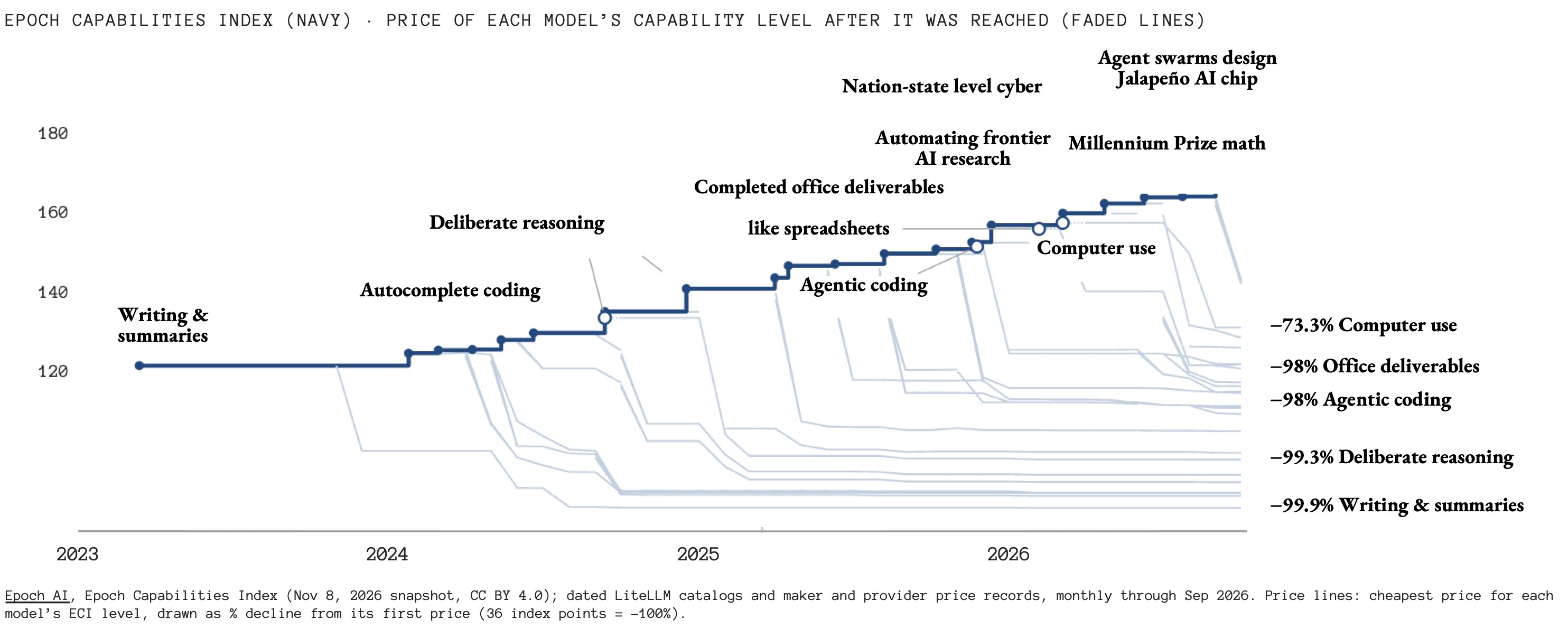
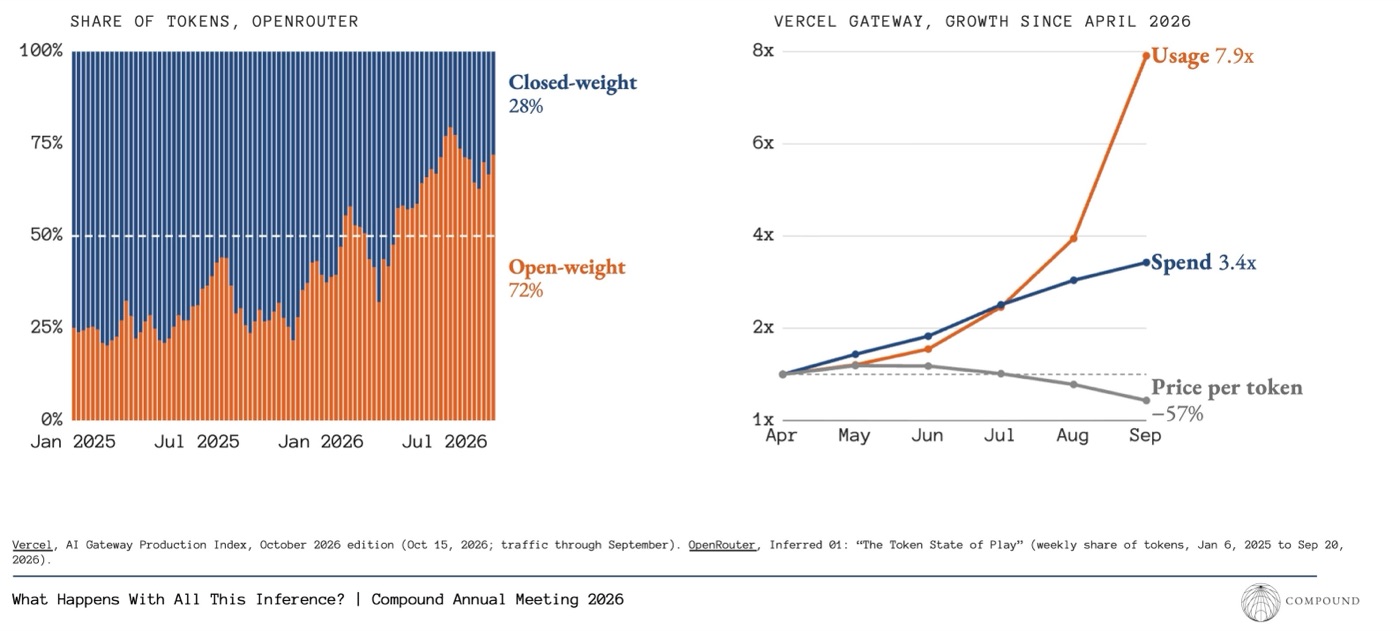
- The one question. “Can they continue to find new use-cases for frontier tokens over time in order to outpace the compression of existing intelligence?” The cost of Current Day Frontier Tokens trends toward zero as models get more efficient and rivals catch up; open-weight models catch up roughly 4 to 12 months later. Token share on OpenRouter has shifted toward open-weight models (about 72% open vs 28% closed by late 2026 in his chart), while Vercel gateway data shows usage up 7.9x and spend up 3.4x since April 2026 with price per token down 57%.
- A sliding window of high-ROI categories. Frontier tokens are most valuable in zero-sum or high-asymmetry domains “where being 5% smarter first matters a lot more than 95% cheaper, but slightly later”: finance, cybersecurity, defense/government, biology, materials science, and (often cited) semiconductor design.
- The GPU-hour spread. Another framing: Anthropic turns a $2 to $9/hour commodity (a B200 GPU-hour) into a $20 to $50/hour blended asset, or $100+/hour at the frontier, and uses the spread to fund R&D. Hosting an open-weight model like DeepSeek earns roughly $5 to $9/hour, “basically the same as bare GPU rental” (his footnote: rough internal modeling).
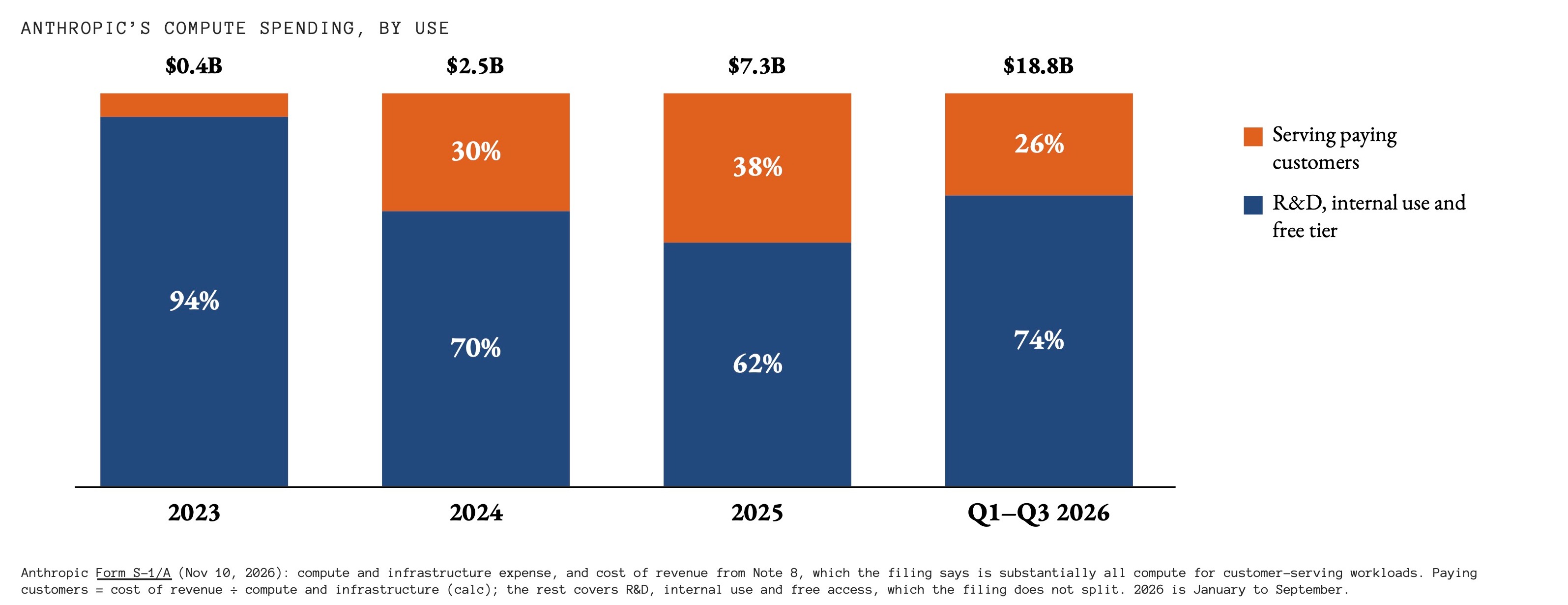
- The compute split is a Rorschach test. Per Anthropic’s Form S-1/A (Nov 10, 2026) as charted in the essay, compute spending grew from $0.4B (2023) to $2.5B (2024), $7.3B (2025) and $18.8B (Q1 to Q3 2026), while the share serving paying customers went 6% to 30% to 38% and back down to 26%. Bears read it as frontier R&D outgrowing revenue compute; bulls read ~$18.5B annualized of R&D and internal use as conviction in future use-cases.
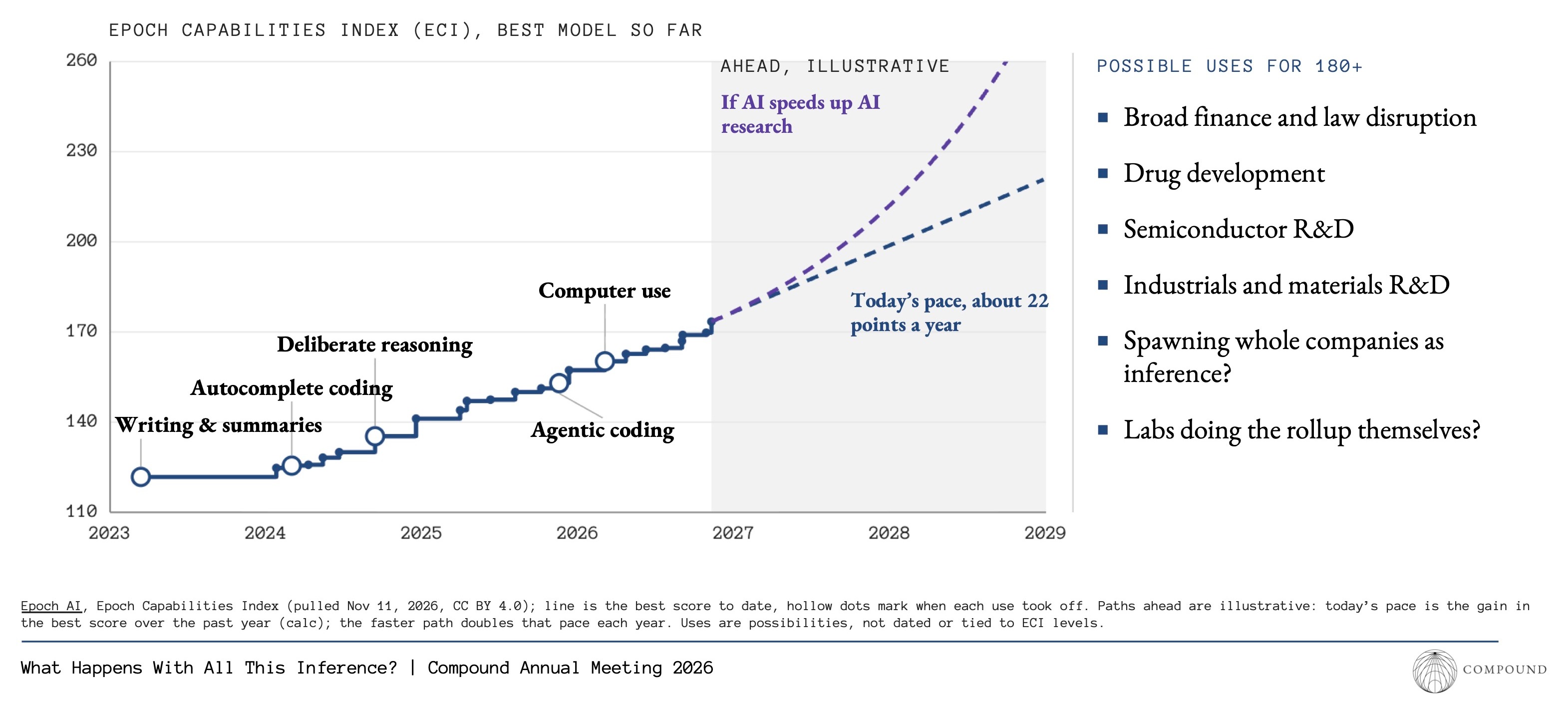
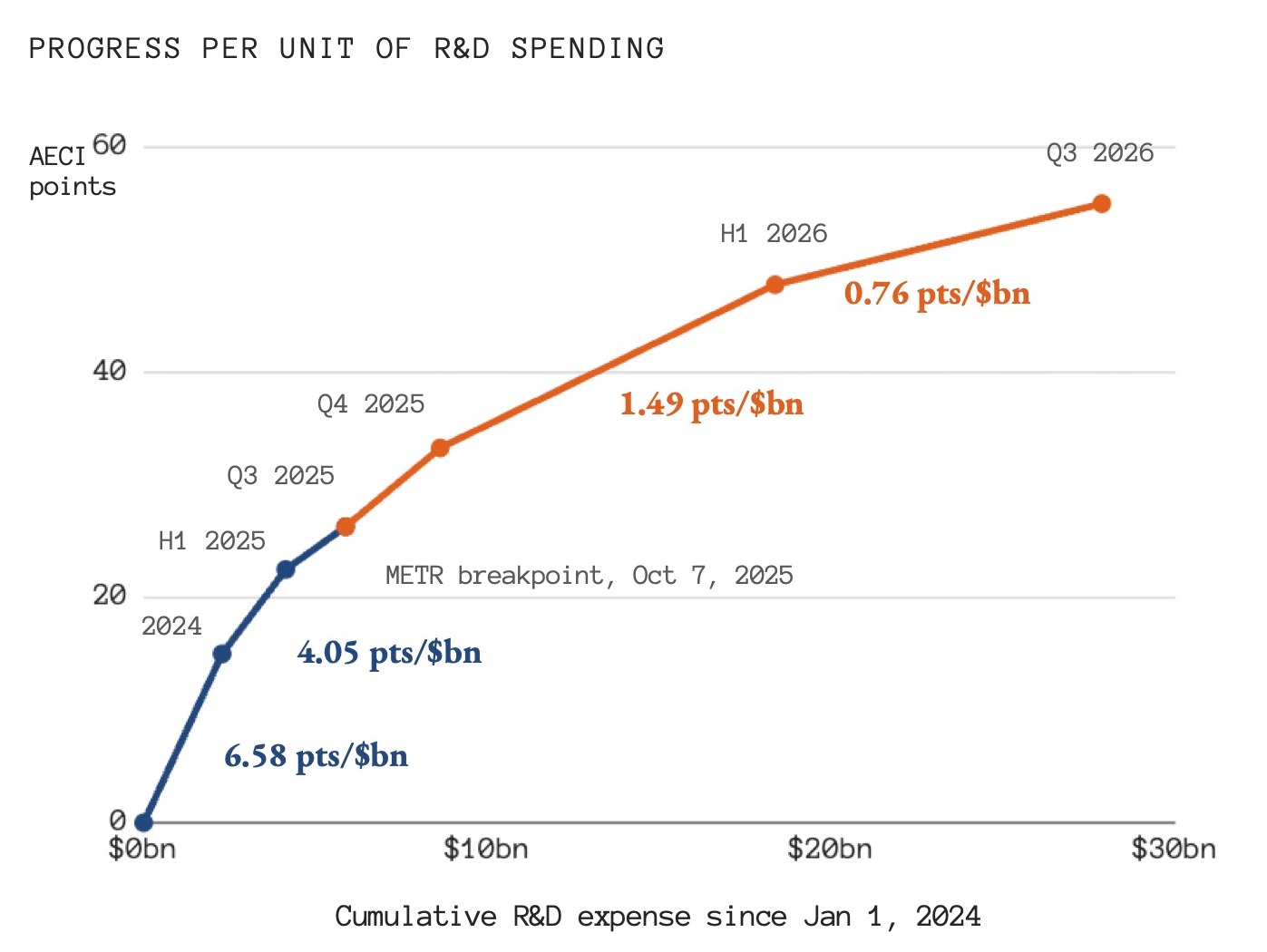
- Diminishing returns per R&D dollar. Capability gains per dollar fell from 6.58 ECI (Epoch Capabilities Index) points per $B of R&D in 2024 to 0.76 points per $B in Q3 2026. The bull counter is that ECI points are not linear in economic value (120 to 130 unlocked summaries, 150 to 165 unlocked agentic coding and computer use, 170+ might unlock alpha generation or drug discovery), but the economy still has to absorb those capabilities within the open/closed lag window.
- The Scale/Mercor lesson. Dempsey passed on data-annotation companies (Scale, Labelbox, Crowdflower) early in his career, underestimating both the market and the fact that they were “machines that can be pointed toward persistently shifting goal posts.” His reframe: Anthropic points tens of billions of dollars of compute at shifting goal posts to sell frontier lead time. The catch (footnote 7): Scale and Mercor are variable-cost and can slow contractor spend in a pause, while Anthropic carries massive fixed compute commitments, “which makes an air pocket a lot less forgiving.”
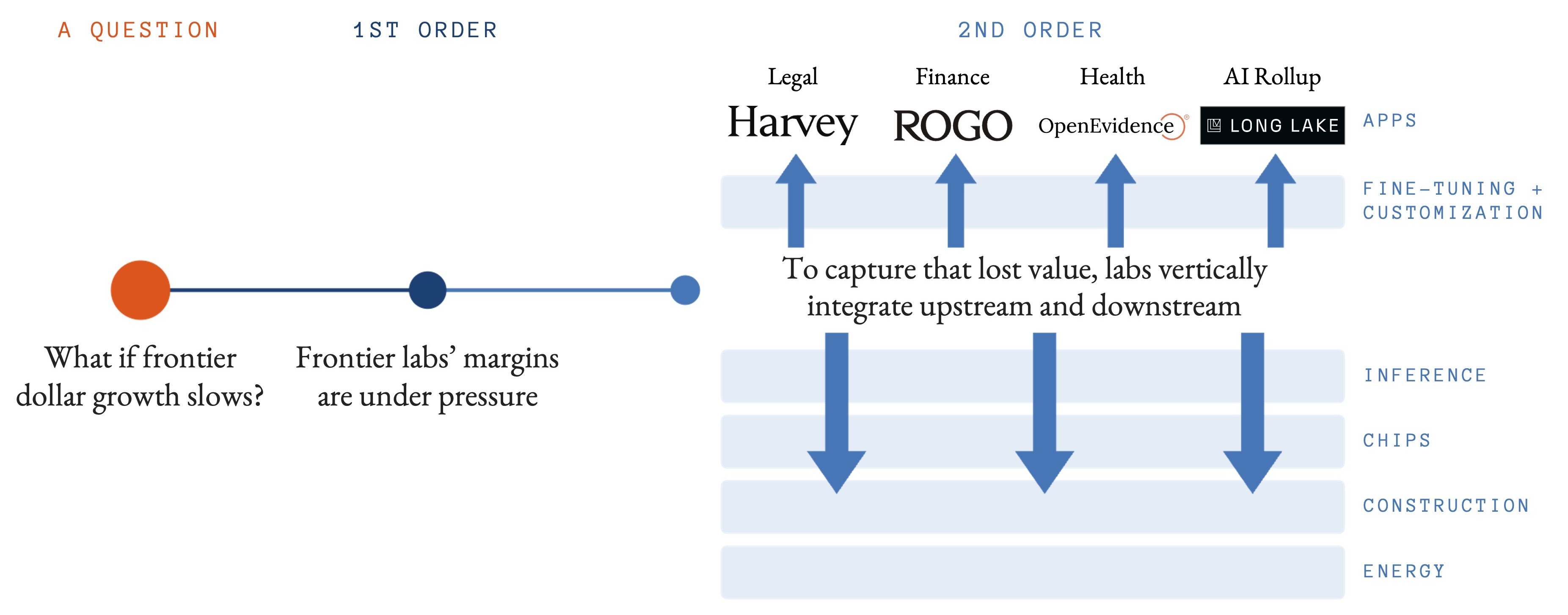
- If margins erode: expand up or down the stack. Down (inference, chips, construction, energy) defends margin but “slowly turns an intelligence lab into a capital-intensive utility.” Up (fine-tuning, vertical apps, rollups) captures workflow value but competes with its best API customers and pushes them toward open weights. Two end states: “a leveraged utility with an R&D department,” or a business that “blows up its own best customers…or something.”
Notable quotes
“To understand Anthropic you might just want to understand one thing which is: Can they continue to find new use-cases for frontier tokens over time in order to outpace the compression of existing intelligence?”
“Mostly zero-sum or high-asymmetry places, where being 5% smarter first matters a lot more than 95% cheaper, but slightly later.”
“People are spending more, which means the open question is who keeps the margin on that spend, and whether labs can keep selling temporary lead time at the frontier before open-weight catches up 4-12 months later”
“Another framing one could use is that Anthropic is in the business of turning a $2-$9/hour commodity (a B200 GPU-hour) into a $20-$50/hour blended asset, or $100+/hour at the frontier, and using that spread to pay for the rest of the fleet doing R&D.”
“Ok so, modeling Anthropic as a business is incredibly simple. They point tens of billions of dollars of compute toward persistently shifting goal posts to sell frontier lead time (and absolute performance) to customers that will increasingly demand and value frontier intelligence.”
“Going down the stack (inference, chips, construction, energy) is a way to defend margins as volume keeps ripping while dollar growth slows, though it slowly turns an intelligence lab into a capital-intensive utility”
“Anthropic is best understood as a leveraged utility with an R&D department.”
Charts and figures
How it connects
- Anthropic and Frontier AI Labs: the subject; compare Field Notes 015 — Anthropic’s Margin Math (Contrary Research, Oct 2026) on the same margin question.
- Open-Weight Models: the 4 to 12 month catch-up lag is the clock the whole business model races.
- Commoditizing Complements: the essay’s pure-play problem (Google or Meta pricing near-frontier intelligence near cost because they monetize AI elsewhere) is the complement strategy seen from the lab’s side; see I wish more people knew… (tweet) for the Nvidia version.
- Michael Dempsey: also wrote Dear VCs, Just Give Up (Michael Dempsey).