The Agentic State (ChinaTalk, Luukas Ilves)
| Author | Jordan Schneider, Phoebe Chow & Luukas Ilves |
|---|---|
| Published | November 23, 2026 |
| Format | Interview |
| Original | Read the original |
The Agentic State (ChinaTalk, Luukas Ilves)
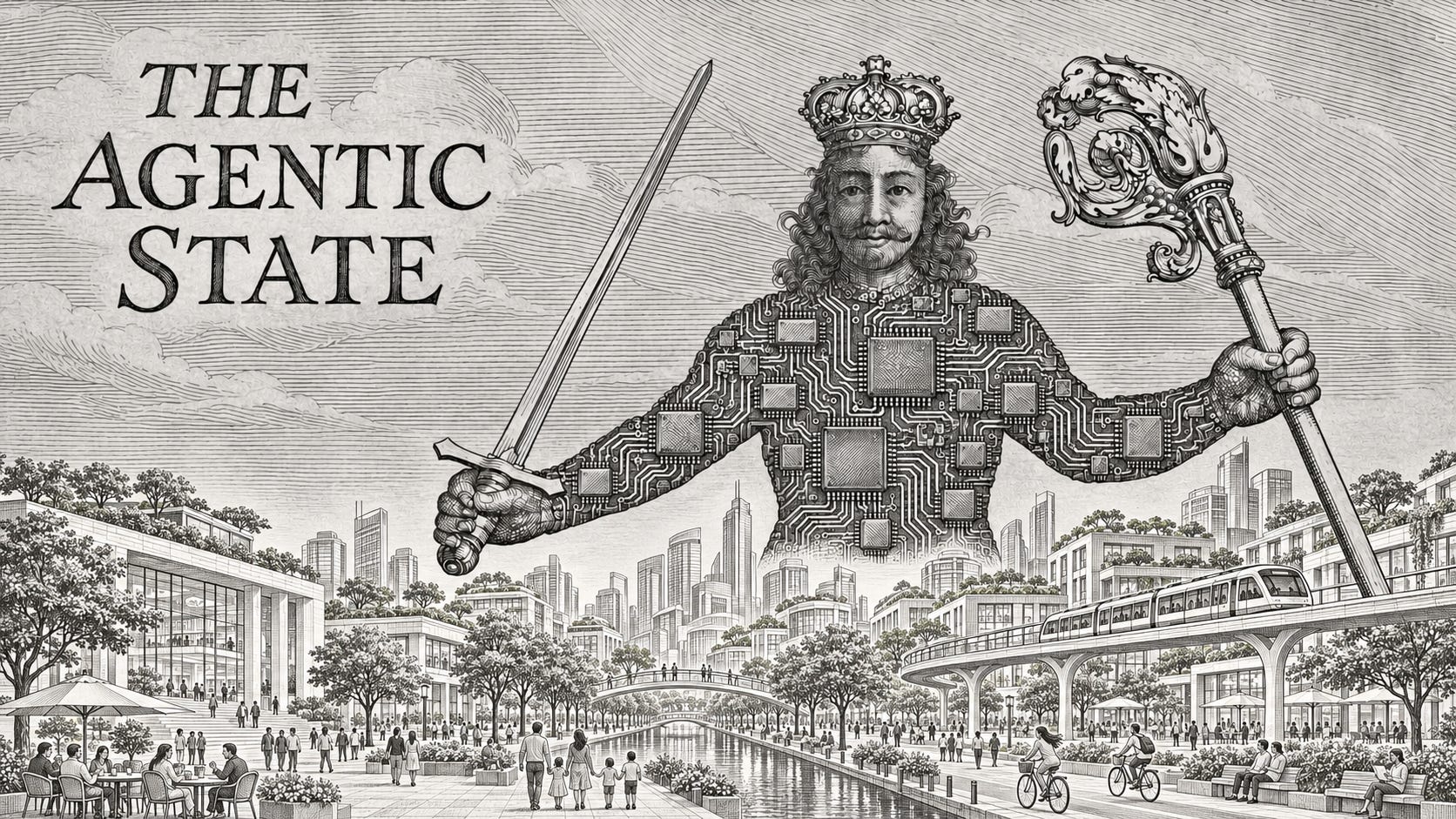
ChinaTalk podcast, published as an edited transcript on November 23, 2026. Jordan Schneider interviews Luukas Ilves, co-founder of the nonprofit The Agentic State, former government CIO of Estonia and former adviser to Ukraine’s Deputy Prime Minister. Subtitle: “How AI can transform government for the better.” Roughly 8,000 words.
Summary
Ilves’s argument is that agents are good at exactly the kind of cognitive workflow government runs on, so governments should be redesigned around them rather than defending against them. The piece is a deliberately optimistic case; Schneider notes he gets a guest arguing the upside “maybe twice a year.”
Agentic flooding is the push factor. Cheap intelligence means citizens file FOIA requests, grant applications and permits in unprecedented volume, first with LLMs in the loop and increasingly through agents talking to government services directly. The tempting reaction is to “raise the levees”: more CAPTCHAs, in-person requirements, declarations that no LLM was used. Ilves calls that path “possible, but a tragic one,” since it means refusing legitimate demand created by broken services.
The 2031 vision. In governments that get this right, most public services, including complex ones like building permits and licenses, run end to end in about a minute, with new services stood up in a day after an election or a crisis. Ilves frames automation as a labor-supply answer rather than a cost cut: across much of the OECD the average civil servant, teacher and back-office worker is over 50, and the real question is whether automation can keep pace with retirement.
Worked example: New York’s sidewalk-café backlog. The NYC Comptroller found an 18-month process from application to approval. Ilves separates the deterministic checks and judgment calls (automatable: define each judgment, build small probabilistic assessments, send the 5–10% of exceptions to a human the same day) from the public-review step, which should keep its friction but can still use agents to notify affected residents and let them explore the plans. He argues the license itself is “ultimately an entry in a database recording a legal status and its constituent conditions,” which suggests continuous compliance in place of four-year renewals, and a fee nearer $100 than $1,000.
Friction that is political, not technical. Schneider raises Annie Lowrey’s The Time Tax: some friction exists because politicians want access to be hard. Ilves agrees both are true, contrasts Estonia’s mandate that a benefit’s “product owner” reach every eligible person, and argues AI changes the unit economics of the friction that is accidental. He sees the U.S. as newly interesting because state capacity has become a bipartisan agenda at the state and local level, and American enterprises are more “AI-pilled” than most of the world’s.
Citizens may out-tech their governments. For the first time an individual with Claude Code or Codex can have better tools than the agency serving them. That can produce “shadow” government services (copycat versions of America.gov already exist abroad), for good or ill. Ilves’s case for optimism: most people cannot affect what goes wrong with AGI, but they can materially affect what goes right, and “the intent and nature of the actor matter as much as the character of the technology.”
Case studies. Ukraine’s Diia app (over half of adults by 2022) added a chatbot on top of a data and identity layer, so a logged-in user can request certificates by stating what they want; paying traffic fines is the first transaction. Estonia, Delaware and Germany are exploring MCP servers so a citizen’s own agent can connect to government, which raises the question of linking an agent’s machine identity to a legal identity. Singapore leads on getting civil servants to vibe code. An Estonian procurement tool drafts small-purchase tenders, does the market research, and will eventually query suppliers’ MCP servers for prices and bids.
The bottleneck moves. “Code is no longer the expensive bottleneck. But that just moves the bottleneck” to formally defining processes and running evals. Ilves wants a Hugging Face-like function “for government, not for government IT”: shared, structured models of government processes, which governments can publish because, unlike companies, they have an openness mandate.
People and funding. Two-thirds to three-quarters of any transformation is process and organizational change. Successful teams blend long-tenured insiders with outsiders who know what good looks like; Ilves rejects both the static agency and “the DOGE playbook” of AI-pilled 23-year-olds who don’t understand the processes. The nonprofit is testing whether global learning infrastructure is philanthropically fundable, with private capital as the fallback; it runs an observatory tracking every publicly announced use of agents in government, and launched governance-review tooling with the Center for Civic Futures after finding states sitting on finished agents for months.
How Kyle found it
Saved via @singareddynm, who is assembling an informal syllabus on the “agentic state”: “how sovereignty, individual freedom, and the relationship between citizens and the state will be reshaped by transformative AI.” The tweet names Balaji Srinivasan and the Network State as the starting point and this interview as a newer contribution.
Connections
- GovTech and State Capacity: the subject; Ilves’s version of state capacity is process redesign around agents.
- Estonia: his reference case for digital government (proactive benefits, the procurement tool).
- AI Agents: the technology, and the “agentic flooding” problem it creates for institutions.
- Network State: the more radical framing of the same question that the syllabus tweet pairs it with.