No Signs of AI Payoff Outside the Tech Sector (Torsten Slok)
No Signs of AI Payoff Outside the Tech Sector
The Daily Spark (Apollo, “Macroeconomic Indicators & Trends”), October 24, 2026, by Torsten Slok, Partner and Chief Economist at Apollo Global Management.
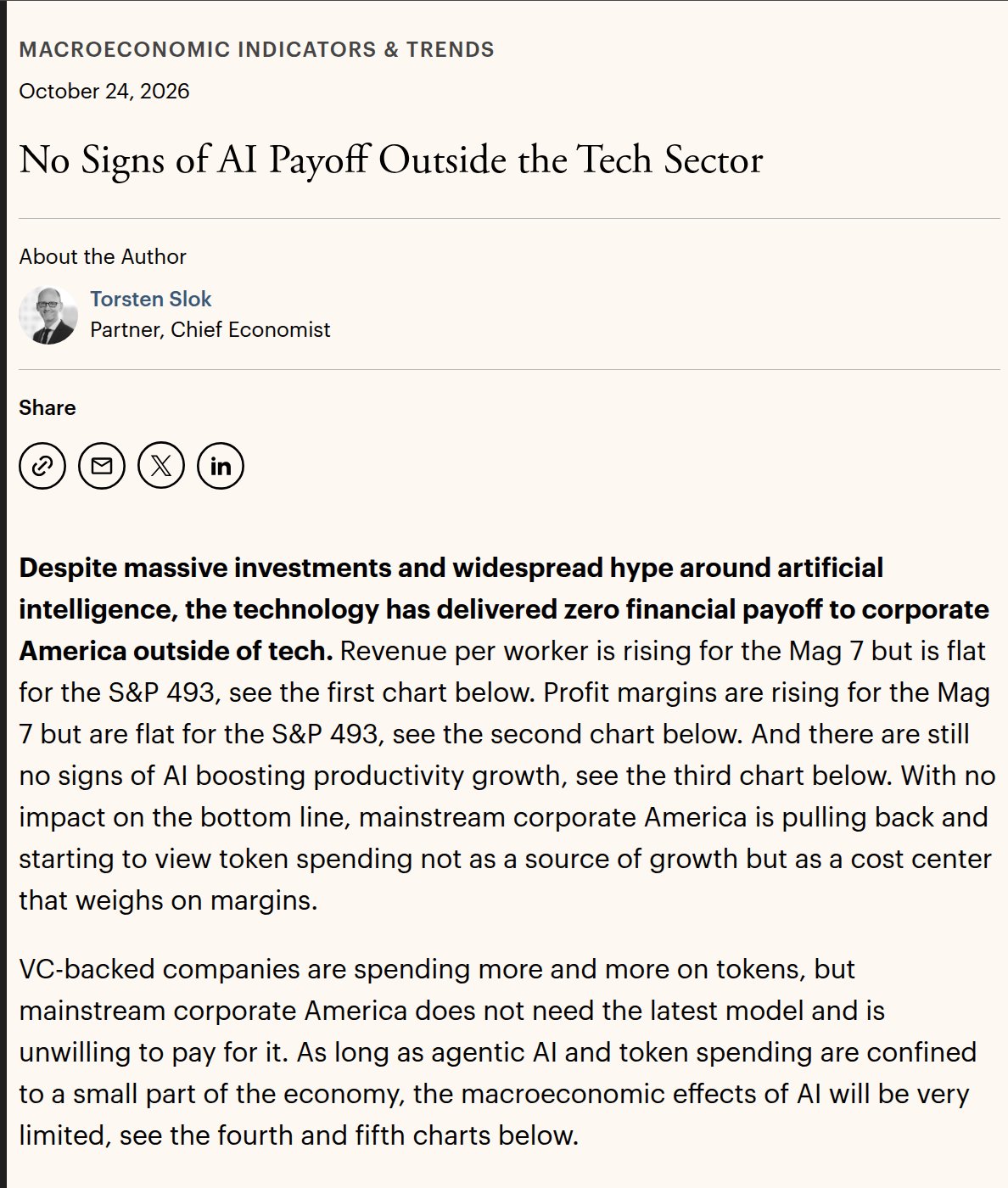
One-line: AI has delivered “zero financial payoff” to corporate America outside tech: revenue per worker and margins are rising for the Mag 7 and flat for the S&P 493, and productivity shows no AI boost.
The note is short — five charts and three paragraphs — and it travelled far for its size. It is filed here together with the reactions to it, because the reactions are most of what is worth keeping.
Key claims
- Revenue per worker (inflation-adjusted, indexed to 2019 Q4) is rising for the Mag 7 and flat for the “S&P 493” (Bloomberg, Macrobond).
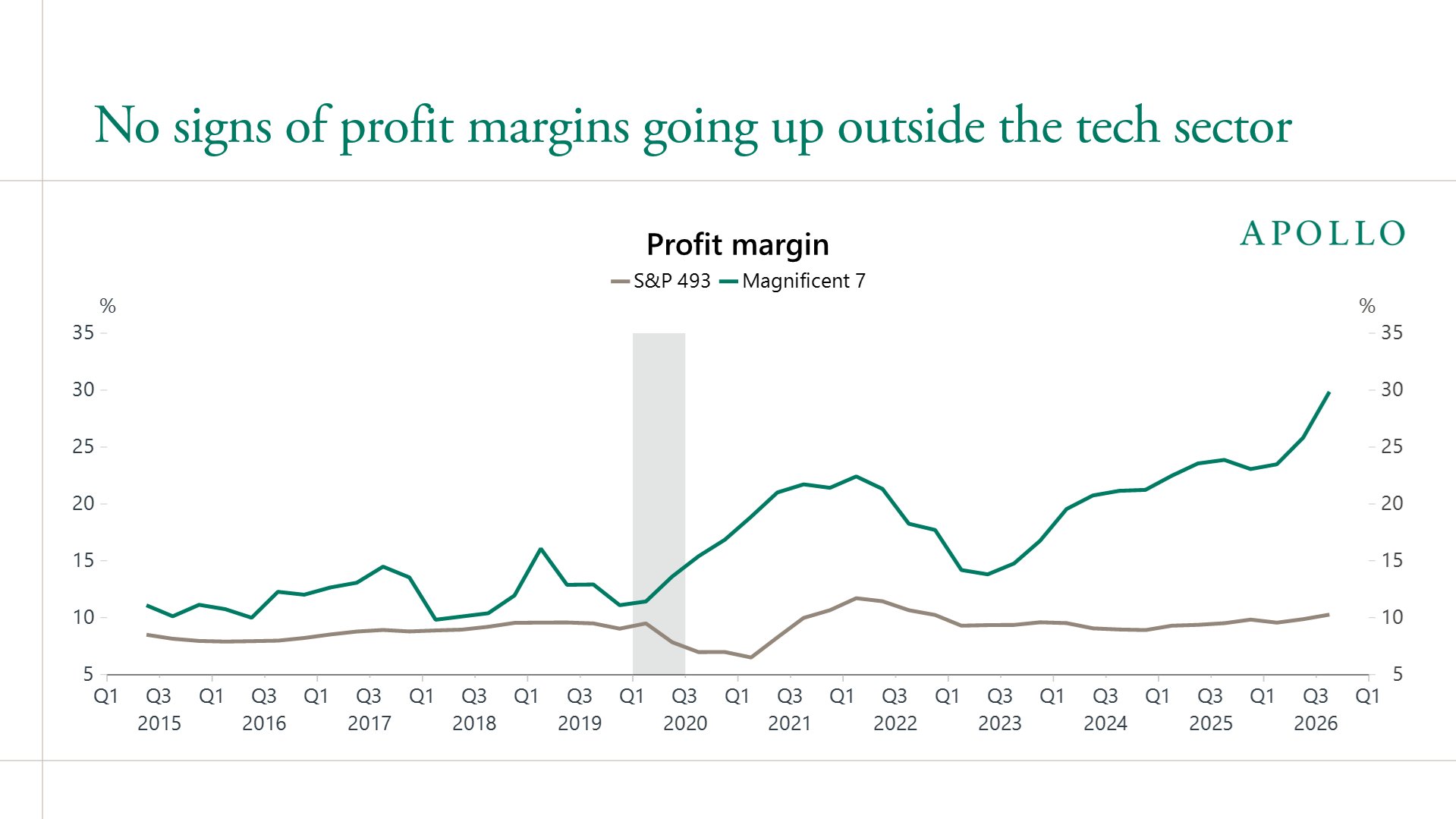
- Profit margins are rising for the Mag 7 and flat for the S&P 493.
- Productivity: no sign of AI in total factor productivity, using the San Francisco Fed’s utilization-adjusted series (Fernald, 2014).
- Token spending is turning into a cost line. With no effect on the bottom line, mainstream corporate America is “pulling back” and starting to view token spending as a cost center that weighs on margins rather than a source of growth.
- The spend is concentrated. VC-backed companies keep spending more on tokens; mainstream corporates “do not need the latest model” and won’t pay for it. Two charts from the Ramp AI Index (via Ramp chief economist Ara Kharazian) show AI spending concentrated in a small number of firms and “circularity” in token spending.
- Conclusion: as long as agentic AI and token spend are confined to a small part of the economy, the macro effects of AI will be very limited. The AI story will be decided in the S&P 493, and there is no evidence yet of better revenue growth or margins there.
Notable quotes
Despite massive investments and widespread hype around artificial intelligence, the technology has delivered zero financial payoff to corporate America outside of tech.
VC-backed companies are spending more and more on tokens, but mainstream corporate America does not need the latest model and is unwilling to pay for it.
Charts
The five charts named in the note: (1) revenue per worker, Mag 7 vs S&P 493; (2) profit margins, Mag 7 vs S&P 493; (3) utilization-adjusted TFP; (4) AI spending concentration (Ramp); (5) circularity in token spending (Ramp AI Index). Two of them, as posted by Haseeb Qureshi:

The reactions
Four responses, saved October 25, 2026. They split into three critiques: the method is wrong, the timeline is wrong, and the messenger has a book to talk.
The method: aggregates can’t measure a variable — Haseeb Qureshi
Full post: This Apollo report, claiming AI… (tweet). Qureshi calls the note “a complete non sequitur.” His three points:
- Wrong comparison. You measure a variable’s contribution by comparing companies that use more AI against companies that use less. A flat aggregate like margins across all companies cannot answer the question.
- Wrong unit. The Mag 7 are mostly AI sellers; the S&P 493 are mostly AI buyers. Splitting on that line doesn’t isolate adoption.
- Wrong backdrop. Rates rising, oil at $116, inflation rampant, consumer sentiment at a record low. If AI buyers are holding margins through that, it is consistent with AI buoying the economy. “TL;DR: the conclusion of this article is completely ass-backwards.”
The timeline: electricity took decades too — Stu Willson
Full post: Do you know who loves… (tweet). Willson grants Slok is “probably right about the S&P 493 in aggregate,” then reaches for the electrification analogy: factories had power for decades before productivity jumped, and the jump came when owners redesigned the floor around the motor. Most companies are “sprinkling AI across the org”; the buyers who rebuild workflows from the day they close report different numbers. His examples are AI-native acquirers — Long Lake (HOA managers taken from 0–5% growth to 20%+), Titan, Fura and Dwelly (EBITDA margins doubling where its tools are fully deployed). See AI Rollups.
Every company that reads this chart as permission to wait makes the job easier for the ones already doing the work.
Jon Stokes put the same idea in one line, quoting the note: “LLMs are running the standard-issue Gartner hype cycle” — the trough of disillusionment, on schedule. See Hype Cycles.
A companion post, saved the same day, explains why sprinkling fails from inside a portfolio: safwaan’s We’re not a PE fund… (tweet) — executives start with “a fairly well scoped task that takes a few hours a week,” and taking that at face value “saves some guy five hours per month” without improving the business. The better start is the vision (“In an ideal world, how would this company operate?”) and working backwards; the work is “a LOT of data wrangling … and a little bit of AI.”
The messenger, and where the gains land — Manish Tripathi (LinkedIn)
Tripathi’s post agrees with the productivity finding — he had predicted in July 2024 that GenAI would add little to GDP or productivity — but says to take the report “with a pinch of salt”:
- The author. He disputes an earlier Slok claim that consumer AI agents moving deposits to high-yield accounts could cause bank runs, arguing banks don’t need deposits to lend (citing a Bank of England paper on money creation).
- The firm. Apollo is a PE firm whose business is mostly structured credit and debt — by his count about 81% of its ~$1T AUM.
- Where it lands. Agentic gains will show up in enterprises over the next year or two, and for consumers mainly in healthcare and legal justice. But even enterprise gains may not reach GDP: agents automate white-collar workflows, which makes companies cheaper to run, and “getting your white collar work done faster and with less ppl does not mean, it leads to increased revenue.” He calls it a coming “Catch 22.”
He also notes that Gary Marcus was circulating the report without the nuance.
How it connects
- AI Productivity — the central question: where AI shows up in the numbers, and when.
- AI Keeps Stubbornly Refusing to Take Our Jobs — Noah Smith’s case that firms using more AI hire more, which is the firm-level comparison Qureshi says Apollo should have run.
- AI Rollups — Willson’s counter-evidence is a list of AI-native acquirers.
- Hype Cycles — Stokes’s read.
- Cognitive Mercantilism (Venkatesh Rao) — saved the same day; argues demand for intelligence is elastic, the long-run answer to “no payoff yet.”
- Jevons Paradox — the demand-side logic both Rao and the electrification analogy lean on.