Conjuring Scenius
| Author | Packy McCormick |
|---|---|
| Published | May 2020 |
| Format | Essay |
| Original | Read the original |
History’s great leaps come from scenius, the “communal form of the concept of the genius,” and by adding four ingredients to Kevin Kelly’s four, communities can raise their odds of becoming one; the Coronavirus pandemic is the catalyst that could make the next scenia global and online-first.
Conjuring Scenius
Key claims
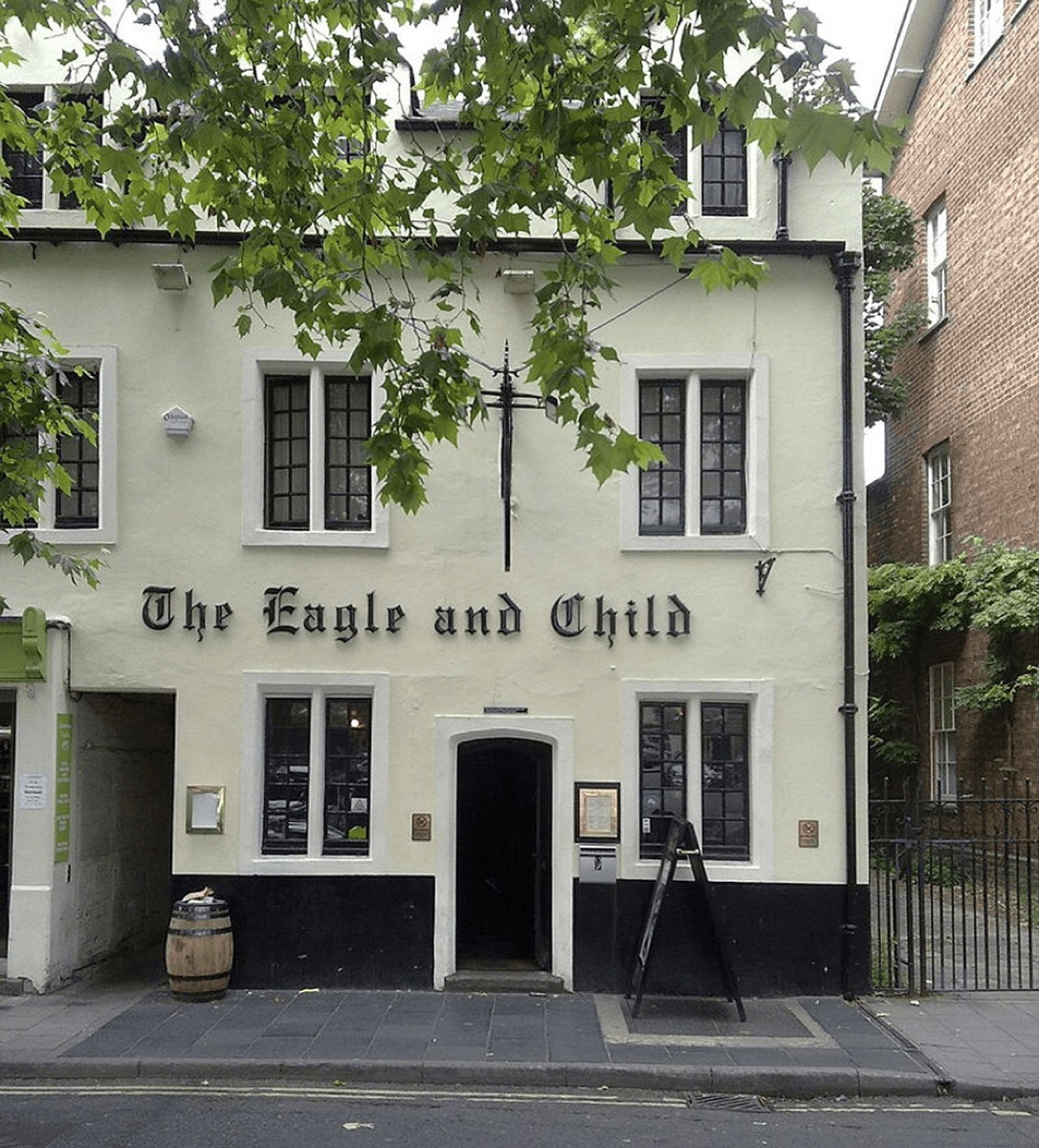
- The Inklings as proof of concept. Patrons of The Eagle and Child pub in Oxford “wrote three of the five best-selling fantasy series of all-time within an eighteen year period”; J.R.R. Tolkien dedicated The Lord of the Rings to the group. McCormick sets this beside the Hype House, the LA mansion where “nineteen of TikTok’s biggest stars live, create, and collaborate.”
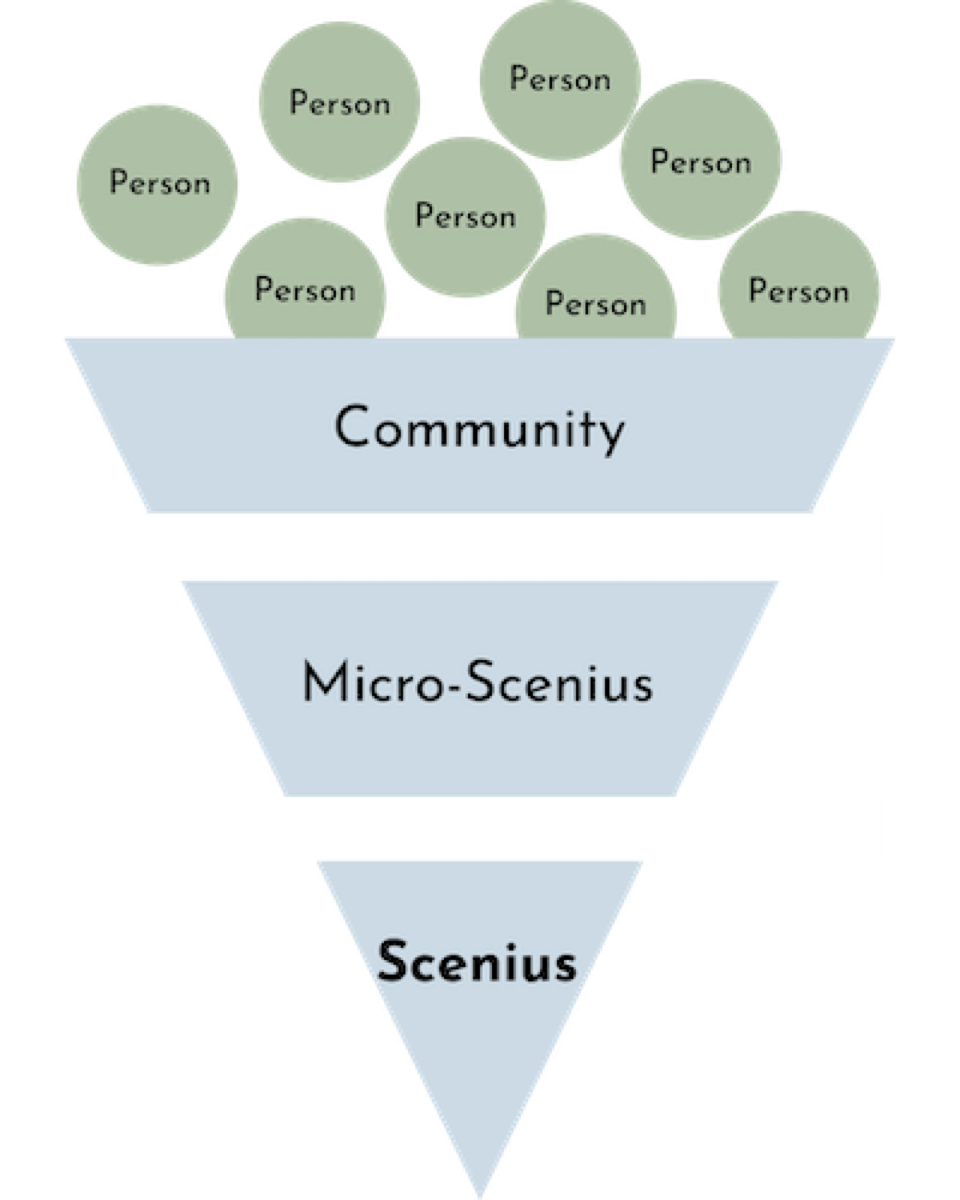
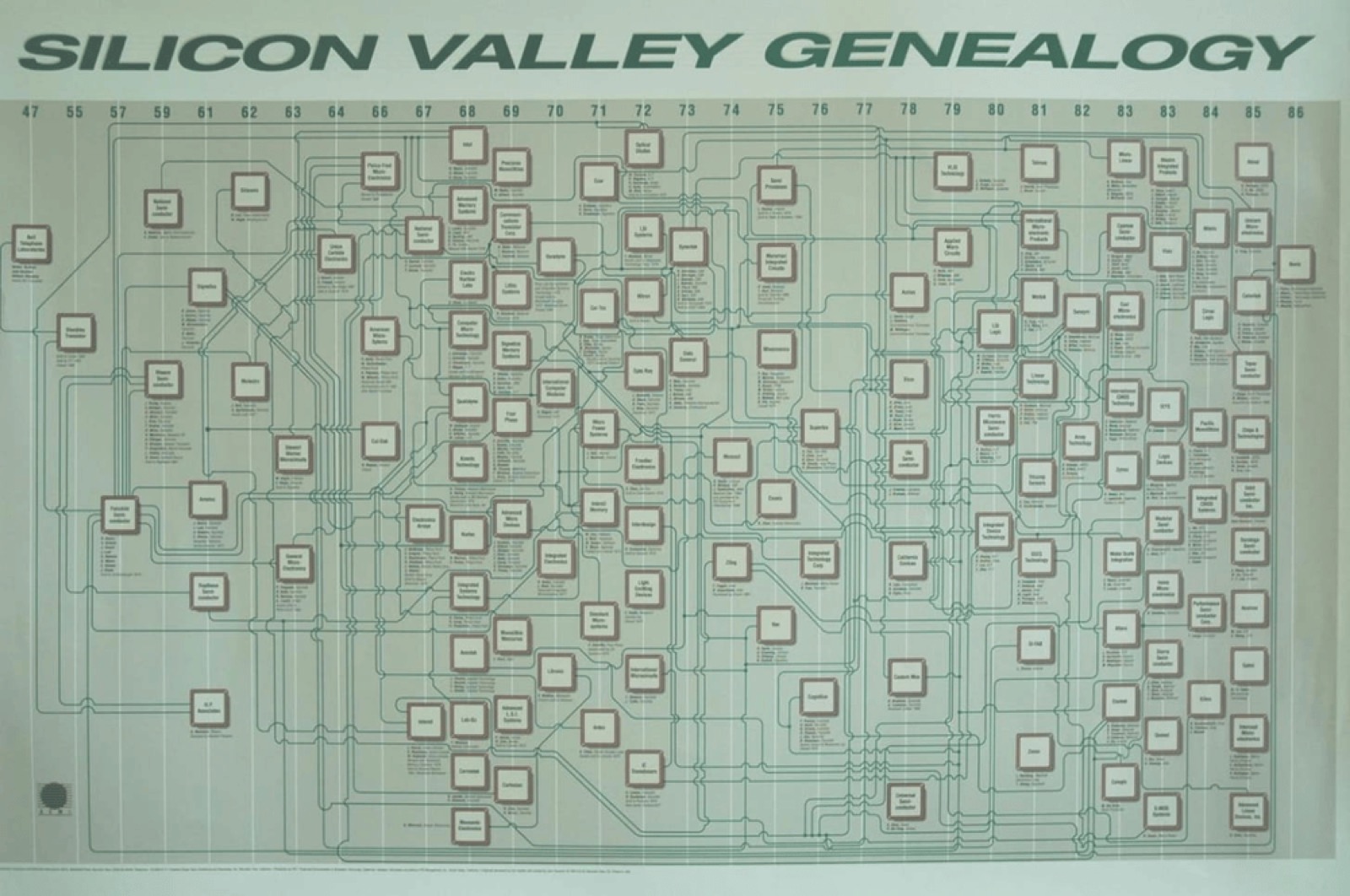
- Definition and funnel. Brian Eno coined Scenius for “the intelligence and the intuition of a whole cultural scene.” Scenia pass through three stages: community, then micro-scenius (“a generative community that creates its own novel ways of thinking, doing, or creating,” e.g. Homebrew Computer Club, Write of Passage), then scenius (influence “foundational for a new way of thinking,” e.g. Silicon Valley, the Scottish Enlightenment).
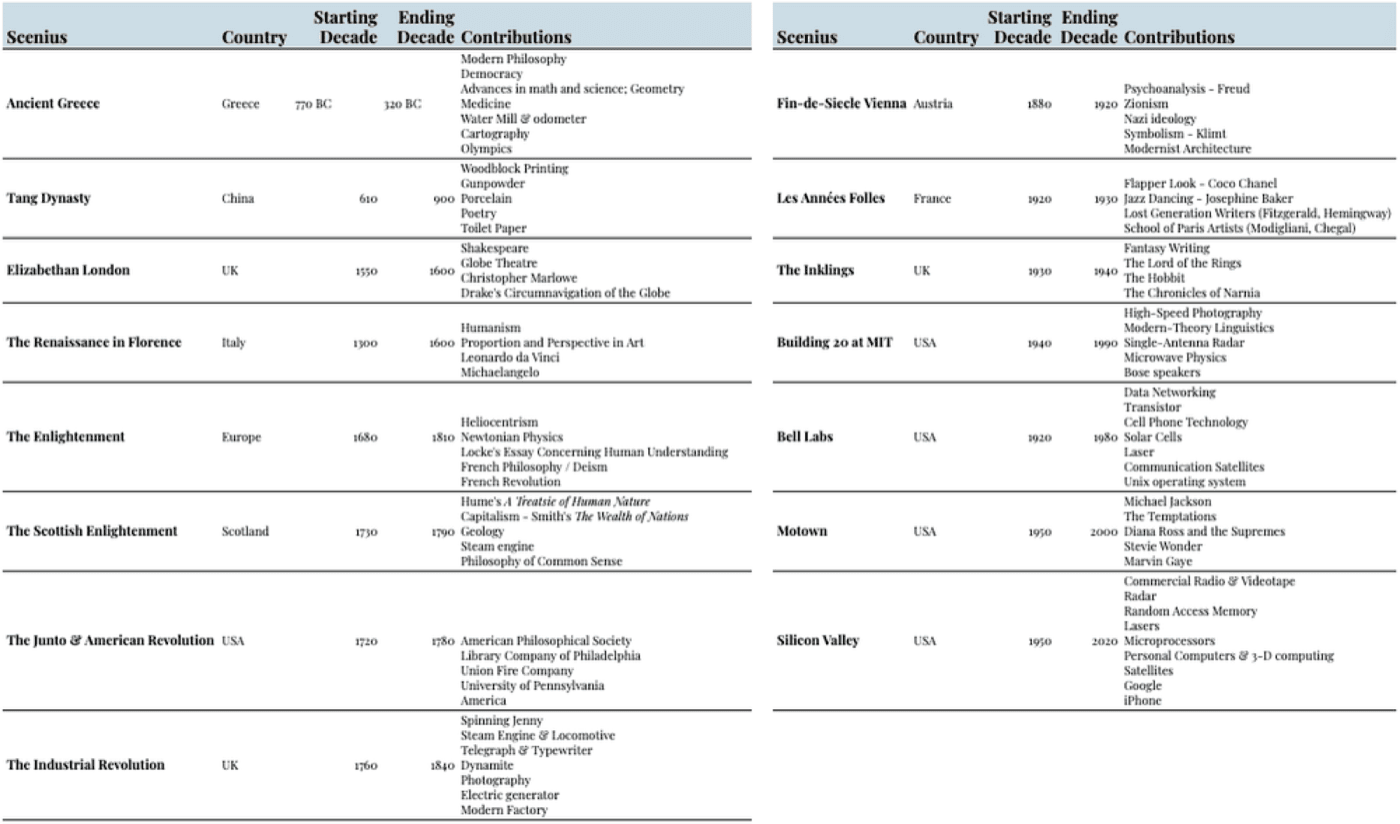
- Thirteen-plus historical scenia, mapped. A table runs from Ancient Greece (770–320 BC) through the Tang Dynasty, Elizabethan London, Renaissance Florence, the Scottish Enlightenment, the Junto, Fin-de-Siècle Vienna, Les Années Folles, the Inklings, Building 20 at MIT, Bell Labs, Motown and Silicon Valley, each with its contributions.
- Kelly’s four ingredients, and their limit. Kevin Kelly’s 2008 list is mutual appreciation, rapid exchange of tools and techniques, network effects of success, and local tolerance for novelties. Kelly concluded the best you can do is “NOT KILL IT”; McCormick agrees no single scenius can be commanded but argues enough attempts under the right conditions will produce some.
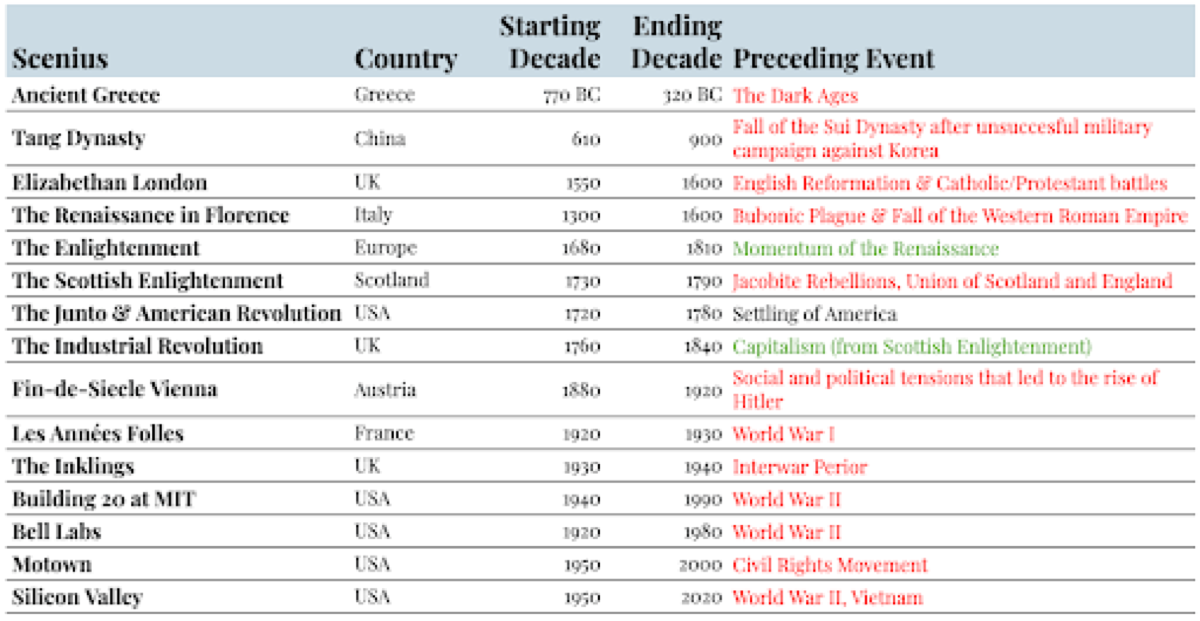
- Ingredient 1, emergence from catastrophe. Almost every scenius in the table followed a catastrophe or long misery (the Renaissance after the Bubonic Plague, Bell Labs and Building 20 after World War II, Motown amid the Civil Rights Movement). “Without World War II, there would be no Silicon Valley.” Fast Grants raised $21 million and awarded 127 grants in just over a month, the “type of speed and universal focus that only a crisis can bring about.”
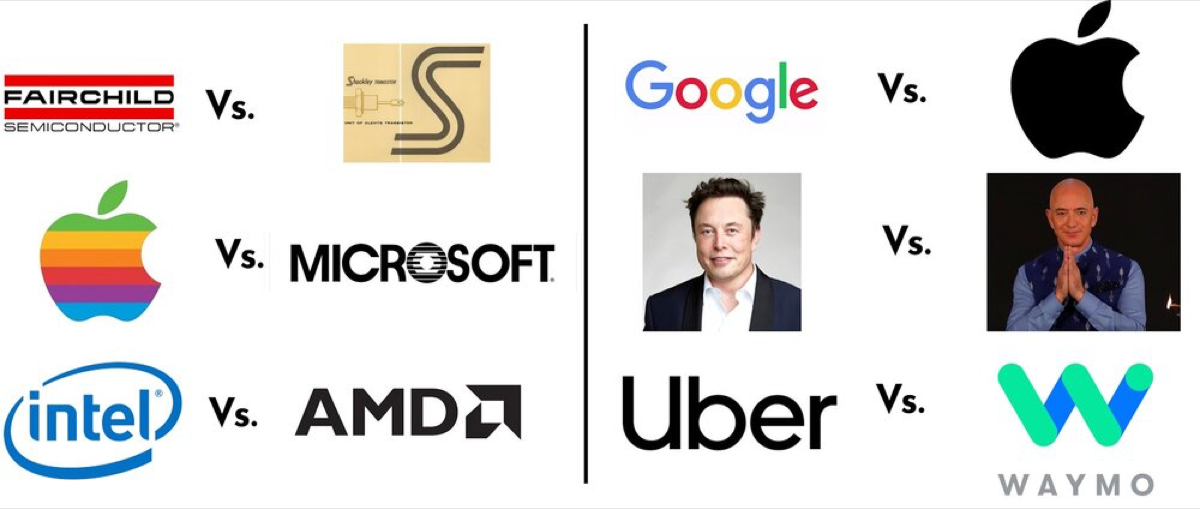
- Ingredient 2, competition. Alberti’s Della Pittura made painting measurable through perspective, which made artists comparable; in 1503 Florence’s council deliberately set Leonardo and Michelangelo on opposite walls of the Palazzo della Signoria (concorrenza).
- Ingredient 3, place-based ritual. Six hundred taverns sprang up in Edinburgh alongside the Scottish Enlightenment; Benjamin Franklin’s Junto met every Friday at the Indian Head Tavern with twenty-four standing questions and produced the American Philosophical Society, the Library Company, the Union Fire Company and the University of Pennsylvania. Michael Andrews’s “Bar Talk” paper found Prohibition cut patenting “by 8-18%” in counties that wanted to stay wet.
- Ingredient 4, diversity of thought and experience. Berry Gordy hired a white head of sales, Barney Ales, so Motown could sell “to all people”; eight of Rolling Stone’s 100 Greatest Artists were Motown artists. Silicon Valley checks all eight boxes, which is the essay’s answer to the Great Man objection.
- Modern candidates. Anna Gát’s Interintellect (a Slack that drew 500+ members in 48 hours) and David Perell’s Write of Passage (“somewhere between a community and a micro-scenius”) both lean on in-person ritual, which implies “technology can enhance traditional Place-Based Ritual, it cannot completely replace it.” Modern scenia will pair non-zero-sum internal competition (Pioneer’s leaderboard) with zero-sum fights against incumbents and global problems.
Notable quotes
“The Eagle and Child played host to scenius, the major driving force behind much of the world’s progress.”
“Community, micro-scenius, and scenius represent three distinct phases that a group passes through. Nurturing scenius means helping a group move through the funnel from community, to micro-scenius, and then scenius.”
“Too much time spent in unbroken abundance allows innovation to compound until it reaches the Wall-E state. Catastrophe breaks that curve, creates new needs, and opens the door to progress.”
“Scenius is communal, but communal doesn’t necessarily imply Kumbaya. Scenius can get competitive.”
“Applying mathematics to art enabled objectivity, objectivity enabled competition, and competition brought the best out of two of Florence’s greatest artists.”
“Scenius is a remix, a riff off of what has come before combined with fresh perspectives.”
“The internet is a revolutionary complement to in-person gatherings, but it is not a total replacement.”
Charts and figures
How it connects
- Scenius / Talent Vortex — the wiki’s concept page for this idea; Brian Eno coined the term and Kevin Kelly first listed its ingredients.
- Junto · Benjamin Franklin — the place-based-ritual case study.
- Bell Labs · Silicon Valley · Renaissance — three of the historical scenia in the table.
- Write of Passage · David Perell · Interintellect · Anna Gát — the two modern candidates.
- Tyler Cowen · Patrick Collison — their “New Science of Progress” framing and Fast Grants.
- Write Like a Comedian — Capital Camp (David Perell) — Perell’s later “writing is social” workshop, which also ends on Tolkien and Lewis.
- Packy McCormick · Not Boring · Collaboration.