Borrowed Time (AI Investment Brief)
From kwharrison13.com · Long read
Borrowed Time (AI Investment Brief)
| Author | Azeem Azhar and William Gildea |
|---|---|
| Published | November 25, 2026 |
| Format | Newsletter |
| Original | Read the original |
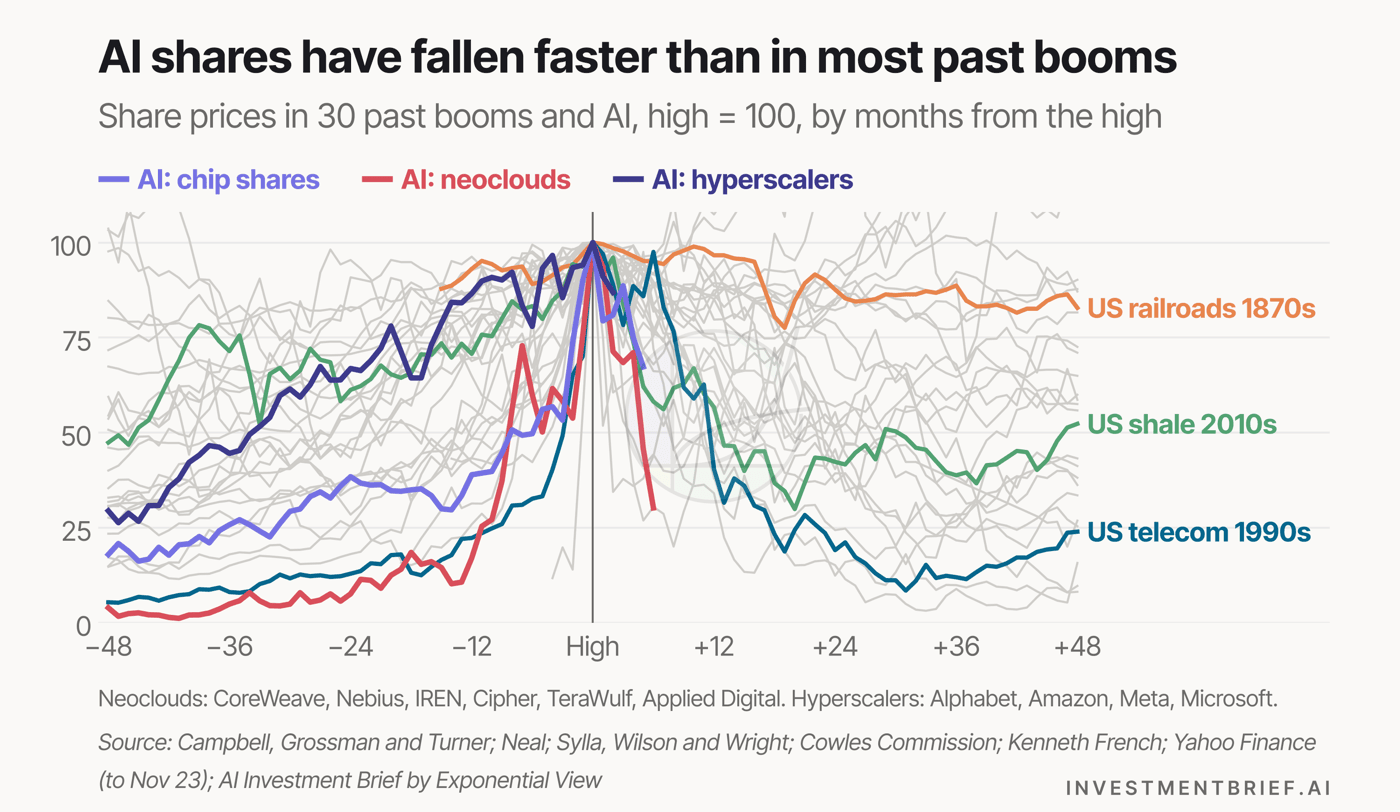
Three in four technology booms that needed a physical buildout ended in a bust; AI has two of the three traits that marked the busts, and whether it gets the third depends on revenue keeping pace with CapEx commitments over the next two years.
Borrowed Time (AI Investment Brief)
[PARTIAL] Paid post. Captured through the free preview only (Kyle’s account is not a paid subscriber); the capture ends at the “A short history of technology booms and busts” header. The dataset, the AI comparison, the 35%/yr revenue requirement and the verdict are behind the paywall and are listed below only as the preview describes them.
Key claims
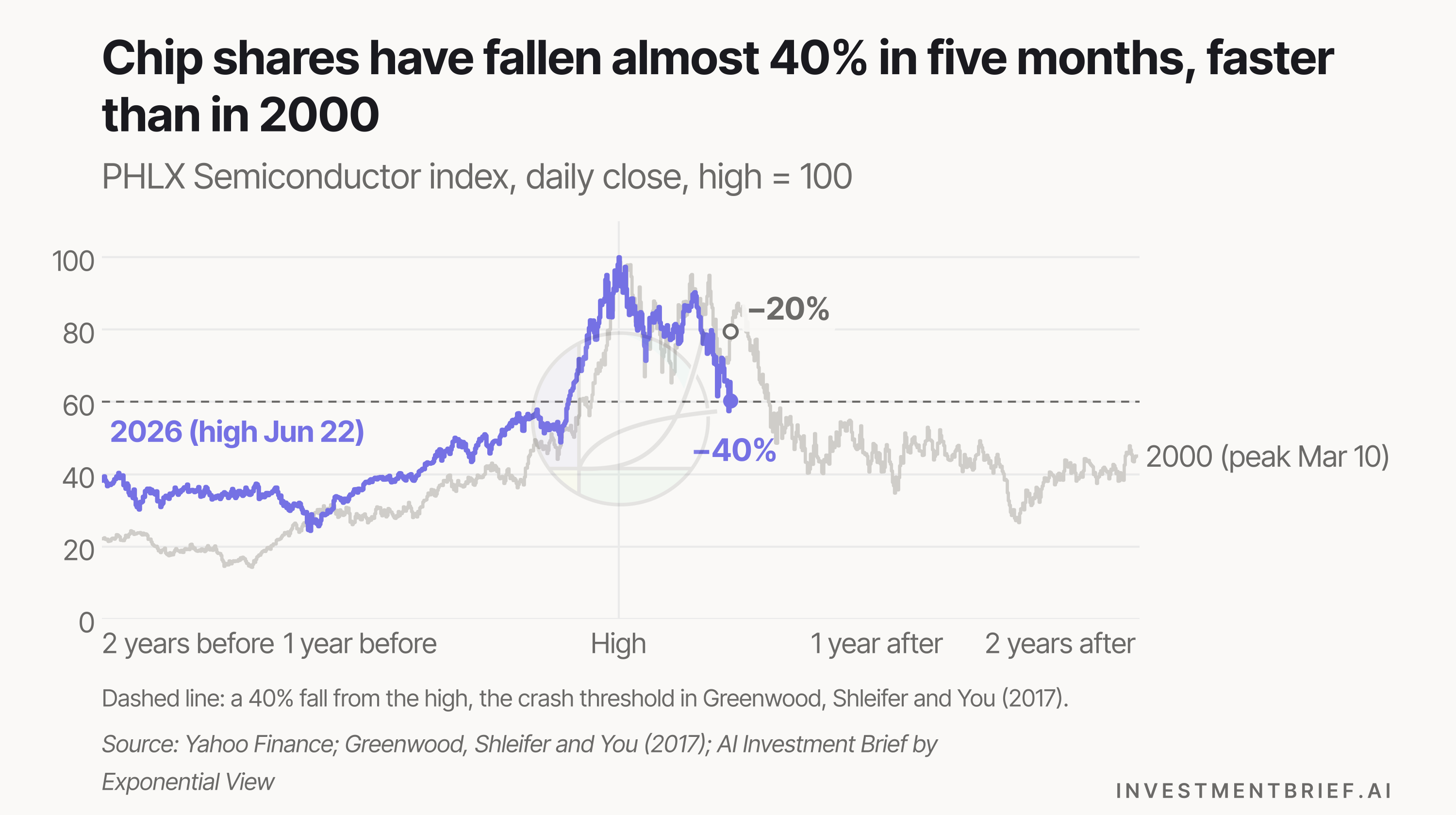
- The sell-off vs. the demand. As of Nov 25, 2026, AI shares had sold off across chips, neoclouds and hyperscalers; Anthropic traded below its IPO price from the previous week; a Monday rally after Jensen Huang’s return to Nvidia didn’t hold, and the PHLX Semiconductor index sat ~40% below its June high. Yet demand hasn’t obviously weakened: their generative-AI revenue tracking shows spend growing at every layer, and Nvidia’s data-center revenue more than doubled year over year.
- The “earnings bubble” worry. The authors read the contradiction as investors pricing what comes next: fear that revenue growth, and the CapEx it funds, must eventually slow (citing an FT “earnings bubble” piece).
- Semis already know this cycle. Chips run on boom → overbuild → bust (they point back to their own Micron: Thanks for the memory), and chip shares have now fallen faster than in 2000.
- ~800 technologies, three centuries. Rather than reaching only for railroads and telecom, they studied nearly 800 technologies. Three in four booms that required a physical buildout ended in a bust — e.g. British bicycle makers in the 1890s, US nuclear plants in the 1970s, proton-therapy centers in the 2010s.
- Three traits marked the busts: (1) listed pure plays, (2) outside money, (3) building ahead of paying demand. Per the paywalled section summary, booms with all three ended in a bust 94% of the time.
- Where AI sits. AI has the first two. On the third, revenue has kept pace with the build so far, but CapEx commitments set a high bar for the coming two years; the paid section says today’s commitments require AI revenue to grow 35% per year, and lists signals that would show an overbuild first.
Charts and figures
Notable quotes
Three traits marked the busts: listed pure plays, outside money, and building ahead of paying demand.
How it connects
- AI Capex and Bubbles — the core question: is the buildout ahead of paying demand?
- Boom — Bubbles & The End of Stagnation — the counter-case that bubbles can be productive even when they bust.
- Technological Revolutions and Financial Capital / Carlota Perez — the installation-period frenzy-and-crash pattern the 800-technology study tests empirically.
- Nvidia, Micron, Anthropic — the companies named in the sell-off.
- Azeem Azhar — Exponential View, the publisher.
Curated by Kyle Harrison. Organized by Claude. Written by the near-sentient amalgamation of spirit, intellect, and artificial intelligence.