Big Tech Off-Balance Sheet Concerns
Big Tech Off-Balance Sheet Concerns
Author: MBI Deep Dives URL: https://www.mbi-deepdives.com/big-tech-off-balance-sheet-concerns/ One-line: The WSJ’s “$3 trillion” in off-balance-sheet AI commitments is real and properly disclosed, but it is overstated (it treats undiscounted future lease payments as if they were present values) and spread over decades, so investors needn’t panic. The worry is the trend: the numbers only go up.
[PARTIAL] The argument is captured in full. The email cuts off after “My current portfolio is disclosed below:”, where the author’s portfolio disclosure sits behind “Upgrade to continue reading.”
Key claims
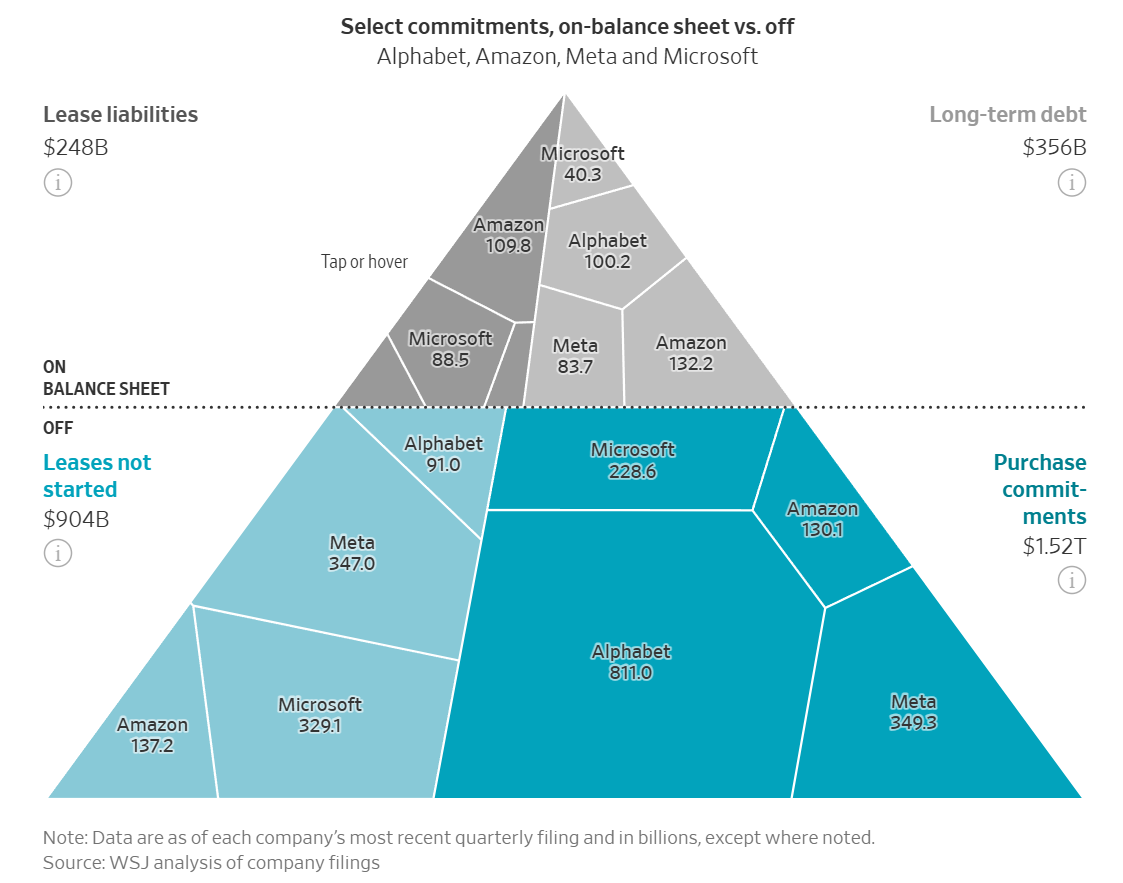
- The WSJ headline: $3 trillion. A Wall Street Journal analysis of filing footnotes, “Why Big Tech’s AI Spending Is $3 Trillion Higher Than It Seems,” found nine top tech companies held about $3 trillion of off-balance-sheet commitments, mostly AI-related. That is growing faster than the ~$600 billion of capex they reported over the past year, and about triple what they owe on leases and long-term borrowings. The Financial Times has been covering the same trend; the author had foreshadowed it in his own piece “The coming debt deluge.”
- Off-balance-sheet doesn’t mean hidden. Quoting Olga Usvyatsky: these commitments are kept off the balance sheet because GAAP doesn’t require them to be recorded until a lease starts or goods are delivered, and they are disclosed in footnotes and the MD&A. That disclosure is how the WSJ was able to compile them (see Accounting).
- The WSJ’s iceberg compares two different measures. It sets present-value lease liabilities against undiscounted future payments on leases that haven’t started. Usvyatsky notes existing lease liabilities run about 20% below undiscounted payments, which would turn the $904 billion of off-balance-sheet leases into roughly $723 billion. The author goes further: many data center leases that haven’t started will begin in 2028–29 and run 15–20 years, so the discount should be larger and “$723bn is probably still the high end.”
- Disclosure got worse in 2020. Until 2021 the SEC required a standardized contractual-obligations table in every 10-K. The November 2020 MD&A “modernization” replaced it with a principles-based discussion of “material cash requirements.” Amazon kept its table voluntarily, Microsoft kept a partial version, and Alphabet and Meta switched to narrative only.
- Amazon: ~$650B, ~60% after 2030. In the next five years the commitments look “quite manageable” year by year, and the author “won’t be surprised if such commitments run well into 2050s.”
- Microsoft: ~$502B, ~68% beyond FY’27. That makes it more front-loaded than Amazon, which has ~83% beyond FY’27.
- Alphabet: $811.0B, the largest. Of that, $200.7B is short-term (~25% due in 12 months). A separate $707.0B figure covers fixed or guaranteed commitments, mostly long-term supply agreements expected to be fulfilled through 2030. Its energy agreements run 2–26 years with obligations through 2054, mostly take-or-pay. Alphabet doesn’t reconcile the two figures; the author infers the gap (open purchase orders) sits mostly in the short-term bucket.
- Meta: $349.31B non-cancelable. About $53.52B is due in 2026 and $81.65B in 2027 (~15% in 2H’26, ~23% in 2027). The commitments cover third-party cloud capacity, servers, network, data centers and Reality Labs hardware.
- No insomnia yet, but keep watching. Unless AI returns “spectacularly disappoint,” investors needn’t worry about existential questions. But these numbers are a 1H’26 snapshot, they keep going “up and to the right,” and the author describes “a bit of a ‘FOMO’ approach to these commitments.” He says he will re-check after every quarter.
Notable quotes
“Nine top tech companies had some $3 trillion of off-balance-sheet commitments mostly related to AI, according to a Wall Street Journal analysis of footnotes in their most recent securities filings.” — The Wall Street Journal, quoted in the piece
“Off-balance-sheet does not mean that the accounting is wrong or violates GAAP.” — Olga Usvyatsky, quoted in the piece
“Applying that same relationship simply as an illustration to the $904 billion of the off the balance sheet leases in the Journal’s analysis would produce a lease liability of roughly $723 billion — about $181 billion below the amount shown in the visualization.” — Olga Usvyatsky, quoted in the piece
“Almost ~60% of its total $650 Billion commitments are after 2030!”
“The energy service agreements include terms ranging from two to 26 years, with obligations through 2054, and generally include take-or-pay provisions for minimum quantities of energy supply and substantive termination fees.” — Alphabet 10-Q, quoted in the piece
“Given these contexts, I do not think big tech investors need to suffer from insomnia after looking at such gigantic off-balance sheet commitments.”
“There is almost bit of a ‘FOMO’ approach to these commitments and if they keep doing it and obligations become larger and larger over time, I may need to re-assess to what extent I can exhibit a bit of nonchalance to off-balance sheet exposure.”
Charts and figures


How it connects
- Amazon — the most detailed disclosure: ~60% of its $650B in total commitments falls after 2030.
- Microsoft — ~68% of ~$502B in commitments extends beyond FY’27.
- Alphabet — $811B in total material purchase commitments, with energy agreements running through 2054.
- Meta — $349B in non-cancelable commitments.
- Oracle — named in the WSJ excerpt among the companies whose future obligations don’t appear on the balance sheet.
- AI Infrastructure — the main driver of these off-balance-sheet obligations at all four companies.
- Capital Expenditure — the on-balance-sheet counterpart (~$600B/year disclosed) the commitments are compared against.
- Accounting — the core of the piece is an accounting point: present value vs undiscounted payments, and when GAAP requires a commitment to be recorded.
- Debt — the author frames this as a follow-on to his “coming debt deluge” thesis. The commitments are about triple what the companies owe on leases and long-term borrowings.
- MBI Deep Dives — the author’s newsletter; see also It’s Not a Lie if You Believe It.
- Dead Money (Ed Zitron) and Let AI Burn — the bear case on the same AI capex financing. Ed Zitron calls it “dead money”; MBI’s read is more measured.
- Texas Teachers’ CIO Warns AI Capex Boom Echoes Past Busts — an institutional allocator looking at the same buildout and comparing it to past infrastructure booms.
- What Is So Hard About Behind-The-Meter Power for Datacenters Part 1 — the energy side of the buildout. Alphabet’s take-or-pay energy agreements running to 2054 are one example of it.