Kyle Harrison
article
Aggregation Theory (07.21.15)
Aggregation Theory (07.21.15)
Author: Ben Thompson in Stratechery URL: https://stratechery.com/2015/aggregation-theory/ One-line: The internet made distribution and transaction costs zero, flipping the value chain so that whoever owns the user relationship — not whoever controls distribution — wins. Aggregation Theory
Key claims
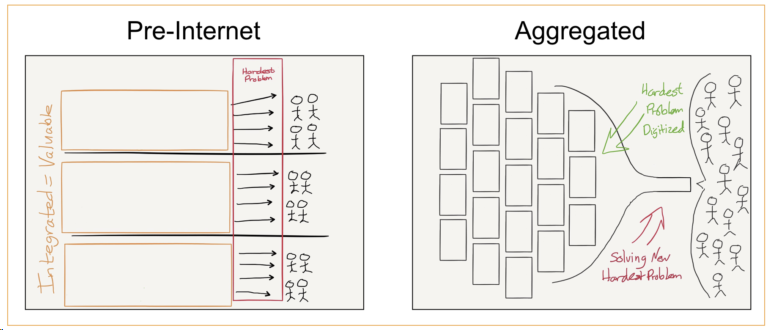
- The value chain for any consumer market splits into three parts: suppliers, distributors, and consumers/users. The best way to make outsize profits is to gain a horizontal monopoly in one part, or to integrate two parts for a competitive advantage in a vertical solution. Pre-internet, the latter depended on controlling distribution.
- The internet turned this on its head: it made distribution of digital goods free (neutralizing the distributor’s old advantage), and made transaction costs zero, making it viable for a distributor to integrate forward with end users at scale.
- Order matters: Google pioneered the model by modularizing content providers. Content has always been monetized by proxy — newspapers, CDs, cable TV — and “the shift to digital has exposed these proxies for the rent-collection mechanisms they are.”
- All the examples share strong winner-take-all effects: the services become better the more users they serve, and they can serve every consumer on earth. ==This, above all else, is why consumer technology companies are so highly valued both in the public and private markets.==
How it connects
- Defining Aggregators (09.26.17) — Thompson’s later, formal definition of the three aggregator characteristics and the Level 1/2/3 taxonomy. Read back-to-back with this on 10 June 2020.
- Aggregation Theory — the concept page; this is the founding essay.
- Ben Thompson / Stratechery — author and publication.