What Do You Have To Believe?
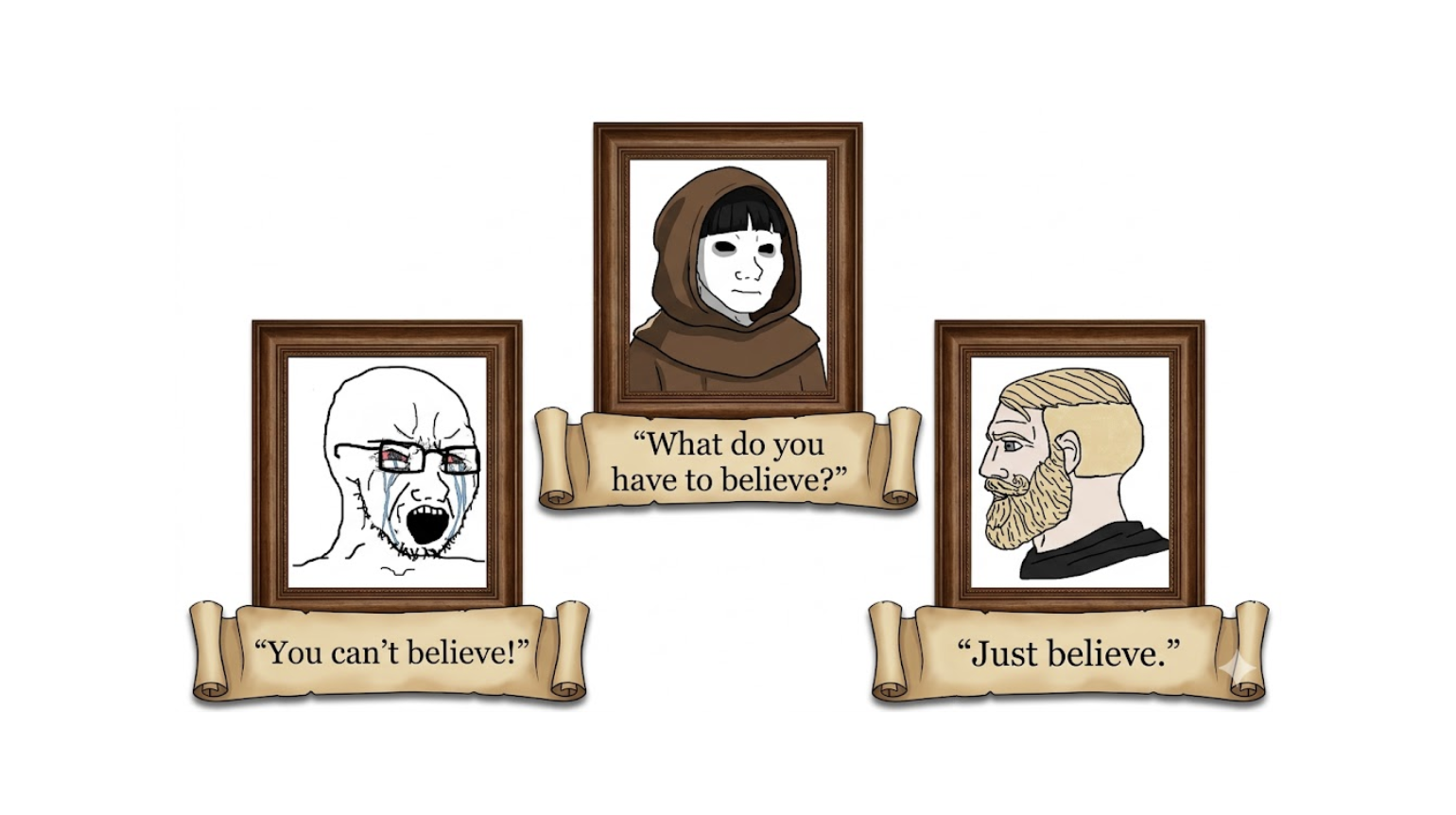
There’s a common bell curve meme that makes the rounds. While the majority of weepy nobodies screams about the complexity, both idiots and gurus on either end of the spectrum unite around common simplicity. A similar idea came to mind today, albeit the bell curve moniker isn’t right. Instead, its a balance of nuance.
When it comes to forming a belief system as an investor, its more about finding this nuanced middle. There are gigachad’s on one end who want to preach unrequited optimism. “You can just do things.” On the other end there are Perma-Bears; people incapable of seeing the opportunity or upside in anything.
But my position on determining your belief system rests somewhere in the middle. It kicks outside the standard bearish / bullish mentality and embraces, instead, the messy middle of nuance where you’re forced to not just pick a side (e.g. anti- or pro-), but to, instead, articulate your worldview. And you get there by asking a question that rings through investing of almost every shape and size: “what do you have to believe?”
Passing
Across thousands of meetings with startups over the course of my career, I’ve passed on dramatically more opportunities than I have chosen to invest in. As a result, I have a fairly broad corpus of experience passing with people; i.e. letting them know I’ve chosen not to invest. Lately, I’ve found the framework that best articulates my “pass rationale” is this idea of “how many things have to go right and not being able to get comfortable with that.”
I was talking about this with a friend and his response was fair and direct: “is there any case of a startup that doesn’t need a lot to go right to go big?” My response was that it isn’t a binary; either this will be easy or this will be hard. In fact, if there is one binary in startups it is the universality of the fact that this will be hard.
Instead, as I explained to my friend, its a spectrum. A weighted average of all the things that have to go right. I’ve written before about how Marc Andreessen calls this “the onion theory of risk.”
The Onion Theory of Risk
When I first wrote about this topic over three years ago, this is what I said:
“Building a company is a massive multivariable calculation of risk-adjusted outcomes. Think about all the checklists you’ve ever seen where investors tick through the aspects they look for in a potential investment. Marc Andreessen calls this the “onion theory of risk”. Each aspect of a business is another layer:
Andreessen’s original list still holds up. Each is a layer:
- Founder Risk: Does the startup have the right founding team? A great technologist, plus someone who can run the company? Is the technologist really all that? Is the business person capable of running the company?
- Market Risk: Is there a market for the product (using the term product and service interchangeably)? Will anyone want it? Will they pay for it? How much will they pay? How do we know?
- Competition Risk: Are there too many other startups already doing this? Is this startup sufficiently differentiated from the other startups, and also differentiated from any large incumbents?
- Timing Risk: Is it too early? Is it too late?
- Financing Risk: After we invest in this round, how many additional rounds of financing will be required for the company to become profitable, and what will the dollar total be? How certain are we about these estimates? How do we know?
- Marketing Risk: Will this startup be able to cut through the noise? How much will marketing cost? Do the economics of customer acquisition — the cost to acquire a customer, and the revenue that customer will generate — work?
- Distribution Risk: Does this startup need certain distribution partners to succeed? Will it be able to get them? How? (For example, this is a common problem with mobile startups that need deals with major mobile carriers to succeed.)
- Technology Risk: Can the product be built? Does it involve rocket science — or an equivalent, like artificial intelligence or natural language processing? Are there fundamental breakthroughs that need to happen?
- Product Risk: Even assuming the product can in theory be built, can this team build it?
- Hiring Risk: What positions does the startup need to hire for in order to execute its plan? E.g. a startup planning to build a highscale web service will need a VP of Operations — will the founding team be able to hire a good one?
This is the framework that is most often in my head when I’m evaluating any particular investment opportunity, at least as it pertains to startups. Each risk is a dial. In some cases, certain aspects of a business can be relatively derisked, so the dial is low. In others, the crux of the business is dependent on a very high risk variable. Again, there is no binary equation that will yield a go / no go conclusion. Instead, it is a gradually deteriorating feeling of comfort.
When I first wrote about the onion theory of risk it was in a piece called Risk Management in the Age of YOLO. Looking back, I think its actually probably one of the better pieces I’ve ever written. I ended that piece with this paragraph:
Risks come in all shapes and sizes—personal, spiritual, physical, professional. In the words of Andy Rachleff: “Human nature is not comfortable taking risk; so most venture capital firms want high returns, without risk, which doesn’t exist.” Risk is very similar to failure: “The less time people spend with [it] the less comfortable with it they become.”
The “comfort” level I feel with risk is not innate; it is honed. Over time you become more comfortable with certain types of risk. Market risk is much less scary when I’ve seen how almost every market I’ve ever evaluated has proven to be larger than I expected. Hiring risk has become inextricably connected to “marketing risk” or “storytelling risk.” One leads to the other, so my comfort with one depends on my comfort with the other. But some risks have become unequivocally critical, like founder risk. There’s no chance if you get that one wrong.
One of the ways to become comfortable with risk is to think about it more. A LOT more. Sequoia has a practice in their investment memos that we adopted when I was at Index Ventures. Originally, I believe the idea came from Larry Summers: the pre-parade and the pre-mortem. Roelof Both explains it this way:
“At the outset [of an investment], dream, for a second, if everything goes right. In the pre- parade, why should we imagine that this company could yield a 10x or 100x return for us? And then the pre-mortem really helps you focus on the key challenges the company has to overcome. There’s a version of that that the management team themselves needs to conduct which is; forget about the fact that you have three three years of runway; [what if] you only had 12 months left? What would you do? It is really clarifying to focus the mind.”
Two thought experiments: (1) one where everything has gone gloriously right, and (2) one where everything has gone catastrophically wrong. Most founders I meet have done a half-version of the first one (usually labeled “vision”) and almost none of the second.
The Pre-Parade
The pre-parade asks: what is the forward-looking best-case scenario? What does this company look like in 5–10 years if everything we underwrote actually works out?
The reason this matters is all about calibration. If the best-case looks like a $300M outcome, then the math of an early-stage venture investment is already broken. You can’t take a 10% chance at a $300M outcome and call that a venture deal; the expected value doesn’t get you to a fund return. The pre-parade is the discipline of asking, “if I’m right about everything, am I right enough?”
The very best founders I’ve met can articulate the pre-parade unprompted. They’ve thought through what the company looks like in a decade, not just in hand-wavy ambition terms, but with a clarity of thought that is palpable They can describe the scaffolding of the future they want to build. And critically, they want the consequences of that future. They’re not just saying it because investors like big numbers; they actually want to live in the world the pre-parade describes. That, I’ve written before), is the single most important characteristic an ambitious person can have: the willingness to want the consequences of what you want.
The Pre-Mortem
The pre-mortem asks the harder question. What is the forward-looking **worst-case **scenario? What does this company look like in 5–10 years if it goes wrong, and what specifically went wrong?
The pre-mortem is harder because it requires a particular kind of paranoia that most founders have been coached not to display. A founder is supposed to project conviction. But the best founders I’ve met are paranoid in private and confident in public. They’ve already imagined every way the thing dies.
There is a great line in The Founders about David Sacks’s tenure at PayPal:
“‘One of the thought experiments I ran through was, if I was running eBay Payments, what would I do to kill PayPal?’ Sacks said. ‘And I came up with lots of different things! I was always worried that one day they were gonna figure it out.’”
That is the pre-mortem in operating mode. Sit in your competitor’s chair. Imagine the smartest, best-resourced version of the entity that wants to kill you. What do they do, and how do you survive it?
The OG of this paranoid posture, of course, is Andy Grove, the former Intel CEO. The book he literally titled Only The Paranoid Survive is the foundational text on this idea:
“Business success contains the seeds of its own destruction. The more successful you are, the more people want a chunk of your business and then another chunk and then another until there is nothing left. I believe that the prime responsibility of a manager is to guard constantly against other people’s attacks and to inculcate this guardian attitude in the people under his or her management.”
So what does that entail? Just constant worry with no plan in sight because any attempt at planning should only be met with more fear? Wrong. Andy has a great framework for how to plan in this kind of environment:
“You need to plan the way a fire department plans: It cannot anticipate where the next fire will be, so it has to shape an energetic and efficient team that is capable of responding to the unanticipated as well as to any ordinary event.”
Notice that he isn’t telling managers to predict the specific death. He’s telling them to build the muscle that survives the unpredicted death. That is the right way to do a pre-mortem. You’re not trying to forecast which onion layer fails. You’re trying to know that one of them will, and to be the kind of organization that responds.
Granted, no founder can predict the future with certainty. But there is a meaningful difference between the founder who has war-gamed the death of their company in private and the founder who hasn’t. The former has ten more years of survival muscle than the latter, and you can feel it in a 30-minute pitch.
Therefore, What?
Back to the original question. What do you have to believe?
Every investment is a stack of beliefs about a stack of risks. The onion. The dial-by-dial accumulation of comfort and discomfort. You cannot remove the risk. You can only increase the surface area of the things you’ve actually thought about.
The pre-parade forces you to be specific about what success even means. The pre-mortem forces you to be specific about what failure even means. Most investors and most founders skip both, and then act surprised when the outcome doesn’t match the vague gut they were running on. You can’t eat narrative.
I’ve written before about how every decision is made on data and then measured by outcomes. We are wrong 90%+ of the time. But we still bother. We bother because we believe. Believing; actually believing, is being able to articulate, with specificity, what you have to believe and why.