Saving the World is Like Cleaning House

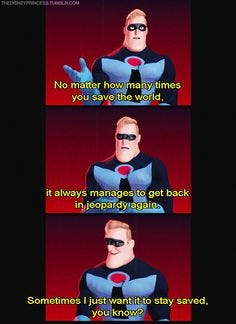
It will always get messy again. Granted, for most of my life I’ve been the cause of the mess rather than the frustrated crusader in the fight for its cleanliness.
But the principle is the same, it can be mind-boggling how little impact most of our efforts really make. The time we spend working on a project, whether its at work, school, or in our personal lives, how much of a difference will it really make?
When I served an LDS mission in Pennsylvania, I saw a system that was disorganized. Missionaries would spend hours knocking on doors, finding people who might be interested in what they had to say but then never going back. So I built a system that included spreadsheets, maps, and stickers. It was (I thought) perfect. This area book would keep track of everyone. Creating this system wasn’t so easy, it took two people working for three months to get it done. But I made something that worked better than anything our mission had ever seen.
Within a few months of me leaving, another missionary left that area book on the roof of the car and drove off. Six months of work added up to a tasty snack for a Pennsylvania mountain goat somewhere.
In 2008, my sister Linlea was the student body vice-president at our high school. I was two years younger and not a very observant young man. Linlea worked so hard to change something she saw was a problem. In our school, when you got there as a freshmen, you had to run for class office like every other class. Linlea saw that that policy made it difficult for students to understand what they were getting into. So, she changed the freshmen voting process and made it so that freshmen entered student council as nominated class ambassadors.
Well, two years later I was the student body president and being the poorly qualified public officer that I was (let’s face it, I won because my video was the bee’s knees,) I didn’t remember what Linlea had done. And I thought, how strange it is that the freshmen operate differently than everyone else, this shouldn’t be. So I changed it back.
While I was still that same unqualified public officer, I saw something else I thought ought to be changed. As long as anyone could remember, in our school the homecoming court had to be escorted to the homecoming stage by a football player or a cheerleader. I thought to myself, “this is 1955,” and set about to change that.
And I did. One guy got to walk with his 5-year old niece. I got to walk with a good friend. It made the experience more personal.
But did that make a difference?
While I was thinking about these experiences, I called my sister Linlea and confessed to her that I had undone her work, hoping it wouldn’t crush her tender heart. I then asked if, knowing what she knows now, if she still would have exerted the effort to do what she did?
And she said, “Yes. At the very least, doing that helped two years worth of freshmen become better prepared to serve in student government.”
I work with a lot of different organizations, mostly student-run, volunteer groups and I want to have an impact on how those groups work. But what will really make a difference? How will I define success?
If I’m a boxer and I work my whole life and I get a shot at the world championship, and I lose… Did I fail?
I asked this question to my wife. She thought about it for a bit.
“Yes. But I wouldn’t say that you didn’t accomplish anything.”
Camden talked about watching So You Think You Can Dance, and they had a season where they had kids participate. Kids would be getting cut and the parents are saying “I’m still proud of you because you worked hard.”
Just because you’re not better than other people, that doesn’t make you a failure. But then you’ve got kids who just are not good at something. So just showing up isn’t and shouldn’t be enough to consider yourself successful. That’s the issue we have now with kids who grew up getting “participation” trophies.
So where’s the balance? You have to do more than show up, but you don’t have to win or be the absolute best to be successful. I wouldn’t say you are unsuccessful because you haven’t gotten everything you worked to get.
When I told Camden the story about mine and Linlea’s net zero effect when it comes to student government, she said “I think you were both successful at your jobs. You got something done. And maybe it needed to be one way at one time and one way another time. And that doesn’t mean that one of you is more or less successful. It doesn’t have to be a zero sum game, and to approach it that way discredits effort and any other factor.”
If 10 represents a measurement of universal kindness and Camden is at 7 and I’m at 2, it’s fair to say she’s doing better than me. But me being at a 2 is not failure. It’s not about where you are right now, it’s about the level to which you eventually attain, the direction you’re traveling.
Clayton Christensen, business theory and Godfather of The Innovator’s Dilemma said in a Harvard commencement, and later a book, and a TED talk, that the way we measure our life needs to be catered to our present circumstances. “If we knew the future would be exactly the same as the past, [the same] approach [as last year] would be fine. But if the future’s different — and it almost always is — then it’s the wrong thing to do.” When I’m attempting to define success for myself, it can’t be just doing what I’ve done, or doing what other people have done. The focus can be on who we are becoming. Instead of telling people “what to think,” Christensen focused on teaching them “how to think — and then [they} reach the correct decision on [their] own.”
If I could travel back in time and tell Linlea “hey in 2 years, I’m going to undo your work,” would she still have done it? Would I still have made an area book? I think thoughts like that create the same problems as living in regret, wondering what if I had done this? Or lived there? Regret can never reform vision, it can only dampen it.
As I think about the coming year, I don’t want to say, “I’m going to launch a company,” or “I’m going to write a novel.” I want to measure my life, not by the events I experience, but by the person I become. It’s up to each of us to decide what kind of person we want to be and craft our goals to achieve that becoming.