It’s Not Always Good to Be The Exception

Recently, I was on a flight to California. I’ve been on at least 50 flights in the last 5 years. I can sleep on planes, read, eat, watch movies, anything. I’ve never once had any kind of problem flying. On this particular flight, I was sitting next to my wife and 3-month old son. As we were taking off, things did not go well. We experienced some drastic turbulence. I had that feeling that you get at the top of the swing. That’s not an airplane kind of feeling, that feeling should be reserved for rollercoasters and quiet, internal embarrassments.
This wasn’t just any bump. Flight attendants hit the ground, the woman in front of us had yogurt that ended up on the ceiling. If the drink cart had been in operation, somebody would have died.
And what was my initial reaction? When everything calmed down, I immediately took comfort in statistics, telling my wife about how, even still, the likelihood of being in a plane crash is infinitesimal. 1 in 11,ooo,ooo. And even if you ARE in a crash, you still have a 95.7% chance of surviving.
As I said that, I had a deeply depressing thought. What if some of the people on the planes involved in 9/11 had been telling themselves that just before they took off? What if the students at Columbine, or the people at Pulse had just finished thinking about their 1 in 25,000 chance of dying in a shooting.
Should the fact that some danger is only remotely likely mean we shouldn’t be afraid of it? From what I can tell, the majority of people are irrational in their feelings. They’re micro-optimists and macro-pessimists. The world is going to hell, but my life is doing fairly well. They generally assume that very few bad things will happen to them, while at the same time assuming that most of the good things will happen to them.
People frequently think of themselves as a rarity. The chances of being a millionaire are pretty low, but a lot of people, in their heart of hearts, still assume they’re going to be pretty wealthy. One of the reasons that most people look at welfare and think of it as “lazy people stealing my money,” is because they don’t think of themselves as poor. John Steinbeck said, “the poor see themselves not as an exploited proletariat but as temporarily embarrassed millionaires”
That is a uniquely American micro-optimism. Below is a graph of American’s in relation to other countries on a spectrum of their level of median income.
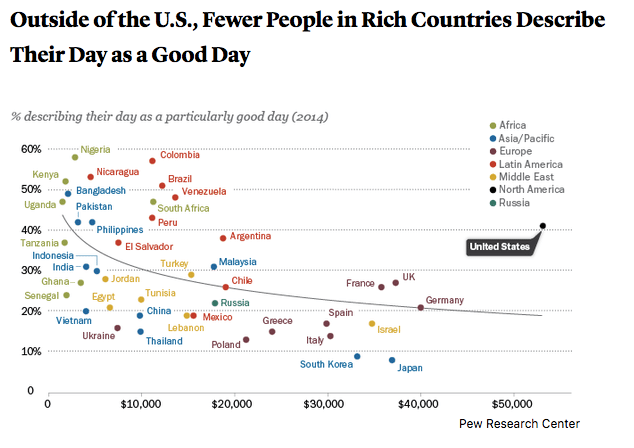
The question in this survey specifically asked about THEIR day. People feel particularly positive about the way that things are going for them. One of the biggest drivers behind people’s macro-pessimism is politics. 57% of people surveyed said that politics caused a significant amount of their stress.
“Recently Warren Buffett said that because of the ‘negative drumbeat’ of politics, ‘many Americans now believe their children will not live as well as they themselves do. That view is dead wrong: The babies being born in America today are the luckiest crop in history.’”
The world is, in fact, better than it has ever been.
Dr. Edward C. Chang, a clinical psychologist who runs the Perfectionism and Optimism-Pessimism Lab at the University of Michigan, said “It’s a dual process mechanism, the sort of daily meditation that helps people regulate their expectations. It’s this psychological process that keeps people from becoming so optimistic they’re like Mr. Magoo, or so pessimistic they fall into a pit of despair. The two compliment each other; whether you’re more or less optimistic or pessimistic is heavily dependent on the culture you live in, the culture that shapes your values.”
So what’s your culture?
Michael J. Sullivanwrote a series of fantasy novels called the Riyria Chronicles, and in them, I found Myron, one of the most optimistic monks that has ever monked. When asked about his intense positivity, he simply responded, “If you don’t abandon hope on pleasant days, why do so on those that begin poorly?”
Maybe the takeaway is this: be bravely grounded in a mediocre reality, and then work to change things positively.
The point is to isolate the things you can and can’t control, add an aspect of data-awareness, and live your life.
In Stephen Covey’s book, “The 7 Habits of Highly Effective People,” one of those habits is to be proactive. Recently, I was having lunch with a friend who was an active Gary Johnson supporter during the election, and an avid Facebook revolutionary. After the election, he felt exhausted. “I’ve decided to stop reading or following anything about politics. I can’t control things anyways, and it just makes me more stressed.”
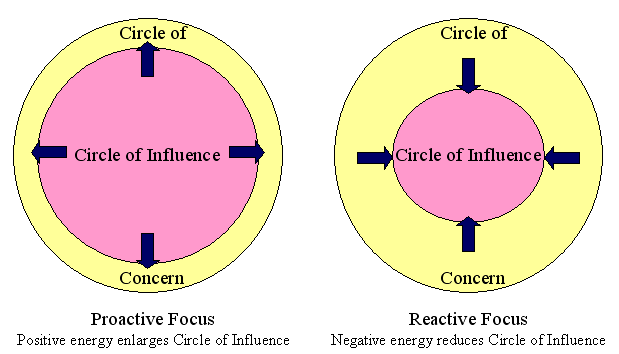
What my friend was feeling was the restrictive nature of focusing on reactive measures. When we look at the whole world, with all its problems, and injustices, we begin to feel our circle of concern expand, crushing our ability to influence anything. Instead, by isolating those controllable aspects of our life, we can, in fact, become more in control of the things in our world. Our circle of influence expands as we become more and more effectively in control of the things around us.
So whether you’re worried about dying in a plane crash, or winning the lottery, remember this. Becoming passive, allowing Facebook or Twitter or your friends opinions to dictate how you feel, is what you can call being acted upon. Choosing to define your own thoughts, feelings, and opinions, working to educate and inform yourself, changing your circumstances, these things are the essence of acting, becoming a proactive participant in your own life.
Recently, my wife and I had the chance to hear from The Bucket List Family. If you haven’t heard of them, they are the Gee family. A successful entrepreneur along with a wife and two kids that made millions, sold everything they had, and created a sustainable brand-driven career traveling the world.
In speaking to a group of college students, Garret Gee perfectly laid out three ways to make sure you’re living a proactive life.
- Be true to yourself
- Live every day like it’s your Saturday
- Don’t be afraid to go against the norm
“No ones opinion of me is more important than my opinion of me.” Whatever you do, make sure that you feel good about how you’re living.
Every kid grows up, so excited to wake up on Saturday, and eat cereal while watching TV. Garret’s advice isn’t to live so you can be lazy every day. It’s to find what makes you so excited that you wake up ecstatic to be alive. If you’re waking up groggy, sad, or feeling powerless, you’re doing something wrong.
And finally, Garret told the story of how, as a college student, he decided that he was there for an education, not just a degree. So he set about to do whatever it takes to craft the education he wanted. He found the classes he wanted to take. A lot of them were restricted to non-majors. His plan? Go for the first week. Be there early, sit in the front, wear glasses (“I don’t know why, but it helped”), and afterwards, thank the professor for his class. Never once did he have a professor tell him he couldn’t take their class.
Don’t think that, because everyone around you does something a certain way, that that automatically becomes the way you have to do things.