Backing Up My Facebook Post on Gun Violence

My wife keeps telling me not to post controversial things on Facebook. I served an LDS mission in Pennsylvania where I met a lot of amazing, wonderful people. Many of them are proud, conservative Republicans and I love them for that. The variety of people on my Facebook helps me keep a decently rounded view of the different opinions in the world.
I don’t know all the answers. I don’t know whether or not we should ban assault rifles (or assault weapons?…weap..rif…semi-automatic weapons?) or adopt more careful controls over certain weapons. I do think Americans should be able to have guns, though I don’t think anyone is trying to “abolish the second amendment,” (starting at 6:48) but I do think that gun violence is a problem.
I am NOT arguing who I am voting for, Republican or Democrat. I am not talking about countless other controversial issues that rend the very fabric of Facebook. My point in writing this is not even specifically to talk about gun violence. I want this to be about the responsibility of knowledge in an information age.
First, let me start with a quick story. A few years ago I was having lunch with a smart young woman. She had attended a few semesters at Stanford and we were talking about Japan. In one of my classes, I had heard that the birth rate in Japan was dangerously low. I mentioned this to her and she said, “Yes, but the abstinence rates of Japan aren’t going up. So people are still having sex, they’re just not having children.”
My initial reaction was, “…how could you possibly know that that’s true?” But then I realized…how did I know that what I had said was true? I had just heard it in a class, I hadn’t checked into it. So I mumbled, “you’re probably right.” And we moved on. After all, she had gone to Stanford, what did I know? Well, I decided to look further into the question. Turns out, she was totally wrong. In fact, 59% of Japanese women have “no interest in sex.”
That experience has always stuck with me. As a smart, well-spoken person, she had taken advantage of my ignorance on that topic to say something that wasn’t true. And that’s not inherently evil, she’s a good person. But at a time when we have direct access to the knowledge of all mankind via the internet, we have a responsibility to understand and support what is observably true and to try and become educated as to what is and isn’t real.
Unfortunately, even when you read statistics and see data, you can see completely contradictory interpretations. Data can shape reality — but more and more, who knows what data we should listen to? John Oliver did an amazing piece on how science can’t just be B.S. that makes us feel good or confirms whatever we want to hear.
Al Roker (TODAY Show): “I think the way to live your life is to find the study that sounds best to you, and you go with that.”
John Oliver: “No! No, no, no, no! In science, you don’t just get to cherry-pick the parts that justify what you were going to [think] anyway.”
Granted, he goes on to make some disparaging comments about religion which represent a whole different conversation, but my point is about the way we view the data. It has to follow set patterns of certification. When I did an internship at Amazon, every single decision we made was specifically driven by data.
There’s nowhere I’ve noticed this complete lack of respect for data more than in the world of politics. A friend of mine (not from P.A.) posted this on Facebook.
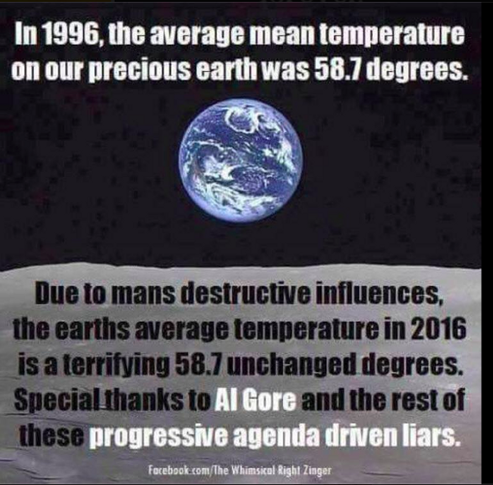
When I saw this, I thought “I guess the science is still out, if this is true, how can climate change be real?” I looked at the citation below the statistic, but it was just a Facebook page, not a citation for the data. So I decided to look more into it and found this climate change evidence page on NASA’s website. I posted it back in April to get a response. Still waiting to hear back.
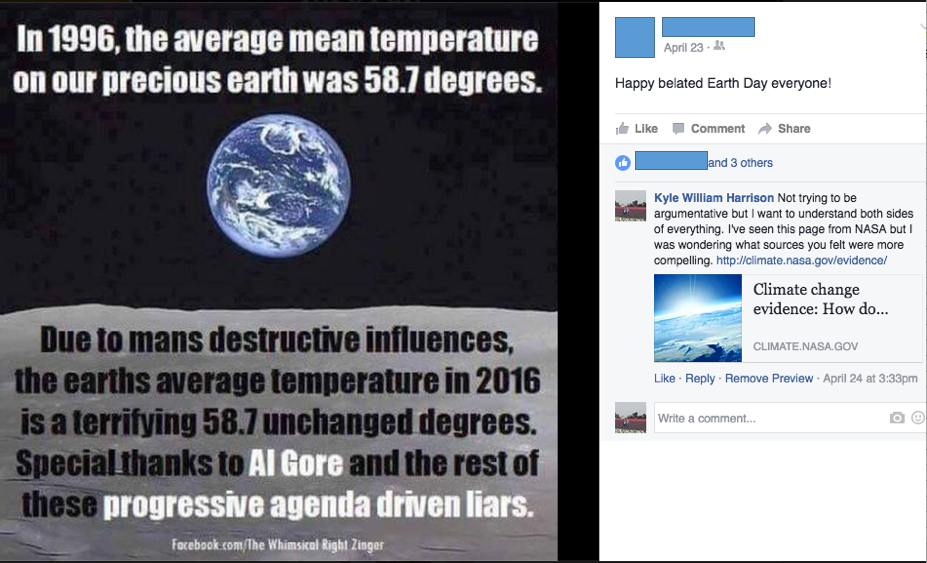
Again, I’m not arguing about global warming, but the fact that we have to be willing to check the data and discuss from there. Just because NASA has evidence of climate change doesn’t automatically mean we have to ban fossil fuels or only eat broccoli, but we have to include the data in the conversation rather than ignoring it.
Recently, I had another post-centric experience on Facebook regarding statistics and data. I posted the video below about the breakdown of all gun violence incidents in 2015 and the associated causes. The main point at the end is that only two mass shootings in 2015 were tied to radical islamic terrorism.
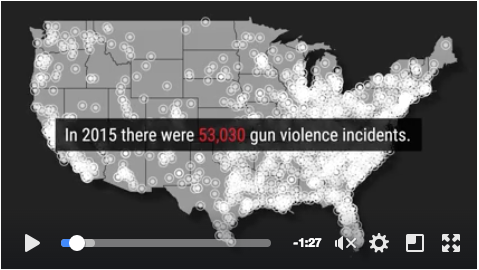
**SPOILER ALERT: I don’t want to take away anyone’s guns.**In fact, I don’t think I could even if I wanted to. Most of my gun-owning friends are men large of stature. I am not.
In response to this video, some of my friends commented that these numbers seemed unlikely to be true. That was the impetus for this post. I didn’t want to just say “guns are bad,” because I don’t believe that. But I didn’t want to give in and say “you’re probably right, this data seems wrong.” Based on the experiences I’ve talked about above, I wanted to fulfill my responsibility to learn more about this. And since I was going to spend a little bit of time doing it, I wanted to put it somewhere more lasting than a Facebook comment (e.g. this post).
First, I googled “330 mass shootings 2015.” I wanted to find where that statistic came from. I found the Gun Violence Archive. It tracks every reported incident of gun violence in the U.S. For 2015, it reported 331 mass shootings. For each incident, it records the event, the location, the names and information of the victims and assailants and categorizes it based on the context, whether it was a bar fight, a gang-related incident, etc. It doesn’t have a filter where you can look at these categories, they’re just mentioned in the details of each incident. I could have waved it off as “close enough,” but I wanted to make sure. So I made an excel copy and went through every post, looking at the details and tracking the cause of each mass shooting.
The results were fairly close to the stats in the video:
- Bar/club/party incidents 96
- Gang/Drive by shootings 83
- Domestic Disputes 68
- Lone wolf/unknown motive 54
- Armed robberies/home invasions 12
- Drug related incidents 11
- Terrorist/Hate crimes 6 (of these, 3 were tied to radical Islam)
The reason this video focused on 2015 specifically is because on Dec. 7th 2015, Donald Trump called for a ban on Muslims until we figure out “what the hell is going on” with Islam, a comment spurred by the San Bernadino shootings. The point the video was making was that we need to figure out what the hell is going on with gangs, crime, domestic abuse, drugs and hate.
In case the Gun Violence archive was biased, I made sure to check with pro-gun sources here, here, and here.
Each of these articles outlined the various Islamic attacks that have occurred in the U.S. since 2001. They also supported the fact that in 2015, only 3 Islamic attacks occurred and in one, shots were fired but no one was harmed.
What else did I learn? If you expand that scope to the whole world, in 2015 there were 2,893 reported attacks linked to radical Islam where 27,620 people were killed and 26,143 people were injured.
My point in all of this is NOT that ISIS does not pose a threat or that we can just ignore what’s going on in the world. My point is that we have a responsibility to engage with information. And as it relates to gun violence, it is irresponsible to say that these violent shootings are a symptom of radical Islam but as these numbers show, there is a bigger issue. When compared to other countries, the U.S. has a problem.
“Americans are 10 times more likely to be killed by guns than people in other developed countries, a new study finds. Compared to 22 other high-income nations, the United States’ gun-related murder rate is 25 times higher. And, even though the United States’ suicide rate is similar to other countries, the nation’s gun-related suicide rate is eight times higher than other high-income countries, researchers said.”
This is the data that I think people need to consider. And when you’re deciding whether or not it makes sense to legalize marijuana (is it going to help the economy? Or kill more people?), should you decrease military spending or not, ban Muslims, build a wall across the U.S.-Mexican border, or any other issue, we have a responsibility to educate ourselves, understand the data and try to make informed decisions.
We won’t always be right, but we have to try and consider the data as we discuss. And then once we’ve all made ourselves more informed, we have to realize that people with different opinions are NOT idiots. We’re all trying to figure out what’s best. We need to stop having conversations like we know all the answers and start having conversations as if we’re looking for the answers.