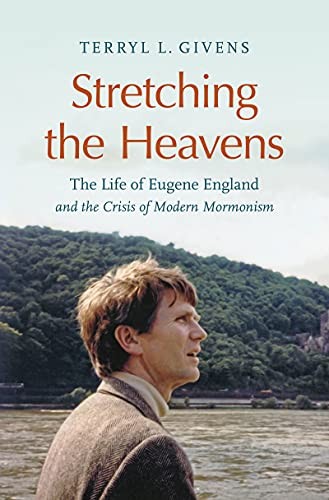
Stretching The Heavens
Key Takeaways
Kyle, in 2024 in Books: The last book in my theme of exploring pragmatic faith, this is a biography of a man who was not exactly in the mainstream of “Mormon” culture, but had a profound impact on it. This book is particularly good at helping articulate why a “think for yourself” religion is critical. Anytime dogma starts to become the core north star for any group your ability to grow, progress, or learn becomes much more limited. Joseph Smith was an enemy to dogma. But in the nearly 100 years since he was the prophet, The Church of Jesus Christ of Latter-Day Saints has most certainly struggled with an attachment to dogma over doctrine.
Terryl Givens’s biography of Eugene England read with a recurring tension about institutional Mormonism’s relationship with its own thinkers. Three threads:
-
“Learning to be righteous in the dark.” The frame from Discipline Is Destiny resurfaces here — England’s instinct that constant divine contact “moves towards the devil’s plan” rather than the saint’s. Internalization over scaffolding.
-
The branch breaking from the tree. A repeated framing: each Christian sect that separates and calls itself “the true tree” loses the connection to the broader tradition. England’s framework was unusually open to Catholic critique of Protestant breakage.
-
Ultimate universalism. “Wait, what?! We are actually ultimate Universalists.” The Charlotte Haven anecdote about progression even in the lowest kingdom — a Joseph Smith doctrinal thread that the modern Church doesn’t emphasize but that runs through the foundational sources.
Connections
Books:
- The Crucible of Doubt — same Terryl Givens author cluster; the doubt-as-condition frame England pioneered.
- Joseph Smith — Rough Stone Rolling — Richard Bushman’s account of Smith shifting revelation from the prophet to councils, and Smith’s antidogmatic “liberty of believing as I please” that England read as the true orthodoxy.
- Leonard Arrington and the Writing of Mormon History — the same Camelot-era Historical Department and scholar-vs-institution tension; Leonard Arrington hired England and judged him blacklisted.
- Working Toward Zion — a Mormon thinker engaging secular intellectual life; resonates with England’s consecration and anti-materialism themes.
- Discipline Is Destiny — supplies the “learning to be righteous in the dark” frame England voiced when he argued constant divine contact “moves towards the devil’s plan.”
People:
- Eugene England — the book’s subject; founder of Mormon studies, Dialogue editor, and disciple-in-exile.
- Terryl Givens — biographer and author of the title.
- Joseph Smith — England’s hero and standard of orthodoxy; the King Follett theosis, universal progression, and antidogmatism England tried to recover.
- Brigham Young — England’s biographical subject (Brother Brigham) and, in the race essays, the figure England held responsible for the priesthood ban.
- Boyd K. Packer — the apostle whose “The Mantle Is Far, Far Greater than the Intellect” and counsel to resign Dialogue crystallized England’s conflict with institutional authority.
- Bruce R. McConkie — author of Mormon Doctrine and the “Seven Deadly Heresies” talk that publicly censured England over God’s progression.
- Hugh B. Brown — the apostle-heretic who privately dissented on the priesthood ban and whose universalist sermon England cherished.
- Spencer W. Kimball — who studied Bush’s Dialogue article before revoking the priesthood ban in 1978.
- Richard Bushman — historian quoted on Smith’s shift of revelation to councils; encouraged England to tell his story.
- Neal A. Maxwell — apostle and correspondent England edited; recipient of England’s “Abrahamic test” letter.
- Hugh Nibley — wrote the preface praising England’s “Why the Church is as True as the Gospel.”
- Orson Pratt — the original Latter-day Saint theologian repeatedly rebuked by Brigham Young, drawn as England’s nineteenth-century parallel.
- Joseph Fielding Smith — the apostle who killed B. H. Roberts’s systematic theology and whom England judged “fooled into false belief” on race.
Concepts:
- Religious Internalization — England’s instinct that scaffolded, constant divine contact undercuts agency; righteousness must be internalized.
- Righteous in the Dark — the operative phrase for that internalization frame.
- Eternal Progression — the King Follett / Lorenzo Snow doctrine (“as man now is, God once was”) England harmonized as “Perfection and Progress.”
- Universalism — the Charlotte Haven progression-from-the-lowest-kingdom thread England drew out as the Restoration’s “incredible new emphases on universal salvation.”
- Atonement — England’s empathy-over-penal-substitution reading in “That They Might Not Suffer,” the doctrinal stance that drew formal complaint.
- Agency — the law-and-consequence framework England defended; Lucifer’s plan as the destruction of agency.
- Grace — salvation as a condition of being rather than reward or infused gift, contra the Protestant “pronounce righteous” reading.
- Republic of Letters — England’s dream of a Latter-day Saint republic of letters where faithful dissent reads as loyal provocation.
- Free Speech — the “necessary opposition” Lippmann frame of England’s final discourse on freedom of discussion.
- Polygamy — England’s “Abrahamic test” reading of plural marriage as inspired-but-temporary, not an eternal principle.
Highlights
- Latter-day Saints, by contrast, take the words literally, and as vindication that, when confronted with two competing Goods, Eve chose the greater.
- Latter-day Saint apostle John A. Widtsoe gave the following theological explanation: “In life all must choose at times. Sometimes two possibilities are good; neither is evil. Usually however one is of greater import than the other. When in doubt each must choose that which concerns the good of others — the greater law — rather than that which chiefly benefits ourselves — the lesser law. That was the choice made in Eden.”
- England’s religious dilemma was a conflict between two laudable values: in his case, loyalty to conscience and loyalty to an institution he believed was divinely led.
- You may suffer a lot, but you live intensely. Your life may be among the best things you have to offer and that story must be told. — Richard Bushman to England, 18 March 1992
- As he matured, the rudest awakening of his life would be the recognition that, as the philosopher Max Scheler wrote, the tragic nature of our universe centers on the precisely opposite state of affairs: the blind indifference of a material, terrestrial sphere to the moral worth of its inhabitants and their actions.
- “My religion began with feelings. It was only later that they were confirmed with intellectual experience.”
- More than once, he told the story of the vow, Hannah-like, he had made before Gene’s birth. “I prayed you into this world, my son. I wanted a son so bad, and when it looked like we would lose you, I pled with the Lord. I consecrated you to the Lord and promised you would never have to slave in the dirt like I did. I told the Lord I would work my fingers to the bone … if you could live and be a teacher and writer for the church.”
- We knew Eugene was very bright because when he was in grade school in Downey they would use him in plays. The high school would use him if they needed a young boy” because “he knew everybody’s parts.”
- In high school, most all the Latter-day Saint students enrolled in seminary, but Gene’s participation was particularly intense.
- Max felt it was in these intense, intimate, and safe circles that England first learned to probe for resolution of difficult issues between faith and conscience.
- The greatest influence on Gene’s life at this time was one of the revered spiritual mentors of midcentury Mormonism, Lowell Bennion, who had published the first English-language study of sociologist Max Weber. Bennion had also founded the Latter-day Saint Institute of Religion, adjacent to the University of Utah, the year after England’s birth (it was only the church’s fourth institute, a program offering non-credit LDS religious classes). He also founded the state’s first food bank and homeless shelter, as well as the Teton Valley Boys Ranch. In a church that tended toward insularity and dogma, Bennion was an open-armed humanitarian and a practical Christian.
- It was under Bennion’s influence, too, that Gene experienced a kind of spiritual awakening, and the first stirrings of discontent with the church’s doctrinal status quo on one topic in particular. As he remembered it, the class was being led by Bennion in 1953. Gene’s marriage, graduation, and mission were all in the future. A student asked why, if God is no respecter of persons, as the scriptures and common sense clearly indicate, a difference existed in God’s church between blacks and all others. I immediately answered, as I had been taught all my life, ‘Well, God is also a God of justice, and since blacks were not valiant in the preexistence, they are cursed with the consequences.’ In the discussion following my remark, Brother Bennion … simply asked me how I knew blacks had not been valiant. When I had no answer but tradition, he gently suggested that the God revealed in Christ would surely let blacks know what they had done wrong and how they could repent, rather than merely punishing them — and since God had done no such thing, it seemed better to believe that blacks had been, and were, no different spiritually from the rest of us. It is impossible to exaggerate the impact of this experience in shaping Gene’s future career as a writer, thinker, and interrogator of church teachings. He concluded, “As I thought about this, … I came to realize … that many of my beliefs … were based on flimsy and unexamined evidence.”
- Bennion was no theologian or systematic thinker — but his common-sense approach to lived religion instilled in England the passion to translate church doctrines into a more organic, coherent framework for discipleship.
- Missionaries today are confined in their reading to a few church-approved titles. It’s unlikely that given such strictures, Gene’s insatiable appetite would have been curbed. In their absence, he maintained a steady diet of titles, including Robert Wilder’s Ride the Tiger, John Steinbeck’s East of Eden, and Epictetus.
- They responded to his unflagging efforts to awaken their curiosity with “wonder-cupped faces and shining eyes of recognition or joy of newness.” About the same period, Gene begins to marvel in his journal at how his experience of reading scripture and poetry alike (from Robert Frost to the Rubaiyat of Omar Khayyam) was suddenly richer, more meaningful. Observing so much human need around him, spiritual and emotional, and the inadequacy of any human response by his coworkers, sharpened his focus on the inner life — of himself and those he served. One sees throughout his entries a spirit fine-tuning itself to the vibrations of the human heart.
- Gene would later become one of the most acute critics of the church’s teachings about race; for now, he could only fume, “hating the hundreds of missionaries who have come here, had a good time, lived off the fat of the land, done their ‘job,’ and not taught these people anything important.”
- At one point, Gene was so exasperated that he wrote a letter of complaint to an admired General Authority, Marion D. Hanks (Gene had been a student in Hanks’s Institute of Religion class at the University of Utah). With acute insight, Hanks helped England to understand that part of the problem was doubtless the ill grace with which he condemned the shortcomings of his contemporaries and predecessors. Gene’s moral indignation earned him a stinging rebuke, not for being wrong but for being judgmental. He called Hanks’s response “the most helpful letter I have received from another human being in my life; he taught me to see the danger of riding off by myself on a white horse, to realize that just as one must not only be sincere but also right, so one must not only be right but also effective, and it wasn’t very effective to go around self-righteously condemning my fellow missionaries.”10 The lesson was one that England would attempt to learn, time and again — with varying degrees of success. But the seeds of his future conflict with institutional authority appear clearly.
- “Being on a mission and working with people and getting interested in how people thought and in their cultures made me realize an interest I had long had was really my primary interest: literature and writing.”
- Studying William Faulkner with Carvel Collins (largely responsible for bringing Faulkner public acclaim) was too good an opportunity to miss. Of course, as one friend recalled, he had to “cut class at MIT and come down to Harvard and to the English classes” taught by Collins and others.
- In 1962, Gene was one of 120 recipients of the award and entered Stanford University to study with Wallace Stegner, who would become America’s premier Western writer.
- The Church of Jesus Christ of Latter-day Saints has the distinction of being the religious group most systematically persecuted by state and federal governments in America’s history. And yet, ironically, from the twentieth century on the Saints have generally been seen as among the nation’s most patriotic citizens.
- On this issue, Gene England broke decisively and vocally with his coreligionists. As he recalled the process by which his dissent unfolded, I had believed, with a certainty that was complete and religious, that the U.S. Constitution had been inspired by God, that our government therefore was essentially Christian, devoted to goodness and truth, and directed by God in its purposes and actions. In particular, I had believed our presidents were sincere and truthful. On 4 August 1964, our government announced that North Vietnamese gunboats had twice attacked an American destroyer in the Gulf of Tonkin, and that consequently we had bombed Hanoi and were greatly increasing our buildup of American troops. At the Stanford library, I had been reading reports and analyses in periodicals from around the world — not just American sources — of what was happening in Vietnam. I had become increasingly uneasy about our policies and now became convinced (as was later admitted) that our government was lying about the Tonkin Gulf Incident — and suddenly my whole world shifted. For me, being convinced that a president had lied and that our government was willing to deceive us and kill people far away, in my name and using my taxes — for what seemed more and more an unworthy and unjust cause — was a life-changing experience.
- England had not questioned church doctrine or authority, but he had challenged a Mormon cultural commandment: Do not act in defiance of prevailing church norms of thought and behavior.
- In the founding days of the church, Joseph Smith had bridled at orthodoxy tests, proclaiming in one case that “I never thought it was right to call up a man and try him because he erred in doctrine. … I want the liberty of believing as I please. It feels so good not to be trammeled.”
- At last a Latter-day Saint [who] really says something! [He] take[s] us out of our intellectual flatland and finds us room to turn around in, breathe deeply, and do some exploring.— Hugh Nibley, preface to England’s Why the Church is as True as the Gospel
- Joseph Smith’s commitment to the life of the mind, personally and institutionally, was absolute. He studied German and Hebrew, and tried to master ancient Egyptian hieroglyphics. He organized a School of the Prophets, where his peers were enjoined to “become acquainted with all good books, and with languages, tongues, and people” (Doctrine and Covenants [D&C] 88:79, 90:16). He founded a museum, library, and university in Nauvoo, Illinois. “Intelligence is the great object of our holy religion,” he declared. And intelligence, he continued, “is the result of education, and education can only be obtained by living in compact society. … One of the principal objects then, of our coming together, is to obtain the advantages of education; and in order to do this, compact society is absolutely necessary.”
- Smith was much influenced by the philosopher Thomas Dick, whom he quoted approvingly. In his most popular work, Dick had written that “the principles of mathematics, … the truths of natural philosophy, astronomy, geography, mechanics, and similar sciences, will be recognized, and form the basis of reasoning and action, so long as we are sentient beings and have a relation to the material system of the universe.”
- It is truth that exists throughout universal nature; and God is the dispenser of all truth — scientific, religious, and political.”
- The church’s first generation yielded a bumper crop of both autodidacts, like Orson Hyde and the Pratt brothers Parley and Orson, and the well-trained, like Oberlin graduate Lorenzo Snow. Parley Pratt was the closest the church had to a systematizer of Latter-day Saint doctrine, while Orson was the most highly regarded speculative theologian of the new faith (frequently reined in by the authoritarian Brigham Young, who himself authored a fair number of theological innovations, later discarded).
- Their recurrent clashes brought into sharp relief the irreconcilability at the heart of the faith tradition’s central paradox: personal autonomy and intellectual freedom contending against prophetic authority and institutional power.
- As one evidence of Latter-day Saint social progressivism, when the University of Deseret reopened in 1868 after a hiatus of some years, women comprised almost 50 percent of the class.26 (At this time, women nationwide received less than 15 percent of bachelor’s degrees awarded; all told, only 0.7 percent of American women eighteen to twenty-one years of age were attending college in 1870.)
- That year, according to the 1880 census, Utah’s literacy rate (ages 10 and above) was 95 percent, when in the country as a whole it was 87 percent, placing it ahead of thirty-four states and territories.
- At the exact moment BYU was trying to segregate gospel instruction from secular learning, Widtsoe was moving in the opposite direction, with titles like Joseph Smith as Scientist (1903–4, 1908), Science and the Gospel (1908–9), and Rational Theology (1915). Clearly, the church’s consensus about the merits of worldly learning was fracturing.
- At the same moment, more powerful figures were moving in the opposite direction. Permission to publish the brilliant autodidact B. H. Roberts’s The Truth, the Way, the Life, the first attempt at a monumental synthesis of Latter-day Saint theology, had stalled in a committee of five apostles in 1930. One reason was Joseph Fielding Smith, a powerful voice suspicious of “dangers lurking in modern thought.”
- His remarks would later be counterbalanced by a Talmage speech insisting on the harmony of true science and true gospel understanding, “The Earth and Man,” which was, according to some sources, published by the church.
- Clark was a staunch defender of orthodoxy who, in Armand Mauss’s opinion, “had a more profound impact on the Church than any other First Presidency appointment since Jedediah M. Grant’s during the ‘Reformation’ in 1854.”
- In the fading generation, the church’s most erudite scholars had been called upon not just to expound doctrine but to produce numerous church teaching manuals. Talmage’s Great Apostasy (1910) was originally designed as a manual for the Young Women’s auxiliary, and his Jesus the Christ was the official Melchizedek Priesthood manual in 1916. Roberts had produced a highly influential, five-volume Seventies Course in Theology which was used in that quorum for the years 1907–11; the Young Men’s Mutual Improvement Association published a three-year manual based on his study of the Book of Mormon, New Witness for God (1903–6). John Widtsoe’s Science and the Gospel was the Young Men’s Mutual Improvement Association Manual of 1908–9. His Joseph Smith as Scientist (1908) was adopted for that program in 1920–21, and he also produced for that organization the tellingly titled manuals How Science Contributes to Religion (1927) and (the coauthored) Heroes of Science (1926–27). Widtsoe’s Rational Theology (1915) was used as a Melchizedek Priesthood manual. Clearly, the church valued these men of science and gave them a powerful role in shaping the attitudes of church members, and youth especially, toward science and the gospel. Now, official attitudes toward a vigorous intellectual culture reversed course.
- In “The Charted Course of the Church in Education,” Clark articulated a vision that became the official statement of guidelines and underlying philosophy informing the worldwide network of Latter-day Saint educators. It is unlikely that any address of the twentieth century did more to shape and constrain the church’s intellectual culture for coming generations. (Only in 2016 did a senior apostle reformulate the philosophical underpinnings of CES culture.)
- Two years later, the increasingly influential Clark would direct Commissioner of Education Franklin West that teachers “should carefully refrain from saying anything that will raise doubt or question in the student’s mind about the gospel. … Every fact, every argument, every reason that can be found must be used to support church doctrines — the gospel — not to question them.”
- Franklin West. West was much beloved by his teachers for the freedom of thought he promoted; in his view, he was released because “there was a little feeling because I was a scientist, that I couldn’t be an honest-to-goodness sound believer in the church’s theology.”
- Bennion didn’t improve his standing by publicly challenging apostle Mark E. Peterson’s defense of the Negro Doctrine, as it was called, in a 24 August CES convention.
- George Boyd, followed up with another question, prescient in its theological pertinence: Doesn’t dogma require “a unanimous decision?” Otherwise, how are we to know, in the face of competing pronouncements, “what is authoritative — coming from the past?”
- Hence the striking explanation for sacrificing personal preferences and convictions to harmony, which Hugh B. Brown expressed to England shortly before his death: “I think all my brethren in the quorum are wrong in this decision,” he said referring to their persistence in defending the policy of denying Blacks the priesthood in the 1960s. But “I would do nothing to destroy the unity of that quorum on which your and my salvation depends.”
- in Latter-day Saint understanding, council consensus is not a substitute for divine revelation; council consensus is the particular form that revelation is believed to take.
- But by 1835, as Richard Bushman notes of Smith’s subsequent restructuring of the leadership, “Smith not only shifted the responsibility for revelation from himself to his councils, he moved the locus of revelation from the individual prophet to the church’s administrative bureaucracy.”
- As Bushman has noted, “The implication was that decisions in council were to be of equal authority with revelations to the prophet.”
- This consensus-driven practice, rooted in Latter-day Saint theological understanding, has costly consequences. Change and innovation are frequently thwarted until total consensus is reached; and when maverick individuals break ranks, they may be silently tolerated rather than disciplined or repudiated.
- Bruce R. McConkie, published the most influential compendium in Latter-day Saint history: Mormon Doctrine. Two apostles assigned to review the book for church president David O. McKay recommended over 1,000 corrections, and McKay suspended its republication “even in a corrected form.”
- The book’s enduring success, in spite of its contested authority and accuracy, is perhaps a testament to the human proclivity for neatly packaged dogma.
- One of the key contributions that Gene England made to his faith tradition — at his cost — was to illuminate the chasm between Latter-day Saint theology and Latter-day Saint culture, and it was in the realm of politics that this fissure emerged most starkly.
- England persistently picked that identification apart, arguing that far too many American values associated with conservatives were in fact antithetical to the gospel. As he said to a student reporter, “The values we’ve upheld as Americans are values of racism and sexism and materialism, anti-environmentalism, militarism.”
- “As to the silence of the brethren on some of these matters, the program of respect and loyalty which the Church engenders in its leaders is at the cost of the contentment of most. Nobody likes to shut up when he feels he ought to be saying something, but in the long run there seems to be little virtue or gain in sporadic and personal outbursts.”
- My faith in [Christ] encourages me to enter into dialogue. — England, “The Possibility of Dialogue”
- England was by temperament an optimist. Latter-day Saint theology fed that optimism. A religion that denied original sin and inherent depravity, asserted the literal parenthood of God (as a Heavenly Father and Mother), and espoused the eventual deification of virtually all human beings could not help but shape its theologically informed disciples into hopeful, positive Zion-builders.
- One word more than any other characterizes his aspirational energies to build consensus and cooperation: dialogue.
- As conservatism and retrenchment replaced the intellectual heyday of Mormonism’s 1930s and 1940s, a group of prominent intellectuals including Lowell Bennion, T. Edgar Lyon, George T. Boyd, William Mulder, and Sterling McMurrin, part of a group who called themselves “the Swearing Elders,” began to meet and discuss Latter-day Saint topics with a critical — in some cases jaundiced — eye. They floated among themselves the project of a journal devoted to a scholarly examination of things Mormon, unhindered by church oversight.
- Historian Leonard Arrington published an article in the first issue of BYU Studies on the Latter-day Saint Word of Wisdom, the health code prohibiting tobacco and alcohol. His thesis that the code’s strict enforcement in early Utah was more financial than spiritual in motivation raised hackles with administrators, and the university suspended the journal’s publication for a year. The lesson was learned and controversial subjects were henceforth avoided.
- Committed to the venture, they sent out a prospectus to gauge the potential audience, announcing that “many men need some medium in which to consider their historical and religious heritage in relation to contemporary experience and learning. Some are excited about the dialogue this encounter provides and the good fruit it bears in their lives. Others find themselves alone in their experience and cut off from such a dialogue — and too often feel forced to choose between their heritage and the larger world. We are now preparing to publish a journal designed to meet the needs of both these groups.”
- Leonard Arrington had just organized the Mormon History Association (MHA) as an independent forum for Latter-day Saint scholarship.
- Not only rhetorical effect was at stake; if Salisbury had said, “we are active, believing, faithful members of the church, therefore we want to enhance the intellectual conversation in the church,” he would have avoided a stance of confrontation and he would have better reflected the view of England and Joseph Smith and Brigham Young alike, that intelligent engagement with doctrinal matters was of the essence of true discipleship.
- in 1872 inaugurated their own journal, the Woman’s Exponent, unabashedly feminist in its orientation. Leonard Arrington declared the journal “the first ‘permanent’ woman’s magazine west of the Mississippi and second in the nation after the Boston Woman’s Journal.”
- England, by contrast, held that “my Mormon faith affirms the world as good. … [Christ] insists that my words and actions be integrated with each other and relevant to that world — that they not just speak to it but really make the connection. … We must be willing to consider that anything we believe or base our lives upon may be a partial truth — at best seen … ‘through a glass darkly’ — or even may be dead wrong.”
- In Packer’s message to the All Church Coordinating Council Meeting, he read part of a letter from a church intellectual who wrote, “My concern is that the Brethren are contending with the church’s own scholars. … In the Catholic Church, the great scholars’ efforts were used by the Church to refine and strengthen the doctrine (St. Augustine, Thomas Aquinas, for example). In our Church, the scholars are put down, even banished.” Packer’s response was to state that the writer “needs to understand that the doctrines of the gospel are revealed through the Spirit to prophets, not through the intellect to scholars.”30 In other words, “What has Athens to do with Jerusalem?” That was the message many in the church were still hearing and promulgating, even though — as the Catholic Church has long recognized — the priestly vocation and the theologian’s vocation are not in competition. This canard had earlier been corrected by Heber J. Grant, but sadly he did so in a private and not a public setting. In 1945, a church magazine urged upon its readers the maxim that “when our leaders speak, the thinking has been done.”31 Many Saints are familiar with that expression; few are aware that when church president George Albert Smith learned of it, he immediately and indignantly repudiated the statement. “Even to imply that members of the Church are not to do their own thinking,” he wrote, “is grossly to misrepresent the true ideal of the Church.”
- Some described Gene’s teaching style as “Questions to Gospel Answers.”34 It was said with affection but hinted at a subversive approach that did not sit well with the orthodox mainstream.
- So central to church practice is this affirmation of absolute certainty about saving truths that it indelibly alters the very nature of religious conversion.38 This cultural anomaly explains Dilworth Young’s incomprehension at England’s entirely reasonable proposition that disciples needed to be open to the possibility of error in the church or its teachings.
- Rodney Stark had predicted in 1984 that Mormonism was en route to becoming the first new world religion since Islam. A generation later, the seemingly unstoppable growth trends had stalled.
- England had insisted in that first Dialogue issue that it was launched “for the express purpose of helping young LDS students … build and preserve their testimonies.” His initiative was a concrete exemplification of not “looking upon doubt as a sin — or as a virtue — but [seeing] it as a condition, a condition that can be productive.”
- England himself. As he continued his essay, “I have been able, in all my proving, to discover and to continue to hold some things fast as certainties — faith in the divinity of Christ and in the saving power of His teachings and atonement, faith in the divine mission of His Church and His modern prophets. … Yet I have found that my very specific faith does not cut me off from this rich complexity, but actually intensifies and informs with meaning my involvement in it.”
- As he elaborated a few years later, “The increase in questioning, even in skepticism, since the Enlightenment, … some see as evidence of Satan’s battle against the Restoration. But, on balance, I believe that such skepticism has been positive: it has certainly undermined false religion and bad faith. … If skepticism is properly understood and used it can reinforce the need for both religion and faith. … Skepticism, in the perspective I am searching for here, the questing, questioning approach of heart and mind, leads directly back toward the balance of humility and fearlessness we find only in truth faith.”
- In a culture that essentially criminalized doubt, thousands of members found themselves faced with limiting black and white options, to affirm or reject. With no room to embrace complexity and fallibility and a messy past, they chose rejection. Only recently have apostolic voices extended the church’s arms to embrace those unable to articulate honestly a template of religious certainty.
- As Henry Eyring’s father had famously and reassuringly stated, “In this Church you don’t have to believe anything that isn’t true.”
- In a real sense, the roots of the Joseph Smith Papers project go as deep as those first issues raised by Walters. To its credit, Dialogue was willing to publish his controversial article.”
- For the liberals, however, the new journal was intellectual catnip. An overwhelmingly conservative member base meant a relatively limited readership. But it also meant an absence of competition for the liberal voices that did exist — and from the minority left-of-center membership submissions poured in. In the early years, England noted the impressive acceptance rate of a mere 5 percent.
- McMurrin laments that “Mormon liberalism … showed some life in the thirties, [but] never quite made the grade. The liberals talked a great deal, but they had no courage of decision or action. … They are still around, but in influence they have been displaced by a breed of noisy and deceptive irrationalists who give the appearance of orthodoxy while denying its spirit.”
- Mormonism is fundamentalism turned against itself,” McMurrin wrote).55 And that those who thought themselves the most vociferous defenders of orthodoxy were in reality breaking faith with Smith’s universalist, eclectic, and antidogmatic tendencies. England also passionately held, as McMurrin did more sanguinely, that “Mormonism has far more intellectual strength than is commonly supposed, even by most Mormons,” with an obscured heritage of intellectual “adventure, vitality, and creativity.”
- “That They Might Not Suffer: The Gift of Atonement” challenged traditional LDS readings of the atonement as a kind of penal substitution, making empathy rather than justice the occasion of Jesus Christ’s suffering.
- “What a sad irony,” he observed in the essay released to the press, “that a once outcast people, tempered for nearly a century in the fires of persecution, are one of the last to remove a burden from the most persecuted people ever to live on this continent.”
- How, he asks, can a Latter-day Saint “be completely dedicated to the authority of the church and its prophetic leadership without abdicating his own agency and moral responsibility?”
- In a further blow to such foundations, he quotes from a reported 1954 conversation in which President David O. McKay was heard to say “there is not now and there never has been a doctrine in the church that the Negroes are under a divine curse. … Withholding the priesthood from the Negro … is a practice, not a doctrine, and the practice will someday be changed.”
- England loved quoting his wry remark to a BYU audience: “We are not so much concerned with whether your thoughts are orthodox or heterodox as we are that you shall have thoughts.”
- The controversies surrounding the prohibition on Blacks in the priesthood came to a head four years later in 1973 when Lester Bush prepared a comprehensive overview of the priesthood policy that, in his opinion, “virtually undermined the entire traditional case for the inspired origins of Mormon teachings” on the subject. His work was historic and paradigm-shattering, landing like a thunderbolt. Bush traced the ban’s background, finding not revelatory direction but culturally inherited mythologies and simple prejudice. He then submitted his manuscript to the apostle Boyd K. Packer for review.89 Having met personally with Packer, Bush would later insist that “there was no suggestion of ‘don’t publish it,’ ” and scholars in the church’s Historical Department praised the manuscript. When the article went to press as the centerpiece of a special Dialogue issue devoted to the race issue, fault lines became more pronounced and momentum for change grew.
- “If not, I hope I can be forgiven,” he said. “No, the Brethren won’t forgive you,” the administrator predicted. Rees responded, “Then that disturbs me more than the blacks and priesthood issue.”
- Spencer Kimball, who spearheaded the revocation of the ban in 1978, “had studied [Bush’s article] carefully and marked it up extensively.”
- God will forgive us “if [we] err on the side of mercy,” he said in persuading McKay to approve a marriage involving dubious lineage.
- In a church that had experienced decades of persecution and misrepresentation, England was openly showing disloyalty; at least, that was how his rhetoric struck leaders.
- “The policy of denying blacks the priesthood is rationally untenable from a number of perspectives — historical, theological, ethical, social, psychological, in fact from all perspectives but one — ecclesiastical authority. But for me that perspective outweighs all the others because I am convinced that ecclesiastically the Church is doing what the Lord has directed.”
- The ban may be deleterious to those proscribed — the Black race — he argues, but it reflects poorly only upon those whose spiritual immaturity made such a ban necessary for the establishment and early growth of the church.
- The most plausible source of the ban was human weakness, not divine foreordination, and that put the solution within reach of a membership prepared to make progress against racist presuppositions.
- Brigham Young: “We believe that women are useful, not only to sweep houses, wash dishes, make beds, and raise babies, but they should stand behind the counter, study law or physic, or become good bookkeepers and be able to do the business in any counting house, and all this to enlarge their sphere of usefulness for the benefit of society at large. In following these things they but answer the design of their creation.”
- Until then, he had been confident that “the Lord directed things and he inspired people to call them and that was it.” Henceforth, the realities of how the human factor intruded into the chain of inspiration and revelation were painfully evident.
- I did find at St. Olaf, compared to Stanford or California State University, much greater freedom — from legal and professional as well as social pressure — to be forthright about my convictions. — England, “Great Books or True Religion?”
- “I saw more and more how relative are the terms liberal and conservative. I found I could change from one to the other simply by walking across Stanford Avenue from the university to the Institute building. On campus, among graduate students and antiwar and civil rights activists, I was that strange, non-smoking, short-haired, family-raising conservative; at the Institute, I was that strange liberal who renounced war and worried about fair-housing and free speech.”
- He framed his talk as a rejection of the theological (Is Mormonism Christian?) in favor of the religious (Am I, a Mormon, also Christian?). With this maneuver, he demonstrated his propensity for unity over disharmony. For by rendering the question into one of universal Christian discipleship, he downplayed Latter-day Saint distinctives and exceptionalism, established a core kinship between Lutherans and Latter-day Saints, and gave voice to his own abiding faith in Christ at the heart of his own discipleship.
- Maxwell, a man who came increasingly to be revered for his meekness and humility, gamely replied: “Help me understand your message about my ‘syntax’ when it gets a little mannered. I value your editorial judgment, so don’t hesitate to elaborate when you have the time. I must go on learning and growing before the laws of nature make that too difficult.”
- However, he had suffered a humiliating rebuff in 1970, when Joseph Fielding Smith became the new church president. For the first time in the modern church, a new president declined to retain a counselor in the new presidency (Brown had been a counselor to McKay). Brown returned to his place in the Quorum of the Twelve apostles.
- Still, England was consumed by his dream of a Latter-day Saint republic of letters, in which faithful dissent from the party line would be seen as loyal provocation; he wanted to hope that his love for the gospel and the institution that framed it would cover a multitude of sins; and he acted on the belief that his unwillingness to question the integrity or good faith of the Brethren would be reciprocated.
- He conceived the idea of launching a Joseph Smith University in Carthage, Illinois, proposing to purchase a Catholic school that was for sale. He even called George Romney to offer him the presidency of his pipe dream. (“I’m too old for new projects,” the elder statesman replied.)
- He offered some examples: “Intellectual Heroes of the Restoration,” a volume of intellectual history, a biography of Joseph Smith, and a “critical study of Mormon literature.”
- Arrington reviewed England’s work and was enthusiastic. He suggested that regardless of the movie’s future, a half-dozen or so essays like the few he had done could be published as a collection. England heard through the grapevine that Arrington was even considering taking him on board to assist in the writing of the major Brigham Young biography that he was himself planning. (England went on to draft some of the chapters, and Knopf would publish the book in 1985 as Brigham Young: American Moses.)
- He now read those setbacks as painful prompts to a career reorientation: historian and biographer of the church’s founding luminaries.
- Although in the academy the lines that separate doctrine from intellectual history may be clearly defined, in the Latter-day Saint church, they are frequently confused, as are the terms doctrine and theology. Consequently, the theological enterprise has not fared well.
- Doctrine, a New Testament term, means teaching or instruction, and in religious studies carries the meaning of an authoritative teaching or instruction. Theology, in contrast, is “God-study” or “God-discourse.” It represents human attempts to articulate the implications, grounds, rationality, or ramifications of religious propositions.
- As a consequence, with a few important exceptions, a growing distinction appears in the Latter-day Saint consciousness between “doctrine” as true, inspired, and authoritative teachings, on the one hand, and theology as the purely human pronouncements associated with an apostate Christendom, on the other. Theology, in this later view, is what happens when revelation fails.
- By 1930, B. H. Roberts was finishing his masterwork, an ambitious, systematic theology of Restoration doctrine called The Truth, the Way, the Life (first published posthumously in 1994). It was killed by a reading committee of the leadership, however, largely at the instigation of Joseph Fielding Smith, who objected to what he saw as Roberts’s compromises with scientific theory.
- By the 1970s and 1980s, Mormon theology had become a virtual oxymoron. England recognized the crucial distinctions between doctrine and theology. Doctrine was authoritative, and it was dogmatic, absolute and divorced from historical and cultural considerations.
- England, by contrast, saw theology as a handmaid to doctrine, not a competitor. His principal model in this regard was the same B. H. Roberts who was the last great practitioner of Mormon theology. He quoted Roberts’s charge, which he took personally to heart as his “inspiration and guide.” In 1906, Roberts had written, I believe “Mormonism” affords opportunity … for thoughtful disciples who will not be content with merely repeating some of its truths, but will develop its truths, and enlarge it by that development. … The work of the expounder has scarcely begun. The Prophet planted by teaching the germ truths of the great dispensation of the fullness of times. … The disciples of “Mormonism,” growing discontented with the necessarily primitive methods which have hitherto prevailed in sustaining the doctrine, will yet take profounder and broader views of the great doctrines committed to the Church; and, departing from mere repetition, will cast them in new formulas; cooperating in the works of the Spirit, until they help to give to the truths received a more forceful expression, and carry it beyond the earlier and cruder stages of development.
- He saw himself as at the furthest possible remove from the vocation of church dissident. Quite the contrary — he saw himself as a provocateur, perhaps, but never a dissident. (“I always saw myself as an apologist for the church,” he said shortly before he died.)
- England was trying to take Mormon culture back to its — and Christianity’s — earliest theological roots. Smith had famously taught the most radical version of theosis in Christian history — boldly proclaiming the human potential to be fully divine. “You have got to learn how to make yourselves Gods,” he preached shortly before his death, “the same as all Gods have done — by going from a small capacity to a great capacity, from a small degree to another, from grace to grace, until the resurrection of the dead, from exaltation to exaltation — till you are able to sit in everlasting burnings and everlasting power and glory as those who have gone before, sit enthroned.”
- England understood this perfectly: “I have thought for some time that the old and usually fruitless argument about whether we are saved by faith or by works is resolved by seeing salvation as a condition of being, gradually brought about through a combination of God’s gifts and our response to them that changes us — not a mere reward for works or irresistible infusion of grace.”
- Even more provocatively, he summarized, “I think being in contact with God constantly is moving towards the devil’s plan” (a reference to Latter-day Saint belief that Lucifer’s strategy is to destroy human agency).
Kyle: Learning to be righteous in the dark.
- England was on the right side of his church’s theological history, but at the wrong moment in the church’s institutional history.
- Mid-twentieth-century Mormonism sacrificed much of its theological radicalism in order to better assimilate into the American (and traditional Christian) mainstream.
- England singled out Robert L. Millett, later the dean of BYU’s Religious Education college, who praised these newfound emphases on an absolute God, human sinfulness, and salvation by grace. Millett considered them a “retrenchment and a refinement” of early Restoration thought. So too did BYU professor Stephen Robinson, who, in attempting a bridge-building publication with evangelicals, ended up “sounding more Evangelical than Mormon” on crucial issues like inerrancy and sufficiency of the biblical canon, salvation by grace alone, the “substitutionary” atonement, and — most important — the nature of God. England with good reason saw these new emphases as Protestant incursions, not found in Joseph Smith’s teachings.
- The doctrinal foundation of Protestantism is the Reformers’ view that the critical New Testament word dikaioun [verbal form of the noun “righteous” ] “means ‘to pronounce righteous,” whereas the prior, Catholic view was that it signified “to make righteous.”
- God’s grace is real, but in Smith’s understanding it emerged at the premortal council when Christ offered to sacrifice himself to make human resurrection universal and human exaltation possible. Grace cannot bestow salvation because salvation is neither a gift won nor a reward earned. It is a condition attained when sanctified individuals become the kind of persons, in the kinds of relationships, that constitute the divine nature.
- These theological perspectives of England would be years in developing. And they would culminate in his finest piece of theological explication: his posthumously published “Weeping God of Mormonism.”
- The Latter-day Saint God, by contrast, does not orchestrate human behavior, choice, and events to comport perfectly with his will. He participates in rather than transcends the ebb and flow of human history, human tragedy, and human grief.
- Lowell Bennion had taught that the atonement is not something that pays for our repentance, it … actually gives us the power to repent in the first place. … It was a very powerful lesson to me about how the atonement works and it’s probably led to my major contribution doctrinally. — England, undated interview with son Mark
- The closest thing to a uniquely Latter-day Saint theology of atonement was developed in the early twentieth century by B. H. Roberts, who attempted to reconcile scripture with a less retributive take on God’s justice.
- Without a framework of law that reflects these oppositional realities, choice would be uninformed, consequences random, and agency void. As Alma asks, “How could [man] sin if there was no law? How could there be a law save there was a punishment?” (Alma 42:17). Or as church president Russell M. Nelson points out (as did Dallin Oaks in discussing abortion), true agency requires that after we freely make choices we be “tied to the consequences of those choices.”
- Roberts’s theory was little read and had no impact on Latter-day Saint thinking. As a result, Saints have by and large embraced the language and metaphors of penal substitution.
- “We do not repent in order that God will forgive us and atone for our sins, but rather God atones for our sins … in order that we might repent and thus bring to its conclusion the process of forgiveness.” In other words, “the … atonement actually gives us the power to repent in the first place.” It does not do this by any divine calculus of repayment, compensatory suffering, or righting of the scales of justice. In England’s elegant prose, the mystery of atonement is no mystery; in a process shorn of metaphysics, we find ourselves face-to-face with the supreme instance of unconditional sacrifice, “the shock of eternal love expressed in Gethsemane.” And we are transformed by that recognition.
- From the perspective of Latter-day Saint orthodoxy, however, two problems exist with England’s theological revisionism. First is the language of substitution in LDS (and biblical) scripture that England neglected to address. As one example, Book of Mormon prophet Alma declares that repentance “could not come unto men except there were a punishment, which also was eternal as the life of the soul should be” (Alma 42:16). As another, Lehi teaches that “he offereth himself a sacrifice for sin, to answer the ends of the law” (2 Nephi 2:7). The Book of Mormon elsewhere refers to the “demands of justice,” and the Doctrine and Covenants explicitly declares that Christ suffers in our stead if we repent (D&C 19). Some kind of substitution seems clearly implied. Had England offered his interpretation as a supplement to or tempering of substitutionary atonement rather than a wholesale replacement, he probably would have raised no hackles.
- He had described in his original complaint, and repeated in his report, what disturbed him most: “He categorically rejects the idea of any principle of heavenly, eternal, or God-related justice or even mercy in terms of meanings espoused by the Church. Rather, he sees Christ’s role as simply a motivator. … The issue of justice he sees as strictly a mortal-human problem. We demand justice of others as well as of ourselves. … Our understandings of gospel principles heighten our guilt feeling or, in other words, our demanding justice of ourselves. Christ loves the sinner unconditionally.” And the atonement’s efficacy comes through “the emotional impact of the recognition of that unconditional love.” It was an accurate summation of the principles expounded in the essay.
- “Great Books or True Religion? Defining the Mormon Scholar,” a spirited defense of faithful intellectualism.
- “As one measure of our failure [that of his generation and the one preceding], I ask you to name those thinkers and writers who are now willing and able to appear in all four of our periodicals for expression of ideas, Exponent II, Dialogue: A Journal of Mormon Thought, BYU Studies, and The Ensign.”
- Packer read aloud to England “long sections” from that recent talk on art and artists, a hard-hitting piece in which he observed that “people who are very gifted, it would seem, tend to be temperamental,” adding, in the words of a senior apostle, “more temper than mental.” His next words were an unstinting reprimand to the man sitting before him: “Few have captured the spirit of the gospel of Jesus Christ and the restoration of it in music, in art, in literature. They have not, therefore, even though they were gifted, made a lasting contribution to the onrolling of the Church and kingdom of God in the dispensation of the fulness of times. They have therefore missed doing what they might have done, and they have missed being what they might have become. I am reminded of the statement ‘There are many who struggle and climb and finally reach the top of the ladder, only to find that it is leaning against the wrong wall.’
- And here we arrive at the heart and core of England’s dilemma. For though he saw himself as anything but a toady or a lackey, increasingly owning his role as symbol of Latter-day Saint intellectual independence and fidelity to higher principle, he recognized that one could only serve as that symbol and effect positive change if one remained loyally within the institution that he loved too much to either leave or leave alone. And incapable in his mind of differentiating his loyalty to Christ from his loyalty to what he was convinced was Christ’s church, he proceeded to do precisely what he had so roundly condemned. He submitted to Packer’s counsel in order to remain in — or in his case, move closer to — the Brethren’s “good graces.” He resigned his position with Dialogue.
- Eugene England Sr. had recorded in his personal history his conviction that “parents can pretty well set the course of their children’s lives if they will drill into their characters the ideals they should have.”16 It is abundantly evident that England felt a great chasm between the ideals his parents had in mind for him and his failure to achieve them. He grew up hearing repeatedly the story that he had been consecrated to the work of the Lord. His friends thought it obvious that England Sr. wanted a General Authority son, and “Gene labored his whole life over guilt for not fulfilling his father’s ambition for him.”17 Toward the end of his life, a therapist assigned England to recapture his earliest childhood memories. Tellingly, his first two involved the trauma of disappointing his father.
- Church Historian Leonard Arrington gave a particularly tragic assessment of the state of Latter-day Saint intellectual culture that summer of England’s hire — and it included bad news for England of which the professor was not even aware. The church historian confided in his journal, “We seem to be going through a period of anti-intellectualism. … [People such as] Lowell Bennion, Gene England, despite his devotion to the Church and the Gospel, his sincerity, and his desire to please, is not permitted to publish. … Just because he was a founding editor of Dialogue.” England was far from alone. Carol Lynn Pearson was put on the blacklist because she gave a talk four years ago which was mildly favorable to ERA [the Equal Rights Amendment]. Through prayers and tears she finally got Elder [Boyd K.] Packer to make an exception for her and she may now continue to publish in Church magazines. But for a period she was on the blacklist. Jim Allen is now on a blacklist because of his Story of the Latter-day Saints, although he doesn’t know it yet, and it would break his heart if I told him. I am on a kind of blacklist. The Church News has been told not to review Building the City of God, and not to publish any of my books without specific clearance by the Quorum of the Twelve. Scott Kenney is on a blacklist because he is publishing Sunstone. Claudia Bushman is on a blacklist because of Exponent II. And so on. … It is now necessary for Mormon intellectuals to publish under pseudonyms. I will not reveal here the pseudonyms being used, but there are several who use them, and thus far they are “getting away with it.” It reminds one of the Susa Young Gates, Emmeline B. Wells, Orson F. Whitney and other personalities at the turn of the century who used them and “got away with it.”
- Richard S. Marshall submitted a senior paper in his honors history class titled “The New Mormon History.”
- Gene England was for Mormon belles lettres what his friend and contemporary Leonard J. Arrington was for Mormon history. … Future anthologies will call this era of Mormon letters, “The Age of England.”— Richard Cracroft, “Eugene England and the Rise and Progress of Mormon Letters”
- To further this endeavor, the editor announced the inauguration of a church magazine called the Contributor, designed to “foster and encourage the literary talent of their members … that it might say to every young man and every young lady among our people, having literary tastes and ability, Write.”
- You can’t tell how good it made me feel to know that the Lord knew that there was such a person as Joseph Millett.
- Not all sociologists agree with Thomas O’Dea’s assessment, in the Harvard Encyclopedia of Ethnic Groups, that Latter-day Saints constitute “the clearest example to be found in our national history … of a native and indigenously developed ethnic minority.”50 But Sydney Ahlstrom’s befuddlement speaks volumes: “One cannot even be sure if the object of our consideration is a sect, a mystery cult, a new religion, a church, a people, a nation, or an American subculture.”
- What I think lasts is the stories. … I feel a deep communion with all who believe the Joseph stories, even if they are members of the NRA or even if they smoke and drink. I think we are a people of the sacred stories. …
- Ed Geary, who wrote him with wry hyperbole, “I fear you may find that it is a riskier business at BYU to defend Joseph Smith than dirty movies, since we are apparently to understand that Joseph, while not an apostate or heretic, was mistaken.”7 What he likely meant was that Smith’s intellectual adventuresomeness, lack of dogmatism, and open embrace of truth from across sects and culture found little place in that particular historical moment of the church’s evolution.
- “We need to cultivate moral courage. It seems clear that most forms of insincere and unloving speech arise from fear: fear of serious reflection on what we most care about and want to be, fear of exposing our limited selves, fear of the opinion or power of others.”
- The common root of modernism’s challenge to religion was what Grant Wacker calls “the dilemma of historical consciousness.” The Higher Criticism that spread from German universities to the American landscape posited convincingly that “what Scripture is, and how Scripture was composed and put together is a matter of history, and to investigate those matters fully is a duty to truth.”
- Since all authority was vested in those scriptures, this modernist impulse called into question, in Charles Hodge’s words, “whether Christianity is historically conditioned … or whether it is, as it claims to be, one final religion.”
- If revelation could not claim a transcendent, historically unconditioned status, then the church was no more reliable as a source of authority than the scripture. No wonder that a concerned Pope Pius X declared modernism “the synthesis of all heresies” in a 1907 encyclical.
- When England joined the Historical Department in 1975, “Camelot,” as nostalgic historians would remember the Arrington years, was about to be prematurely erased from the Mormon map. Arrington’s brand of history never had the full support of the leadership. We saw earlier how his 1959 revisionist essay on the church’s health code, the Word of Wisdom, argued that its enforcement by Brigham Young was economically, rather than divinely, motivated.
- No wonder the religious historian Martin Marty could observe in 1983 that “Mormon thought is experiencing a crisis comparable to but more profound than that which Roman Catholicism recognized around the time of the Second Vatican Council (1962–65). Whatever other changes were occurring in the Catholic Church, there was a dramatic, sometimes traumatic shift in ways of regarding the tradition. One of the conventional ways of speaking of this shift comes from the observation of philosopher Bernard Lonergan. He and others … argued that Catholicism was moving from a ‘classic’ view of dogma to a thoroughly ‘historical’ view of faith. In the classic view, Catholic teaching has come intact, as it were, protected from contingency, from a revealing God.”20 In the case of Mormon studies, “ways of regarding the tradition” are certainly contested, but the church’s leadership was hardly likely to respond with anything parallel to Vatican II.
- His initial impressions capture the magnetism that would draw hundreds into the England circle over the years, friendships forged in the intimacy of a living room salon. “As I walked in, there was a different kind of feel, a different kind of energy to anything I had experienced in the Mormon Church before. Experiences that I had until then were kind of formal, kind of impersonal, and this was very personal. This was an energy of wanting to know what you thought, what your feelings were, what your struggles were. … It was not authoritarian; it wasn’t like he kn[e]w more than you did. It was very emotional actually.”
- “If he was feeding one of the babies he had a book in his hand. Which I would too if I could, but I was usually taking care of the other kids too.”
- Nineteenth-century Saints were fully comfortable with a religious understanding that took seriously the modifiers “continuing,” “living,” and “open,” as they referred to revelation, church, and canon respectively.
- One listener to the major course correction wrote his uncle, “Why does the Lord permit things to go on in a wrong or loose way, where the dearest rights and tenderest feelings of the human heart are involved?” Then answered his own question: We have to “gain knowledge and wisdom by repeated trials and mistakes, He has left us in a measure free to act and see what we would do.”
- By the late twentieth century, however, the dominant narrative was one that closely approached infallibility on the part of prophets, flawless linearity in the church’s history, and near-perfect harmony in the manifold doctrinal pronouncements of the leadership through time.
- In his most radical challenge to Christian orthodoxy, Smith had proposed in a late sermon that “all Gods have [progressed] from a small capacity to a great capacity, from a small degree to another, from grace to grace … from exaltation to exaltation.” Yet he had also endorsed the absolutist definitions of God as having all knowledge and power. Subsequently, each strain of thought had its expositors and critics among the church leadership.
- England’s talk traced the well-documented Latter-day Saint history of the teaching that, in Lorenzo Snow’s formulation, “as man now is, God once was,” and that he continues to progress, from its origins in Smith’s King Follett Discourse, through Brigham Young, B. H. Roberts, John Widtsoe, Hugh B. Brown, and Spencer W. Kimball. In his characterization of the idea, God “is perfect in respect to us and the sphere we inhabit” but is in some sense progressing in other spheres. In other words, he harmonized the two perspectives.
- Believing in a church presided over by God, he was confident that contradictions could be minimized and apparent conflicts reconciled. This is everywhere apparent in England’s writings and public presentations; it is typified in the title he gave to the published form of his Varsity Theatre presentation: “Perfection and Progress: Two Complementary Ways to Talk about God” (my emphasis). England noted, “My simple thesis … is that, in fact, these statements are not contradictory. These Church leaders were using two different, but complementary, ways of talking about God based on two different aspects of the Mormon understanding of God, both of which … are essential to our theology and must be maintained.”
- His June 1980 talk titled “Seven Deadly Heresies” called out England clearly and unambiguously, with McConkie’s anathema pronounced against heresy number one: “There are those who say that God is progressing in knowledge and is learning new truths. This is false — utterly, totally, and completely.”55 Other teachings McConkie labeled heresies actually enjoyed — and still enjoy — wide or even majority support among the leadership, such as that evolution is real and that people may progress through the heavenly kingdoms after death. For this reason, at least according to England’s report of a conversation with Marion D. Hanks, “the brethren were just livid” because McConkie made doctrinal claims “which were not in any way official. So they chastised him and told him he had to change it.”
- As he would later explain in frustration, “I have students aware of the fact that prophets have said God is progressing, other prophets have said he is not. They come to me with their questions about this apparent disagreement.”
- This means, among other things, that it is my province to teach to the Church what the doctrine is. It is your province to echo what I say or to remain silent.”
- Packer’s address to church educators, titled “The Mantle Is Far, Far Greater than the Intellect,” incorporated four “cautions.” The second of them referred to “a temptation for the writer or the teacher of church history to want to tell everything, whether it is worthy or faith promoting or not. Some things that are true are not very useful.”
- Of Packer in particular, he wrote, “He demands that Mormon historians provide only a church history diet of milk to Latter-day Saints of whatever experience. … But a diet of milk alone will stunt the growth of, if not kill, any child.” He protested what he saw as a demand “that historians write Church history from a siege mentality.” Quinn asked indignantly, “Why does the well-established and generally respected Mormon Church today need a protective, defensive, paranoid approach to its history?”
- Quinn was at pains to insist that his objectives were the same as Packer’s and Benson’s, though his prescription differed: “A so-called ‘faith-promoting’ Church history which conceals controversies and difficulties of the Mormon past actually undermines the faith.”
- Publishing outlets for Latter-day Saint books were likewise increasingly categorized as orthodox (the Foundation for Ancient Research and Mormon Studies [FARMS], BYU Studies) or liberal (Signature Books, Smith Research Associates). England’s dreams of dialogue were not faring well.
- In the extremely rare cases where prophetic authority seems to ask us to do or believe something that goes against conscience, that is, in what could be called an “Abrahamic test,” we are responsible to know absolutely … that the demand comes from God. — England to Neal A. Maxwell, fall 1990
- Latter-day Saints occupy a uniquely fraught territory that is easy to mischaracterize. That is because Latter-day Saints are a people of a hyper-Protestant sensibility operating within a hyper-Catholic structure. That conflict may go far toward explaining some of the most traumatic episodes in Latter-day Saint history, where deference to authority trumped personal conscience at appalling cost — from polygamy to the Mountain Meadows Massacre to a racial priesthood ban.
- Theologian Stephen Webb’s assessment is absolutely correct: Joseph Smith “was, in a way, reinventing Catholicism for a time and a place that did not have access to a truly Catholic presence.”
- As one Catholic ethicist notes, “Under no circumstances should one violate one’s conscience — one must always follow even an erring conscience.”85 The paradox is that a devout Catholic will in this view suspect the error lies in himself, not the church. This paradox — that even an erring conscience is binding on us — was clearly taught by Thomas Aquinas. However, Aquinas complicates his maxim. To act against personal conscience is always wrong. But that doesn’t mean, he adds, that acting consistent with conscience is always good. For to be good, the will must be good in both intention and in effect or substance, that is, the will must be both well motivated and itself in harmony with divine law.
- Logically, Latter-day Saints should find themselves fully in accord with the Catholic critique of the Protestant view: “On Protestant grounds, the task of explicating the relationship between conscience and authority is not merely Herculean. It is impossible,” writes one Catholic. The reason is simple: “Protestantism has no adequate notion of ‘Church.’ Not only do they have no way to guarantee the rightness of private conscience, but neither can they establish the rightness of the ‘Church.’
Kyle: A branch of the tree breaking free and calling itself the true tree.
- In its Latter-day Saint equivalent, England came painfully late to the recognition, in his words, that no one church apostle spoke for the institution. He didn’t realize, he said, that his responsibility was to “ ‘Follow the Brethren’ not ‘Follow the Brother.’ ”98 No one mortal voice could be equated with the voice of God; but he had lived most of his career intimidated by the specter of such a chimera.
- Many tensions wracked England’s spiritual equanimity, but none were more constant than what Martin Buber refers to as the contest between “I” and “Ego,” by which the Jewish philosopher meant the drive to place oneself in relation as a feeling, caring, subject with other centers of consciousness, with the “Ego” resisting this aspiration of the “I.” The “I” wills to enter into genuine community as a full participant in loving and listening mutuality; while the “Ego” demands to assert one’s voice, to differentiate it from the chorus of humanity, and affirm one’s integrity, one’s authentic selfhood. Religious community amplifies that tension, since it requires commitments that will inevitably collide at some point.
- On 8 March 1992, England described the rationale behind the effort in a press release: “It requires an act of faith to think that sending food into ambiguous and changing conditions is worthwhile. But our hearts tell us that feeding the hungry is right, whatever their politics.”
- At the same time, he protested “the simple irrationality of being judged not by what I write but solely where it is published.” He criticized the fact that the New York Review of Books “published more faith-destroying and anti-Mormon material than Dialogue,” yet he was being “tarred” for publishing in the latter. “A strange way to build the kingdom,” he complained.
- Just before, in 1980, he had published a biography of Brigham Young, Brother Brigham. (The church publisher had rejected the manuscript in 1976, during the time Arrington said England was blacklisted; the independent LDS publisher Bookcraft published it.)
- Gene never had a thought he didn’t write about. — Philip Barlow, conversation with author, 2018
- Mary Bradford captured the logic of England’s preference for this genre — both as critic and as practitioner. She said that England was “devoted to the essay as a logical extension of that vital form — the testimony.”
- Brigham Young thought one of Joseph Smith’s principal achievements was that he “took heaven, figuratively speaking, and brought it down to earth; and he took the earth, brought it up, and opened up, in plainness and simplicity, the things of God; and that is the beauty of his mission.”
- If only one of England’s writings were to survive, “Easter Weekend” would most accurately preserve the essence of the inner man: his foibles, his insecurities, and his distinctive discipleship.
- It is the most confessional of England’s writings: The main problem is that Gene understands what is right to do but does not do it.
- they write letters to him telling how he helped them live the gospel better and helped them understand repentance. But he still does terrible things. It is still hard for him to be honest. He covers up his mistakes with lies. He pretends he knows things or remembers people or has read books when he has not. I think he loves to do right, but he has a hard time being honest or kind when the chance to do so is sudden or embarrassing or when he is in pain or lonely. If he has time to think, he is very often good, but not when he is surprised.
- England relates how beloved church prophet David O. McKay had lived in the area. “I pointed at the sagebrush-covered hills to the north. ‘He said he rode his horse many times out onto those foothills and knelt and begged the Lord for some manifestation, but that when he got up he always had to admit nothing had happened.”
- His talk is a sermon on the evils of materialism, an exhortation to live the temple covenant of consecration and an echo of the Lord’s reproof to a world steeped in inequality: “We should be equal in temporal things or we cannot be equal in spiritual things.”
- His thesis offered a new take on the post-Reformation question of why a church is necessary — and in so doing he dismantled the most persistent myths in Latter-day Saint culture: One cliché Mormons often repeat is that while the gospel is true, even perfect, the Church is, after all, a human instrument, history-bound, and therefore understandably imperfect — something to be endured for the sake of the gospel. Nevertheless, I am persuaded … that, in fact, the Church is as “true,” as effective, as sure an instrument of salvation as the system of doctrines we call the gospel — and that is so in good part because of the very flaws, human exasperations, and historical problems that occasionally give us all some anguish.
- One consequence of too much religious certitude, as England recurrently worried, was lack of maneuvering room when realities failed to meet expectations.
- Smith, the revelator and translator, complained emphatically about communicating his sublime visions from the “little narrow prison almost as it were total darkness of paper pen and ink and a crooked broken scattered and imperfect language.”21 Brigham Young reminded his flock that “when God speaks to the people, he does it in a manner to suit their circumstances and capacities.”
- England found in such caveats “a remarkably complete and sobering inventory of the problems involved in putting God’s knowledge of the universe into human language and then having it understood. It should make us careful about claiming too much for ‘the gospel,’ which is not the perfect principles or natural laws themselves — or God’s perfect knowledge of those things — but is merely the closest approximation that inspired but limited mortals can receive.”
- Paradox, contraries, and opposition were central components of England’s theological understanding. He would often cite Smith’s aphorism that “by proving [testing] contraries, truth is made manifest,” and the Book of Mormon’s proposition that “there must needs be … opposition in all things” (2 Nephi 2:11).
- If we cannot stand the misery and the struggle, if we would prefer that the Church be smooth and perfect and unchallenging rather than as it is — full of nagging human diversity and constant insistence that we perform ordinances and obey instructions and take seriously teachings that embody logically irresolvable paradoxes — if we refuse to lose ourselves wholeheartedly in such a school, then we will never know the redeeming truth of the Church. It is precisely in the struggle to be obedient while maintaining integrity, to have faith while being true to reason and evidence, to serve and love in the face of imperfections and even offenses, that we can gain the humility we need to allow divine power to enter our lives in transforming ways.
- The use of church funds for artists to practice drawing nude models in fin-de-siècle Paris in preparation for adorning the sacred inner precincts of a temple is surely one of the most delightful ironies of religious history.
- “Provocative to Gene was not a negative word.”
- First, he objected to the policy he had heard reported that BYU administrators were not allowed to attend Sunstone symposia or publish in Dialogue. The policy was “insulting,” “irrational,” and censorship by “prior restraint.” (That policy, formal or not, would soon extend to potential hires as well.)
- The speculative dimension of his remarks alluded to his interpretation of past polygamy as an Abrahamic test of temporary duration, as inconsistent with sexual equality, and a clear violation of the “one flesh” mandate of Genesis 2:24. If his arguments were deficient, it was because they were devoid of any supportive statements from the leadership, and relied upon abstract if compelling principles rather than an exposition of the actual costs and damages that decades of polygamy inflicted on the psyches and sensibilities of the men and women thus engaged.
- The closest he came to explicit condemnation was his assessment, “from talking with Mormon women, that the devaluation of women inherent in the expectation of polygyny is destructive of their sense of identity and worth now.” Hence, even though “it was once an inspired practice, [it] is not an eternal principle,” he opined.
- Will they learn true faith and a desire for obedience … or will they learn how to question?”
- England attempted a temperate rapprochement, but his feminist indignation got the better of him. “I think you quite wrong if you teach (as you say on page 8 you believe) that the essential difference between men and women is that ‘it is women who have the babies’ and that thus the essential purpose of eternal marriage is ‘to bear children in the next world’ and that given ‘the periodic nature of women, the basic essential biological reproductive difference between men and women,’ polyandry would be absurd in heaven but polygyny would make things more efficient. … It is terribly demeaning to women.”
- “The religion department is seen by many others as narrow, provincial, anti-intellectual, not doing respectable work and not really worthy of being part of a genuine university.
- Reese pointed out that England had expressed “embarrassment” for Brigham Young, referred to Joseph Fielding Smith as “fooled … into false belief,” and said Bruce McConkie had not “taken the … obvious step … to rid the church of false doctrine on races.” He intimated that Young was “racist” and Smith “gullible and foolish.”
- He ramped up the latter critique in this article, calling polygamy a “clearly sexist practice” and claiming that in its aftermath “the Church … developed a semi-official sexist theology to support it.”
- Contesting the thesis of Latter-day Saint historian Ronald Esplin, who has ventured that Brigham Young is unlikely to have introduced changes in racial positions that Smith did not himself initiate, England lays the blame for the origins of Latter-day Saint racism squarely at Young’s feet. The evidence England musters for Young’s personal racism is bitter medicine to modern ears: Young described Negroid features as “the mark of Cain,” declared summary death the fitting punishment for miscegenation, and made other painful statements. More disturbing, England found enduring echoes of such racism well into the twentieth century among church leaders. Equally problematic to England was the continuing prevalence in Latter-day Saint culture of the very mythology that Joseph Fielding Smith had himself relinquished (according to England’s 1973 account, which he now repeated), that the priesthood ban had been a punishment for subpar valiance in the preexistence. England noted that even prominent Latter-day Saint leaders had acknowledged error in their previous explanations (like Elder McConkie’s famous act of contrition: “Forget everything that I said … that is contrary to the present revelation. [I] spoke with a limited understanding”). Yet, remarkably, noted England, even McConkie continued to publish his view that “the race and nation in which men are born in this world is a direct result of their pre-existent life,” and other races arise from “racial degeneration” and “apostasy.”
- the array of prophetic, apostolic, and Seventy-level voices constituted, in his demonstration, not a prophetic misstatement later contradicted but rather a prolonged, systematic, authoritative consensus that was later determined to be false. (Though the church has stopped short of declaring the priesthood ban itself an error, it has pronounced the various rationales that had sustained it to be mere speculation.)
- One could see England’s efforts as an attempt to exorcise the demon of racism by confronting it fully and honestly. One Black member from South Africa wrote to thank England for confronting the racism that still pained him personally, and which “none of the [local] priesthood leaders is bold enough to deal with … head-on.”
- In 1971, Darius Gray, a convert from the 1960s, was assigned by the church leadership to the presidency of a Latter-day Saint support group for Blacks called Genesis. When asked in 2018, almost fifty years later, and forty years after the priesthood restriction was lifted, if the day was coming when an organization like Genesis would be unnecessary in the church, he replied unhesitatingly that at this point we are “not even close.” If anything, racial tensions have “only increased” in recent years. One explanation he gives is that Black members who have been “wounded” are expected to put the past behind them and concentrate on the healing effects of the atonement. “Wait,” he responds. “I didn’t cause the problem. When we speak of the Atonement, are we doing it to hinder a conversation about something that is [still] occurring that needs to be spoken to?”
- Rather than excuse or contextualize, England presented as unstinting and unfiltered a catalog of Young’s (and others’) racist views as he could muster, almost as an act of public confession and penance on behalf of the church. Alternately, one could interpret the essay (as others apparently did) as an unfair and ahistorical crucifixion of Young, too smugly presentist and gratuitously defamatory to be a good-faith effort at understanding the cultural universe of a nineteenth-century prophet.
- He took the chastisement meekly and remarked afterward to his son, “I am always willing to give them the benefit of the doubt. I really believe they are called of God and that they are apostles. I still say maybe they know something I don’t know.”
- But when he turns to the core of the issue, it was the same as in the Bruce McConkie episode exactly one decade earlier: Members of the church were increasingly aware of prophetic inconsistencies in the historical record but were called to operate in an environment of effectual infallibility. In 1980, Bruce R. McConkie had refused to engage England about this collision of competing narratives, opting instead to invoke his apostolic authority to pronounce doctrine, ignoring the larger historical reality and competing apostolic voices with which rank-and-file members had to contend. In his role as a teacher, a scholar, and an apologist, England insisted, he could not avoid his responsibility to wrestle with such conflicts.
- Senior apostle Russell Ballard, recognizing that a new church pedagogy was necessary to a spiritually healthy and resilient membership, enunciated a radically new ethos. Signaling a self-conscious shift in response to historical developments, he said, “As Church education moves forward in the 21st century, each of you needs to consider any changes you should make in the way you prepare to teach, how you teach, and what you teach.”70 More specifically, “It was only a generation ago that our young people’s access to information about our history, doctrine, and practices was basically limited to materials printed by the Church. Few students came in contact with alternative interpretations. Mostly, our young people lived a sheltered life. Our curriculum at that time, though well-meaning, did not prepare students for today — a day when students have instant access to virtually everything about the Church from every possible point of view.” Ballard continued, “Gone are the days when a student asked an honest question and a teacher responded, ‘Don’t worry about it!’ Gone are the days when a student raised a sincere concern and a teacher bore his or her testimony as a response intended to avoid the issue.” Then, directly countering the anti-intellectual attacks and controversy-avoidance of the 1980s, he recast brutally honest scholars — of the type England was — as assets rather than challengers of the faith. “If necessary, we should ask those with appropriate academic training, experience, and expertise for help. … Inoculate your students by providing faithful, thoughtful, and accurate interpretation of gospel doctrine, the scriptures, our history, and those topics that are sometimes misunderstood. To name a few such topics that are less known or controversial, I’m talking about polygamy, seer stones, different accounts of the First Vision, the process of translation of the Book of Mormon or the Book of Abraham, gender issues, race and the priesthood, or a Heavenly Mother.” “Gospel transparency” and “spiritual inoculation” are the “best antidote,” he summarized, encouraging teachers to “study … the best LDS scholarship available,” describing almost precisely the strategy that had cost England the goodwill of the leadership.
- As he defended himself to Maxwell and Oaks almost three decades before Ballard’s revision of the Clark mandate, “I often deal with sincere, troubled young people who believe they see contradictions among statements or teachings of Church authorities. … Many seem to have been taught that unless they change their minds and believe each new thing as they hear it from authority, they are not worthy members. So they think they have to either violate their integrity or throw the Church over entirely. I suggest that they make a distinction between, on the one hand, Church policies and official statements of doctrine that … they must obey or at least accept as binding, … and, on the other, regular teachings of Church authorities that they are to take very seriously. … But I suggest that the latter category is not binding upon them.” He was trying to create a larger space for spiritual independence, by narrowing the domain of orthodoxy.
- England, he complained, equated the LDS sensibility with a commitment to “the optimistic view of life, to faith in Christ and his Atonement, … to a liberal concept of the nature of humans and of God and to a conservative moral life.” As Cracroft rightly remarked, “Such a definition … makes no differentiation between Christian and Mormon.”
- By disposition, he placed intellectual freedom at the center of his whole system of ethics — a freedom he thought was well exemplified in his hero Joseph Smith. (“I want the liberty of thinking and believing as I please. It feels so good not to be trammeled.”)
- The reaction from the liberal wing of the church was immediate and furious. Even the universally admired, saintly Lowell Bennion declared, “It is a poor religion that can’t stand the test of thinking.” At least two individuals who wrote letters of protest to the First Presidency were called in for worthiness interviews by local leadership.
- As England perceived the situation, “They want to restrict freedom without having to pay a political price for it.”
- Looking back on the era of his Vietnam radicalism, he explained, “It’s really important to break through the absolutism of power and realize that anytime you make anything into an absolute government or church, that is a form of idolatry. The natural tendency of human organizations is to move in that direction. It takes really active opposition from within to stop it. Openness and freedom for all points of view [are imperative]. If anything in our society represents that, I think the university does.
- “I can’t quite figure out why they released me from the Gospel Doctrine Class,” he mused, even as he answered his own question: “apparently because someone complained about my unorthodox ideas, especially against the Gulf War and in favor of stopping [school] prayer.”
Kyle: He was right about ALOT of stuff
- As Packer and his colleagues were trying to unite Zion, England chided his colleagues for their “monoculturalism,” distributing to faculty a Barbara Ehrenreich editorial on the subject. “I would have thought that Mormons, who have been among those victimized by monocultural prejudice,” would be “especially empathetic” to the multiculturalism Ehrenreich defended, he added in his own note.
- Holland offered to look into England’s concerns, adding, “It troubles me that someone as ingenuous as you, without, it seems, any hidden agenda or animosity and as honest and faithful in your writings, arouses any anxiety in the Brethren.’
- At the symposium her paper, “A Dialogue toward Forgiveness: A Chronological History of the Intellectual Community and Church Leadership,” combined the language of rapprochement and meekness with expressions of outrage and indignation.
- In August 1992, he had written to Dallin Oaks, who had testified before Congress on the subject of religious freedom. England criticized the practice of public prayer and even suggested that Latter-day Saints in Utah, “as the dominant religion,” might voluntarily exercise a moratorium on the practice “as an act of mercy” toward those of minority faiths.
- Packer replied to such critics the next month in a General Conference address: “For those very few whose focus is secular and who feel restrained as students or as teachers … there are over 3,500 colleges and universities where they may find the kind of freedom they value.”
Kyle: “Go back to your own country if you don’t like it.”
- “Academic politics is so vicious because the stakes are so low,” reputedly opined Henry Kissinger, and never were those words more applicable than to American English departments of the 1980s and early 1990s.
- the Latter-day Saint scholar-critic Wayne Booth).
- The paradox resides in the fact that the Church of Jesus Christ exhibits at once the most feminist and the most antifeminist theology imaginable. On the feminist side of the ledger, the faith is virtually alone among Christian denominations in subscribing to Elizabeth Cady Stanton’s dictum that “the first step in the elevation of woman to her true position, as an equal factor in human progress, is the cultivation of the religious sentiment in regard to her dignity and equality, the recognition by the rising generation of an ideal Heavenly Mother.”30 Latter-day Saints emphatically rupture the patriarchal monopoly of heaven by teaching of a literal, personal, embodied Divine Feminine who copresides with the Father.
- On her present-day webpage, Farr says that “good teaching is, in bell hooks’ words, ‘teaching to transgress.’
- The independent journals, a flourishing Mormon History Association, a professional scholar running the church Historical Department, and new access to the rich archives were producing a flood of historical research — much of which was increasingly threatening to the uncomplicated faith-promoting narratives members had inherited.
- In words that sound remarkably like England’s self-appraisal, Quinn saw himself as “hunting for ways to justify contradictions between simplified official accounts and messy human history,” believing that “these two halves of his personality were complementary, that he would use them to build up the faith he loved.”
- Quinn resigned from BYU in 1988, referring thereafter to his former place of employment with bitter overstatement as “an Auschwitz of the mind.”
- Packer may well have had England’s forays into speculative theology in mind when he added, “The doctrines of the gospel are revealed through the Spirit to prophets, not through the intellect to scholars.”
- The group was thereafter known as the “September Six.” The six were forthcoming about the exact charges behind their discipline to varying degrees, and the church does not discuss details surrounding any church discipline. However, the most common factor was scholarship that challenged orthodox narratives — whether about the meaning of Isaiah, details of Heavenly Mother doctrine, or Latter-day Saint history. The disciplinary actions were widely perceived as orchestrated by the leadership as a powerful warning about the limits of intellectual inquiry that would be tolerated.
- At the same time, his essay includes a small but significant conversion narrative about his own coming of age in his efforts to reconcile faithfulness and intellectual independence vis-à-vis these church authorities. “I have come, through careful study and trial, to the following approach: I am bound by my beliefs about their calling to be attentive and receptive to everything any of the Brothers say — to listen charitably and invite the Spirit to confirm, to be fundamentally believing and submissive. I am bound by covenant to obey the official directions of the president, the First Presidency, and the Quorum of the Twelve — and to obey according to the best understanding that plain sense and the confirmation of the Spirit can give me, and not according to the claimed understanding of any other person.” Recognizing that essential distinction between dogma as taught by consensus and views pronounced by individuals is why, he explained, he felt justified, back in 1989, in publishing the talk (on God’s continuing progression) that had earned him official and public censure by Bruce McConkie.
- He had an enthusiasm for life, love of life, love of literature, love of music, love of drama and wanted to share that. That was the thing about Gene, he just wanted everybody to go with him. He wanted everybody to see what he saw and experience what he saw: the great taste of Indian food, this not to be missed play or this great dessert, and I just think there is something wonderful about that. His life was marked by the devotion and the love but also the infectious enthusiasm and passion for the world.
- He started the year off reading a collection of essays on science and Mormonism (The Search for Harmony),4 and was moved by Richard Smith’s account of growing up a Latter-day Saint in the 1930s, “being encouraged in his early love of science by apostles like Talmage and Merrill and mentored by Henry Eyring in a conviction that began with Joseph Smith and Brigham Young and Orson Pratt — that science was a welcome part of Mormonism.”5 Such nostalgia deepened the pain of the tides wearing down faithful Latter-day Saint intellectual culture. In his journal, England directed his anger not at those leaders, but at “the intellectuals themselves” in positions of influence —“those who have failed or refused to find ways to oppose anti-intellectualism and denigration of both science and humanistic learning,” whether BYU professors or quorum members.6 Even while damning their inaction, he lamented that he, outspoken as ever, had been “increasingly rejected and marginalized by the Church and BYU over the past four years.” “Clearly with the approval or at least permission of men I believe are apostles of the Lord Jesus Christ,” he added. The first lament was merely painful. The second was his enduring cross.
- “I spent the worst Christmas of my life, partly because of our conversation. … I’ve just about decided that I simply cannot go on having experiences where I learn that men I believe with all my heart are apostles of the Lord Jesus Christ are displeased with me, that some even distrust me. … The options are to stop writing about Gospel and Church matters or leave BYU — possibly both.”11 What he really hoped for were affirmations that the church — and BYU — valued him and encouraged him to stay. Bateman was not about to provide either.
- He questioned the church’s canonical scriptural exceptionalism: “Every people has the word of God, much of it in written form, from the Hindu Bhagavad Gita to the Oglala Sioux Black Elk Speaks.” He wanted to contextualize and historicize prophetic revelation: “Even prophets can be at times affected by their cultural conditioning.”
- One of England’s favorite films was A Man for All Seasons, a celebration of that martyr to conscience, Thomas More. To his daughter Margaret, More had written, “I am … the King’s true faithful subject and daily beadsman and pray for his Highness and all his and all the realm. I do nobody harm, I say none harm, I think none harm, but wish everybody good. And if this be not enough to keep a man alive, in good faith, I long not to live.”
- “Now, twenty years later, I find myself labeled a liberal, publicly attacked and privately punished, not for violating the academic freedom document prescriptions against criticizing Church leaders or opposing Church doctrine, but for violating cultural taboos that are mistakenly made into religious issues: for publicly opposing war, for exposing my own and other Mormons’ racism and sexism, even for teaching nationally honored but liberal Mormon writers.”
- A common refrain was the recognition that England’s essays, or England’s personal interactions, were responsible for the writer’s abiding faith in the face of contrary winds.
- The first hour was an abominable sermon, the old guy giving the class no chance to interact. … The entire message was obedience! … I walked away so disgusted I was thinking seriously about getting myself excommunicated. Then I suddenly remembered that Gene England would be teaching the next class, and I returned to the chairs under the sacred trees. His hour was so thoughtful that I changed my mind: I’m not going to bother about getting excommunicated. In fact, I found myself thinking: any religion or culture that can produce a man like Gene, a man who can get away with unpopular, deeply thoughtful interpretations with a congregation like that, is worth belonging to.
- If Leonard Arrington is the father of Mormon history, Eugene England has the parallel distinction as the founder of Mormon studies. That he established its foundations as a disciple-in-exile was but the final irony of his tempestuous career.
- The day after Thanksgiving, he had written in his journal, “I’m suffering more than any time I can remember. I have a constant hurt in my stomach that is not sharp like an ulcer just dull, but seems the result of some inner stress. I find myself reviewing my past and thinking of decisions and actions I would like to go back and change and thinking of my future as rather bleak because of those decisions and actions.”
- He confided in his journal, “I’m getting close to a panic attack. I lay in bed this morning for almost an hour, just barely hanging on. My mind keeps circling, circling, over past failures, mistakes, omissions, wishing I could go back and change things. Nothing attracts me, fills me with desire to do, accomplish, feel. As I think of what I must do, it all seems banal, petty, doomed to failure.”
- He supplemented his repentance with antidepressants, but still wondered whether he was being “fitly punished with much sorrow and a withdrawal of the spirit.”
- The same day, he wrote his final journal entry — where he sounded a still-defiant note. Referring to the church that had deprived him of his position at BYU, he quoted Walter Lippman, who wrote of the “ ‘necessary opposition.’ His point was that the leaders of any institution must allow their opponents the right freely to challenge official positions, not out of any generosity of heart, but because the leaders desperately need to hear opposing views in order to keep their own excesses in check.”62 As with Goethe’s Faust, two spirits were at war in his breast to the very end.
- And then, with words that must have aggravated England’s already considerable misery, Maxwell added, “Frankly, your struggles may reflect having lived so long in the intellectual world that you might be ‘past feeling’ in terms of the precious process which may be under way.”
- The neurosurgeon on call, Dr. Howard Reichman, operated immediately and removed four golf-ball-sized cysts and a large tumor from his right temporal lobe. (England’s children, in the throes of both sorrow and bitterness, named each cyst after a different BYU administrator, rumor had it.)
- “A sweet little old lady in Circleville delivered Kimball’s wisdom to a priesthood gathering. ‘There are three types of men in the Church, brethren. One type learns from reading good books and the scriptures. One learns about life from observations. And then there’s the third type who just has to piss on the electric fence himself.’
- Take some risks. Leave something unresolved but deeply felt. — England’s comment on a student’s paper
- The nineteenth-century apostle Orson Pratt, the most original theologian the Latter-day Saint tradition ever produced, frequently locked horns with Brigham Young. Like England, Pratt was publicly rebuked from the stand and required to repudiate some of his teachings. But Young’s famous tribute to Pratt could also be said of England: “If Elder Pratt was chopped up in pieces,” Young proclaimed, “every piece would cry out ‘Mormonism is true.’
- Standing for the last time in his Provo Pleasant View ward, he acknowledged that perhaps his daughter was right. Perhaps “my problem was that I was trying to save the world and I neither had the ability nor was it my assignment.”
- Jesus Christ is our Savior, that he is the greatest reality in the Universe. He restored his church to help us learn to love each other and all human beings as he loved us.”
- Friend Gary Browning offered the same summation of England’s life: Wherever the questing of a conversation led, however many the digressions or speculations, the “journey ended up at the same place, and that was with his incredible, unmoveable, unshakeable faith.”
- England was arguably more orthodox than his contemporaries — if orthodoxy is measured as consistency with the words and spirit of the church’s founder, Joseph Smith.
- He found a path forward in the writings of Catholic theologian Karl Rahner, who recognized a parallel problem in Catholic theology. Though Catholicism has far more members than do the Latter-day Saints, its numbers still pale against the many billions of uncatechized and unbaptized across the world’s many cultures and pre-Christian centuries. The Jesuit theologian developed a notion of the “anonymous Christian” and held that “a person lives in the grace of God and attains salvation outside of explicitly constituted Christianity … because he follows his conscience.”
- Charlotte Haven was a Nauvoo, Illinois, resident who heard Joseph Smith say that a spirit in the lowest kingdom “constantly progresses in spiritual knowledge until safely landed in the Celestial.”
Kyle: Wait, what?! We are actually ultimate Universalists
- The temple ritual Smith instituted itself recapitulates this form. In its most basic outline, temple ritual charts the progress of the individual from premortal life through mortality and into the beyond, passing through the lower two kingdoms and culminating with entry into a representation of the celestial kingdom itself. Excepting only those few who will refuse Christ’s love till the end, Smith later taught, man “cannot be damned through all eternity, there is a possibility for his escape in a little time.”7 Joseph’s brother Hyrum also believed that no salvific state in the hereafter was static.
- James Talmage, virtually the only apostle to produce a theological treatise (two actually) under official imprimatur, wrote in his first edition of the Articles of Faith that the answer was implicit in the principle of eternal progression itself: “Advancement from grade to grade within any kingdom, and from kingdom to kingdom, will be provided for. … Eternity is progressive.”
- However, by England’s day, two of midcentury Mormonism’s dominant voices, those of Joseph Fielding Smith and Bruce R. McConkie, had emphatically declared such eternal progress for all to be damnable heresies. (“The scriptures say there is no progression from one kingdom to another. This really should settle the matter,” McConkie told one questioner. Then he added, surprisingly, that “I am not aware of any of the present or past General Authorities ever thought any differently than this.”)
- As a consequence, rigorous and permanent lines of demarcation separating the saved from the vastly more numerous nearly saved were taken for granted by most all Latter-day Saints from that era going forward. England insisted that “surely the Restored Gospel does not merely substitute four divisions of judgment for two” [the three kingdoms of glory and outer darkness in place of heaven and hell].
- He recalled a moment when Brown was lecturing on God’s infinite, unconditional love. Then, with tears in his eyes, Brown told the class, “I’m considered a heretic in my own church because I can’t accept its teaching that, when we die, we are judged and go to heaven or hell. … The God of perfect love I know … would never stop loving us and trying to save us.” So, too, did England “rejoice in God’s … permanently offered forgiveness.”
- And so England drew out another aspect of Restoration teaching — that embodiment with its immersion in the crucible of earthly schooling is itself a prime purpose of mortality, and is accomplished irrespective of one’s faith tradition: “In saner moments, I … open my imagination to the billions of diverse lives who have learned about and experienced that love in many diverse ways. I realize that the mortal experience of those billions is not wasted because they don’t have the version of the gospel that I have. They are learning and experiencing vital things, … important spiritual growth, even as they are being prepared — just as I am — to eventually hear the fullness of the gospel.”
- Almost buried in those words was another provocative implication. That members of other faiths were being prepared, “just as I am — to eventually hear the fulness of the gospel” suggested that as a Latter-day Saint he had neither a monopoly on nor a totality of the truth.
- Joseph Smith, like England, was himself far from proprietary about truth monopolies. Smith said late in his ministry, “If the Presbyterians have any truth, embrace that. If the Baptists and Methodists have truth, embrace that too. Get all the good in the world if you want to come out a pure Mormon.”
- In his last public discourse, England’s voice broke on this very point. “We must protect the right of our opponents to speak because we must hear what they have to say. … [Pauses]. … Because freedom of discussion improves our own opinions, the liberties of other[s] are our own vital necessity. … Freedom of speech … may not produce the truth. … But if the truth can be found, there is no other system which will normally and habitually find so much truth.”
- As long as a scholar’s “speculative theology” makes no authoritative claims, it is highly unlikely to be condemned today; in fact, a Society for Mormon Philosophy and Theology was organized in 2003 and publishes its own journal, Element. Dialogue continues to thrive as a journal, as does Sunstone, although their reputation as “alternative voices” to orthodoxy is undiminished.
- Most ironic and tragic, perhaps, is the unfolding of the clash with secularism that has taken such a toll on the church’s youth — and that England foresaw and tried to assuage. In 1998, as England was being exiled from the institution he had so loved and tried to improve, he made a tragic prediction: “I think we are going to have a situation where these people [‘bright and experienced and more liberal in their views’] are just going to leave.”
- Speaking of the “twenty-year chill between the church’s administrative and intellectual leaders” that began circa 1980, Philip Barlow writes, “The earlier permafrost … exacted an ongoing toll on a new generation whose native tongue was the internet. … This cacophonic choir introduced a widening public to versions of the historical and social problems that [Leonard] Arrington and his colleagues”— foremost among them being Eugene England —“had earlier attempted to address, with erudition, in the context of faith. The result among an unprepared populace was frequent dismay, even panic, and a sense of betrayal. ‘Why weren’t we told these things while growing up in the church?’ The dismay proved contagious among a widening minority, contributing to the Mormon inflection of a growing societal disenchantment with organized religion.”
- Such honesty is now part of Latter-day Saint institutional culture: the church sponsored an unflinchingly honest account of the atrocity in 2011;28 the Joseph Smith Papers project encompasses a comprehensive, unexpurgated record of all Joseph Smith’s writings, sermons, and correspondence, and a new multivolume church history is in process, acknowledging with unprecedented frankness Smith’s polygeny and polyandry, and the church’s follies and foibles as well as its faith-building accomplishments.
- What his friend Lavina Anderson said of the period of most intense friction between intellectuals and leadership was to him an unquestioned verity: “Someday all of us who have lived through this month, leaders and members alike, will look back and see it as a time when truth and courage meant very different things to very different but equally honorable people.”
- England was troubled and vexed by the particularism of Latter-day Saint theology, its cultural as well as doctrinal claims to privileged status among the great faiths of the world. “So what am I to do with my overwhelming conviction that God does such particular things for Latter-day Saints … and my equally strong conviction that he must be an awfully partial, even inefficient God if he indeed reserves such small favors, or even much of his attention, for a very, very small minority of his children. … It violates the basic spirit of Christianity itself — and certainly of the Restored Gospel with its incredible new emphases on universal salvation.”
- He wrote devotedly about the Book of Mormon, engraved on gold plates and translated by seer stones, with its awesome power to convert, yet he also saw its anachronisms and nineteenth-century intrusions. “There is a lot of Joseph Smith in that book,” he told a friend. But it was also marked by authentic ancient voices “like Nephi and Alma and Moroni” whom he took to be real people.
Referenced in
- 2024 in Books essay
- Anti-intellectualism note
- By the Hand of Mormon note
- Dialogue: A Journal of Mormon Thought note
- Eugene England note
- Free Speech note
- Hugh Nibley note
- Leonard Arrington note
- Lowell Bennion note
- Reinventing Knowledge: From Alexandria To The Internet book
- Religious Internalization note
- Restoration: God's Call To The 21st Century book
- Terryl Givens note
- The Faith of a Scientist book
- The September Six note
- Wrestling the Angel note