Kyle Harrison
article
Why We're Building for a Product-Led World (Toplyne)
Why We’re Building for a Product-Led World (Toplyne)
Toplyne’s founding essay on why product-led growth needs new go-to-market tooling.
Why it was kept
The passages Kyle kept: product-led as a philosophy, the rise of the individual contributor as buyer, SaaS go-to-market eras from outbound cold calling to inbound marketing to product-led growth, the 2–5% median free-to-paid conversion, and how Toplyne worked with InVideo. [STALE] — the blog no longer resolves (checked 2026-09-29); archived copy: https://web.archive.org/web/20220121235819/https://blog.toplyne.io/leaving-sequoia-to-build-for-plg/
As Kyle captured it
- Why we’re building for a product-led world by x and x at Toplyne.io Best-in-Class Tech Stacks
- Toplyne, a go-to-market (GTM) orchestration platform that lets product-led teams connect the dots from user signals (behavioral, demographic, billing, and more) to business outcomes (new sales, upsell opportunities, reduced churn).
- To us, being product-led is a philosophy that casts the product as the protagonist in each part of a user’s journey.
- Among those, the rise of the developer, the growth of the creator economy, and the explosion of data teams and platforms. However, there was one underlying trend that captured our imagination through its ubiquity: The rise of the individual contributor
- Software buying decisions are no longer happening in the corner offices of high-rise buildings but rather in the bustling trenches of engineering, sales, product, design, marketing, customer success, finance, and legal.
- Nine in ten early-stage founders we met in 2020 are building for product-led growth (PLG). The later stages are no different - an increasingly skewed proportion of VC dollars are flowing into PLG companies with every passing year.
- The best product-led companies are successful due to their maniacal obsession with delighting their users. Customer Obsession
- Whether it’s bubbling up the most engaged users for sales calls or building plug and play features to help traditional companies transition to product-led. Our goal is to be in service of the end users of software.
- The crazy SaaS valuations we see in the market today are in part the function of two decades of laborious work in (1) widening the ToFu and (2) increasing conversion rate.
- The 2000s saw SaaS companies use outbound cold calling as their means of lead generation. Teams of highly paid salespeople and business development representatives would spend hours a day cold calling potential prospects in companies who (A) probably didn’t need their product and (B) had no way to build trust in the product without paying 100s of thousands of dollars to try it.
- In come the 2010s bringing with them the rise of Google and inbound marketing. Marketing teams at SaaS companies figured that they could pay search engines to redirect traffic their way based on keywords and phrases customers were already searching for. For example, a user searching for the phrase ‘helpdesk’ would be suggested the Zendesk website. Solves for the problem (A) of intent, but not really for (B) low trust and high barrier of entry.
- Enter product-led growth, which is ushering in the roaring 20s of SaaS! The cost of delivering software has reduced to such an extent that companies can very profitably provide millions of users free access to their products. The ToFu for SaaS companies has exploded and the likes of Zoom, Github, and Postman have 10s of millions of users - comparable if not more than most consumer products like Doordash and Airbnb.
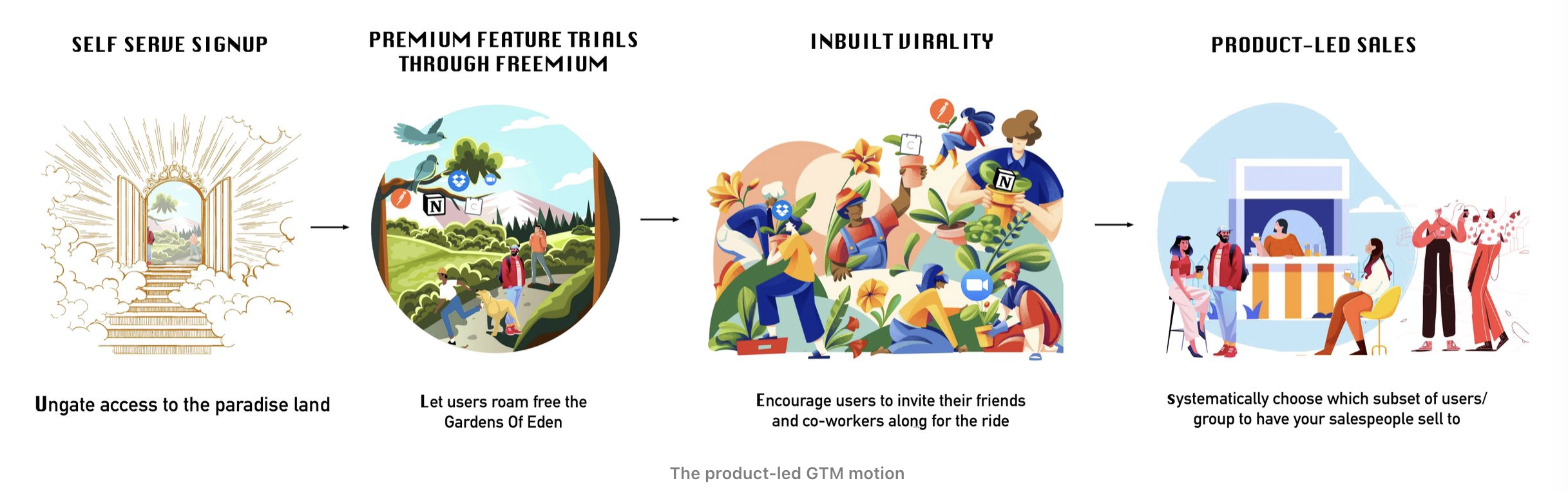
- Not only do you get your product and customer base to create ToFu for you, but your potential customers are already active users of your product. They not only trust you but already rely on you for a significant part of their day - ask any free user of Notion, Figma, or Productboard.
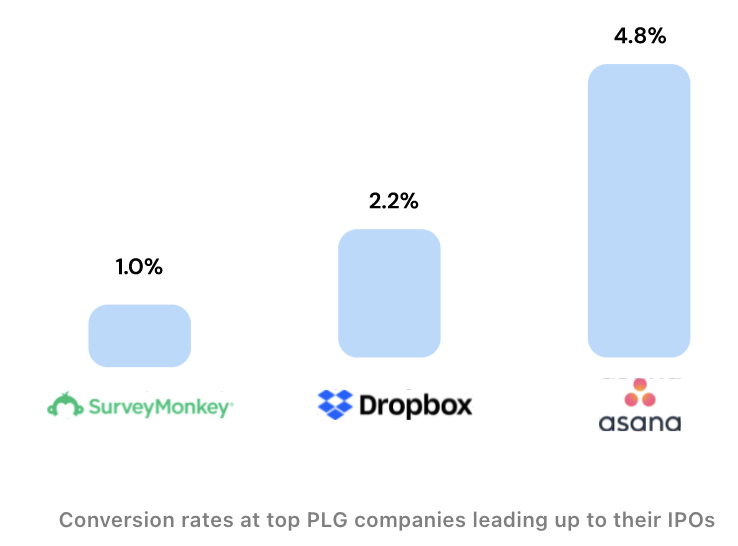
- The median product-led company converts only 2-5% of its overall user base to paying customers
- Toplyne.io Product
- 360° view: First, Toplyne helped InVideo consolidate product usage information (from Amplitude), billing information (from Stripe) and communication history (from Salesforce), into a single view for each of its 1M+ users.
- Segmentation: The team then used Toplyne’s segmentation engine to identify segments of users who have the highest likelihood of conversion. The segmentation logic was driven by suggestive insights provided by Toplyne’s AI model, which highlights the most relevant user actions and demographic qualifiers that correlate most with conversion. (refer image below)
- Integration into their workflow: The team then created a daily cadence for each of their key geographies that pushed the profiles of qualified users along with actionable user data (such as persona, device type, and probability of conversion as per Toplyne’s model) into Salesforce.